Search

Showing 10 of 7241 results

  • From the CE: Promoting New Zealand’s education in Asia

    The visit by Education Minister Chris Hipkins to South Korea, Indonesia and Singapore in October 2022 was an opportunity to reaffirm the Government’s strong commitment to international education. Representatives from the university sector, Te Pūkenga, schools, as well as the PTE and EdTech sectors, and ENZ were part of the accompanying delegation. Bilateral meetings were held with key Ministers in each country, and there were opportunities to meet with alumni, agents local school children and others. You can read more about this trip in this edition of E-News. 

    This month, Prime Minister Jacinda Ardern’s visit to Asia also included a significant international education component, particularly in Viet Nam. Education was highlighted as an important pillar of partnership in all bilateral meetings, and we were delighted to help arrange and participate in an education forum in Hanoi. We will report on this trip in more detail next month. 

    Our recent international education events have featured a mixture of ENZ-run events and commercial and global events. The key aim has been to raise the awareness and profile of New Zealand education, and provide a platform for New Zealand education providers to engage directly with prospective students and their families, with education agencies and other key stakeholders, particularly within Asia. Recent events have included a Korean agent seminar, COEX Fair and New Zealand education night reception in Seoul, a reconnecting series with Japanese partners in Tokyo, Viet Nam agent seminars and fairs in Hanoi and Ho Chi Minh City, and a Thai agent seminar and fair in Bangkok. Looking ahead to next year’s events, ENZ’s international event calendar for the first half of 2023 is now on our website here

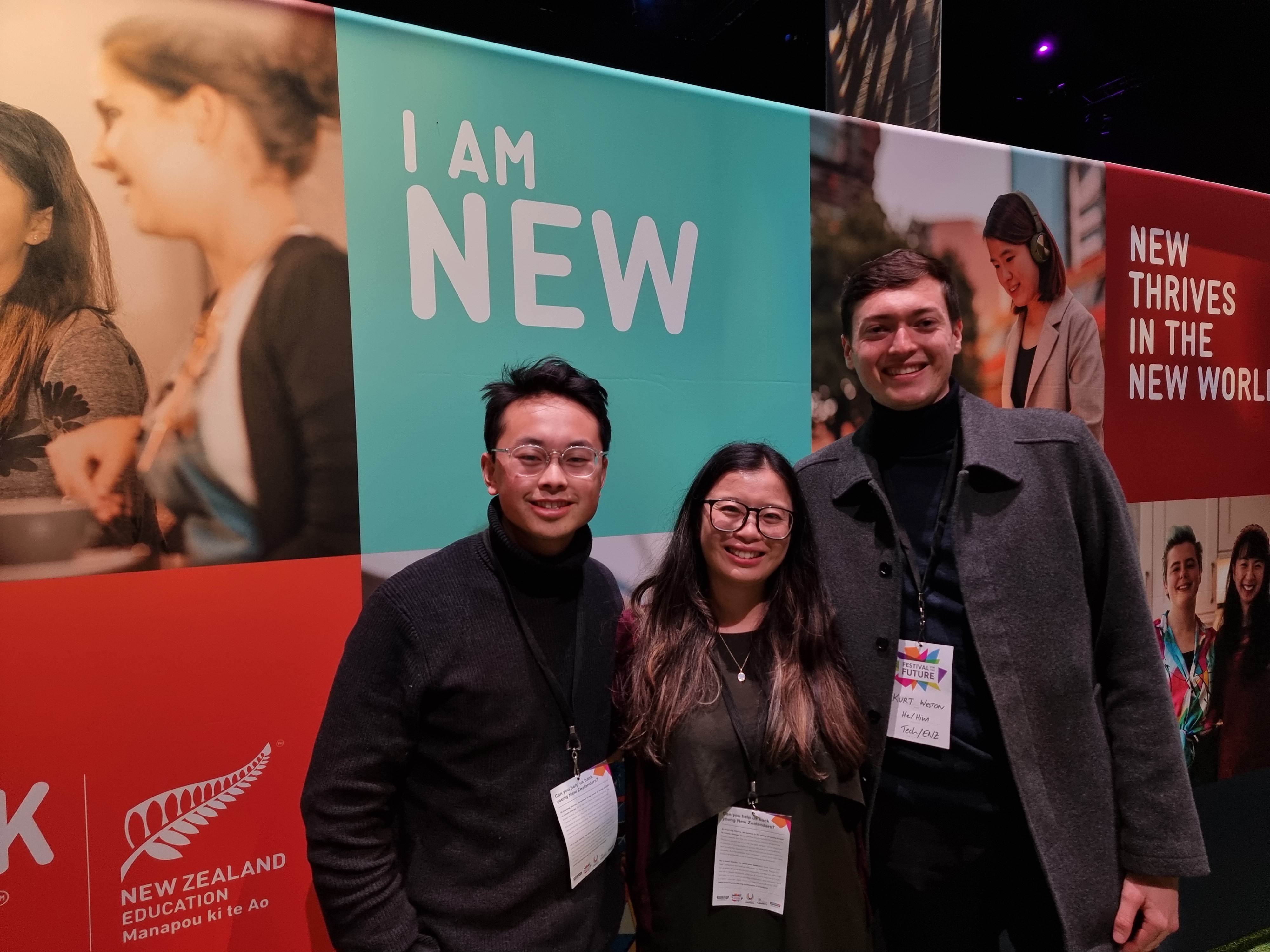
    The second phase of New Zealand’s successful international marketing campaign, I AM NEW, is now underway with a primary focus on China, India, South Korea, Japan, USA, Brazil, Viet Nam, Thailand and Germany. While the initial campaign aimed to raise awareness that New Zealand has reopened for international education, this second phase is focussed on reigniting interest in a New Zealand study experience, and transforming that interest into a commitment to study with New Zealand. A Spanish version of the I AM NEW campaign has also just been launched yesterday in Bogotá, Colombia, to reach this important segment of the Latin America market. 

    As we work with our partners and stakeholders within New Zealand and offshore to promote New Zealand education in the lead up to the 2023 student intake, we are hearing about a shortage of homestay accommodation that it would be good to resolve. More families are needed to welcome international students into their homes. This can be an enormously rewarding experience for everyone involved, one that builds lasting friendships and a deeper understanding of people from another language and culture. We will be talking with the sector to agree the best approach to addressing this challenge.  

    Finally, if you are looking to contact our Auckland-based team, please note that we have moved out of our office on Quay Street, and will be in a new office at 191 Queen Street from 5 December 2022.  

    He rau ringa e oti ai – Many hands make light work. 

  • esther brimmer nziec 2017

  • New Pastoral Care Code of Practice for Tertiary and International Learners Released

    Today, the Government released a new Code of practice for the pastoral care of tertiary and international learners, to take effect by 1 January 2022, as required under the Education and Training Act 2020.   

    This revised Code is the product of many conversations, engagements, emails, phone calls, and hui.  We are thankful to everyone that has spent time to help improve the wellbeing and safety of tertiary and international ākonga. 

    The overall purpose of this work is to develop a system of supports for the wellbeing and safety of domestic tertiary and international learners, through one set of clear rules and expectations for providers that can be tailored to their learners’ needs. 

    We have summarised the key changes and provided links to the new code and Ministerial Press release, below  

    What does the new Code mean for tertiary providers?

    Tertiary providers will need to consider how their overall systems and resources support learners’ wellbeing and safety. 

    It will be important for providers to build and maintain strong relationships with learners and other interested stakeholders to identify and define the issues that are important for their communities and develop appropriate strategic goals, plans and practices around them. 

    Providers are expected to:

    • build capacity across their organisation to engage and empower learners to manage their own wellbeing
    • proactively identify and respond to learners who may face additional challenges as early as possible and tailor extra support to meet their needs.
    • respond effectively in an emergency.

    The new Code continues to focus on outcomes and flexible practices that enable providers to support their learners in ways that best meet their needs.

    What does the new Code mean for tertiary and international ākonga?

    The Code will make providers more accountable to learners, their families and community. The new Code expects tertiary providers to consult with learners, and other stakeholders when developing, reviewing, and improving their strategic goals, plans and practices. It also expects providers to be transparent about their wellbeing structures, strategies, practices and performances.

    What’s changed for international ākonga?

    The new Code covers domestic and international tertiary students and international students in schools. The goal is to ensure consistency within tertiary providers rather than having separate Codes for international and domestic learners in the same provider. The new Code continues to spell out the expectations that apply now for providers regarding the specific needs of international learners. There are no changes to requirements for schools, in New Zealand, who host international students.

  • Tony Gray Board member.jpg website resize

  • From the CE: Welcoming back our international students

    Many of these students have travelled to New Zealand for the first time, leaving their families and friends behind to explore a New Zealand education experience. It’s a big deal for them, and for us. Normal student visa processing only just resumed a few weeks ago, and so most of the students are here thanks to the cohort processes that you supported, or as short-term visitors from visa-waiver countries with strong links to New Zealand.  

    Thank you for making them so welcome, and for sharing their stories through the media. Education New Zealand Manapou ki te Ao has been pleased to support these welcomes by providing Tū Ngātahi pins to share with the students. The pins were created to welcome and demonstrate our support for international students – Tū Ngātahi is a te Reo Māori phrase calling us to ‘stand together’. The Pikorua twist design is inspired by the pikopiko fern, whose fronds curl around one another, which is a symbol of the connection of cultures and the importance of friendship. 

    You can read about the recent international student welcome at Waitangi in this edition of E-News, and I’m looking forward to meeting students in Christchurch later this week. 

    Our 29th international education sector conference, NZIEC KI TUA 2022, finished on Friday – what a great event! There were some exceptional speakers, fascinating discussions, not to mention a few funny moments behind the scenes. The virtual conference, with its themes of Reflect, Reconnect and Renew broke previous records by attracting 1,065 attendees. Thank you to all of you who took part and helped make this such a successful event. All the sessions were recorded, and they will remain available to you on the event portal until 16 September 2022.

    As I mentioned at the conference, ENZ has recently made some changes to our leadership team, to ensure we are well placed to work with you on the rebuild of international education. We now have two new roles in ENZ’s senior leadership team that are specifically focussed on meeting your needs as a sector: GM Sector Engagement, and GM Sector Services. The newly appointed GM Sector Engagement is Wendy Kerr, who will join us in October. Sahinde Pala, who will already be well known to many of you from her work at ENZ since 2016, has been appointed GM Sector Services. In addition, the role of Ed Tuari as our Manukura - Chief Advisor Māori is now also part of the senior leadership team. This change reflects the importance of our work to transform the understanding of international education and ensure the education system delivers with, and for, Māori in the international context.  Wendy and Sahinde are both profiled in this edition of E-News, and you can see the full senior leadership team on our website here 

    Finally, I want to acknowledge the work done by our international teams every day around the world, on behalf of New Zealand’s international education sector. There are numerous stories in E-News each month that provide a glimpse of some of their activities. In this issue, you can read about new scholarships, digital exchanges, workshops for education agents, education cooperation agreements, and more.  

    He rā ki tua

    Better days are coming 

    Ngā mihi,

    Grant McPherson 

  • PR 2324 136 OIA proposal documents

  • DSC 3438.jpg resize

  • ENZ Strategy 2023 27

  • IMG 6223 v2

  • Around the world in five

    GLOBAL

    Engaging with international schools as a distinct recruitment channel 

    Direct contact with college counsellors in international schools is key to boosting recruitment of high-calibre students into universities.

    Read more


    UK

    University applications rise amid Brexit uncertainty

    A record number of 63,690 applicants from outside the EU are applying to study at UK universities, which is an increase of 9 per cent compared to last year.

    Read more


    JAPAN

    Outbound short-term mobility continues growth

    Short-term study abroad programmes continue to see growth in Japan with more than 105,000 students choosing one in 2017, spurred on by its government’s internationalisation agenda.

    Read more


    US

    Real estate is the new gateway to the Ivy League for international parents

    Wealthy parents of international students are beginning to see buying expensive apartments in the United States as not only an investment in real estate but in their children’s education.

    Read more


    GLOBAL

    Instagram and international students: How do universities use their accounts?

    Five strategies that universities are using on Instagram to successfully influence international student decisions.

    Read more

What's in it for me?