Search
Showing 10 of 7395 results
- IMG 3471
- Step 3
- Student Visa Dashboard for May 2018
- List of successful Sister Schools October 2015 upload to website
- INZ Flyer education providers June 2015 print
- VietNamNZEdForum 4
-
New Zealand-trained astrophysicist receives top honour in Malaysia
She was awarded the prestigious Commander of the Order of Loyalty to the Crown of Malaysia, by Sultan Abdullah at his annual Honours ceremony. It carries the title of Tan Sri, one of the highest federal titles, and is only held concurrently by 250 living recipients.
Dr Othman studied physics at the University of Otago in the 1970s and returned for post-graduate study in the 1980s, becoming the first woman to graduate from the university with a PhD in Astronomy and Astrophysics. She then went on to forge a remarkable career in the male-dominated space industry.
Colombo Plan Scholar
Dr Othman came to New Zealand on a Colombo Plan scholarship. The Plan, a forerunner to our modern development assistance programmes, aimed to promote economic and social development in Asia through education and training.
Having fallen in love with physics as a teenager in the 1960s, Dr Othman didn’t discover astronomy or astrophysics until she arrived in Dunedin to study for her PhD in 1974.
“There were very few books available at that time and there was not much interest here in Malaysia, but it was very different in New Zealand,” she says. “Neil Armstrong’s landing on the moon in 1969 was a very significant event, but I didn’t think at that time that I would have space as a career. Not in a million years.”
Studying in New Zealand opened a world of opportunity for the young, Muslim scholar. Not only did she make a career in the space industry, but she became a leading authority, being appointed the Director of the United Nations Office of Outer Space Affairs in 1999, and the founding director of Malaysia’s National Space Agency in 2002.
She acknowledges it has been challenging at times. “It’s been a hard road because I’ve had to start everything from scratch. There was no set path to get to where I am today.”
Working to promote science and technology
She says her role at the UN was less about science, and more about diplomacy and politics. “How to balance one country’s requirements against another’s. Bringing people to the table together, even if they don’t agree, to try and agree on how to proceed. The other aspect of the job was to see how we could use space to enhance the development of developing countries, especially in science and technology.”
It is mostly her work at home for which she has been recognised by the King. As Malaysia’s first astrophysicist, Dr Othman was instrumental in introducing astronomy and space sciences into school and university curricula, advised the Government on space matters, was the driving force behind the National Planetarium in Kuala Lumpur, initiated the country’s National Microsatellite Programme, and headed Mega Science 3.0, the ambitious project to transform Malaysia into leading global player in science and innovation by 2050.
Justice and fairness in New Zealand education
But it all started as an international student in New Zealand, a time Dr Othman remembers as being both liberating and rewarding. “I particularly loved the egalitarian environment of the university, and that reflected wider New Zealand society.”
“There will always be a role for New Zealand in supporting education internationally through its cultural perspective on science,” she says. “There is no hierarchy in New Zealand science – professors treat their students as equals and encourage them to challenge and ask questions. That approach has stayed with me through my career.
“New Zealand education also instils a deep sense of justice and fairness.” – Malaysia alumna and astrophysicist Dr Mazlan Othman.
-
Incheon Metropolitan Office of Education deepens links in New Zealand
The delegation from Incheon Metropolitan Office of Education East Asia Global Education Institute (Incheon MOE) travelled to Ngatea, Wellington, Canterbury and Otago – visiting providers from the schools, university and vocational education sectors.
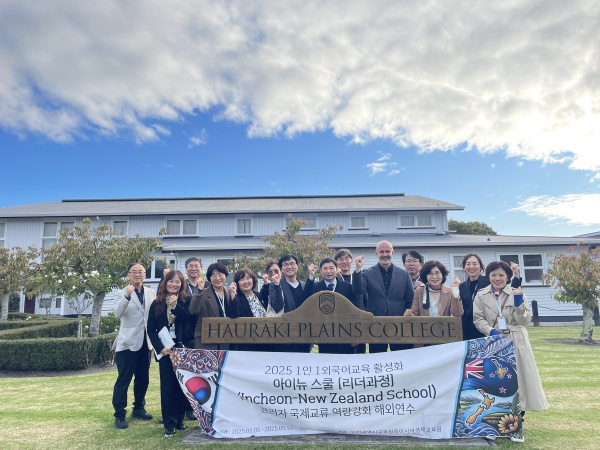
The visit began with a visit to Ngatea to connect with Hauraki Plains College and Ngatea Primary School.
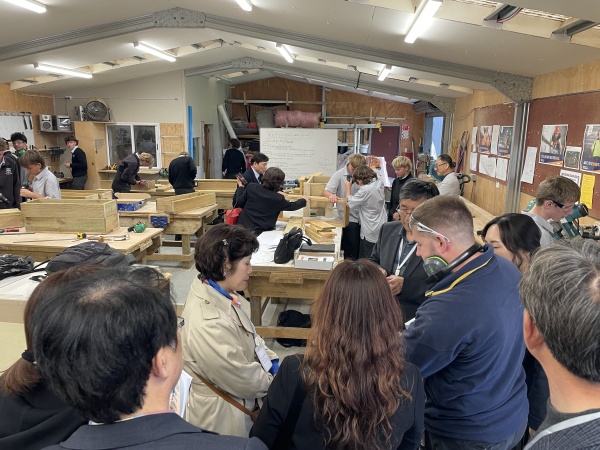
Observing the Agriculture Academy and trades-based courses at Hauraki Plains College.
A key aspect of the delegation’s time in Ngatea was the signing of a Memorandum of Understanding (MoU) between Hauraki Plains College and four schools from Incheon: Sunin High School, Shinsong High School, Geomdan High School and Youngwha International Tourism High School.
The intent of the MoU is to strengthen educational ties between the schools, which includes a reciprocal exchange program.
The first of these exchanges will see 28 students from across the four Incheon schools visit Hauraki Plains College in October 2025, 28 students from Hauraki Plains College will then travel to Incheon in April 2026.
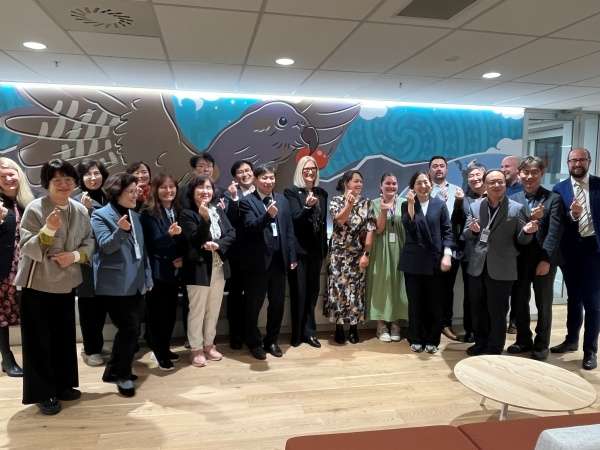
The delegation was formally welcomed to the Wellington with a Mihi Whakatau hosted by ENZ Chief Executive Amanda Malu, local staff and the Ministry of Education (MOE).
In Wellington, the delegation received a detailed briefing from the Ministry of Education and visited Scots College to observe the school in action.
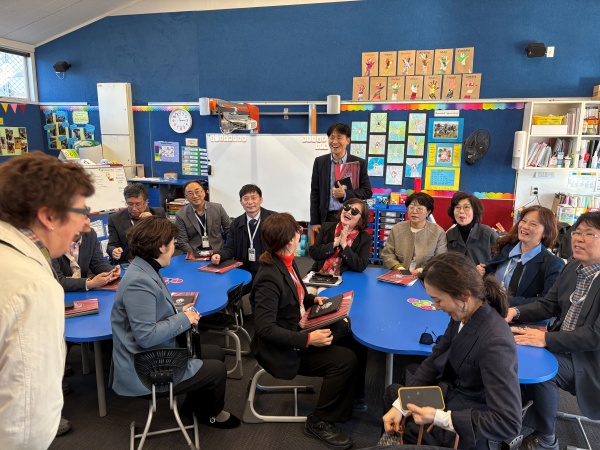
Scots College Junior School Principal, Rachael Huggins, showing the Incheon delegation around a primary-level classroom.
Down to Christchurch, the Incheon delegation visited Lincoln University to fine-tune the details of an MoU signed in January this year. The partnership arrangement will support five Incheon students to study at Lincoln University each year.
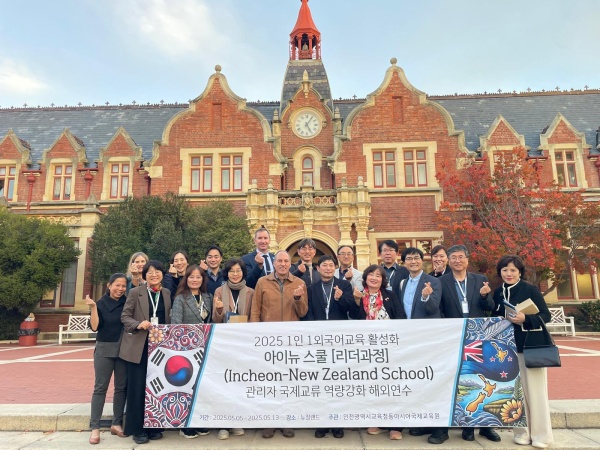
Incheon delegate members with Lincoln University staff from the Faculty of Agriculture and Life Sciences, Faculty of Agribusiness and Commerce, Academic Preparation and Pathways and International Operations.

Waitākiri Primary School Principal Mr. Andrew Barker introduces a Year 6 long-term international student from Korea to the delegates. She shared how much she has enjoyed her time at Waitākiri Primary School and expressed her sadness that her year at the school is coming to an end.
The group visited Shirley Boy’s High School and Avonside Girls High School in Christchurch, with a side-visit organised with Waitākiri Primary School.
Further South, a visit was arranged with Otago Polytechnic in Cromwell to understand the pathways to vocational education in New Zealand.
Director of Incheon Metropolitan Office of Education East Asia Global Education Institute, Jooyong Kim, said visiting New Zealand schools was a truly meaningful and deepened delegates understanding of the education system.
“We hope this visit will help strengthen the relationship between schools in New Zealand and Incheon”.
“We look forward to future collaborative projects with New Zealand institutions,” he added.
Several of the schools visited have expressed interest in deepening these new relationships, with planning underway to keep up the momentum and connect again at ENZ-led fairs and agent seminars in Korea later this year.
- PHOTO 4
- 2425 211 Quarter Two Report for 1 October – 31 December 2024 briefing Redacted