Search
Showing 10 of 7395 results
-
Patrick Au: a champion for international students in New Zealand
Disclaimer: This story was originally published on New Look, which was also operated by Education New Zealand Manapou ki te Ao. It has been republished here to ensure wider access and visibility.
He has spent more than two decades working with international students and Asian migrants in primary and tertiary healthcare settings, understanding their mental health needs and advocating on their behalf.
Patrick is a registered psychiatric nurse and counsellor who migrated from Hong Kong in 1991, completed his Master’s in Education in 1999, and has worked tirelessly to support Asian communities in New Zealand. He is now stepping down from his role as Asian Mental Health Coordinator for the Auckland District Health Board to commit more time to private practice.
It was Patrick’s emerging reputation for specialty expertise which led to the International Education Association ISANA asking him in 2010 to prepare a presentation to international education providers about the mental health needs of international students. This was quickly followed by a contract with the Ministry of Education to present a series of workshops nationally.

“I was overwhelmed by people calling me and asking me for advice,” Patrick says. “This is where I seriously started my work with international students.”
In more recent years, Patrick has been a key player in the Auckland Agencies Group, which brings together multiple organisations with the common goal of enhancing student wellbeing.
The issues which international students can face vary, depending on their age and stage of education. For younger school students it can be homesickness and lack of parental guidance. Older students also face settlement issues but can have the added pressure to succeed.
“People come here to study and so they need to be successful,” he says. “From an Asian perspective, we are a collectivist society. Your success is not just for yourself, the grades and glory are for your family too. If you are successful at your study you are acknowledged as a successful person, but what if you’re not able to finish your study? The pressure is on you.”
Prevention and awareness key to mental wellbeing
Patrick is a great believer in the importance of awareness and prevention when it comes to mental wellbeing and says New Zealand has made good progress with the availability of resources which students can access on campus, through workshops, and online. Support services are widely established, and the International Students Wellbeing Strategy ensures government agencies work together to support international students to feel safe, well, and welcome in New Zealand.
“Most Asian cultures believe the body and mind are not separated. So we need to address the root cause of problems in behaviourial terms - how to adapt to the new environment, how to get better sleep, how to cope with exam pressure, how to eat well, rather than talking about mental health. When they hear these two words they will withdraw from you,” he says.
“There is very limited mental health education in the students’ home countries, but with all the online resources available here students are researching the issues. There is much wider awareness, and sometimes it is friends who recognise issues and offer peer support in seeking help.”
Patrick knows that some students come up against cultural intolerance and misunderstanding but says that New Zealanders have come a long way since the early days of the international education sector in understanding the challenges which international students can face, but also the contribution they make to society here.
International students talented and motivated to contribute
“International students bring cultural diversity and increase cultural awareness among New Zealanders,” Patrick says. “The students who come here are quite talented and motivated to contribute. Once they have completed their education, they can contribute in many ways."
“International students bring cultural diversity and increase cultural awareness among New Zealanders” – Patrick Au, mental health expert and international student advocate
International students can be the bridge between their home country and New Zealand. If you want to do business in these countries, international students can play an important role as they often act as informal ambassadors for New Zealand and can open doors to business.
New Zealanders are also contributing to their success by creating a nurturing environment for them to complete their studies. Over the years we have seen lots of successful international students who have started working and contributing to the New Zealand economy after completing their education.
“If they have a positive experience, they are also instrumental in encouraging other students from their home country to come to New Zealand. I think it is a win-win situation.”
- card 1 welcome chch4
- Internship Providers for PMSLA3
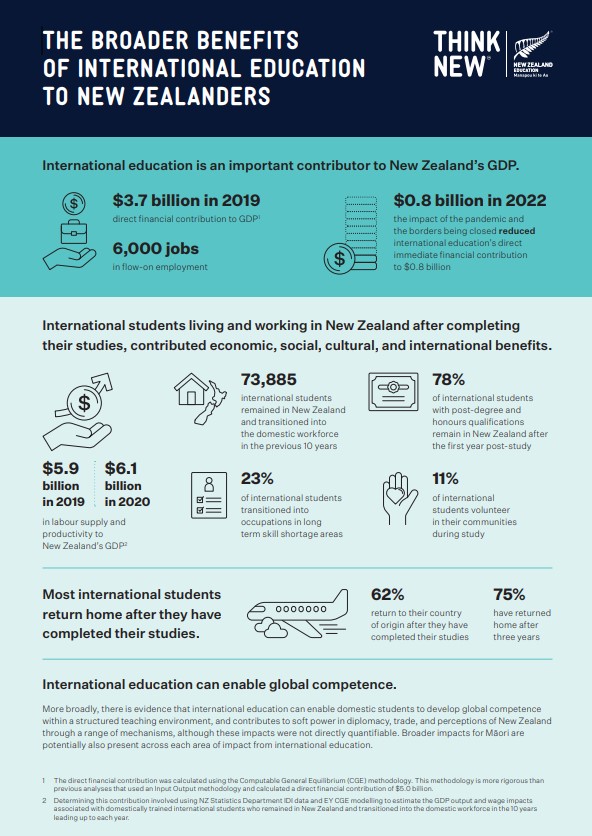
- BIV infographic screenshot
- harakeke 1
-
Updated UIP system gives better user experience
The UIP system is an automated data collection system that will collect individual learner and provider data from UIPs. These providers are private training establishments that enrol international students and do not receive government funding.
Additional improvements were made to make the system more user-friendly. This work was completed on 1 May 2018 in time for submission of trimester 1 data this year. The updated UIP system is easier to use and features a new online portal - an additional option for providers to submit data.
The UIP system is a cross-agency project by the Ministry of Education, New Zealand Qualifications Authority and Education New Zealand and will help provide a more comprehensive picture of international student enrolments for this sector. Over time, this information will also help improve market analysis and inform decisions to support the international education industry.
Tour groups or group study tour operators will submit aggregate data through the Tour Group portal, which is also now live.
More information about the UIP system including the data requirements, the options to submit data and the Tour Group portal can be found at the STEO website.
For any questions, please contact UIP.DataCollection@education.govt.nz.
- NZ Proposal
- Sino NZ
- j2
-
Reminder about education providers’ responsibilities when using education agents
The responsibilities for Code signatories are covered in detail in Section 38 (for tertiary education providers) and Section 58 (for school education providers). Section 38 reads as follows:
38. Process 2: Managing and monitoring education agents
Signatories must have practices for effectively managing and monitoring the performance and conduct of education agents in relation to learner safety and wellbeing under this code, including –
(a) carrying out and recording reference checks on potential education agents to ensure as far as possible that they are not involved in any conduct that is false, misleading, deceptive, or in breach of the law; and
(b) entering into written contracts with each of its education agents; and
(c) during the term of a contract, monitoring the activities and performance of its education agents in relation to –
(i) their obligations as specified in the contract; and
(ii) whether they provide prospective and enrolled international tertiary learners with reliable information and advice about studying, working, and living in New Zealand; and
(iii) whether they act with integrity and professionalism in their dealings with prospective and enrolled international tertiary learners; and
(iv) whether they have engaged in any activity or conduct that, in the opinion of the signatory, is or may be in breach of the law or that jeopardises the signatory’s compliance with this code; and
(d) managing the education agents by –
(i) terminating contracts with an agent if there is evidence which, on balance of probabilities, shows that the education agent –
a. has been involved in any serious, deliberate, or ongoing conduct that is false, misleading, deceptive, or in breach of the law; or
b. has jeopardised the signatory’s compliance with this code; or
(ii) taking appropriate action to address misconduct by act or an omission by an education agent in relation to the other matters described in subclause (c); and
(e) ensuring that its education agents have access to, and maintain, up-to-date information relevant to their duties as specified in the contracts with the signatory.
The full Code is available on the NZQA website here.