Search
Showing 10 of 7395 results
- Schools full year 2014 PDF
-
PM mission advances New Zealand and China education relationship
The New Zealand Education Connect event on 20 June at the New Zealand Embassy in Beijing brought together leading Chinese government representatives, institutional partners, education agents, and alumni to strengthen people-to-people links and celebrate collaboration.
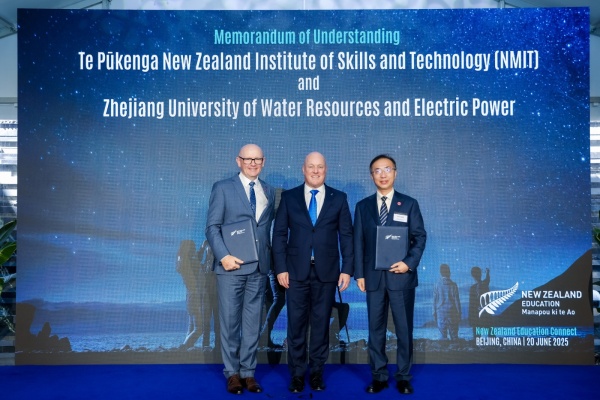
The event programme was packed, with nine Memorandums of Understanding (MoUs) signed between New Zealand and Chinese counterparts, and another MoU signed between Victoria University of Wellington and Fudan University on 19 June.
Providers from across the tertiary education sector signed the MoUs – with Victoria University of Wellington, Unitec, NMIT and UP Education’s University of Auckland International College and New Zealand Tertiary College formalising partnerships.
These agreements cover a mix of in-market delivery, joint programmes, and initiatives to grow student mobility between New Zealand and China.
This builds on the now over 60 approved joint education programmes and institutes recognised by the China Ministry of Education between New Zealand and Chinese institutions, and other education partnerships across early childhood education, vocational training, higher education, and research areas.
The New Zealand Education Connect event had senior leaders officially launching New Zealand’s Country of Honour campaign for the upcoming China Annual Conference and Expo for International Education (CACIE), China's largest platform for international education, due to take place in October this year.
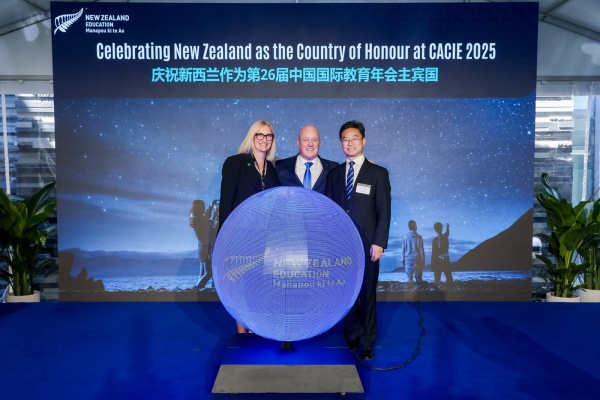
ENZ’s Chief Executive, Amanda Malu, launches the Country of Honour campaign for New Zealand at CACIE alongside Prime Minister Luxon and CEAIE’s Secretary General Jun Yang.
ENZ Chief Executive, Amanda Malu, said it’s exciting to see advancement of the partnerships New Zealand providers have built with their Chinese counterparts.
“We’re eager to see the outcomes of the new agreements formalised at New Zealand Education Connect and look forward to deepening our bilateral ties by leading a delegation to CACIE later this year,” she said.
Information on the registration process for New Zealand education providers to join the New Zealand Country of Honour events in October will be shared next month on ENZ’s event page.
The Country of Honour promotional video is available with Chinese subtitles on The Brand Lab.
-
Driving student interest in Indonesia through strategic co-funded initiatives
ENZ and SUN Education delivered a jam-packed programme of student recruitment events in Surabaya and Jakarta in late May to drive student interest and connect New Zealand providers with potential partners for academic collaboration.
Surabaya
The activity began with an introductory meeting between Universitas Airlangga’s International Office and visiting New Zealand providers to explore opportunities for academic collaboration between our two countries.
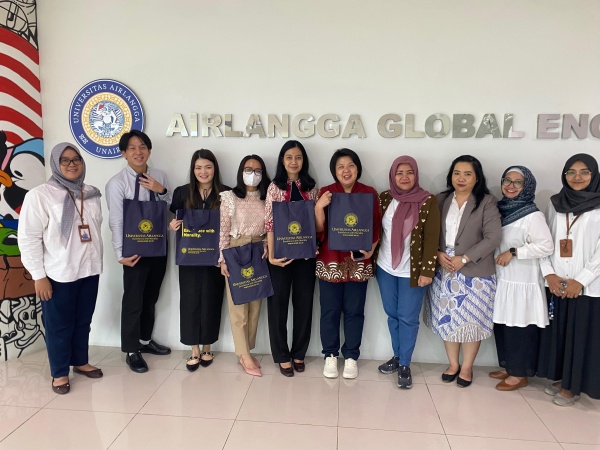
The meeting was attended by representatives from the University of Auckland, Auckland University of Technology, the New Zealand Honorary Consulate in Surabaya and SUN Education.
Discussions centred on potential areas of partnership, including articulation pathways, staff exchanges, guest lectures, and joint research initiatives.
The following day, providers met with prospective students at the Study in New Zealand Exhibition in Surabaya.
The exhibition featured the University of Auckland, Auckland University of Technology, University of Waikato, UP Education, University of Otago, Le Cordon Bleu, the Southern Institute of Technology and Lincoln University.
The event attracted around 200 students and their parents.
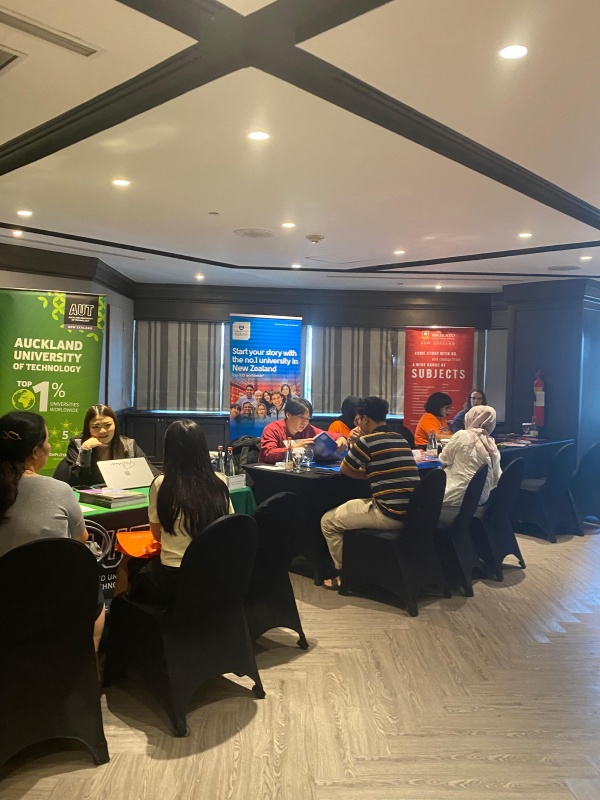
Study in New Zealand exhibition attendees learning about tertiary education options in New Zealand.
Jakarta
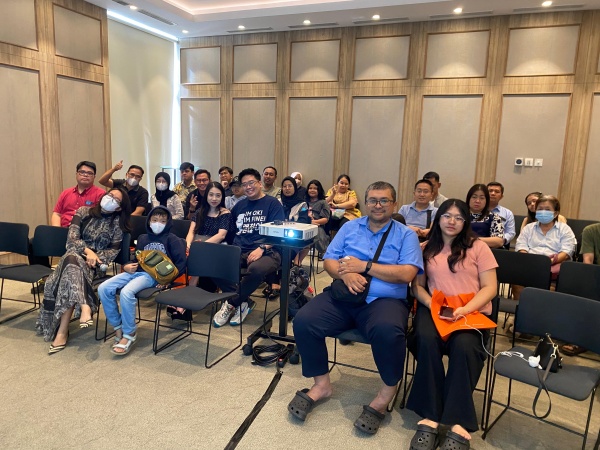
Over to Jakarta, ENZ organised an exhibition featuring a strong line-up of New Zealand institutions, comprised of all eight of New Zealand’s universities alongside the Southern Institute of Technology, Le Cordon Bleu, University of Canterbury International College and UP Education.
The fair attracted approximately 250 students and parents, all eager to explore the diverse study options and world-class education opportunities that New Zealand has to offer.
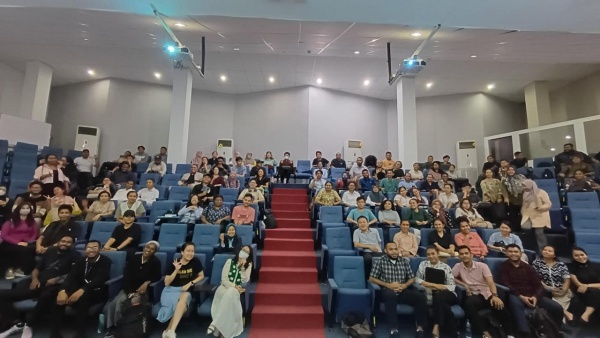
To close off a busy student recruitment period, a mini exhibition was hosted at Universitas Indonesia, the top-ranked university in Indonesia.
The exhibition was specifically for LPDP Affirmative Scholars and students interested in postgraduate-level study.
As part of the event, ENZ Market Manager, Naluri Bella, delivered a ‘Study in New Zealand’ session, which attracted around 100 enthusiastic attendees.
The session provided insights into New Zealand’s high-quality education system and scholarship opportunities, helping to raise awareness and inspire future postgraduate study pathways.
ENZ’s Regional Director (Asia) Ben Burrowes said the activities were designed enhance agents’ and students' awareness of New Zealand’s world-class education offering.
“These collaborations help position New Zealand as a competitive and credible choice for Indonesian students,” he added.
- Takina 1 NZIEC KI TUA 2024 will be held at Takina Convention Centre in Wellington
- IMG 3012
- Marcos Steagall hi res pic 02.jpg resize
- Hero image Tools
- shanton chang tweet
- Overall full year 2014 PDF
-
Putting a healthy smile on the dial of Fiji’s children
“I love working with children, particularly those living with disabilities and special healthcare needs who require more inclusive oral health policies and programmes.”
He spent the early years of his career working as a hospital dentist and teaching at the Fiji National University’s School of Dentistry and Oral Health but was ambitious to accomplish much more and knew he would have to study overseas to achieve his goals.
He travelled first to Portugal to enrol in a Master’s in Public Health and then to the University of Otago’s Faculty of Dentistry to undertake his Postgraduate Clinical Doctoral Degree in Paediatric Dentistry.
As a third generation Fijian of Indian descent, he describes his international education experience as “life-changing, academically and culturally fulfilling.”
But Jason says he could never have afforded to study in New Zealand without the support of a Manaaki New Zealand Scholarship, funded through the Ministry of Foreign Affairs and Trade. The programme sets out to build future leaders in developing countries by supporting students to upskill here.
Advocating for better oral health outcomes
Improving the oral health of young people drives Jason’s clinical and research work and he knows that implementing a preventative approach to tooth decay is key to achieving sustainable outcomes.
“The mindset in the Pacific is that people mostly don’t come to the hospital clinics for dental care, they wait for pain or symptoms before seeking help,” he says. “But we need to advocate strongly for prevention which is more cost-effective and acceptable.”
Arriving at the University of Otago in 2019, Jason embarked on his thesis researching the remineralisation potential of selected peptides (one of the building blocks of protein) in preventing tooth decay.
“Dental decay is prevalent, especially among children, but it is reversible in its early stages. The mainstay of prevention has been fluoride, but we proved that the peptides do have remineralisation potential. Investigation is now under way to learn how it performs alongside fluoride.”
“I think it has huge potential for the future. The dream would be that we have the next generation of children growing up without fillings in their mouths.”
Jason says this kind of research would not have been possible in Fiji. “I was very grateful for the experience at Otago. It was an environment that was both supportive and collaborative. It opened up networking opportunities for me. And those networks still support me today.”
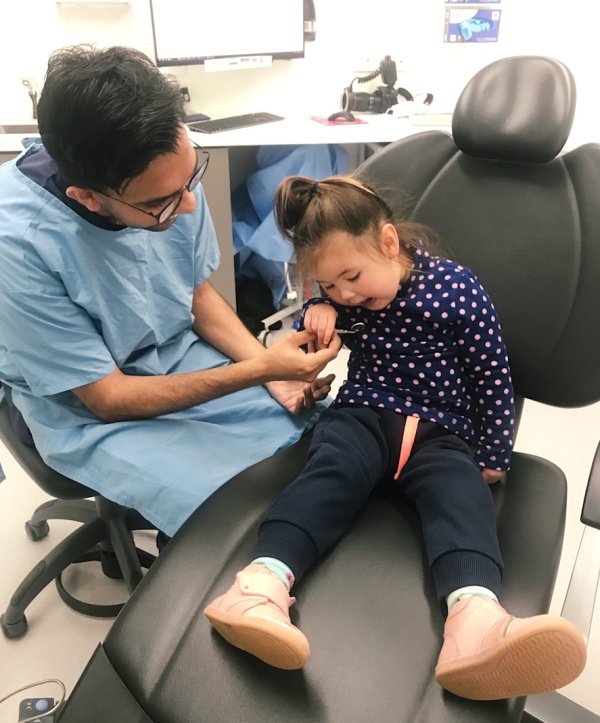
Jason also cared for patients at the faculty’s clinical facilities and theatre suites and provided on-call dental services for emergency patients after-hours at Dunedin Hospital, building close bonds with some of his young patients, especially those with special needs.
"The dream would be that we have the next generation of children growing up without fillings in their mouths."International education builds skills and confidence
After his graduation in December, Jason returned to FNU School of Dentistry with additional skills and new-found confidence. “I think that gaining a formal specialist qualification has given me a voice to continue to advocate for children’s oral health through dental education.”
He wants to establish preventative oral health programmes in schools and help improve the curriculum being taught to dental students in the region, integrating recent innovations and research evidence.
It’s something he has been thinking about for many years. “Hopefully now we’ll get this done.”
“I’ve expanded my knowledge, upskilled, and I think I have become more confident as an academic, and as a person. I’ve got my international education and training to thank for that.”
Manaaki scholar gives back to the community
Jason is certainly fulfilling the brief of the Manaaki Scholarship to give back to his community. He is maintaining his clinical hours, teaching the next generation of dental students, volunteering his services at an NGO-run paediatric cardiac care hospital, and mentoring students wanting follow in his footsteps by studying overseas.
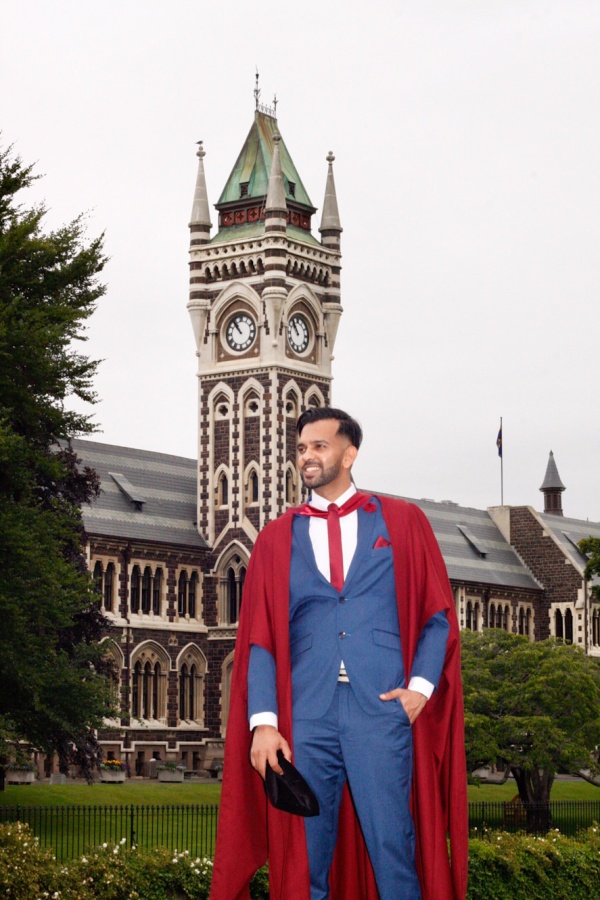
“International education is very important to Fiji as a developing country,” he says. “I thought it would be valuable to be able to guide students who would benefit from international scholarships in meeting their professional goals, while building capacity in the region.”
At heart, though, he is an academic and he hopes that in the coming years he can raise the research profile of the Pacific region and build a solid database which will help to secure the funding for much-needed oral healthcare programmes.
“My message is that there is no general health without oral health. It’s not going to be easy, but we need to start somewhere to get a voice for children and for the profession.”