Search
Showing 10 of 7395 results
- Santiago Shipping Label
- LAW4MSME High school winner
- WellingtonStaff 68
-
New Zealand and Viet Nam sign Arrangement, strengthening education ties
This arrangement was signed by New Zealand Minister for Tertiary Education and Skills, Hon Penny Simmonds and Viet Nam’s Minister of Education and Training, Nguyen Kim Son during the Prime Minister of the Socialist Republic of Viet Nam His Excellency Phạm Minh Chính’s visit to New Zealand from 9 – 11 March. Prime Minister Pham and Prime Minister Luxon witnessed the signing of this arrangement, which covers the period 2023 – 2026.
The EEA, which will replace the Strategic Engagement Plan on Education (SEP) 2020 – 2023, identifies areas of engagement and sets new targets over the next three years.
Specific areas covered in the arrangement include collaboration and information exchange in English language training, short courses and executive education programmes that New Zealand provides in Viet Nam.
The arrangement will also explore opportunities to build mutual value in English language literacy, early childhood education and science, technology, engineering, and mathematics (STEM) disciplines. Sharing and publicising scholarship programmes in both countries will be undertaken while institutions will also be encouraged to increase research engagement as well as student, lecturer and research exchange activities.
Both countries have also agreed to actively support the activities of alumni groups in both Viet Nam and New Zealand, and celebrate the lifelong connections generated through these networks.
The signing of this arrangement with Viet Nam aligns with the New Zealand Government’s priority to revive international education, lift its contribution to New Zealand’s economy, and diversify international education markets. Concerted effort is going into deepening and broadening our overall bilateral relationship with countries in Southeast Asia including Viet Nam, including our trade and economic interests.
ENZ’s Acting Chief Executive, Linda Sissons, said the Education Engagement Arrangement provides an important opportunity to build on the longstanding education partnership between New Zealand and Viet Nam.
“Viet Nam is a multi-sectored market for New Zealand’s international education industry and an important source country for international students.”
“This arrangement demonstrates to prospective students and their families that New Zealand is a partner of choice for the Vietnamese Government in the field of education, which aligns with the New Zealand Government’s priority to build a more resilient and sustainable sector.”
“With its strong focus on partnerships, the arrangement also lays an excellent foundation for further growth by New Zealand’s tertiary sector. It presents real opportunities for our EdTech sector to continue to build on the recently completed market familiarisation trip, with further development of opportunities that support Viet Nam’s digital transformation strategy.
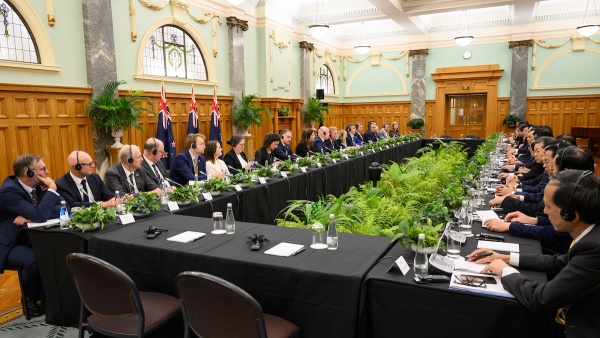
Bilateral meeting between New Zealand and Vietnam during the Prime Minister of Vietnam, His Excellency Mr Pham Minh Chính's visit to New Zealand. March 11, 2024 in Wellington, New Zealand. Photo by Mark Tantrum.
The first Strategic Engagement Plan on education (SEP) was signed in 2015, laying the foundation for a strategic education partnership between New Zealand and Viet Nam. The SEP sits under our overarching bilateral Education Cooperation Arrangement between the Ministries of Education, which was refreshed in 2022. The SEP was renewed in 2018 and again for the period 2020 – 2023, between Education New Zealand and Viet Nam’s Ministry of Education and Training (MoET) and was signed during the year we marked the 45th anniversary of diplomatic relations with Viet Nam (2020). This built on existing education initiatives and identified new opportunities to be co-developed and delivered for the mutual benefit of both countries. You can read about the last signing of the Strategic Engagement Plan in 2020 signing here.
Following the signing of the EEA, both education ministers participated in a bilateral meeting to discuss the education relationship between the two nations, current priorities and the development of activities under the new arrangement. This discussion touched specific areas of collaboration such as early childhood education, institutional partnerships and vocational training.
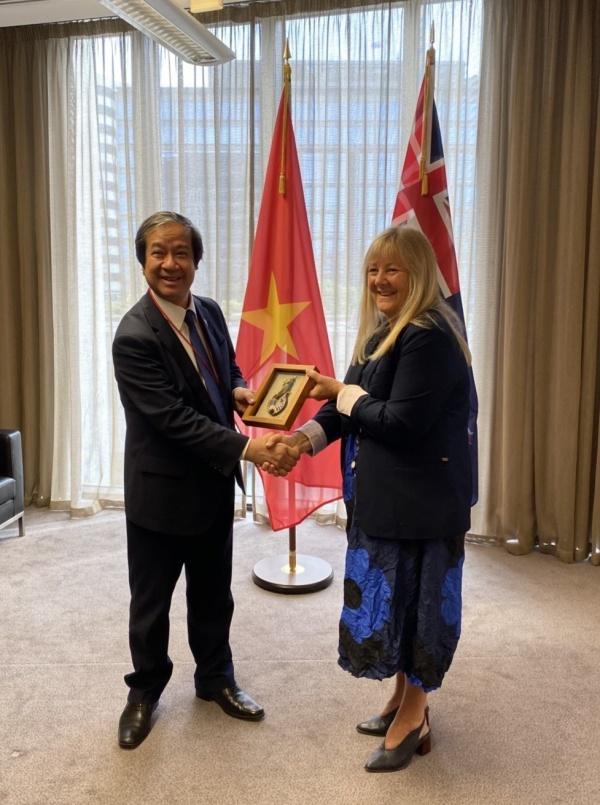
Minister Penny Simmonds present Minister Nguyen Kim Son a gift following the bilateral education ministers meeting.
New Zealand is offering Vietnamese students two government scholarship programmes for secondary school study (the New Zealand Schools Scholarships – NZSS) and for postgraduate study (the Manaaki New Zealand Scholarships). In view of increasing demand for study with New Zealand, ENZ has implemented a wide range of initiatives to equip Vietnamese learners with the 21st century skills, and support families in obtaining up-to-date information to plan for their study journey in New Zealand.
The New Zealand Education Day, ENZ’s flagship event, is scheduled on 19 and 20 October. It has been held annually since 2017 and attracts hundreds of visitors.
- Risk management policy 2024 25 Approved by the Board on 23 October 2024
- ENZRA Logo Secondary3
- PMSA Guidelines
- Around the world in 28
- Governance of ENZs recognised education agents
- IMG 4429