Search
Showing 10 of 7395 results
-
More than a system upgrade: How Manaaki is changing the way scholarships are delivered
Anamata, the end-to-end technology system that helps manage the Manaaki New Zealand Scholarships, recently launched its Drop Two stage that introduces new functionality. This helps the system manage placements, improve budget management and extensions and a range of enhancements that support the scholarship journey.
Drop Two marks another important step towards a more sustainable, flexible and scholar-focused programme. But this achievement is about much more than technology.
Since 2022, Education New Zealand Manapou ki te Ao (ENZ) and the Ministry of Foreign Affairs and Trade (MFAT) have been working together to transform how Manaaki New Zealand Scholarships are delivered. The Future State Programme aims to improve the scholar experience outcomes, strengthen provider partnerships and create better information and insights to support decision-making.
Manager of MFAT’s Scholarships Unit, Alexandra Grace, noted that achieving ‘Future State’ has been a long-held ambition under the Ministry’s partnership with ENZ.
“We’re closer than we’ve ever been and look forward to full design and implementation of Anamata.
“We thank all those who have got us to this point. Onwards to the final stretch!!”
The programme is also supporting a shift in how ENZ and providers work together. By combining technology, policy simplification and new ways of working, it is helping create stronger partnerships, increase our ability to measure the scholarship’s impact, drive more informed decision-making and enable more responsiveness to scholar requests.
ENZ’s Director – Scholarships, Carla Rey Vasquez said Manaaki is much more than a scholarships programme.
“It’s one of New Zealand’s most important ways of building connections with partner countries and creating life-changing opportunities for future leaders across the Pacific and beyond.
“That’s why Drop Two matters. While it’s a significant technology milestone, it’s really about giving ENZ and our providers better tools, information and ways of working to support scholars and support New Zealand’s international connections through education.
It’s a great example of how people, policy and technology can come together to improve scholarship outcomes,” Carla said.
The successful launch of Drop Two reflects years of effort, resilience and collaboration from MFAT, ENZ’s Manaaki New Zealand Scholarships team, education providers and delivery partners. It has also been shaped by feedback from those who use the programme every day, reinforcing the importance of listening, learning and continuously improving.
While there is more work ahead, Drop Two is an important step towards a future Manaaki programme that is easier to deliver, better for providers and, most importantly, centred on the success of scholars.
For more information, email manaakichange@enz.govt.nz.
- sitchinaweek
- entry9
-
Around the world in five
BRAZIL
Brazil’s study travel market bounces back
A recent survey shows Brazil’s outbound study surged by 14% in 2016, with students’ priorities shifting in terms of preferred programs of study, driven largely by employability factors. As such, language programs remained the most popular option, as speaking an international business language is seen as “essential” for students in the country.
US
Internationalisation and student recruitment increasing among US colleges
A new study of US colleges found nearly 30% of respondents reported high levels of international activity within their institutions, compared to 21% in 2011. When asked why, US colleges cited “improving student preparedness for a global era” as their main motivator, listing key activities such as “increasing study abroad for US students”, “recruiting international students” and “partnerships with institutions.”
CHINA
Hong Kong’s education system needs more heart and ‘soulware’
How can China best equip its next generation with the skills needed for a rapidly changing world? City University (CU) might have the answer. Despite being a young university with many students from lower-income families, it has made its way into the top 50 in the QS World University Rankings. CU President Way Kuo said the key is “soulware”, and has established regular exchange programmes with overseas universities to allow students to study abroad and “open their minds”.
UK
‘Widening gap’ between London and rest of country in language GCSEs
A widening gap is emerging in the take-up of language GCSEs between pupils in London and the rest of the country, a new report has warned. London is the only region in the country where the percentage of pupils taking language GCSES has risen over the past three years, possibly a result of the many multi-lingual pupils there normalising the ability to learn other languages.
INDIA and BRAZIL
Still a long way to go on internationalisation
India and Brazil are the largest higher education systems in the world in terms of numbers of students (alongside China and the United States) and the largest developing economies after China. While both nations have a long way to go, some important developments should be noted, including growth in scientific outputs and funding for public institutions.
-
Kiwis shine at NAFSA
The New Zealand delegation included all eight universities, four ITPs and an English language school, and to expand global perceptions beyond New Zealand’s tourism offering, it showcased Kiwi innovation and creativity with the campaign line New Ideas Grow Better Here.
Each institution chose an innovative student project to highlight, ranging from a fully recyclable electric car to New Zealand’s first virtual reality movie.
As platinum sponsor of the Opening Plenary, New Zealand used its spotlight moment for a performance by Elena, a Maori classical violinist, followed by Sir Richard Taylor, who spoke about New Zealand’s strengths as an education destination.
Lisa Futschek, ENZ’s Regional Director, Americas and Europe, said the well-coordinated presence of the New Zealand institutions was a great example of collaboration.
“That single, clear message – creativity and innovation – definitely caught the attention of NAFSA attendees, and made us stand out against the 300 other booths in the Expo Hall.”
We plan a special E-News next week with more comprehensive coverage of NAFSA’s highlights.

Helen Clark (centre) stopped by the New Zealand booth in the Expo Hall

Showcasing Kiwi innovation and creativity
- Wellington next
- flags
-
International study experience in Brazil excites scholarship recipients
A group of 15 students from the universities of Auckland and Waikato have recently returned to New Zealand after a month’s study in Brazil focusing on history and rights of indigenous people.
The students are group recipients of the Prime Minister’s Scholarship for Latin America, which promotes international study opportunities for New Zealanders.
The group’s itinerary included lectures and field trips around Brazil, including Brasília, São Paulo, the largest city in the southern hemisphere; and Ubatuba, a beautiful, coastal city that joins the Atlantic Forest to the ocean.
Students had the opportunity to meet local indigenous communities such as the Guarani and share their experiences and stories of Aotearoa New Zealand. They discovered the challenges and difficulties faced by indigenous people in Brazil, as well as the richness of their ways of life, music and handicrafts, as well as their connection to their spiritual world.
One of the highlights for the students was their visit to the recently opened Museum of Indigenous Cultures in São Paulo, which offered them a glimpse of the contemporary expression of Brazilian indigenous art, with diverse manifestations such as photography, hip-hop and art installations with social protest.
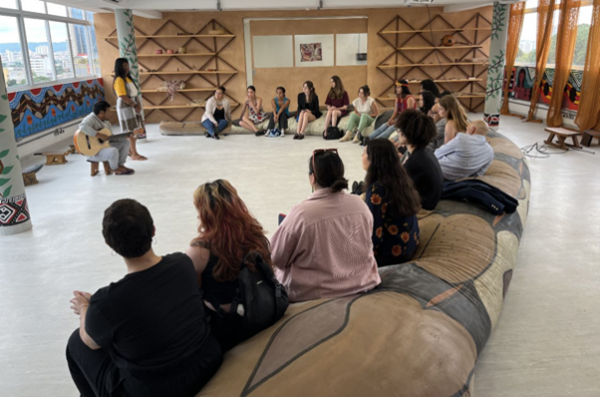
Members of the Museum of Indigenous Cultures perform a traditional song for visiting students from New Zealand.
The ENZ team in Brazil closely followed the journey of the scholarship recipients across the country.
ENZ’s Senior Market Development Manager – Brazil, Bruna de Natale said the students’ visit was a wonderful opportunity that has further grown the rich, cultural, and academic connections between Brazil and New Zealand.
“We were pleased to see how deeply the students immersed themselves in learning about history and indigenous rights in Brazil and make connections with indigenous communities in the country. It’s amazing to see the Prime Minister’s Scholarships for Latin America enable this rich exchange of ideas and knowledge between New Zealand and Brazil,” de Natale said.
The four-week visit ended in Brasília, where the students synthesised their learning in Brazil by presenting original projects that promote the connection between the indigenous cultures of Brazil and Aotearoa New Zealand.
The students’ insights are also captured on video that can be viewed here on LinkedIn.
- IMG 1186
- pmsa india 1