Search
Showing 10 of 7395 results
- Leadership Statement 20 09 11
-
Photo story – New Zealand education showcased in China
New Zealand speakers take the stage
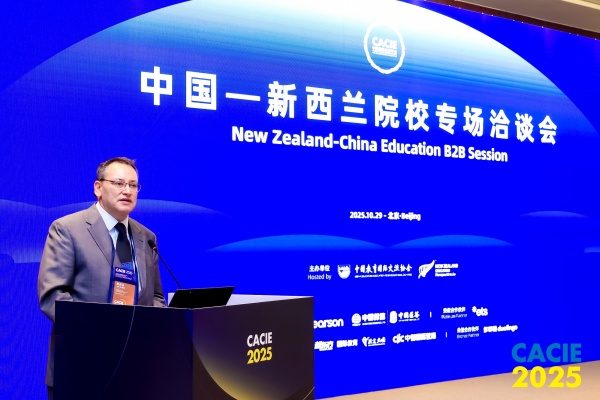
Minister for Universities and Minister of Science, Innovation and Technology, Hon Dr Shane Reti delivering welcome remarks at New Zealand-China Education B2B Session. As part of the China Annual Conference for International Education (CACIE), the B2B Session attracted over 117 visitors to engage in productive dialogues with participating New Zealand tertiary institutions aiming to build collegial partnership.
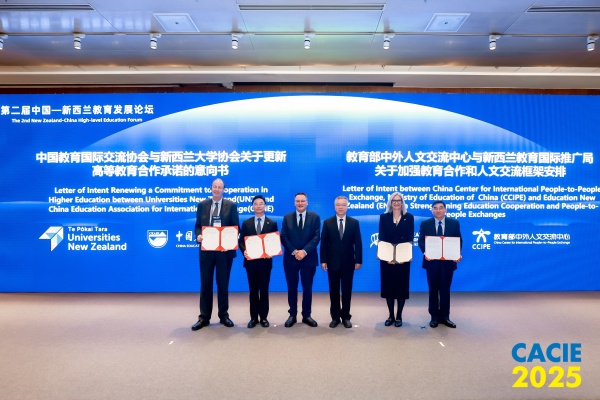
Minister for Universities and Minister of Science, Innovation and Technology, Hon Dr Shane Reti and REN Youqun, Vice Minister of Education of China witnessed the signing of Letter of Intent between Universities New Zealand and China Education Association for International Exchange (CEAIE) and Education New Zealand and China Centre for International People-to-People Exchange (CCIPE) at the 2nd New Zealand High-level Education Forum. The letters of intent between Chinese and New Zealand government agencies places existing collaboration within a more formal framework, allowing both sides to work more effectively together to advance shared education cooperation goals.

Minister for Universities and Minister of Science, Innovation and Technology, Hon Dr Shane Reti delivering remarks at CACIE Night, a key plenary event at the conference. In his remarks, he recognised New Zealand’s role as Country of Honour at CACIE and celebrated the deep and enduring education ties between New Zealand and China.

ENZ Chief Executive Amanda Malu speaking to a packed audience at CACIE Night, highlighting the strengths of New Zealand’s education system, the unique student experience, and the values that underpin our education brand.

Professor Damon Salesa, Vice-Chancellor, Auckland University of Technology (AUT) provided the Academic keynote address at the CACIE Plenary event.
During his address, Damon said: “This year, as New Zealand was recognised as the honour country, we were invited to share our story. It is a story of a small, agile education system that is responding to global challenges with creativity, care and collaboration.”
“It is a story of how we are preparing our learners for a future shaped by advancement in technology, while ensuring that innovation remains human-centred and culturally grounded,” he said.
China Education Expo
The New Zealand pavilion at the China Education Expo was front and centre, attracting many of the 15,000 attendees who attended the Expo in Beijing over two days.
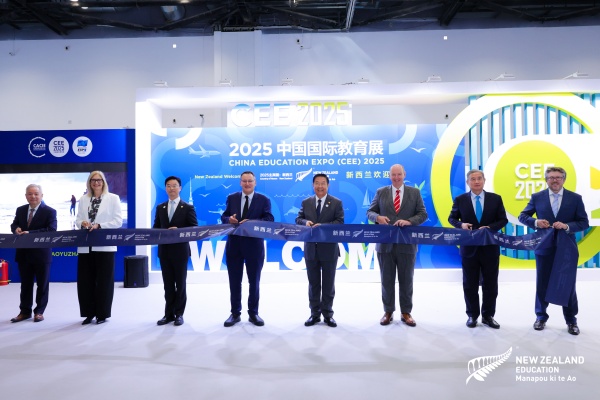
Representatives from New Zealand and China cutting the ribbon to officially open the New Zealand pavilion at CEE.

Te Wehi Haka, the Haka Experience, provided a Māori cultural performance that attracted students, parents, agents and partners to the New Zealand pavilion.
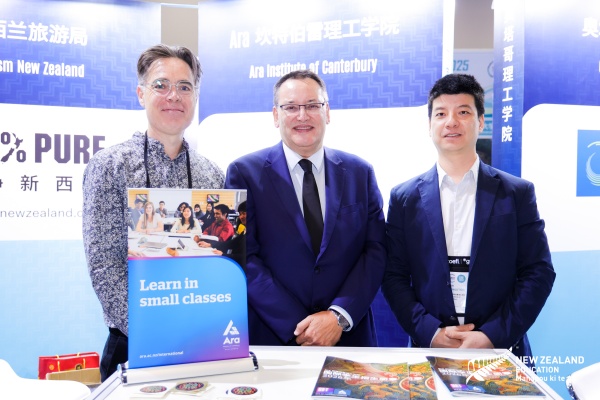
Ara Institute of Canterbury international department staff alongside Minister for Universities and Minister of Science, Technology & Innovation, Hon Dr Shane Reti (pictured centre).
Following the expo, 87% of those surveyed said their knowledge of New Zealand as a country to study in has improved after visiting the New Zealand pavilion
Additionally, 73% of those surveyed said they are more likely to consider New Zealand as a country to study in after visiting the New Zealand pavilion.
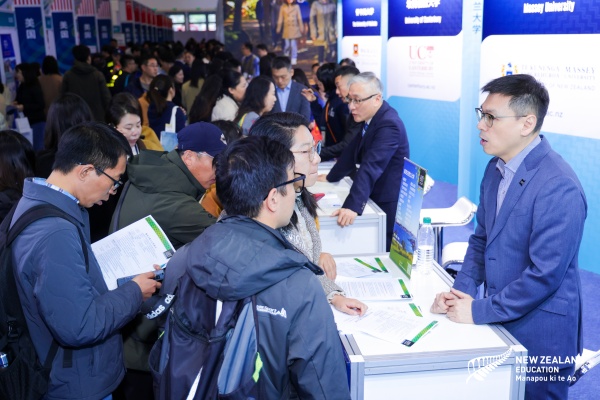
New Zealand education providers talking to crowds of prospective students and their parents at CEE.
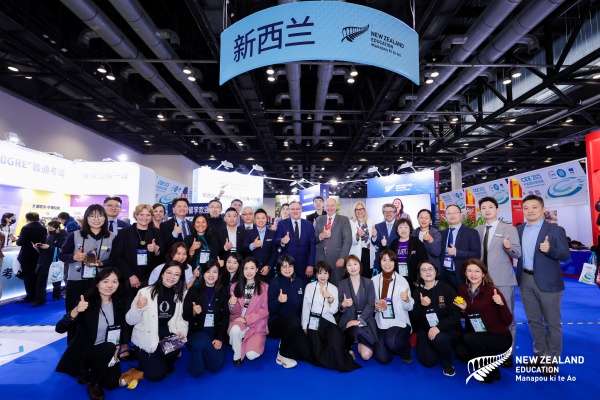
Representatives from the New Zealand government alongside New Zealand education providers at the CEE New Zealand pavillion.
ENZ Agent Seminars in Beijing, Chengdu and Wuhan
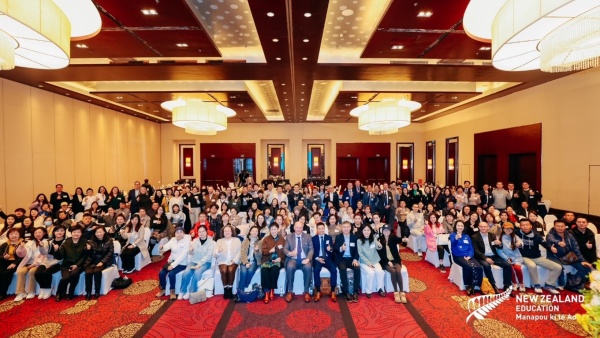
Attendees of the agent seminar in Beijing.
Building on the buzz of CACIE, ENZ hosted three Agent Seminars across Beijing, Chengdu and Wuhan.
The seminars connected over forty New Zealand education providers and around 320 visitors.
The seminars supported New Zealand providers to build connections with Chinese education agents
ENZ Director of Marketing, Adrian Hirst, said the personal connections made were a highlight of the event series.
“Sharing dinner at an agent’s home with parents and future students was a highlight, the informal setting sparked a lively Q&A session, which reinforced the trust families place in the process and the responsibility we all carry in our roles,” Adrian said.
Maximising the Country of Honour opportunity
Being named Country of Honour at CACIE and CEE was a prime opportunity for New Zealand to showcase its world-class education to Chinese audiences. ENZ delivered a strategic, multi-phase approach that built momentum before the events, maximised on-site impact through high-profile media coverage and Ministerial presence, and amplified engagement digitally with campaigns on platforms popular in China.
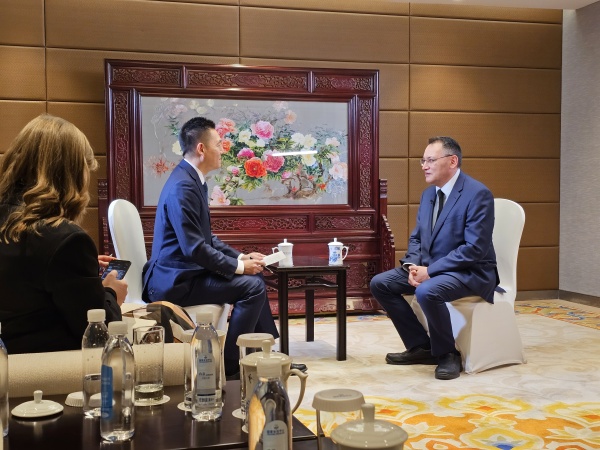
Minister for Universities and Minister of Science, Innovation and Technology, Hon Dr Shane Reti being interviewed by leading state media outlet, CGTN.

ENZ Chief Executive Amanda Malu speaking to China’s largest state TV network, CCTV at the CEE New Zealand pavilion.

ENZ Regional Director for China, Ron Xavier reporting in from CEE, speaking to Sina Education.
-
From the Chief Executive: Growth and global partnerships in international education
Kia ora koutou,
It’s great to be home following an impactful, whirlwind visit to Beijing for the China Annual Conference and Expo for International Education (CACIE).
I am pleased with the collective outcomes we have achieved from this visit. For one, New Zealand education institutions formalised 32 new partnerships with their Chinese counterparts that present real opportunity for knowledge exchange and pathways for students to experience the best of both countries.
ENZ signed a letter of intent with the China Center for International People-to-People Exchange to grow our education cooperation, particularly through institutional relationships across higher education and schools.
As Country of Honour at CACIE 2025 New Zealand had unparalleled opportunity to demonstrate why we are a high-quality education destination, backed by a strong student experience and a reputation for safety, inclusivity and innovation.
Last week ENZ’s extended leadership team, including our offshore Regional Directors, came together in Wellington. As part of our programme we visited four education providers across the region – Wellington College, Victoria University of Wellington, Whitireia and WelTec Petone and Le Cordon Bleu Wellington – before meeting with the Schools International Education Business Association (SIEBA) to understand the work they do with schools nationwide. These were insightful engagements that enriched our understanding, and we appreciated the warm welcome extended.
In other news, I am pleased to share with you that Tony Gray has been appointed permanent Chair of the Board of Education New Zealand. Tony has been a strong advocate for us while Acting Chair and a genuine pleasure to work with, so it is fantastic to have him confirmed in the role to 31 October 2027.
Lastly, I wanted to finish by acknowledging the sad passing of two public sector colleagues, Paul Irwin and Neil Miller, during the month of October.
Paul Irwin was a valued colleague at ENZ, having been a member of the Senior Leadership Team and part of our whānau for seven years. Although I didn’t work with Paul at ENZ, I knew him from his advertising industry days when we worked together on the ‘It’s Not OK’ campaign for action on family violence. His passing is a tremendous loss and he will be remembered for his strategic smarts, calm nature, and his leadership of New Zealand’s education brand over the years.
As Chief Advisor - Policy and International at the New Zealand Qualifications Authority, Neil Miller was a regular presence at International Peak Body meetings over the last four years. Neil would bring his deep-thinking skills and humour to these meetings, and always took a genuine approach to listening and helping solve issues that matter to us all.
Our thoughts are with their families and friends.
Moe mai rā, Paul and Neil.
Kua whetūrangitia kōrua
Return, take your place amongst the stars along with your ancestors that adorn the sky.
Ngā mihi nui,
Amanda Malu
Chief Executive
- Malaysia roadshow 004
- Simon
- scott brown
- Photo Linda Sissons3
- DanielWilsonwebcrop
- Tokyo20orientation20photo2032
-
Update from Immigration New Zealand
It is now easier for Chinese passport holders to study short courses in New Zealand if they are travelling from Australia and hold an eligible Australian visa.
Chinese passport holders can now come to New Zealand from Australia with a New Zealand Electronic Travel Authority (NZeTA), rather than applying for a study visa.
An NZeTA allows you to come to New Zealand as a visitor and study short courses of up to three months. You don’t need a study visa.
To be eligible you must:
-
be travelling from Australia – not transiting through Australia
-
Hold an eligible Australian visa
-
Meet NZeTA requirements
-
-
be in good health.
-
have a good character
-
have a genuine reason for visiting New Zealand
-
have enough money to pay your expenses
-
have plans to leave New Zealand at the end of your stay.
-
More information, including the full list of eligible Australian visas, is available on the Immigration New Zealand website: Visa free travel from Australia to New Zealand for Chinese visitors :: Immigration New Zealand.
You can request an NZeTA through the official NZeTA app or website : NZeTA application - request an NZeTA | Immigration New Zealand. A guide is available in Simplified Chinese: NZeTA application guide for citizens of China :: Immigration New Zealand.
-