Search
Showing 10 of 7355 results
-
Summer in NZ
The student retention workstream, a key focus of the Government’s Recovery Plan for international education, has delivered new resources, partnerships and online activity to support international students (and providers) over summer.
Alongside the Summer in NZ initiative, ENZ has been facilitating Instagram Live sessions on social media focused on the themes of wellbeing, employability, skill development and keeping students connected with one-another. For the schedule, visit the Summer in NZ page on the ENZ website, and watch on the StudyinNewZealand Instagram account (@studyinnewzealand). Further sessions will continue over summer.
A Tencent livestream with the theme of how to spend your summer in New Zealand was hosted by students on the NauMai NZ WeChat mini programme. Another two upcoming livestreams in the new year will feature how Chinese students are spending their summer and celebrating Chinese New Year in New Zealand.
ENZ has also partnered with LinkedIn and secured a number of LinkedIn Learning licences. We are now offering these to international students, via providers, free of charge to use over the summer period. This platform is used by education providers across the world to complement their existing courses.
ENZ has also been working with AFS New Zealand to deliver the Global Competence Certificate. The first course facilitated by Massey University began at the end of November. The next course begins 1 March – find out more and sign up here: https://www.massey.ac.nz/massey/about-massey/events/afs-nz-global-competence-certificate/afs-nz-global-competence-certificate_home.cfm
New NauMai NZ pages, developed in conjunction with providers and regional networks, have been added to NauMai NZ (under Summer in NZ), providing advice and information on activities and opportunities to engage and connect students over summer. Students whose programmes are finishing this year are also being encouraged to consider further programmes of study in New Zealand.
The Your Great Kiwi Summer Fair was held at the end of October. The audience was highly engaged, with initial feedback reporting that the fair was a useful source of information. Feedback will help inform future events with international students in New Zealand.
Since the fair, Northland Inc and Study Auckland have launched BeKiwi, a one-stop digital platform for international students looking for travel and volunteering experiences in the Northland and Auckland regions.
We understand this summer will be a very different one for many international students. We thank you for your support and encourage you to continuing sharing this information and these resources with them, as we stand together with our international students to make the most of their time here.
- MFAT24 103 Manaaki Scholarships 2024 signature final 2
- Faith FP4
- Senior Market Development Manager Korea Dec 2018
- Study with New Zealand news page1
-
Māori cultural experience builds lasting bonds for international students
Alongside courses in Māori culture, customs and language, some educational providers in New Zealand have offered an immersive noho marae (marae stay) experience. For students a long way from home, the warmth of the welcome and the sharing of knowledge, traditions, and food, gives them a lasting sense of belonging to Aotearoa.
One of the first educators to recognise the importance of sharing Māori culture with international students is Taituwha King, Senior Lecturer in Māori and Indigenous Development at Auckland University of Technology (AUT). For almost 20 years he has been running noho marae at the beginning of each semester to give international students a comprehensive cultural introduction to their study experience.
Such was the success of noho marae that King developed a course around it, called International Noho Marae – Indigenous Encounters of a Māori Kind, in 2010. It covers basic Te Reo Māori, Māori history, waiata (songs), and cultural customs, and is capped off with a weekend marae stay. It quickly became the second most popular class for international students at AUT, after another of King’s classes – Te Ara Pou Leadership. More than 1500 students have enrolled in the courses since 2002.
“The courses put indigenous goggles on students and open them up to areas of discussion with their own indigenous people,” King says.
Immersing in Māori culture is life changing
This is certainly true for Native American student Hailey Suina, from the Pueblo of Cochiti and Navajo Nation. She travelled to New Zealand on the Education New Zealand Go Overseas scholarship, already curious to explore the cultural connections between the Māori people and the indigenous people of North America.
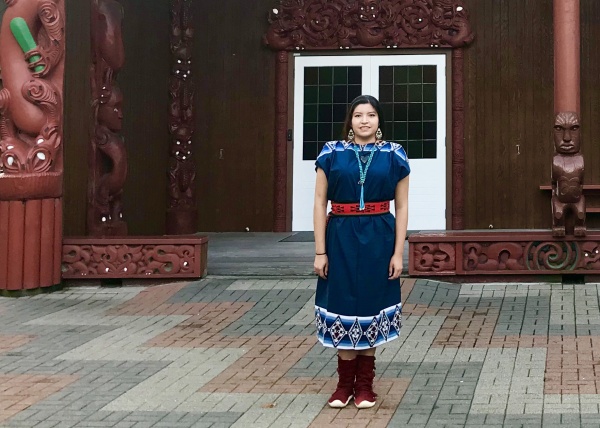
She describes the time she spent immersed in Māori culture as “life-changing,” and returned home determined to use her experiences to become a leader in her community.
Hailey says she was amazed by the similarities between the Cochiti Pueblo and Māori peoples, which include a collectivist rather than an individualistic culture, a sense of guardianship for nature, and strong ties with ancestors.
“From the moment I arrived, I felt a deep connection with the Māori culture. It was like stepping from one home to another.”
So strong was the concept of whānau and whakawhanaungatanga (kinship connections) for a number of King’s students, that they developed Whānau Councils as a way of staying connected and building on the bonds of their shared New Zealand experience once they returned home. With the first one established in 2010, there are now three - two in the US and one in Europe.
Pre-Covid, students in Europe would meet up annually. King and other AUT staff committed to joining them, cementing the enduring relationship and ongoing commitment of AUT to its alumni.
“Events like noho marae and the Whānau Council meet-ups also provide an opportunity for prospective international students to learn about and consider AUT as a destination to study abroad and build relationships with key employers linked to our alumni,” says King.
Europe council co-founder Anne Heimbeig says being part of the Whānau Council is “a very emotional thing”.
“I’ve met great people from different countries. Together, we’ve overcome lots of stereotypes and wrong assumptions, and brought Māori culture out into the world.”
There was a sense of home, belonging, warmth, and love on the marae, says East Coast USA council co-founder Jessica Cohen.
“Being in the Whānau Council allows us to keep that spirit alive and remember the value of our whānau even when we are far away from our beloved Aotearoa.”
-
Busy season for international education in India
The week after Prime Minister Christopher Luxon’s trade mission to India, Education New Zealand Manapou ki te Ao (ENZ) hosted the New Zealand – India Education Connect 2025 and flew the flag for higher education in New Zealand at the Asia Pacific Association for International Education Conference 2025 (APAIE).
New Zealand – India Education Connect 2025
ENZ hosted the New Zealand-India Education Connect focused on NZ universities strengthening academic and research partnerships with India. The event coincided with APAIE 2025 and was designed to align with India’s National Education Policy 2020 and support the Viksit Bharat 2047 vision.
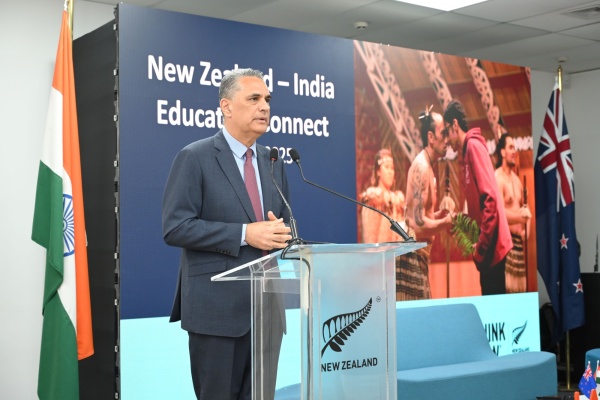
H.E Patrick Rata welcoming attendees of the New Zealand-India Education Connect.
The inaugural session at the Connect event served as a valuable platform to provide an update on the recent high-level bilateral engagements between New Zealand and India during the Prime Minister's visit. It also highlighted the continued prominence of education as a key theme across these discussions.
The event started with high-level bilateral updates by New Zealand’s High Commissioner to India, Patrick Rata, followed by an education overview by ENZ’s Chief Executive, Amanda Malu. Immigration New Zealand also attended and provided a market update as well as conducted a workshop with a selection of Indian education agents.
The programme was strategically designed to provide university representatives with expert intelligence and insights to support the development of their India engagement strategies, aligning with the evolving priorities and demands within the Indian context.
Panel discussions featured senior government officials and sector leaders, who shared perspectives on the increasing significance of deepening education sector collaboration between New Zealand and India. They also highlighted the opportunities presented by India’s National Education Policy 2020 to further strengthen these bilateral ties.
Following the New Zealand – India Education Connect programme and ahead of APAIE, ENZ hosted its NZ Networking Reception which was attended by more than 100 guests.
APAIE 2025
Running in tandem with New Zealand-India Education Connect, ENZ coordinated the New Zealand pavilion at the 2025 APAIE Conference, held in New Delhi from 24-28 March.
The pavilion featured 11 NZ institutions including, all eight New Zealand universities alongside representatives from the Southern Institute of Technology, Whitecliffe College, and Ignite Colleges. The pavilion also had in-attendance key representative from Immigration New Zealand to support providers and stakeholders.
This is the first time APAIE has been held in India that resulted in phenomenal engagement from Indian stakeholders, especially coinciding with this year’s theme on ‘Cultivating Global Citizens for the Future: The Higher Education Imperative in the Asia Pacific and Beyond’.
New Zealand featured strongly across eight panels, with ENZ Chief Executive Amanda Malu contributing to three panel discussions on Indigenous Perspectives in the Internationalisation of Higher Education; a regional update from New Zealand and Laos; and National Strategies for International Education: Three Perspectives from Asia-Pacific. The wider New Zealand speakers led critical conversations on international collaboration, indigenous knowledge, and sustainable education practices.
Director of Engagement for India, Jugnu Roy, said the New Zealand pavilion was buzzing across the three days of the conference.
“APAIE 2025 was an incredible opportunity to connect with global colleagues, exchange ideas, and gain fresh perspectives on the future of international education. The conversations offered plenty of inspiration and practical insights to take away,” she said.
APAIE aims to advance education through enabling greater cooperation between institutions to enrich and support international programmes, activities and exchanges; and to promote the value of international education within the Asia-Pacific region.
-
NZIEC KI TUA 2023 programme announced!
The New Zealand International Education Conference 2023 brings together practitioners and leaders from across New Zealand’s international education sector to look to the future and explore strategies for growth.
Our keynote speakers include:
- Helen Souness: Pathway to the future
- Dr Hinemoa Elder: Māori stories for global learning and teaching
- Dr Stephen Holmes: Post-pandemic insights from international students and parents
- Yemi Penn: Igniting your rebellious curiosity
- Dr Paul Spoonley: International education in 30 years
- Bridget Williams: International education and the sustainable development goals
- Sharon Zollner: The national and global economic outlook for 2024
- Kaila Colbin: Future of education
The conference also includes a range of energising breakout sessions hosted by experts in the sector, centred on the themes of Marketing Smarts, Growing Global, Authentically Aotearoa and Fresh Offerings.
Breakouts include Excellent experiences – Spotlight on student experience insights hosted by Marie Clark and Ross Crosson, ChatGPT, now what? Pitfalls and opportunities of AI in student recruitment hosted by Audrey Voon, Ko wai koe? Building indigeneity into your internationalisation strategy hosted by Monique van Veen and The intersection of EdTech and traditional education hosted by an expert panel.
Check out the full programme here: https://www.nziec.co.nz/agenda
We look forward to seeing you at NZIEC KI TUA 2023, register today: https://www.nziec.co.nz/registration
-
Around the world in five
NEW ZEALAND
Radio New Zealand: Deal promises pathway for eventual return of foreign students
The arrangement organised by Education New Zealand and the country's eight universities would see the universities recognise pre-university courses offered by the company NCUK, which was owned by British universities and had study centres in more than 30 countries.
Read more
UNITED KINGDOMThe PIE News: International students in UK will be able to access vaccine
International students in the UK will be able to access the Pfizer/BioNTech vaccine as it is rolled out across the country, The PIE News has learnt.
UNITED STATES
Study International: Here’s what Biden’s cabinet picks studied in uni
President-elect Joe Biden has announced key nominations for the US Democratic cabinet. It is his first order of business as the incoming US president, and the world is watching closely. “It’s a team that reflects the fact that America is back. Ready to lead the world, not retreat from it,” Biden said.
GLOBAL
University World News: Universities ‘essential’ to climate action, says UN chief
The United Nations secretary general, António Guterres, has called on the world to take urgent action to combat climate change and has praised the work of universities as “essential to our success”.
GLOBAL
ICEF Monitor: Students relying more on education agents for assistance with study abroad decisions
QS data shows that education agents represent an increasingly important marketing channel in the pandemic as international travel is not possible and face-to-face student fairs aren’t happening
- He parirau