Search
Showing 10 of 7355 results
- Viet Nam fairs
- Festival PMS alumni
-
From the CE: Farewell to 2020
2020 has been both the longest and shortest year of my life. It seems like no time ago we were discussing how we could get large numbers of students into New Zealand in time for semester one. Then we were in the midst of a global pandemic.
New Zealand study providers have been admirable in their response. I applaud the way they have ensured that international students in their care have had the information, care and support they needed, especially through lockdown.
Universities, schools and polytechnics, English language schools and private training providers have all moved incredibly quickly. Lectures, classes and assessments were moved online almost overnight.
We heard of fantastic stories of staff members going above and beyond, like that of assistant principal of Havelock North High School, Jamie Kitchin. Jamie opened his home to student Lucas, who arrived in the country just in time for the first term of the year.
In addition, providers and their peak bodies have been a key part of a sector-wide approach – made up of student associations, private and public providers, government agencies and not-for-profit organisations – to respond to the strategic, operational, and pastoral care issues we have faced. Hours have been spent together on Zoom discussing pragmatic responses, like the $1 million Student Hardship Fund and the pastoral care issues around repatriating international students.
I also want to acknowledge education agents both offshore and onshore, who have been instrumental in supporting students and their families and ensuring they were safe and well.
The challenges of 2020 have demonstrated the high calibre of international education in New Zealand.
At Education New Zealand, we also had to rip up our plans for the year and start again.
The 2018 New Zealand International Education Strategy had signalled that change was needed and the sector had to become more sustainable and diverse. The pandemic has accelerated that.
Now, we are guided not only by the strategy, but by the Recovery Plan for international education, with a focus on keeping the New Zealand education brand alive, seeding innovation within the sector, strengthening the system and building on our international relationships.
To date, the most advanced workstream within the plan is the retention of students. You can read about that elsewhere in this issue of E-News.
Elsewhere, ENZ teams around the globe have been engaging with our offshore stakeholders through virtual events, seminars and workshops in support of our new work plan. While travel remains restricted, we’ve found that maintaining those person-to-person relationships are more important than ever.
We’ve launched two brand campaigns (in the UK, Indonesia, Vietnam and China), to keep New Zealand alive in hearts and minds of prospective students. These campaigns have been our most successful to date. The third campaign, Tū Ngātahi, calls on New Zealanders to support international students currently in the country.
And that’s only the beginning. I would like to echo the Minister in saying that we hope to see increased strength, resilience and innovation within international education going into 2021. The international education sector will not only weather this storm, but build back stronger.
Make sure you take time out to enjoy with your family and friends. See you in the new year.
Ehara taku toa I te toa takitahi, engari he toa takitini.
My strength is not that of a single warrior but that of many.
Ngā mihi,
Grant McPherson
Chief Executive Education New Zealand Manapou ki te Ao
-
Japanese agriculture students visit Southland
The students, known as Chikujyo (“ari-girls” in Japanese)came from agricultural high schools across Japan to spend 12 days in Southland at Southland Girls' High School, which offered ESOL classes and technical training in farming. Alongside this, the students visited Fonterra Edendale, Blue River Dairy, Southern Dairy Hub research farm and other dairy farms with women in leadership roles. The Southern Institute of Technology also assisted with some activities.
Misa Kitaoka, ENZ’s Senior Market Development Manager – Japan said the programme generated significant media coverage in Japan and is a great example of industry and institutions collaborating to deliver a programme that highlights New Zealand’s unique education offerings and expertise.
“Students were impressed by the efficiency and productivity of agriculture practices in New Zealand, and the support for women in farming. They left feeling that farming in New Zealand allows a good work life balance,” said Misa.
“I am so inspired by the girls who are using what they learned in New Zealand to promote a new image of working in agriculture that’s more accessible for new entrants, especially females.”
The programme was developed by the Ministry of Agriculture, Forestry and Fisheries’ New Entrant’s and Women’s Division, in consultation with the New Zealand Ministry of Foreign Affairs and Trade, Ministry of Primary Industries and ENZ. It was administered by the Japan Agricultural Exchange Council and was funded by the Japan Racing Association.
-
Around the world in five
US
More international college graduates staying to work in US
The number of international student graduates staying on to work in the US has risen since 2008, with no signs of stopping.
GLOBAL
Bank of Mum & Dad: Global international student funding gap revealed
A new survey shows international students are turning to part-time work and their parents rely on borrowed funds to contribute to their education.
SOUTH AFRICA
English language schools officially recognised by government
English language schools that are members of Education South Africa will be formally recognised by the government, opening the door for students to study English in South Africa with greater regulatory stability and visa certainty.
GERMANY
Germany leads Europe in student social engagement
Germany leads the way in helping students thrive outside class, followed by the UK, Austria and Ireland, according to the European Student Survey by Times Higher Education.
CANADA
Montreal wants its international students to stay
Montreal International has launched a ‘Je Choisis Montreal’ or ‘I choose Montreal’ campaign to help more international students live, work and immigrate to the city.
- Thailand6
- Canty20Strategy20cover20 20small
- BtoB Tokyo
-
BINUS School Serpong wins the KIWI Challenge 2022
The winning team’s ‘Beyond Borders’ idea involved the development of a travel planning app that streamlines and personalises the travel planning process. The team also had a strong focus on local community engagement and inclusivity across people with different abilities.
The KIWI Challenge is an annual ENZ initiative run in partnership with one of New Zealand’s universities. This year Te Kunenga ki Pūrehuroa – Massey University was nominated and chose the topic of sustainable business and entrepreneurship in the tourism industry.
The competition sees participating students from schools across Java and Kalimantan provide an innovative solution or idea on a given theme.
ENZ runs the competition in collaboration with in-market partner, Kopi Tuli (Deaf Cafe), a hearing-impaired community in Jakarta. This partnership is aligned with ENZ’s strategic framework to nurture and encourage diversity, equity, and inclusion, while also showcasing sign language as one of New Zealand’s official languages.
Education Minister Chris Hipkins officially launched the 2022 KIWI Challenge during his visit to Jakarta in October.
The top prize includes vouchers worth $1,000 NZD with team members being able to undertake a virtual internship with Massey University.
The virtual internship will teach students practical skills to ‘take their idea to the world.’ Through eight hours of customised supervision from some of Massey’s academic marketing experts, students will learn how to add value to their idea and create a digital marketing plan to effectively launch their business solution.
The judging panel included ENZ’s General Manager – Marketing and Communications, Geoff Bilbrough; Massey University’s Director of Strategic Partnerships, Dr. Jeffrey Stangl; and co-founder of Kopi Tuli, Tri Erwinsyah Putra.
“I was hugely impressed with what I saw today, you [the students] can be very proud of yourselves and feel very optimistic about the future that you have before you,” Mr Bilbrough said.
Dr Stangl added, “If the future of the planet is in your [the students] hands, then we’re in good shape. Each one of the teams have thought through some very innovative ideas and solutions to problems unique to Indonesia.”
This year, the competition had 36 teams from 18 schools across the Java and Kalimantan regions participating with their innovative ideas and business pitching skills to develop their idea and create a 2–3-minute video presentation to submit to the competition.
Five teams were shortlisted to attend the finals, which were held live in-person (Jakarta) and online (Zoom). Finalists then presented their business solution for sustainable tourism, followed by a question-and-answer session with the judging panel.
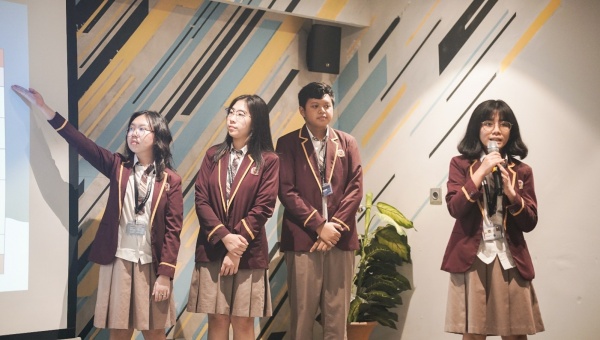
The winning BINUS School Serpong team present their ‘Beyond borders’ strategy. Pictured above (from left to right): Isabel Jo Orleans, Darlene Christabelle Wijaya, Rafael Rangga Natariano, and Calista Zahra Caesariyani
- ENZ 4 copy for enews website 1