Search
Showing 10 of 7355 results
-
What’s next for ENZ events?
The trial of the EventsAIR OnAIR platform began in September with the Japan New Zealand Education Virtual Showcase and Agent Seminar, and will continue over the next few months for events like agent seminars in-market, the Viet Nam Student Showcase, and the Summer Retention Showcase.
Over and above a video-conferencing application like Zoom, the EventsAIR OnAIR platform has functions like a virtual exhibition, live Q & A, and gamification features, where users can compete to win points.
ENZ recently hosted our inaugural India New Zealand Education Week on the EventsAIR OnAIR platform. To have a look at the platform and how it works, you can register and view recordings of the event here.
ENZ has an established relationship with EventsAIR, having previously partnered with them for lead capture at in-person events.
ENZ Director – Channel Services and Partnerships, Dan Smidt, says what really clinched this new collaboration was the wide range of functionality EventsAIR had developed.
“We didn’t want a platform that would simply recreate what you’d expect from an in-person event. We wanted something that would use digital features in a creative way, to really capture the attention and imagination of our attendees.”
Participants are currently limited to providers who registered with ENZ for in-person events in-market before they were cancelled due to COVID-19. At the moment, ENZ is able to offer participation in these events at no cost to the sector.
“In the results of a survey out to New Zealand providers earlier this year, the cost of developing or participating in digital events was one of the most important factors for those considering their event options,” Dan says.
Even before COVID-19 caused global travel disruption and the widespread cancellation of in-person events, ENZ was looking into ways to host more events virtually.
“We know that education providers and students are becoming more conscious of the sustainability of long-haul air travel,” Dan says. “COVID-19 simply accelerated our work in the online event space.”
“This dynamic virtual events platform is the next logical step in the growth of the ENZ digital eco-system. We’re now able to think about how we do events in a whole new way.”
Dan and the ENZ Events Team hope to develop a virtual and hybrid calendar of events for 2021 with OnAIR. Please watch out for more updates on our events work in E-News on our website.
-
Around the world in five
GLOBAL
Survey finds prospective students put the emphasis on welcome and teaching quality
A survey of 62,000 prospective international students found that the most important factor in deciding between destinations is how welcoming and safe a study destination is. The survey also finds that teaching quality trumps university ranking for the majority of prospective students.
ASIA
University alliance in Asia aims to boost regional ties and global influence
Fifteen universities across Asia have formed a consortium to better facilitate mobility and enhance academic and research collaboration in the region. The alliance includes institutions in China, Korea, Japan, India, Thailand, Myanmar, Malaysia, Singapore, Indonesia, Sri Lanka, UAE, Saudi Arabia and Kazakhstan.
THAILAND
Education key in call for more designers
Thailand’s Chanapatana International Design Institute (CIDI), says Thailand lacks the education system needed to make Thailand a centre of excellence in design, and must work on internationalisation and collaboration. Currently, the market demand in Thailand exceeds the country’s capacity with only a limited number of students accepted to universities.
CANADA
Canadian universities see surge of international students
Canadian institutions are seeing jumps of 25 per cent or more in admissions of students from abroad, with record levels of interest from American students. “Canada may be a middle ground between the United States and Europe,” said Ravin Balakrishnan, the chair of computer science at the University of Toronto. “We have the energy and tech-savvy of the U.S., but the safety of European countries,” he said.
AUSTRALIA
Why companies of all sizes should give international student interns a shot
With 22.3% of students at Australian universities being international students, it’s important that they aren’t disregarded for employment, as they’re receiving the same education as local students. Work experience is the best segue for international students and graduates to get into the workforce. Here’s a few reasons why companies should give them a shot.
-
Winners of KIWI Challenge announced
This year was the first where university students were able to enter a new category alongside the schools' challenge.
The winning teams from Petra Christian University and USG Education headed off strong competition from eight other finalists, drawing praise from the judges for their solutions to support youth-led Small and Medium Enterprises (SMEs).
Finalists presented to a panel of judges from University of Otago – Ōtākou Whakaihu Waka and Education New Zealand Manapou ki te Ao (ENZ), who were cohosting the initiative.
Both winning teams received a voucher valued at 10,000,000 Indonesian Rupiah (approximately 1,000NZD) as well as virtual internships from the University of Otago – Ōtākou Whakaihu Waka commencing in semester one, 2025.
Tech-led solutions
A team from Petra Christian University developed an app ‘Partify’ which connects emerging small businesses and keen part-time workers. Businesses post part-time jobs, and workers swipe to find flexible gigs nearby, with AI matching candidates based on skills, location, and availability.

Partify university winner – ENZ market manager Naluri Bella and University of Otago Regional Market Manager Sarah Ewing present the award for First Place in the University category to team members from Petra Christian University for their app ‘Partify’.
In the high school category, a team from USG Education took the top prize with ‘LAW4MSME’, a platform allowing small businesses to access legal information and advice.
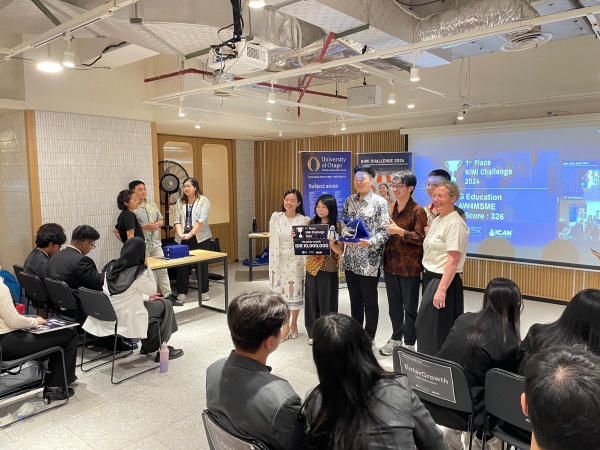
LAW4MSME High school winner - ENZ market manager Naluri Bella and University of Otago Regional Market Manager Sarah Ewing present the award for First Place in the University category to team members from USG Education for their platform “LAW4MSME’.
Explaining the group’s business idea, team leader for LAW4MSME, David Francis said the students found that Indonesian youth-led SMEs lack knowledge of the laws and regulations needed to run their businesses.
“To address this, we developed an AI bot that educates SME owners on these regulations, helping them navigate legal requirements more effectively,” David said.
The KIWI Challenge competition aims to inspire youth across Indonesia to engage in entrepreneurial activities and help resolve societal issues. Over the five years the competition has run, 1000 Indonesian youth have participated. This year, Education New Zealand Manapou ki te Ao (ENZ) partnered with University of Otago to co-host the initiative.
This year’s competition included 49 teams with a total of 221 student participants.
Mentorship key
Mentorship is a key element of the competition. The finalists attended a workshop run by Associate Professor Dr Conor O’Kane, Head of the Bachelor of Entrepreneurship programme at Otago Business School. This assisted entrants to develop their ideas and refine business plans.
ENZ Acting General Manager International Ben Burrowes said he’s delighted to see the continued development of the KIWI Challenge.
“Inviting university students for the first time has given us the opportunity to include a whole new cohort of talented young entrepreneurs, and we have been very impressed with the quality and creativity of their submissions,” Ben said.
“The competition has also benefitted from the enthusiasm and expertise of our colleagues at the University of Otago, and we are grateful for their willingness to partner with us for the KIWI challenge’s fifth year.”
Dr O’Kane said it was inspiring to witness the quality of entrepreneurial thinking among Indonesian students.
“These students have very bright futures. The concepts and programmes the finalists presented were remarkable and captured the impressive ability of the teams to identify tangible business problems and visualise and communicate a solution to these challenges,” Dr O’Kane said.
-
Eighteen million views and counting
Yichen is a cartoonist with five million followers on Weibo. (Weibo is one of the most popular social media platforms in China. A mix of Twitter and Facebook, it’s used by more than 30% of Chinese internet users.)
Yichen was accompanied by a team from Sina.Com. A multimedia outlet, Sina.Com owns Sina Weibo (which hosts Yichen’s account). Its education outlet, Sina Education, was the first professional education-focused online media platform in China. An interactive campaign involving Sina Education; Yichen’s dedicated visit Weibo account and her own personal account, and ENZ’s Weibo account, ensured maximum profiling of this visit on these channels.
The group visited eight institutions in Dunedin, Otago and Queenstown to raise the profile of the South Island as a study destination.
“Yichen’s followed by millions in China for her quirky and positive cartoons and posts about life. She began sharing her work on Weibo when a student at Tianjin Normal University, and has gone from strength to strength since then. Her work is clever, creative and innovative – all qualities that speak to the way that we seek to position and profile New Zealand education,” says Regional Director – Greater China Alex Grace.
“What better way to grow awareness and build preference for New Zealand than inviting Ding Yichen and Sina.com here to truly experience studying in the South.”
From the trip, Yichen produced posts illustrating her New Zealand experiences, which have been viewed 18 million times to date, and Sina.com are publishing content about New Zealand on a specific mini site.
Alex says giving the group a taste of New Zealand’s course content by doing – rather than just showing or telling – made all the difference.
Yichen took part in an animation taster class, took a cooking class, delved into winemaking, and drew with our students.”
“I encourage providers hosting international guests to think about how they can make their visits stand out by ‘doing’, as well as telling and showing. Kiwi students learn by doing, and our guests are here to understand us and our education system better. Let’s make it memorable!” says Alex.
The trip was part of Education New Zealand’s visiting media programme, which brings international media to New Zealand from targeted print, online and broadcast organisations.
-
Latin America: 3 countries, 5 cities, 10 days
From 21-31 April, Minister Joyce visited Santiago, Bogota, Sao Paulo, Cuiaba and Brasilia undertaking a comprehensive programme focussing on international education but also covering his other portfolio areas of science, innovation and economic development.
Simultaneously, ENZ Chief Executive Grant McPherson led a high-level university delegation comprised of Victoria University of Wellington's Vice Chancellor Grant Guilford, Otago University Deputy Vice Chancellor Richard Blaikie, Lincoln University Deputy Vice Chancellor Jeremy Baker and South America specialist Maria Duter, as well as UNZ Executive Director Chris Whelan.
This was Minister Joyce’s first visit to Latin America, and it was a great opportunity for him to experience the culture of doing business in the region as well as to get a first-hand impression of the opportunities. The Minister particularly valued the chance to speak with New Zealand alumni. His various conversations with Chilean penguins, Brazilian Science without Borders’ students and Colombian Colfuturo scholarship recipients confirmed that the messages we promote on New Zealand’s high quality education, safe and creative learning environment, and the building of lifelong friendships and connections all ring very true.
The visit also confirmed that accessing scholarships funded by the governments of Chile, Colombia and Brazil should remain a priority for us. In all three countries there are question marks over the longevity of some scholarship schemes, so maximising the opportunities to underline our commitment to them while in market was useful.
Overall, the Minister’s bilateral discussions with Ministerial counterparts in the region confirmed a solid interest in developing the government-to-government relationships in regard to international education. As well as increasing student flows, interest was expressed in learning from New Zealand’s experience of developing a qualifications framework, standards and quality assurance measures, pathways policies as well as training teachers of English. NZ/Colombia bilateral education consultations have been approved for the last quarter of 2015 and Brazil has agreed to refreshing our current bilateral MOU into an Education Cooperation Arrangement.
The Minister’s visit generated considerable media interest and was covered by television, radio and press, successfully raising the profile of New Zealand as an education destination. The last word goes to the university delegation which supported one another’s offerings as well as the overall New Zealand education story with a refrain that developed during our journeys: “You can’t make a wrong choice in New Zealand”. A powerful message for prospective students.

Left: Minister Joyce presenting at the Brazil Senate Education Committee. Right: The Minister speaks with the media after lunch with the Governor of Mato Grosso State.
Country insights include:
Chile
During the Minister’s visit, a fresh tranche of 80 Chilean high school Penguins Without Borders were confirmed to arrive in July for two terms. Continuation of this programme is uncertain, with no indication of Chilean government plans to send Penguins in 2016. There’s good news, however, on the tertiary Becas Chile scholarship front, with administrators convinced by New Zealand’s arguments that subject-area rankings (rather than university-wide rankings) should be considered when approving study destinations. This paves the way for increased student flow from Chile.
Brazil
The Brazilian Science Without Borders scheme shows increasing numbers of Brazilian students approved for studies in New Zealand. However, with the Brazilian public service facing severe budget cuts, there is no guarantee that the projected 100,000 Brazilian students will be placed for offshore study between now and 2018.
The Minister's opening address at the international education FAUBAI Conference in Cuiaba hit exactly the right note, reaching around 500 international tertiary education contacts from 26 countries. The strong focus in Brazil is on forging strong institution-to-institution relationships to encourage joint research, as well as student and academic exchange.
Colombia
A highlight of the Bogota programme was an event with scholarship agency Colfuturo, with presentations and interactions between the NZ universities and prospective students in person and online. Executive Director Jeronimo Castro is passionate about New Zealand and prospects for increasing student flow are positive.
To find out more about opportunities in the Lain America region, please contact Lisa Futschek or Cecily Lin.

Above: The Minister’s Twitter feed included this media scrum at Faubai.
-
Education links with China
Lisa Futschek, General Manager, International, at Education New Zealand Manapou ki te Ao (ENZ) says the Joint Working Group has become an important mechanism for supporting educational cooperation and exchange with China.
“It’s a valuable opportunity for government agencies and education sector representatives from both countries to exchange ideas and information and build relationships.”.
This is the second time the Joint Working Group has been held virtually. Senior officials and subject matter experts from both New Zealand and China’s education and government sectors came together to discuss topics of mutual interest including higher education, early childhood education, vocational education and applied learning, and quality assurance.
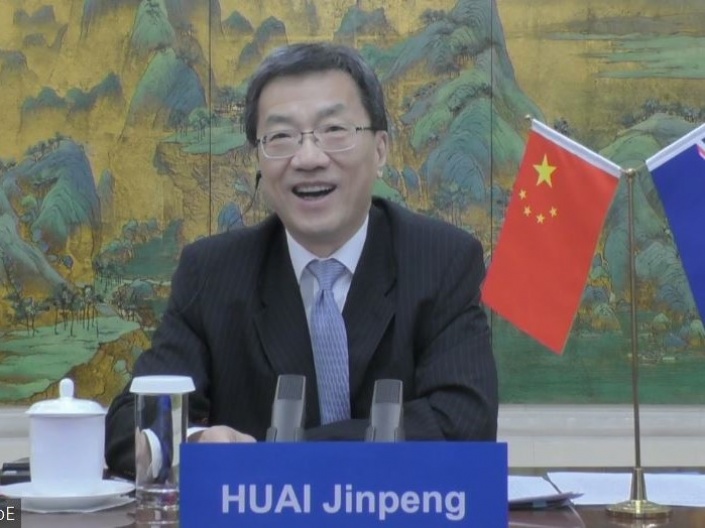
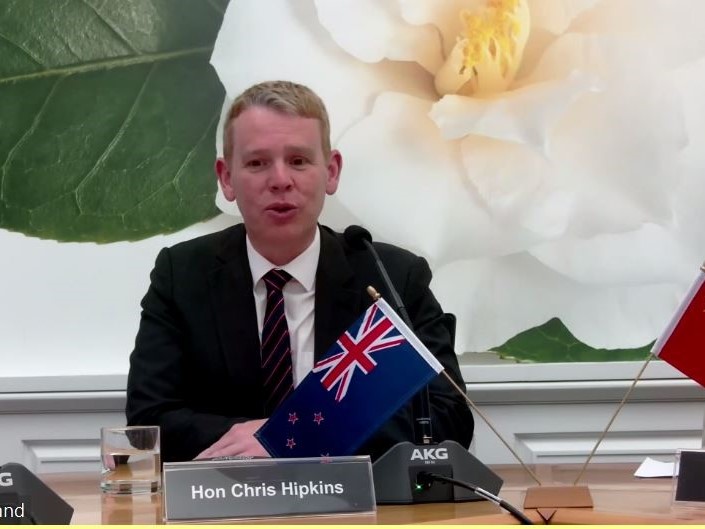
Jinpeng Huai, Minister of Education, People’s Republic of China and Hon Chris Hipkins, Minister of Education, New Zealand exchanged remarks at the Opening of the 10th Joint Working Group
The meeting saw the renewal of the Addendum to the New Zealand – China Arrangement on Cooperation in Education and Training, which covers a range of joint projects including the New Zealand-China Tripartite Partnership Programme. Note: the 2023 New Zealand-China Tripartite Fund is currently open for proposals from New Zealand university representatives.
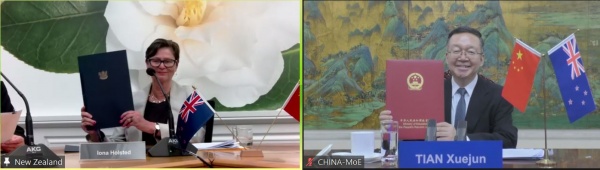
Secretary for Education and Chief Executive, Ministry of Education of New Zealand, Iona Holsted and Vice Minister, Ministry of Education of People’s Republic of China, Xuejun Tian, renewed the Addendum to the New Zealand – China Arrangement on Cooperation in Education and Training.
The meeting also provided an opportunity for New Zealand representatives to provide updates on collaboration with China in the areas of Vocational Education, Higher Education, and Quality Assurance.
David Christiansen, ITP Transition Lead, Te Pūkenga, shared the newly-launched International Strategy and the development of international collaboration and opportunities internationally and in particular with China.
“We wish to renew and strengthen our existing offshore collaborations and create new collaborations. New Zealand has many areas of strength, across a range of industries, where we believe we can offer value and strength to Chinese Industry,” Mr Christiansen said.
There are currently 41 degree or diploma joint programmes across more than 14 subjects from engineering and fashion to viticulture and winemaking, and agriculture. These partnerships cover 20-plus provinces and numerous cities throughout China.
The fifth New Zealand China Higher Education Forum, co-hosted by Universities New Zealand and China Education Association for International Exchange was held virtually on 10 November 2022 and was a discussion topic for the JWG during the Higher Education discussion. Chris Whelan, Chief Executive of Universities New Zealand, was present at the fourth New Zealand-China Higher Education Forum held in Beijing in 2015. He told participants that, back then, “the focus was on how to deepen collaboration between our institutions, how to grow mutual student mobility, and how to ensure high-quality education offerings.” It is evident the New Zealand-China education relationship in the higher education sector has developed over the years to envelop broader current topics such as “green and sustainable development of higher education,” building on the foundation established through years of cooperation.
The final discussion topic, Quality Assurance, saw Alex Bidois from New Zealand Qualifications Authority (NZQA) provide an update on the progress of the working group on the Recognition of Distance Learning Qualifications between NZQA and the China Service Centre for Scholarly Exchange. The working group was established at the ninth Joint Working Group and NZQA has been working with its partner agency to lay a foundation to build towards mutual recognition of distance learning qualifications.
-
New Zealand tops English-speaking countries in Educating for the Future ranking
 There were just 1.6 points between top-ranked Finland (80.9), second place-getter Switzerland (80.3) and New Zealand on 79.3 points.
The overall ranking was a small drop for New Zealand, which ranked first out of 35 economies in the first EIU report which came out in September 2017. However, the 2018 ranking involves 50 economies and additional indicators on which countries were evaluated.
"This is a very good result for New Zealand," said ENZ Chief Executive Grant McPherson.
"New Zealand retains its position as the number one English-speaking country in the ranking as well as its top ranking in the Asia-Pacific region.
"Along with Finland, New Zealand is the only country that has been in the top 3 two years in a row."
The index evaluates the way that countries approach future-focused education to encompass problem-based learning, innovative teaching methods and broader themes of global citizenship.
It has a focus on young people aged 15 to 24 in 50 economies, and measures three pillars of education systems – policy approaches, teaching conditions and broader gauges of societal freedom and openness – as a means of preparing young people to meet the challenges of work and society in future.
You can read the full report here.
The top 10 country rankings were:
Rank
Economy
Score
1
Finland
80.9
2
Switzerland
80.3
3
New Zealand
79.3
4
Sweden
78.1
5
Canada
77.9
6
Netherlands
76
7 =
Germany
74.8
7 =
Singapore
74.8
9
France
74.2
10
UK
74.1
-
Chinese and Kiwi students team up for tech innovation
Twenty six secondary school students from Sichuan Province, China, and 15 students from Avonside Girls’ High School and Shirley Boys’ High School participated in the Canterbury Sichuan Innovation & Technology Youth Summit, held in the city’s Innovation Precinct earlier this month.
Christchurch Educated partnered with the Ministry of Awesome to deliver the five-day programme that included workshops on teamwork and pitching, visits to central city innovation zones and talks from young, local entrepreneurs.
The students worked in teams to develop a tech solution for a problem they identified relating to food, language and culture, transport or city. Solutions included a ‘smart’ rubbish disposal system for dirty cities, an app that uses music to teach new languages, and augmented reality glasses that allow users to interact with people from another country and practise communicating before they visit.
On the final day, participants pitched their solution to a panel of experts from the tech industry who awarded prizes for the most innovative solution, best teamwork and best pitch.
One of the judges, Helen Shorthouse, Technology Sector Leader, ChristchurchNZ, said by working in teams the students had quickly developed cross-cultural understanding.
“It was really impressive the way they took common problems facing both New Zealand and China and developed innovative tech solutions that could be applied in both countries.”
A number of young entrepreneurs from Christchurch start-ups including ShareaCamper, Smish, FluentIQ, EVNEX and the Christchurch City Council’s ‘Are you Alright?’ campaign shared their experiences and helped participants prepare for their pitches.
The event comes out of the Canterbury-Sichuan relationship that has been in development since an MoU was signed with the Sichuan Provincial Government in 2013.
Karen Haigh, ChristchurchNZ Market Project Manager, International Education, said this is the first time the event has been held in Christchurch but there are plans to continue it.
“We foresee the programme being run on an annual basis with Chinese partners, and also offered to other markets such as Korea and Viet Nam.
“We hope it will attract more students with an interest in IT to Christchurch, while showcasing the innovation and tech opportunities here.”
- Overall student visa dashboard full year 2014
-
Student wellbeing strategy launch
The new strategy aims to protect and enhance New Zealand’s reputation as a safe and welcoming study destination. It was officially launched at Ara on 13 June by Tertiary Education, Skills and Employment Minister Paul Goldsmith.
Hayley Shields, ENZ’s Director of Student Experience says the new strategy was the outcome of extensive consultation with the sector as well as with international students about what would make the most difference to them.
“Students that I spoke to at the launch were really pleased to see the new strategy, and to know that their wellbeing is considered so important for their student experience,” she said.
Ara Chief Executive Kay Giles together with Ara staff and international students, representatives of government agencies, Christchurch Educated, and the local community took part in the launch.
Development of the new strategy was led by the Ministry of Education.
Read the International Student Wellbeing Strategy.
Read Minister Goldsmith's announcement.