Search
Showing 10 of 7355 results
-
New enrolment guide for students
Enrolment information has been the second-most requested content on SiNZ social media channels, so ENZ has created an enrolment guide to sit on the SiNZ website.
The guide has two sections: how to apply to study at a primary, secondary or English language school, and how to apply to study at a tertiary institution.
Lucia Alarcon, ENZ International Digital Project Manager, says the guide provides step by step information on the enrolment process for each of these levels of study.
“We’ve included brief information about application procedures, including required documents, application fees, interviews and English language assessments.
“We make it clear that the information is a general guide only, with procedures varying between institutions.”
The enrolment guide is part of ENZ’s new 5 Steps to Studying in New Zealand process, which breaks up the study abroad journey to help students understand how to get started.
The 5 Steps encourage students to check out the practical content we’ve added to SiNZ in recent months. Along with the enrolment guide, the new content includes our Cost of Living and Explore NZ pages.
- NZIEC day1 257editeditedit
- Lead Connect Grow Logo RGB 0
-
UK NARIC workshop in Christchurch
The National Agency for Recognition and Comparison of International qualifications (NARIC) United Kingdom (UK) is a leading provider of training on international qualifications on behalf of the UK government.
There will be four sessions over the two days:
Thursday 22 September
Friday 23 September
There is limited capacity for each session. Non-UK NARIC members can secure their spot at UK NARIC’s website.
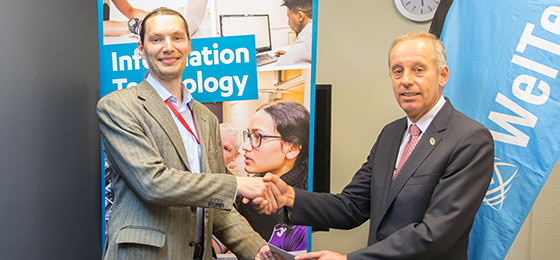
- Weltec IT Award recipients 1Edithero
- P1330825
-
New Sino-New Zealand vocational teacher training base opens
The new training base will operate out of the Shaanxi Polytechnic Institute, a key institution partner for New Zealand ITPs and one of the leading vocational education colleges in Western China’s Shaanxi Province.
It follows the first Sino-New Zealand vocational teacher training base launched in Qingdao Technical College late last year.
Adele Bryant, ENZ’s Senior Advisor – China, said it’s a great opportunity to bring New Zealand best practice to more Chinese TVET teachers, particularly in areas such as curriculum design, quality assurance and assessment.
“More Chinese TVET teachers will benefit from the tailor-made training programmes jointly developed by New Zealand and Chinese TVET experts, building on the Train the Trainers Programme that many Chinese vocational teachers have undertaken in New Zealand over the last few years,” said Adele.
An unveiling ceremony was held on 11 May at the Silk Road Education Cooperation Expo in Xi’an, with representatives from the Shaanxi Provincial Government, Department of International Cooperation and Exchange of the Chinese Ministry of Education (MoE) in attendance.
Other attendees included the President of Shaanxi Polytechnic Institute, Director of the Central Institute of Vocational and Technical Education, the Economic Counsellor from New Zealand Embassy Beijing and Tony O’Brien, Sino-New Zealand Project Director of the Model Vocational Education Programme.
The training bases are part of the Model Vocational Education Programme work plan for 2018-2019.
The Chinese government released its National Implementation Plan for Vocational Education Reform in February this year, in which upskilling TVET teachers is a key priority, including through the building of 100 teacher training centres.
Adele says this would open further teacher training opportunities for the New Zealand TVET sector.
-
Join ENZ-led events across Asia
Interested in attending ENZ led events in Viet Nam, Thailand or South Korea later this year? Or a third-party led New Zealand student fair in Japan? We are pleased to advise that event information is now available to education providers, with applications closing early March. Get in touch at events@enz.govt.nz to request information, stating which event you are interested in.
The full ENZ 2026 events calendar is here.
-
Trans-Tasman collaboration on show in Antofagasta
Education New Zealand Manapou ki te Ao (ENZ) worked alongside Austrade and Study Queensland to deliver university seminars, school visits and a student mini fair, reaching more than 300 students and parents.
The programme promoted New Zealand’s education offering, with a focus on English language studies as an entry point and clear pathways into higher education and other subsectors. Activities included engagement with leading institutions in the region including Universidad de Antofagasta (UA), Universidad Católica del Norte (UCN), Antofagasta International School (AIS) and Colegio San Marcos.
ENZ contributed to seminars on the future of mining, highlighting how New Zealand's education system supports the needs of this key regional industry. School visits and a student mini fair also gave students and families the opportunity to explore study options and connect with education agents for tailored guidance.
Javiera Visedo, ENZ’s Director of Engagement – Latin America, says the programme helped build awareness of New Zealand’s education opportunities in a region with strong potential.
“A key highlight of the programme was the collaboration with Australian partners, which enabled a joint promotion of Oceania as a study destination,” says Ms Visedo.
“Australia already has strong recognition in the region, particularly through the mining sector. Working together allows us to position New Zealand alongside that strength while reinforcing a collaborative rather than competitive approach.”
Local agents played a key role throughout the programme, engaging with students and parents and helping translate interest into tangible study pathways. The activities also strengthened relationships established through previous engagements in the market.
The visit demonstrated the value of regional engagement and trans-Tasman collaboration in expanding awareness of New Zealand’s education offering and maintaining a strong presence in northern Chile.
-
Attracting PhD students to New Zealand
The PhD page highlights the initiatives that have given New Zealand an international marketing advantage in attracting PhD students from around the world.
The page promotes the five key benefits of studying for a PhD here. International PhD students:
- pay the same fees as domestic students
- can enrol their children as domestic students in our state schools
- can work full-time
- are able to apply for a 12-month post-study work visa after graduating
- entitle their partners to apply for an open work visa.
Students can check out the page to find out how our PhD programmes are structured, discover the career benefits of studying for a PhD in New Zealand, read case studies from current international students and learn how to apply – there are links to the PhD areas of each university’s website.
Vietnamese student Tan Duc Do, for instance, decided to study undertake a PhD in Mathematics at the University of Auckland because of the inspiring teaching of his supervisor.
“Most of the lecturers here are working mathematicians, so they can give insight and inspiration into the subject,” says Tan.
For Jeffery Garae, a student from Vanuatu, the major attraction of studying Cyber Security in New Zealand was that international PhD students pay the same fees as local students.
“I was looking at doing a Masters here and when I read about the PhD fees I thought, ‘Whoa – that’s an even better advantage,’” says Jeffery.
The new PhD page also shines a spotlight on the academic and research performance of New Zealand universities, and on the wide range of subjects available for doctoral research.