Search
Showing 10 of 7355 results
- Kiwi cup3
- fileauth 1
- Blog
- 838411 0268 Studyinnewzealand ThinkNEW
-
Winners of KIWI Challenge announced
This year was the first where university students were able to enter a new category alongside the schools' challenge.
The winning teams from Petra Christian University and USG Education headed off strong competition from eight other finalists, drawing praise from the judges for their solutions to support youth-led Small and Medium Enterprises (SMEs).
Finalists presented to a panel of judges from University of Otago – Ōtākou Whakaihu Waka and Education New Zealand Manapou ki te Ao (ENZ), who were cohosting the initiative.
Both winning teams received a voucher valued at 10,000,000 Indonesian Rupiah (approximately 1,000NZD) as well as virtual internships from the University of Otago – Ōtākou Whakaihu Waka commencing in semester one, 2025.
Tech-led solutions
A team from Petra Christian University developed an app ‘Partify’ which connects emerging small businesses and keen part-time workers. Businesses post part-time jobs, and workers swipe to find flexible gigs nearby, with AI matching candidates based on skills, location, and availability.

Partify university winner – ENZ market manager Naluri Bella and University of Otago Regional Market Manager Sarah Ewing present the award for First Place in the University category to team members from Petra Christian University for their app ‘Partify’.
In the high school category, a team from USG Education took the top prize with ‘LAW4MSME’, a platform allowing small businesses to access legal information and advice.
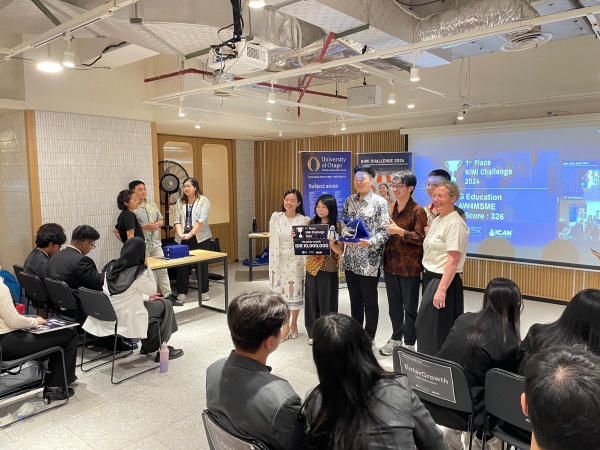
LAW4MSME High school winner - ENZ market manager Naluri Bella and University of Otago Regional Market Manager Sarah Ewing present the award for First Place in the University category to team members from USG Education for their platform “LAW4MSME’.
Explaining the group’s business idea, team leader for LAW4MSME, David Francis said the students found that Indonesian youth-led SMEs lack knowledge of the laws and regulations needed to run their businesses.
“To address this, we developed an AI bot that educates SME owners on these regulations, helping them navigate legal requirements more effectively,” David said.
The KIWI Challenge competition aims to inspire youth across Indonesia to engage in entrepreneurial activities and help resolve societal issues. Over the five years the competition has run, 1000 Indonesian youth have participated. This year, Education New Zealand Manapou ki te Ao (ENZ) partnered with University of Otago to co-host the initiative.
This year’s competition included 49 teams with a total of 221 student participants.
Mentorship key
Mentorship is a key element of the competition. The finalists attended a workshop run by Associate Professor Dr Conor O’Kane, Head of the Bachelor of Entrepreneurship programme at Otago Business School. This assisted entrants to develop their ideas and refine business plans.
ENZ Acting General Manager International Ben Burrowes said he’s delighted to see the continued development of the KIWI Challenge.
“Inviting university students for the first time has given us the opportunity to include a whole new cohort of talented young entrepreneurs, and we have been very impressed with the quality and creativity of their submissions,” Ben said.
“The competition has also benefitted from the enthusiasm and expertise of our colleagues at the University of Otago, and we are grateful for their willingness to partner with us for the KIWI challenge’s fifth year.”
Dr O’Kane said it was inspiring to witness the quality of entrepreneurial thinking among Indonesian students.
“These students have very bright futures. The concepts and programmes the finalists presented were remarkable and captured the impressive ability of the teams to identify tangible business problems and visualise and communicate a solution to these challenges,” Dr O’Kane said.
-
International Student Experience Survey 2023 now open
The International Student Experience Survey (ISES) surveys international students and alumni in Aotearoa New Zealand across all international education sub-sectors and at all stages of the student journey – from those who have just arrived in the country to those who have recently graduated.
The ISES aims to better understand the overall international student experience to identify what is being done well, and where improvements can be made.
It features insights and findings on nine, key aspects of the student experience journey –
- Decision making factors
- Study arrangements
- Arrival and orientation experience
- Education experience
- Living experience
- People and connections
- Value for money
- Work experience opportunities, and
- Future plans
The survey targets international students via multiple channels, with the student sample including those on current student visas, post-study work visas, and those post study, but not currently on a work visa. To maximise uptake, ENZ has also engaged with sector peak bodies and education providers to distribute the survey to their students.
Findings from previous surveys have informed ENZ’s Student Experience work, including the development of bespoke content on NauMai NZ that better serves international student needs, shaped student experience-focused outreach across government and informed partnership with community organisations.
ENZ’s Student Experience Manager, Ross Crosson said that the ISES provides a rich data source to understand the student experience.
“Research-informed findings must inform all our mahi. This survey helps us better understand our students’ experience living and studying in New Zealand, which can be used to inform decisions to improve that experience,” Ross said.
“We look forward to sharing survey findings with the sector, and discussing those findings with them, later this year."
-
NZIEC coming soon – mark your diary now!
It will be free to attend.
The theme for NZIEC 2022 is Towards Recovery: Reflect, Reconnect, Renew.
Covid-19 has had a huge impact on the international education sector. In our first conference since 2019, we will look back at the past two years, and look forward to what we have to offer to the world.
NZIEC 2022 will focus on the sector’s recovery journey and, as the theme suggests, encourage us to: Reflect, Reconnect and Renew.
- Reflect – on what has been a crazy two years. An opportunity for us to share the tough stories, what we learned, how we pivoted, the good stuff we did.
- Reconnect – with each other and with the wider world. Be stimulated by international speakers in offshore markets and hear the latest in trends, shifts and dynamics.
- Renew – building back better for a stronger future. Gain inspiration and embrace innovation so we continue to ThinkNew.
By Reflecting, Reconnecting and Renewing, NZIEC 2022 will help our sector build Towards Recovery.
To ensure we reach the widest possible audience at a critical time for the rebuild of the industry, NZIEC 2022 will be delivered in a virtual format, at no cost to attendees. The virtual format also enables us to connect with a wide range of international speakers and deliver sessions for specific sub-sectors that attendees can opt in or out of. Sessions will be recorded and will be available to registered attendees who cannot attend the original time of the session.
Programme highlights
This year’s NZIEC programme takes a leaf out of the successful New Zealand Partners Workshop Week held in 2021, which connected over 3,000 attendees in sessions spread over the course of the week.
While further details on the programme will be released in July, you can expect the following:
- Conference opening on Monday morning
- Ministerial address
- International speakers
- Industry speakers
- Updates on global market trends and developments
- Market-focused sessions
- Virtual networking opportunities
- Government agency updates
- Conference closing on Friday.
Keep an eye out
Soon we’ll be launching our call for speakers. We’re keen to hear from practitioners right across the sector, so put your thinking cap on if you are interested in presenting – or suggest that a colleague does the same. Further details will be made available in the coming weeks, but if you have an idea for a session, please don’t hesitate to email us: NZIEC@enz.govt.nz
We are also developing a te reo Māori ingoa (Māori name) for NZIEC and look forward to sharing that with you soon.
Registration for NZIEC 2022 will open in July.
Format in future years
The decision to opt for a virtual format this year reflects feedback from our survey of previous and potential conference attendees to find out their levels of interest in attending NZIEC in person this year. While some were keen to gather in person, many more were hesitant to do so due to the cost of attending and concerns regarding Covid-19.
Subject to Covid-19 settings, we plan to resume in-person formats for NZIEC in future years.
-
Sharing our stories about international education
As we prepare for more international students to return to New Zealand, we want to ensure these important guests feel welcome and appreciated by Kiwis. Each time students arrive on our shores, we have a moment to spotlight why international education is great for our communities and the country.
We’ve recently added some new case studies to our Skills Lab website - read more about a successful storytelling example from Hawke’s Bay here.
Many great stories come from the compelling research projects being led by international students in New Zealand. These stories align with our story framework by highlighting how international education helps to shape global citizens and solve the world’s problems.
For example, Dr Htin Lin Aung, a researcher at the University of Otago, is conducting ground-breaking research on tuberculosis (TB), the world’s second-leading infectious killer after COVID-19. Read more about this case study of a newsworthy story about a scientific breakthrough here.
Stories of international education in your organisation, school or region do not have to be serious or complicated. Often, the most intriguing news stories are of everyday people doing good in their communities.
We refer to these as “soft-news” stories, as they are underpinned by a human-interest angle. You can successfully land these stories if you make sure to include the key elements that make up a news story. You can read about how Learning Hawke’s Bay landed a positive story about international education here.
Stories can often have a strong local flavour, which is appealing for local media channels.
This case study will explain how Tauranga’s economic development agency Priority One planned three news stories within the space of a month, a strong example of how a series of stories can quickly build momentum and newsworthiness at a local level. You can read more about this case study here.
If you haven’t used Skills Lab or Brand Lab before, you can sign in through MaiENZ here.
Download Communicating the benefits of international education – a toolkit from Brand Lab.
Latest case studies on Skills Lab:
- Social Licence: Determining a link to Education New Zealand’s new social licence narrative https://skillslab.enz.govt.nz/case-studies/social-licence/
- Social Licence: Developing newsworthy stories about scientific breakthroughs https://skillslab.enz.govt.nz/case-studies/social-licence-scientific/
- Social Licence: Getting feel-good stories on the front page https://skillslab.enz.govt.nz/case-studies/social-licence-feelgood/
- Social Licence: Crafting a story that resonates at a regional level https://skillslab.enz.govt.nz/case-studies/social-licence-regional-level/
- 1000003961
- sister cities pic edited2