Search
Showing 10 of 7355 results
-
Exploring a vision for the ‘Future of International Education’ in Aotearoa
It was an action-packed week in Wellington for Emeritus Professor Bean and his business partner Helen Souness. They were invited to Wellington by Education New Zealand Manapou ki te Ao (ENZ) to facilitate discussions on what the future may look like for Aotearoa New Zealand’s international education sector.
Professor Bean is former Vice Chancellor of The Open University in the United Kingdom and RMIT University in Australia, and is now CEO of the Bean Centre. Along with his business partner Helen Souness, former CEO of RMIT Online, they partner with education experts, education providers and technology companies to shape an education future that works for the rapidly evolving needs of learners, and the evolving landscape of work they will eventually be part of.
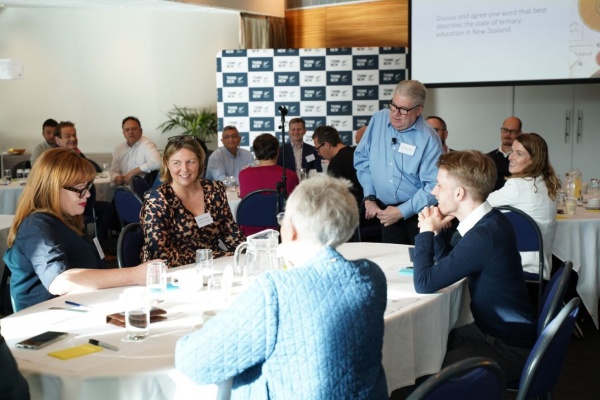
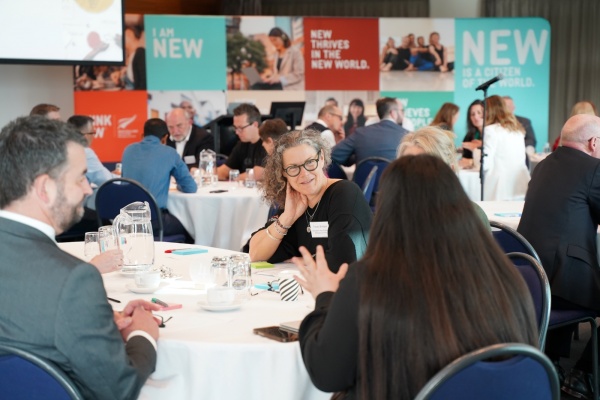
On Tuesday 1 August, ENZ hosted a cross-section of representatives from our international education partners in government, industry and tertiary education institutions at a full-day workshop. The aim of the workshop was to bring together our sector and collectively explore a vision for the future of international education in Aotearoa New Zealand. This work is a key part of Focus Area 2 of the New Zealand International Education Strategy 2022-2030 (NZIES) and how we can diversify our educational products and services and modes of delivery to create a more sustainable and resilient future.
ENZ’s Chief Executive Grant McPherson opened the event and said that it was a privilege to host experts in the field of international education and have them share their knowledge and experience on what is disrupting the world of tertiary and international education globally and what other countries are doing in the face of these challenges.
''I would like to thank everyone that came along with such energy and great ideas. It was a fantastic day and the collaboration between government, industry, and the education sector served to generate some inspiring ideas on how, as a country, we can innovate and differentiate our international education sector to remain competitive on the world stage.
''This is especially important work given the challenges that the international education sector is facing not just in Aotearoa but also around the globe. Professor Bean and Helen Souness really inspired us to think about the future of our sector from the point of view those around us including learners, communities, and industry, in the face of these challenges’’, said Grant.
Professor Martin Bean and Helen Souness had this to say about the 1 August workshop.
YouTube YouTubeProfessor Bean also said “I was delighted to participate in a week of deep thinking as we collectively imagined a brighter future for New Zealand’s international education sector.
“It’s clear that the world of work and tertiary education is changing rapidly and it’s great to see that colleagues in New Zealand are determined to meet the challenges and build a strategy to thrive in turbulent times”.
Another highlight of the day included a presentation from social innovators Hinepounamu Apanui-Barr and Briana Te Haara-Barr on the work that Tokona te Raki: Māori Futures Collective is doing in finding indigenous solutions to global challenges. Their case study and discussion provided valuable input to the day as we then discussed Aotearoa’s unique value proposition.
ENZ’s Sector Engagement General Manager Wendy Kerr, whose team is leading the work involved with Focus Area 2 of the NZIES, said that in the days following the workshop, the ENZ innovation team met with our international education agency partners to reflect on the discussions and wonderful ideas that were brought to the table during the day’s workshop.
“It’s not often we get a chance to shape the future and this week has proved a valuable foundation for many in our sector to contribute to the course of the future of international education for Aotearoa. And what an exciting privilege that is.
She added, ''Now the hard work really begins, and ENZ will be leading the development of a green paper that will be the basis for consultation with our international education partners including government, education providers, industry, iwi, the wider community, and of course, our learners. Watch this space for the exciting developments to come!’’
-
Latest insights on international education
The Insight Story March 2022 is the latest snapshot of international education from Education New Zealand Manapou ki te Ao.
This fourth issue includes research, insights and trends on:
• our top source markets
• other English-speaking international student destinations
• student visa numbers
• international student experiences
• transitions from secondary to tertiary study in four priority Asian markets.
Do you know, for example, which countries are most interested in our Study with New Zealand website?
Or how students from Japan rate the value for money and cost of living in New Zealand, and their overall experience here?
Or which nationalities have the highest number of student visas granted in other English-speaking international education markets?
Or how positively international students rate their experience in New Zealand, and how international student experience at New Zealand universities compares with the global benchmark?
To find the answers to these questions and more, read The Insight Story and sign up for future issues, on the IntelliLab website.
-
Education New Zealand’s Brand Protect our most successful brand campaigns to date
Both campaigns exceeded previous ENZ results and were well above industry standards. These results, alongside the brand tracking research, have affirmed that global appetite for a New Zealand education remains high.
“We have learnt that our message resonates globally with people who are now seeing New Zealand in a whole new light,” ENZ Director Brand, Clayton Foster, says.
The second brand protect campaign – also known as Brand Protect 2.0 – ran from November to December 2020. It targeted the UK, Vietnam and Indonesia, and utilised the same video as the first campaign.
Brand Protect 2.0 reached 47 million people and achieved a high view through rate of 33.79 percent – or one in three viewers watched the video to a meaningful extent. The overall engagement rate was also high at 29.42 percent.
The first global brand campaign ran from July to August 2020. For a modest investment of $190,000 in Germany, Indonesia and Brazil, this campaign reached more than 30 million people across the three key markets and achieved an engagement rate of 22.35 percent. One in four people who came across this campaign watched the video to a meaningful extent.
The Brand Protect campaigns are a key part of the Recovery Plan’s third workstream, ‘Transforming to a more sustainable future state’. They leverage the positive global sentiment towards New Zealand to keep the dream of a New Zealand education alive in-market.
-
ENZ confirms 2021 Recognised Agencies
Education agents play a crucial role in New Zealand's international education ecosystem, including supporting students and their families during COVID-19.
ENZ’s recognised agent (ENZRA) programme aims to increase engagement with quality education agencies that have demonstrated a long-term commitment to promoting New Zealand as an international study destination.
More than ever, ENZ Recognised Agencies contribute to a unique and high-quality student experience and to the positioning, market share and overall achievement of New Zealand within the international education sector.
To acknowledge the impacts of COVID-19 on agents and their inability to place students with education providers in New Zealand, all current Recognised Agencies were provided an opportunity to extend their time in the programme subject to meeting conduct requirements.
The new list of ENZ Recognised Agencies is now available to view online on our StudywithNewZealand website. For queries regarding education agents, please email: agenthelp@enz.govt.nz.
The next round of applications to the programme will open in early 2022.

- PMSLA Universidad de La Sabana2
- PMSLA 16 17R1 list for website2
- Whitecliffe group
-
Winds of Change students team up to tackle shared climate challenges
While world leaders continue to discuss how to best tackle global warming, an inspiring group of students is stepping up collaboration between New Zealand and Chile to better understand the problems both countries face, share knowledge, and identify solutions.
The Winds of Change programme, funded by the Latin America Centre of Asia-Pacific Excellence (LatAm CAPE) and hosted by Otago University, is taking a broad approach by drawing in post-graduate students from a range of backgrounds including natural, physical or social science, business, finance, science communication, and humanities.
They are motivated to tackle climate change by developing sustainable strategies in land management, business, and policy-making. Supporting them is a team of talented academics from both countries whose insight and expertise are helping to create impact.
“The Winds of Change participants are extraordinary leaders from diverse backgrounds with a passion for making a difference,” says lead Otago academic Associate Professor Chris Moy.
“Their collaborative work will help inspire communities and drive change.”
Joining forces to reach common goals
Project manager Hélène Eunson says the multi-disciplinary approach is vital. “It is one of the key features and strengths of the programme. We need people who bring a range of perspectives in addressing climate change issues,” she says.
“We have come to realise that the scientists want to learn more about business and policy-making, and the policy-makers want to learn more about the science. We are trying to join forces to reach our common goals.”
Now in its second year, Ms Eunson says there has been huge interest in the six-month programme, which seeks to attract 30 students in each cohort - 10 New Zealanders based in New Zealand, 10 Chilean students based in New Zealand (“Chiwis”), and 10 Chileans based in Chile.
“These young leaders have a real drive to make a change. They volunteer their time and do not earn credits towards their degrees.”
The participants work in small groups on projects based on common interest, to investigate an aspect of climate change, its impact on the environment and communities, and to identify solutions. Their findings are presented at an annual symposium attended by key industry players, researchers, embassy representatives, and past participants.
The Winds of Change programme includes a series of workshops hosted by a range of expert speakers from both countries including business owners, industry experts, and academics studying climate change.
Pacific partners help shape future solutions
By studying the common climate change impacts that New Zealand and Chile are facing, the students are not only helping to shape future solutions, but also to build relationships with a key Pacific partner and enhance economic and social wellbeing in both countries.
Projects undertaken by the participants have tackled wide-ranging issues including wetland restoration, wildfires, water scarcity, rising sea levels, diversity in agriculture, and renewable energies.
Ms Eunson says the concept of global citizenship is a strong theme which runs through the programme. “The participants share experiences from their own countries and help to create bonds with each other by bringing their different perspectives to the table.”
Being involved in the programme has been a profound experience for many of the participants.
“Often, if you think as an individual about environmental issues, you don’t feel as though you can achieve much, but when you see all these people together with the same objective, you feel really powerful to make change,” says Julia Harvey, who grew up in Invercargill.
“Meeting people from different backgrounds with a common interest has provided a unique opportunity to learn about sustainability in both countries,” says Javiera Otero, originally from Villa Alemana, Chile, but currently living in Napier.
“This experience has given me hope for the future, as there are people out there who want to make changes to live a more compatible life with the planet.”
Winds of Change programme builds credibility and impact
Winds of Change is quickly building its network and outreach. “As we build the credibility of the programme, we will start to see long-term impacts,” Ms Eunson predicts.
This new generation of leaders is already anticipating a future of global collaboration. In last year’s first post-programme survey, participants identified the most important benefits as “building networks, connections, and relationships”, and “having confidence to work in a transnational team”.
LatAm CAPE Director Matthew O’Meagher says he looks forward to the ongoing expansion of the programme to include other partners, and ideally other nations in Latin America. “In this way we can continue to provide the best opportunities for our talented young New Zealanders to engage internationally on innovative scientific, sustainable business, and policy-focused, solutions to climate change.”
Dr Moy agrees. “Our future depends on culturally-aware young leaders that can think globally and work collaboratively to tackle climate change impacts.”
Learn more about the Winds of Change programme on the LatAm CAPE website.
-
New AgentLab platform launched to support education agents
Launched in early August, the new platform features a wide range of relevant information and updates to support education agents and consultants promoting study with Aotearoa New Zealand. This includes a calendar of agent-focused events and webinars, resources, and latest news and updates from across the Aotearoa New Zealand education landscape.
In 2022, Education New Zealand Manapou ki te Ao (ENZ) reviewed its agent engagement programme to ensure its offering for education agents is best placed to support the international education sector’s recovery.
ENZ commissioned Edified to research and evaluate its broad agent engagement programme as well as the ENZ Recognised Agency programme. Refreshing the AgentLab platform to offer agents a wider range of information about Aotearoa New Zealand education was among the recommendations of the Edified report.
ENZ’s Director – Sector Services, Laura Simpson, said the AgentLab platform’s refresh was guided by a need to better support all education agents, knowing the crucial role they play.
“We are developing the AgentLab platform with more tools and resources. We will continue to grow the platform to best serve all agents in their work to support students wanting to study with Aotearoa New Zealand. This helps us ensure that agents have access to accurate information, so they are best placed to drive international student recruitment and support the sector’s post-pandemic recovery.
“This is important work given our goal to grow onshore international student numbers. Rebuilding the sector to a thriving, resilient one is a major focus for Aotearoa New Zealand. We know that the relationship between education providers and agents is the primary one. So our job, set out clearly in Focus Area One of the International Education Strategy, is to make sure we support high-quality education agents in recruiting students to Aotearoa New Zealand and supporting the sector’s recovery,” Laura said.
The new AgentLab platform is hosted at the same address as the old site at agentlab.enz.govt.nz. It is easily accessed through the single sign-on, MaiENZ portal through which ENZ offers all its digital services to Aotearoa New Zealand’s international education sector. Existing AgentLab users will be able to seamlessly access the new site with their current MaiENZ logins.
The discontinuation of the ENZ Recognised Agencies (ENZRA) programme that was announced to the sector and education agents in July was also an outcome of the agent engagement review. All education agents – including former ENZRA agents – will be able to access the same level of information and resources via the AgentLab platform. The discontinuation of the ENZRA programme will not affect this.
-
Report from GHEDEX 2022
This year saw a welcome return to an in-person event, attracting good numbers of students and international education stakeholders. ENZ showcased New Zealand as an education partner for Oman during the “Quality in Higher Education” conference that took place alongside GHEDEX. While in Muscat, ENZ also hosted an event for Omani alumni of New Zealand universities. Twenty-eight attended, from seven universities, providing a useful networking opportunity.
Officials at GHEDEX confirmed that as our border is reopening, New Zealand is included in the just-released Omani Ministry of Higher Education’s 2022/23 handbook for scholarships. Feedback from education agents suggests that fewer scholarship students overall are expected this year.
Dr Nadia Kasto, New Zealand Academic Advisor for the Omani Consulate-General in Melbourne confirmed that from next year, all Omani scholarship students will be able to make their own decisions about the country and university that best suit their study needs.
“All universities have to work very hard to promote themselves to Omani students in order to get as many students as they can.”