Search
Showing 10 of 7355 results
-
A taste of New Zealand
Kicking off on 20 May, proceedings got underway with an invitation-only event, hosted by New Zealand’s Ambassador to the Philippines, David Strachan.
ENZ engaged a number of successful New Zealand alumni for media interviews and delivered a keynote presentation to a highly engaged crowd at the Glorietta Mall, Makati City venue.

The ENZ booth was particularly busy over the three days. A number of prospective students came prepared with specific questions, with many focusing on postgraduate study options.
The Experience NZ event also coincided with the celebration of 50 years of diplomatic ties between New Zealand and the Philippines.
This event was the latest in a series of in-market ENZ activities in the Philippines. It followed a successful agent seminar in Manila earlier this year.
A second agent seminar is being held in Cebu on 14 July and is now open for registration.

-
Empowering early career scientists through New Zealand-Germany research collaboration
The third funding round of the New Zealand-German academic exchange programme, known as the Programmes for Project-Related Personal Exchange (PPP programme), has enabled five New Zealand research projects to undertake research with academic partners from Germany.
The following universities have formed partnerships:
- University of Auckland and University of Paderborn
Topic: Preparing students for a data science future using innovative teaching - University of Auckland and the Technical University of Dortmund
Topic: The development of contextual visual processing in the Ebbinghaus: illusion in children and its underlying neuronal basis (EBBI-KIDS) - University of Auckland and University Medical Centre Hamburg-Eppendorf
Topic: Perspectives of equitable medical education: a comparison between Aotearoa New Zealand and Germany - University of Canterbury and Westcoast University of Applied Sciences
Topic: Younger generations as reflexive agents of change: Motivating Generation (Gen) Z to participate in the voluntary sector - University of Otago and Helmholtz Munich
Topic: Modulation of central GIPR signalling to increase health during ageing
The programme invited researchers to think of a project that would particularly benefit from working with German academic counterparts. Research projects will run from 2025 to 2026, with work taking place in both New Zealand and Germany.
Acting Regional Director, Americas & Europe, Natalie Lulia, said the programme aims to strengthen the relationships between New Zealand and German academics and institutions.
“It opens up New Zealand researchers to a global network of academics.
“Since the programme’s beginning, we’ve seen awardees think forward and explore possibilities of further collaboration with their research partners” she said.
The PPP programme was established in 2021, when ENZ and the German Academic Exchange Service (DAAD) signed a Memorandum of Understanding.
The bilateral agreement between ENZ and the DAAD enables young academics to further their careers and expand their international research links. ENZ contributes funding to support New Zealand researchers, while the DAAD supports German researchers to travel to New Zealand.
Find out more about the PPP programme by visiting the dedicated page on our website.
You can also contact Olga Elli, Associate Director of Engagement, Europe at europe@enz.govt.nz.
- University of Auckland and University of Paderborn
- Audrey
-
Survey shows that New Zealand is among top destinations for Brazilians who study abroad
Belta’s annual survey, sponsored by Education New Zealand Manapou ki te Ao (ENZ), was conducted between December 2022 and April 2023 with 763 students and 317 international education agents from all regions of Brazil surveyed to assess their perceptions of international education. The survey results were shared at a recent event in Sao Paolo with dozens of agents and media attending, in person and virtually, to hear about the survey’s latest findings.
ENZ’s Market Development Manager in Brazil, Bruna de Natale, delivered a short speech ahead of the results release. She said it was positive to see so much interest in the release of the survey results, especially when the results revealed that New Zealand continues to rank strongly as an international education destination amongst Brazilian students.
“In this most recent survey, New Zealand moved to seventh position on the list of top education destinations sought by Brazilians who studied abroad, compared to before the Covid-19 pandemic when it was in eighth place. The main reason driving country choice for the students surveyed is the quality of life – New Zealand ranks very well for the quality of life, education, and the protection of civil rights.
“The quality of teaching is another reason given by those surveyed when choosing New Zealand and 60% of participants rated the quality of our English schools and language programmes as good or excellent. It is fantastic to see that New Zealand continues to attract attention as a quality international education destination and it is certainly on the radar as a desired destination for future exchange students,” said Bruna.
Of the international education agents who were surveyed, 52.9% reported that the demand for students interested in New Zealand has remained stable since the borders reopened, while 20.6% recorded growth in interest. This group projects that the numbers of Brazilian students travelling to New Zealand will return to pre-pandemic levels in 2023 and 2024, with the highest flows expected for the first (35.3%) and second quarters of 2024 (32.4%), with demand increasing gradually from the first quarter of 2023.
For a copy of the full survey in English, please email belta@belta.org.br.

Bruna delivering an introductory speech at an event which released the results from Belta’s survey on international education.
-
Talented young Kiwis awarded PM’s Scholarships to Asia and Latin America
This round of scholarships supports 252 recent graduates or current students to undertake study, research or internships at institutions in Latin America and Asia, including Brazil, Mexico, China, India and Japan.
Awardees are in a range of fields including languages, law, business, health, sustainability and the arts. They will attend for periods ranging from four weeks to one year.
The scholarships enable a wide range of educational experiences, including: a cultural exchange and internship programme for Māori and Pasifika graduates in Vietnam; a global business and innovation programme at the Chinese University of Hong Kong in Shenzhen, China, for a group of undergraduate business students; an internship with an Indian charity supporting street children and another with the United Nations Office for Sustainable Development in Korea.
‘’These scholarships enable talented young New Zealanders to enrich their education offshore, adding international experience and global perspectives to their qualifications,’’ Chris Hipkins said.
“The quality of the awardees, from all over New Zealand and from a wide range of tertiary institutions, is impressive. I am sure they will serve as excellent ambassadors for our country.
‘’Longer term, the international networks and cross-cultural skills that they bring back home will enhance and strengthen our future workforce. Their experiences benefit New Zealand at a national level and improve our ability to engage and connect with Asia and Latin America.
‘’The Prime Minister’s Scholarships support the Government’s goal of a thriving and globally connected New Zealand through world-class international education,” Chris Hipkins said.
Of the successful applicants in this round, 114 will travel on an individual scholarship and 138 will travel as part of a group. They come from a range of tertiary institutions nationwide, including the University of Auckland (69 awardees); Victoria University of Wellington (41); Massey University (40); Whitecliffe College of Arts and Design (16) and the Southern Institute of Technology (nine). There are also 10 recipients from the education NGO, TupuToa.
Here is the full list of PMSA and PMSLA recipients from this round (2019-2020 Round One).
The total value of the scholarships offered in this round is $1.9m. Information on past PMSA and PMSLA recipients can be found here.
- ChCh conf photo
-
New Zealand well represented at the 2024 World Digital Education Conference
The 2024 World Digital Education Conference, attended by representatives from over 70 countries and regions as well as international organisations, aims to work with governments, the education sector, and stakeholders to jointly implement the outcomes of the United Nations Transforming Education Summit, promote education recovery post-pandemic, equitable quality education through digital education transformation, and advance the realisation of the Sustainable Development Goals (SDGs).
Chinese Education Minister Huai Jinpeng provided the keynote speech at the opening ceremony. He noted the impact of technology on education and the need to prioritise education reform to keep pace with changes and harness the benefits of digital education. Minister Huai concluded by saying they look forward to the new impetus into promoting international cooperation in digital education through this conference.
New Zealand was represented by Minister of Education, Hon Erica Stanford (through a pre-recorded session); H.E. Grahame Morton, New Zealand Ambassador to People’s Republic of China; Ardi Barnard, New Zealand Consul-General to Shanghai; Dr Grant Klinkum, Chief Executive New Zealand Qualifications Authority and Education New Zealand’s China-based representatives. The strong presence at the conference contributes to New Zealand’s reputation as an education partner with an innovative approach to digital learning. New Zealand Education Minister Hon Erica Stanford gave a video address and shared New Zealand’s efforts to harness digitalisation to improve our education system and support lifelong learning.
“As an education minister with a relentless focus on the progress and achievement of all students, I see that digital tools and the well-designed use of data have enormous potential to help us drive progress and achievement,” said Minister Stanford.

Hon Erica Stanford, New Zealand’s Minister of Education delivered a pre-recorded session, sharing New Zealand’s efforts to harness digitalisation and data in education.
In his address at the Opening Ceremony, Ambassador Morton highlighted the important role of education in the New Zealand-China relationship and gave insights into New Zealand’s innovative EdTech sector.
“Digital education is at the centre of New Zealand’s EdTech sector and its developments. Three-quarters of New Zealand EdTech companies are actively looking to take their offerings to the world,” said Ambassador Morton.
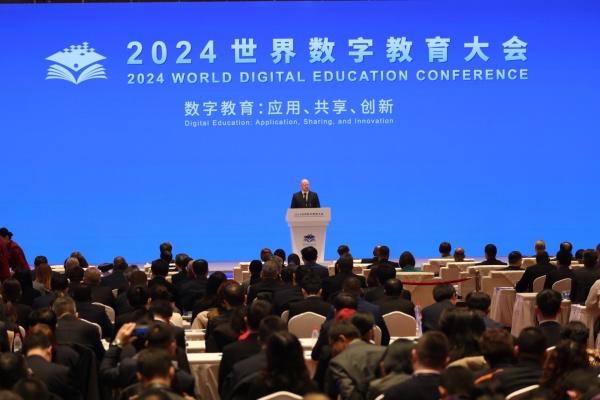
Ambassador Morton addresses the audience during the Opening Ceremony of the conference.
During the Parallel Session on Governance and Digital Transformation, Dr Klinkum shared New Zealand’s experience in quality assurance, qualification recognition and assessment delivery in the digital era.
“We would like to continue working with our international colleagues to ensure that we provide credible education for learners and that life-long learning and global mobility is supported by digital education and reflects the needs of increasingly digital societies,” said Dr Klinkum.
During the conference, organisers held the inaugural launch ceremony of the World Digital Education Alliance (WDEA). Universities New Zealand, on behalf of the University sector, joined the Alliance. The first batch of members is by invitation and as of 30 January 2024, 104 agencies from 41 countries joined the alliance ranging from schools to Technical and Vocational Education and Training (TVET) institutions, training centres, colleges and universities as well as research institutions and enterprises. The initiative aims to fulfil the UN SDG 4, build a mechanism for international cooperation and exchange in digital education, form synergy to promote global educational development, and create a new environment for smart education.
- InSiNZ card
-
Magazine opportunity in Japan
Japanese magazine producer Tomorrow Inc. is starting production on volume two of the Study in New Zealand magazine. The magazine is a comprehensive guide to study options across all sectors of the New Zealand education system – from early childhood through to tertiary education, and including English language schools.
The magazine is produced with the support of ENZ, Tourism New Zealand and Air New Zealand. As well as informing people about our education system and institutions, Study in New Zealand is designed to pique readers’ interest in the New Zealand experience as a whole – our education, lifestyle and culture.
The magazine will be published in October 2016, when it will be available in bookstores throughout Japan and Thailand for around $13NZD. Both the Japanese and Thai editions will have a circulation of 10,000 copies each, and will be distributed at education fairs and to Japanese institutions and education agencies.
Study in New Zealand is also available online as an interactive web portal and all institutions and agencies advertising in the magazine will be featured on the web. Advertisers can choose to advertise in either Japan or Thailand, and discounts are available for those who choose to advertise in both editions.
The rate for a full page advertisement in Study in New Zealand is around $2600 NZD, with a variety of other options available. Sample pages form the 2015 addition can be viewed here.
The deadline for bookings is 15 July 2016.
Those interested in finding out more about this promotional opportunity can contact either Fridrik Juliusson or Tom Amano. Fridrik and Tom will be in New Zealand from 29 May to 6 June, visiting institutions around New Zealand. Please contact them if you’d like to set up an appointment or a visit to your institution.
- Matt Penney 2 2