Search
Showing 10 of 7355 results
-
Christchurch takes education to China
Karen Haigh, ChristchurchNZ Market Project Manager, said the event series was possible due to the highly collaborative way that Canterbury education providers work together.
“Collaborating offshore enables us to present the pathway opportunities for students, and highlight the lifestyle opportunities that make the study experience in Canterbury unique,” she said.
The collaboration continued within ChristchurchNZ, the new city promotion agency that brings together economic development, tourism, major events and international education. For the first time since coming together, the ChristchurchNZ International Education and Tourism teams decided to work together offshore, promoting Christchurch tourism alongside study opportunities.
ChristchurchNZ’s tourism goal for 2025 is to prioritise stronger relationships with export education to better leverage the reciprocal benefits, and increase value for both sectors.
Alistair Crozier, New Zealand Consul-General in Chengdu, said the collaboration between the tourism and education sectors was a no-brainer.
“The inclusion of a tourism element shows that education promotion can be more effective with cross-sectoral synergies, and that raising visitor profile is a key part of student attraction.”
The delegation took part in the ‘Experience Christchurch: New Zealand Education Expo’ in Chengdu, which was part of the New Zealand Consulate’s first ever ‘New Zealand month’ in Sichuan. The event was supported by the Sichuan provincial government education department, which Christchurch Educated has had a growing relationship with since signing a memorandum of understanding in 2014.

Christchurch delegates with invite agents at the ‘New Agent seminar’ at the New Zealand Consulate in Guangzhou.
More than 250 Chinese junior high school students and parents attended, along with the University of Canterbury, Ara Institute of Canterbury and a number of schools.
Karen said the event included interactive introductions to New Zealand and the New Zealand education system, as well as a workshop on ‘Maximising opportunities through international study’ and demonstrations of New Zealand classes.
“The focus was on getting the students to really experience New Zealand education through lots of interaction and participation,” she said.
Alistair said the event, which finished with a fair-style session where students could meet providers and find out more about their institutions, was an excellent showcase of New Zealand education.
“The format, delivery and experience was highly innovative and engaging. The interactive activities, including the classroom sessions, gave students great exposure to New Zealand culture and learning.”
The delegation also held a ‘new agent’ seminar and speed-dating event in Guangzhou, as well as Canterbury Agent Awards luncheons and dinners for the region’s priority agents in Chengdu, Shanghai and Guangzhou.
These events were supported by ENZ representatives Adele Bryant and Felix Ye, and Consulate-General representatives Alistair Crozier, Michael Zhang, Megan Birnie and Rachael Maidment.

Christchurch delegates with invited agents at the ‘New Agent seminar’ at the New Zealand Consulate in Guangzhou.
- Card for website Industry Futures
- Insights Accelerator Learn New Every Day
- Weltec IT Award recipients 2EDIT
- Japan New Zealand education ties strengthen with growing collaboration3
- card 1 welcome chch4
- Grant speaking2
-
Insights for PTEs & ELS on how to better attract students from China
In June, participants from Private Training Establishments (PTEs) and English Language Schools (ELS) in New Zealand were invited by Education New Zealand Manapou ki te Ao (ENZ) and the North Asia Centre of Asia-Pacific Excellence (CAPE) to attend a workshop looking at opportunities in China. The workshop was called “"Navigating the new dynamics of Chinese overseas students seeking to study with PTEs and English Language Schools."
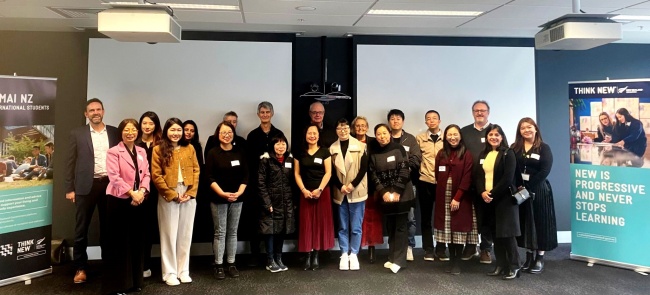
Participants from PTEs and ELS at the June workshop co-hosted by ENZ and North Asia CAPE.
Following the conclusion of the workshop, a report was commissioned by North Asia CAPE and facilitated by ENZ, with Shanghai-based market research company China Skinny conducting an in-depth exploration of key topics discussed during the event.
The report, ‘Insights for New Zealand’s English Language Schools and PTEs to better attract Chinese students’, was launched at an event at ENZ’s Auckland office in September with participants from PTEs and ELS. Mark Tanner, founder and managing director of China Skinny presented the report putting a focus on:
-
Building awareness of your institutions with your Chinese target audience.
-
Considerations for PTEs and English language schools.
-
Examples of how other institutions are marketing to their target audiences in China, with an accompanying checklist.
Richard Kensington, Principal of Academic Relations at UP Education, attended both the workshop and the report launch.
He said, “These initiatives by ENZ provided useful insights into Chinese students considering overseas vocational education, including some we were not previously aware of.
"It also reminded us of the significant potential in China’s vocational education market. We need to explore new, innovative ways to recruit students, rather than just relying on traditional methods,” continued Richard.
The report is based on insights drawn from a survey of 700 vocational and language school considerers and interviews with eight education agents in China. A copy of the full report can be found here - Insights for NZ's ELS & PTEs to better attract Chinese students.pdf
-
-
Bringing Sunshine to a Beijing winter
The series was launched in Beijing on 3 November at a National Symposium on EFL Reading in Schools.
Some 900 teachers from across China attended the two-day symposium, which included a demonstration English class using the books.
Judy Stevenson, Educational Manager of Wendy Pye Publishing, and Adele Bryant, ENZ’s Regional Director for China & North Asia also attended, and were pleased by the response to the series.
“The teachers were very positive about using the books in their classrooms and could see that the emphasis on creative language would be more engaging for their students,” said Judy.

Professor Wang Qiang, Director of the Centre for Foreign Language Education and Teacher Education at Beijing University endorses Sunshine Books at the China launch.
“Students are encouraged to use their imaginations and have fun with language in a way which is new for Chinese education.”
Adele said ENZ had supported Wendy Pye Publishing to pursue these export opportunities through an export growth programme, administered by the Publishers Association of New Zealand.
“Breaking into the huge educational publishing market of China is a milestone for a New Zealand publisher and comes after many years of commitment by Dame Wendy Pye and her team to developing the relationship with FLTRP,” said Adele.
The collaboration will see the Sunshine readers’ and teachers’ notes marketed to junior high schools throughout China.
- Helen with AUT alumni2