Search
Showing 10 of 7355 results
-
Tune in to hear about the FY 2023 student enrolment data
The full year 2013 – 2023 international student enrolment data provided by the Ministry of Education is now available on ENZ’s Tableau Public site. Anyone can access this data and filters which is presented in interactive downloadable dashboards and data tables. ENZ’s media release on the data can be found on our website here.
Marie Clark, ENZ’s Director Insights will be running two sessions for anyone interested in learning more about these numbers. You will hear insights including how subsectors have grown, how recovery has been distributed and our top source countries for total international student enrolments and variation by subsector.
You can register for the webinar which best works for your time zone via the links below. Recordings will also be made available on Intellilab after the sessions.
-
Thursday 25 July 2024 – 8am NZT - https://enz.zoom.us/webinar/register/WN_-VZ_JKXIQh6PhmNNPNRVUw
-
Thursday 25 July 2024 – 7pm NZT - https://enz.zoom.us/webinar/register/WN_dUfHYlP5TzSpCVDJ2cWBdg
If you have anything that you would like covered, please get in touch via insights@enz.govt.nz
-
-
Noteworthy education programme featured during Prime Minister’s Trade Mission to Japan
Hot on the heels of the Prime Minister’s Trade Mission to Southeast Asia in April, relationships with our partner countries in the region continued to be strengthened for the benefit of the education sector during New Zealand’s most recent trade mission to Japan. This mission supported export sectors, including education, to engage with the Japan market and leverage emerging opportunities while advancing the New Zealand brand. The inclusion of education in the high-level visit acknowledges its contribution to the government’s ambition to lift the value of exports.
The strong people-to-people links between New Zealand and Japan are noteworthy with high student mobility in both directions. Japan is the third largest source of international students for New Zealand according to 2023 international student enrolment data with the school sector making up the largest proportion of enrolments. Japan is also a top destination for New Zealand scholars with many joining the Japan Exchange and Teaching (JET) programme and in the most recent Prime Minister’s Scholarship for Asia group announcement, three groups were awarded scholarships for programmes in Japan.
The international education sector was represented by two delegates nominated by ENZ to participate in the full business delegation. Cheryl de la Rey, Vice-Chancellor University of Canterbury, attended as Chair of the Vice-Chancellor’s Committee on behalf of the wider university sector and John van der Zwan, Executive Director, Schools International Education Business Association (SIEBA). Unfortunately, John had to withdraw due to illness.
The education programme elements woven into the high-level visit included a Memorandum of Understanding (MoU) signing, a visit by Mrs Amanda Luxon to a local Japanese school, and scholarship students participating in the New Zealand Sports and Business Leadership luncheon.
MoU between Massey University and a group of all-girls secondary schools
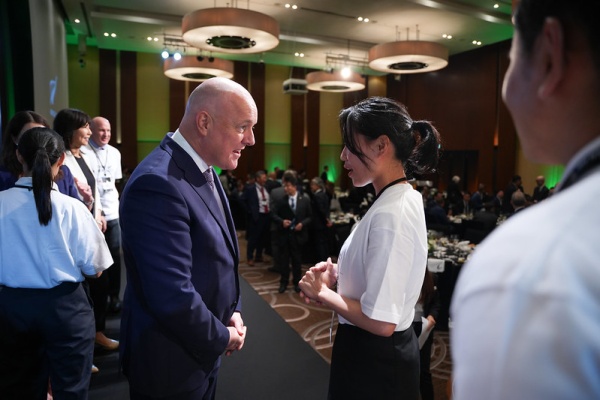
The Prime Minister promoted awareness of New Zealand’s world-leading universities among high schools in Japan through witnessing the signing of an MoU between Massey University and six all-girls secondary schools in Japan.

Prime Minister Christopher Luxon witnessed the signing of the MoU between Massey University and six all-girls secondary schools in Japan.
The memorandum signing ceremony was held at the New Zealand Embassy in Japan on 18 June. The MoU will develop a special admission system, enabling Massey University’s foundation or bachelor’s programmes to accept outstanding students recommended by the principals of the Japanese high schools. Through this agreement, students who meet Massey University's English and academic requirements and receive a recommendation from their schools will be able to enrol in Massey University's bachelor's programmes. Students can graduate with a degree in three years from the time they start their studies.
Shelly Turner, Deputy Vice Chancellor represented Massey University in Tokyo at the MoU signing and said at the signing “Te Kunenga ki Pūrehuroa Massey University has a long-standing relationship with Japan, reflecting our commitment to fostering international education and cultural exchange, and more recently we have seen a growing interest in our full degree programmes.
“We are dedicated to providing comprehensive support to ensure our Japanese students thrive academically and personally. We recognise the crucial role of women and girls in tertiary education and are committed to empowering them to achieve their full potential during their studies, and transition to successful careers,” said Shelly.
The Japanese school Principals, including Japan Women’s University Senior High School Principal, Yumi Susuki also welcomed the new partnership.
“For the past 30 years, our school has deepened its understanding of New Zealand culture and society through language training programs in New Zealand. With the 2022 agreement between Education New Zealand and our school, and now the new special admission system with Massey University, we hope to build even richer relationships and empower our students to shape their future,” said Yumi.
The Japanese schools that signed the agreement participated in the 'New Zealand Education Familiarisation Tour,' co-hosted by ENZ and Air New Zealand in March 2024. During the tour, they found a high level of compatibility with Massey’s educational philosophy, wide range of academic options, future-oriented learning environment, and extensive support for international students.
Homei Elementary School

Mrs Luxon with teachers and students at Homei Elementary School.
International education opportunities were also highlighted in a well-received visit Mrs Luxon made to Homei Elementary School on 19 June (affiliated to Japan Women’s University). It was Mrs Luxon's first trip to Japan and her school visit enhanced New Zealand's presence and reputation among all-girls' schools and universities in Japan.
In 2022, an Education Cooperation Arrangement between ENZ and Japan Women's University (JWU) and its affiliated schools including the Homei Elementary School was concluded to promote student and teacher exchange as well as gender equality and women’s empowerment.
From 2025, Homei Elementary School will send its first cohort of six graders (11-12 years old) to St. Margaret’s College for a short-term study and homestay experience.
Sports and Business Leadership Luncheon
The Sports and Business Leadership Luncheon held earlier in the programme on 17 June celebrated people-to-people connections and promoted New Zealand as an attractive study destination, including through the “Tobitate” scholarship programme.
The Tobitate programme, managed by Japan’s Ministry of Education, Culture, Sports, Science and Technology (MEXT), sends students abroad and New Zealand has welcomed many students as part of this initiative. Ten Tobitate Alumni were invited by ENZ to attend the lunch in support of the New Zealand – Japan sporting ties and to promote education opportunities in New Zealand to the Japanese audience.
The Prime Minister’s remarks during the event celebrated ten years of the Game on English programme (which combines rugby and study in New Zealand for Japanese high school students), highlighted Fonterra’s contribution to its success, and announced Air New Zealand as a new sponsor.
Upcoming Events in Japan for NZ education providers
ENZ’s Acting General Manager International and Regional Director Asia (excluding China), Ben Burrowes accompanied the delegation and said he is looking forward to the upcoming ENZ events in Japan.
“The team is preparing to welcome providers to Japan later this year for the New Zealand Fair and Agent Seminars from 6 to 8 October.
“The timing of Prime Minister Christopher Luxon’s recent visit to Japan couldn’t have been better. We will look to further leverage this focus by continuing our work with the sector to promote New Zealand’s education offerings with prospective students, families and education stakeholders in Japan.”
- covid 19 image
- Study with NZ 8 Landscape
- NZIEC day1 145
- Elle Archer
- ITP 2014 full year PDF
- gosocial1
-
NZIEC KI TUA commits to CANIE Accord
This will see the conference commit to taking urgent action to reduce greenhouse gas emissions and makes the conference part of a global network of international educators working toward that goal.
NZIEC KI TUA’s commitment to becoming a signatory to the CANIE Accord was announced at the closing plenary of NZIEC KI TUA 2023. Additionally, a piece of artwork created by the delegates during the two-day conference, demonstrating the sector’s commitment towards the United Nations Sustainable Development Goals, was presented to CANIE Oceania President Ainslie Moore and co-founder and a global board member of CANIE Dr Pii-Tuulia Nikula.
Signing the CANIE Accord means NZIEC KI TUA is committed to actions such as replacing printing and shipping marketing materials with digital marketing technologies, account for greenhouse gas emissions from attendees, and advocate for accelerated climate action within Signatory’s own organisation and with other stakeholders within their sphere of influence.
Learn more about New Zealand’s approach to sustainability and climate action in international education at NZIEC KI TUA 2024, register today: https://www.nziec.co.nz/registration
Check out the full programme here: https://www.nziec.co.nz/programme
You too, can become a signatory to the CANIE Accord, join the sector-wide initiative to commit to responsible stewardship of the planet and join the global network of international educators working toward that goal. It’s free to become a signatory, check this link.
-
Neuseeland still a popular destination for German High School students
Germany takes the number one spot in all of Europe for the number of international students it sends to New Zealand and the fourth largest in the world for sending high school students after China, Japan, and South Korea. In 2023, 1,417 German students were enrolled at high schools across New Zealand which represented 10% of the total number of school students in the country.
There are positive signs that this number will continue to increase in 2024. 82 high school students were recently farewelled by the New Zealand Ambassador to Germany, Craig Hawke, and Education New Zealand Manapou ki te Ao (ENZ’s) Associate Director of Engagement in Germany, Olga Elli at an event at Frankfurt Main Airport on Sunday 14 July.
The event was organised by Study Nelson, a Nelson-based education agency, that supports German students to find a high school in New Zealand, mainly in the Nelson-Marlborough area. The event was an opportunity for the students, aged between 14 and 19, to meet and engage with each other before they embark on their international study adventure. The students will spend between three and 18 months in New Zealand, depending on their programme and some plan to complete their NCEA Level 3 university entrance here.
One particularly excited member of the group included Emely Soffel, the I AM NEW scholarship winner from 2019, who due to the pandemic, had to wait five years to make her New Zealand study abroad dream come true.
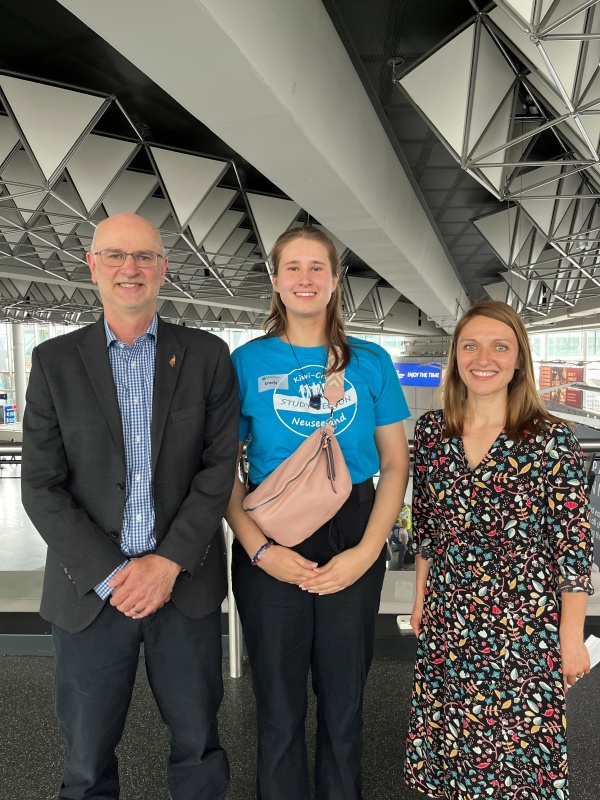
Ambassador Hawke with high school student Emely Soffel, the 2019 I AM NEW scholarship winner who was not able to travel during Covid. They are pictured here with ENZ’s Associate Director of Engagement in Germany, Olga Elli.
Olga said that Germany’s strong recovery in the high school subsector can be attributed to the experienced German agent network who have had long-standing and enduring relationships with high schools back in New Zealand.
“These agents have been building strong bridges between Germany and New Zealand for several years now, some for decades, and have made positive impacts for thousands of young people.
“They have such a deep understanding of the unique offerings that our high schools in New Zealand provide and are an invaluable service to students when trying to decide where to study,” said Olga
She added “German students love coming to New Zealand especially for the opportunity to try out subjects that aren’t typically offered at German high schools. Subjects like outdoor education, fashion design, marine biology, and food technology for example, are always really popular choices.
Ambassador Hawke mingled with the students and enjoyed hearing about their chosen schools in New Zealand. In his farewell speech to the group, he wished them a warm ‘Haere rā/farewell and said, “I invite you all to make the most of the excellent educational experience on offer in our country and also the opportunity to immerse yourself in our diverse culture. I hope you all become lifelong ambassadors for New Zealand.”
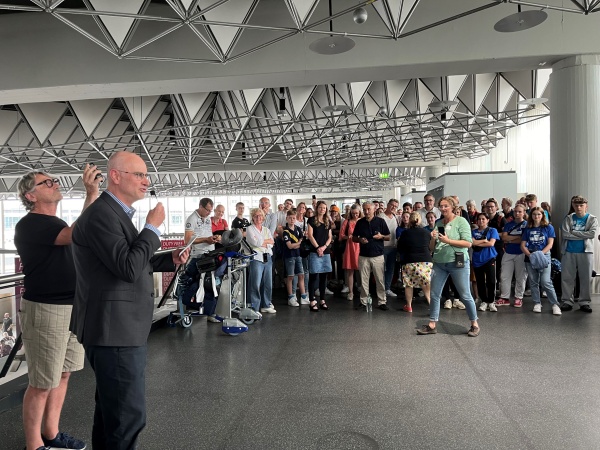
Ambassador Hawke farewells the students at Frankfurt Main Airport.