Search
Showing 10 of 7351 results
-
New ECA signed with US institution
Increased opportunities for students and researchers from diverse backgrounds to study and carry out research in New Zealand, and more international opportunities for Māori will result from the new agreement between the Louis Stokes Alliance for Minority Participation-National Science Foundation International Center of Excellence (LSAMP-NICE) and Education New Zealand Manapou ki te Ao (ENZ).
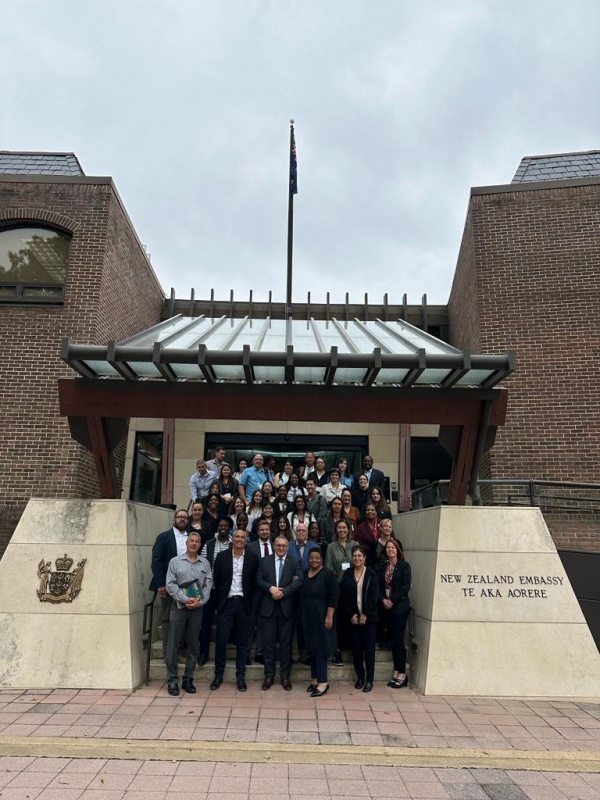
Attendees outside the Embassy of New Zealand in Washington DC, where the meeting was held
The Embassy of New Zealand in Washington DC was the venue for the annual general meeting and conference of LSAMP-NICE on 29-30 September 2022. Representatives of 60 LSAMP institutions across the US attended, as well as international partners including the University of Toulouse, the French Embassy, a Te Kāhui Amokura delegation, and ENZ. The role of Te Kāhui Amokura is to advance and promote the collective interests of New Zealand’s universities to improve outcomes for Māori, and the delegation comprised:
- Rawinia Higgins, Deputy Vice-Chancellor, Māori, at Victoria University of Wellington (VUW)
- Meegan Hall, Assistant Vice-Chancellor Mātauranga Māori, VUW
- Fiona Johnson-Bell, Senior Manager, Education and Māori, Universities New Zealand
- Tim Manukau, Mātauranga Co-Director, University of Waikato Environmental Research Institute
- Megan Ranapia, PhD student, University of Waikato
- Kirita-Rose Escott, PhD student, VUW.
ENZ Manukura Chief Advisor Māori, Ed Tuari, welcomed attendees with a mihi whakatau, and Lance Fisher (Northern Cheyenne) responded with a traditional Northern Cheyenne song. The meeting ended with the signing of the new agreement by Steve Dupuis, LSAMP-NICE Project Principal Investigator, Salish Kootenai College, and Ed Tuari on behalf of ENZ.
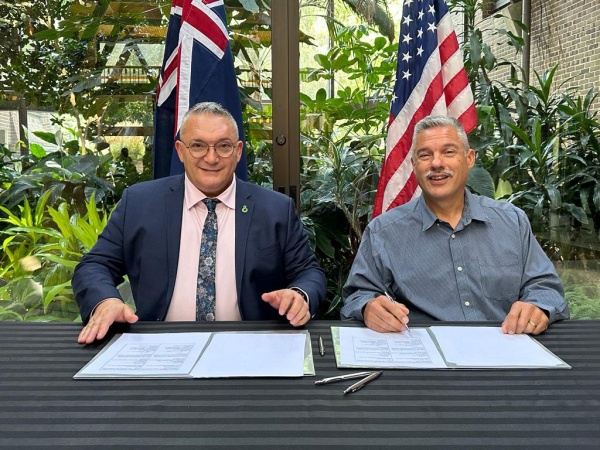
Ed Tuari and Steve Dupuis signed the education cooperation arrangement
“We are working to build people’s understanding of New Zealand as a country with a unique bicultural heritage and strong social justice values,” DuBois Jennings, ENZ’s Director of Engagement, North America said.
“The new agreement reflects that New Zealand is an ideal education destination for students from historically marginalised backgrounds, and it opens up exchange possibilities for Māori and Pasifika students from New Zealand to experience education on US campuses.
“We have been developing these relationships over several years, including at NAFSA earlier this year. Future possibilities include agreements between LSAMP-NICE and individual New Zealand providers.”
In late 2021 the National Science Foundation, Te Kāhui Amokura and ENZ worked together on a series of virtual information exchange sessions, which covered indigenous language research, indigenous data sovereignty, and the impacts of climate change on indigenous communities. More than 150 experts took part, including Native American, Alaskan Native, Native Hawaiian, and Māori scholars.
LSAMP-NICE is funded by the Louis Stokes Alliances for Minority Participation (LSAMP) programme, an alliance-based programme which aims to diversify the science, technology, engineering and maths (STEM) workforce in the US by increasing the number of STEM degrees awarded to historically underrepresented populations, specifically African Americans, Hispanic Americans, American Indians, Alaska Natives, Native Hawaiians, and Native Pacific Islanders. Salish Kootenai College, a Tribal College based in Montana serving the Confederated Salish and Kootenai Tribes, is LSAMP’s lead institution.
- Alumni in China
-
No NZIEC in 2021
Although it may be disappointing, this decision provides clarity for our conference partners, exhibitors and delegates and enables us to focus our resources on supporting the industry’s recovery.
While NZIEC will not go ahead this year, we are planning a range of engagements across the sector. This includes our regular meetings with peak bodies and regional partners as well as specific hui to progress the International Education Recovery Plan.
We’re also exploring other ways in which we can bring the sector together to discuss shared priorities and challenges without the costs involved with NZIEC. We are in the initial stages of planning and will be able to advise further details later in the year. Stay tuned to E-News for the latest information – you can sign up for it here.
-
What is ‘transforming to a more sustainable future state’?
ENZ has been tasked with a programme of work that focuses on the diversification of education products and services. It forms part of the Government’s International Education Recovery Plan, under the “Transforming to a More Sustainable Future State” workstream.
Its overarching objective is to build sector resilience and diversify our offerings to broaden and enhance the value that international education brings to New Zealand over the longer term. This programme of work complements the Recovery Plan’s other focus areas, including early return of students and strengthening the system.
Although the pandemic has accelerated it, the need for diversification through a greater range of innovative products and services was first recognised in the 2018 New Zealand International Education Strategy (NZIES) under Goal 2, ‘Achieving Sustainable Growth’.
We now find ourselves in an environment that has already changed – we must respond to it, both in the short-term while borders are closed, and longer-term to build resilience against further big shocks.
We have a big opportunity now to identify areas where New Zealand can develop new high-value, high quality offerings that are grounded in the unique strengths of New Zealand and our education providers, and to wrap our education system and offerings around those areas.
Areas of focus
It’s important to note that this programme of work is not just about exploring other modes of delivery or a big digital project headed by the Government. Under the Recovery Plan there are three areas of focus in the Diversifying Products & Services programme:
- Exploration, testing and development of new products and services, as per Goal 2 of the NZIES and the 2020 sector Future Focus Programme funding
- Exploration of online platforms or partnerships, both to deliver online products but also to connect with audiences with a specific interest in online learning and/or online pathways to study in New Zealand
- Offshore pathways that will enable learners to begin their New Zealand journey from their home country and then transfer directly into qualifications offered in New Zealand.
We've already made a good start around our exploration of offshore pathway models with the Global New Zealand Education Pathways partnership with NCUK and New Zealand’s eight universities, launched December 2020.
Our overall goal is to support our established model of in-bound mobility with new and different ways of learning and in the long-term grow the overall value of our industry. Additionally, we want to ensure we maximise international education’s contribution to New Zealand’s wider international connectedness.
As Minister Mahuta said in a recent speech, “I believe that diplomacy is intergenerational in intent, where we put people, planet, peace and prosperity for all at the centre.”
Our international education offerings across in-bound and out-bound mobility, including blended, online and offshore delivery, can all be key enablers of this wider vision for our people and planet.
How are we going to do it?
The project team is currently exploring ideas around both innovative means of connecting with audiences (i.e. technology and channels), but also ideas for the evolution of education products, services and experiences that we might offer to international learners.
As a first step, ENZ ran an envisioning workshop in December with a range of innovation leaders from across different industries. From this, we’ve gained a draft vision of direction for future product and service offerings, and identified a set of emerging strategic themes.
The next step was taking these themes, ideas and concepts from December’s workshop and exploring further with govt agencies, and in a subsequent envisioning workshop with the same group of innovation leaders.
These workshops, and future sessions with members of the sector, learners and other stakeholders will co-design around agreed themes, from which ENZ will develop prototypes to test in association with the sector and potential audiences.
The project team and I are very much looking forward to updating and involving you as we progress in this co-design and prototype process over the next few months. We will make sure to keep you updated and aware of opportunities for engagement through E-News, your Business Development Manager, and your peak body.
Ngā mihi,
Paul Irwin
ENZ General Manager – Partnerships & Marketing
- ENZ Agent Seminar Programme 24 August Thailand Final
- CCEI edit3
- Game On Rugby English
- Uni new format Copy
- paul Irwin 3
-
What do Kiwis think about international education?
Our sector’s successful future requires the public and other stakeholders to know about, and value, international education.
ENZ Director Student Experience & Global Citizens, Sahinde Pala, says the research shows us international education is not front of mind for most New Zealanders.
“However, when the benefits of international education were explained to the research participants, most were really onboard. They were also surprised they hadn’t heard it being talked about publicly and in the media.”
Participants responded extremely positively to the fact international students spend in their community, including to help create jobs across many sectors.
Sahinde says the research showed it is vital that communications broaden the conversation. This means sharing stories about the rich full breadth of other international education benefits New Zealanders care about now including, global citizenship, cultural diversity, tourism, and the fact education is a way to share our innovative ways of thinking, learning and living to benefit the world.
Great fresh insights into how to communicate with Kiwis
Sahinde notes this research gives us the first understanding of the ‘profiles’ of New Zealanders regarding international education – promoters, passives and detractors – and how to share communications that will increase public support.
Encouragingly, half of the NZ population are in the promoter group, with a further 47% in the passive group, and only 3% in the detractor group.
“The greatest social licence gains can be made through the ‘promoter’ group which makes up half of Kiwis. These people either know about international education or they fit a profile of having experiences or attributes that mean they are interested in New Zealand’s place in the world and cultural connectivity. The really great news is promoters will talk to others about international education if they hear it being discussed, and in a way that is meaningful to them.
“This is the task for all of us across the international education system,” she says.
The research also shows that two-thirds of New Zealanders are supportive of students coming into the country in 2021. “This is helpful to understand as we want to ensure those who have stayed and those who come this year receive the manaakitanga Think New promises them,” Sahinde says.
Putting the research findings to work and next steps
Using the insights from this research, ENZ is developing a communications toolkit, including ‘right fit’ messaging, for those in the international education system to use in their own public and stakeholder communications. This is scheduled for release in May.
The toolkit will sit alongside this research, and ENZ’s new regular The Insight Story publication, which provides international education data and insight, as social licence tools to help increase awareness and support for international education.
ENZ is also increasing its own communications to help increase awareness of what international education is, where it is going under the Recovery Plan and NZIES and ultimately, how it benefits students, New Zealand and our global relationships.
ENZ will continue research to understand perceptions and support for international education, including to look at ways of getting real time insights into public sentiment and support.
Read all about it!
The report is now on IntelliLab.