Search
Showing 10 of 7351 results
- Malaysia Flag
- Regional Student Visa Dashboard October 2015
- PMSA compilation
-
Letter from the CE on India student market
India is and will continue to be a large part of the international education industry. The vast majority of Indian students who study in New Zealand make a very valuable contribution to our campuses, our workplaces and our society. Every day Indian students, alongside other international students, are helping New Zealand to build its research capability and global linkages, to fill skill shortages and to enrich New Zealand culture.
However, we do currently have a small number of students from India facing potential deportation because of issues with their visa, or with illegal behaviour while they have been in New Zealand. Separately, students affected by the recent sale of an Auckland private training provider are being supported to transfer to a new provider to continue and complete their studies.
There have also been disturbing stories about some cases of the exploitation of international students from employers and others.
New Zealand government agencies are working closely together on these issues, to ensure all students are treated fairly and are well cared for, and to protect New Zealand’s educational reputation. This joint-agency work on international student wellbeing has focused in recent months on Auckland where the majority of international students are located, and involved a range of community meetings and student focus groups to ensure student needs and concerns are being heard and addressed.
It is vital that New Zealand maintains high standards across the international education industry.
It is also important that these events do not tarnish the reputation of an entire community nor devalue the significant contribution that international students from India and elsewhere, and our education providers, make to New Zealand.
To all of us involved in international education, it is a timely reminder to honour our obligations and responsibilities to students. We all – providers, agents, employers, community and ethnic groups, government agencies and other support services – have a role to play in a successful international student experience.
When I talk about shared responsibilities, I am talking about government agencies which set the regulatory frameworks (including setting rules around proof of financial means), and agencies like Education New Zealand which promote New Zealand’s education opportunity offshore. I am also talking about providers which offer students – domestic and international – a wide variety of education programmes. These programmes can act as a stepping stone to further study in New Zealand or overseas. They can also provide a pathway to residence if a student gains the skills that are in demand in New Zealand. At other times, they are very much about the overseas experience.
Education agents and students also have a responsibility for great student experiences. There has been a lot of communication about the obligation on New Zealand providers to manage their agent relationships. Information sharing on agent performance is a key part of Immigration New Zealand’s strategy to support providers’ decisions on the agents they work with. Providers can expect to see greater government engagement on this area of compliance with the new Code of Pastoral Care.
We also have a collective responsibility to share and promote the positive contribution that international education makes to our communities.
We believe that students too have an obligation to come here with genuine intent – that their primary purpose is to study and that they have the means to do so. Working in New Zealand while studying is a way to complement the classroom skills they learn and to really engage with everyday life. It is not intended as a lifeline to cover living costs which can expose vulnerable students to the risk of exploitation.
Of course, New Zealand employers are important contributors to the education experience as well. Everyone in New Zealand has the right to protection through minimum work rights, and we expect employers to uphold New Zealand employment law. We continue to encourage individuals to come forward if they have specific examples of workplace mistreatment. This is the only way we can address these issues.
We are also working alongside the New Zealand communities of international students because we see this as crucial to good outcomes. It helps to bridge the gap that may exist through the different cultural contexts which operate and where, for example, some international students aren’t aware of their rights and protections under New Zealand law.
Of the students and former students facing deportation, some are in New Zealand unlawfully, some have been found to have submitted fraudulent visa applications, and some have committed crimes here. It’s critical that only those who have the right to be in New Zealand remain. This helps to support a quality system for the majority of international students who have, and continue to come here with, genuine means and intent.
Lastly, we acknowledge the role of education providers in this process – we do not accept poor performance. For the hundreds delivering high-quality education programmes in New Zealand, the outcomes for international students are obvious. Education New Zealand has numerous student stories of success. For the small number of providers not performing, agencies are taking appropriate action, not all of which makes it into the public arena, and for good reason. But I can say that agencies are working together more closely than before, sharing information to support change where it’s needed and to continuously improve the New Zealand education experience.
International education is one of the most powerful ways to connect us across the world. Let’s all continue to take responsibility for our part in it.

Grant McPherson
Chief Executive, Education New Zealand
-
Minister sings praises of a NZ education in Japan and Korea
In late August, Minister Steven Joyce visited Japan and Korea to advance New Zealand’s business, innovation and education interests. Most of all, it was a great occasion to celebrate the friendship between our countries.
The visit kicked-off in Tokyo, where ENZ joined the Minister to meet with Toshiei Mizuochi, Japan’s new State Minister for Education, Culture, Sports, Science and Technology, to discuss opportunities in science and innovation. Minister Joyce highlighted New Zealand’s flexible qualification framework and expertise in vocational education, which Minister Mizuochi welcomed.
Following this, Minister Joyce went to Busan and Seoul, Korea, where he visited the Centre for Creative Economy and Innovation (CCEI) and talked about opportunities for working on film projects with Auckland. This includes a September workshop organised by Screen Auckland and AUT to teach staff and students from Busan-based Dongseo University more about film.
Minister Joyce also met with Lee Joon-shik, Korea’s Deputy Prime Minister and Minister of Education, to explore ways to grow the education relationship between Korea and New Zealand. This included the possibility of more Korean-language teaching and learning in New Zealand schools.

CCEI, from left to right: Cecily Lin, Acting Regional Lead, ENZ; CCEI staff; John Riley, Deputy Head of Mission; Clare Fearnley, NZ Ambassador; Minister Joyce; Cho Hong-geun, Head of CCEI; Ryan Freer, New Zealand Trade Commissioner
In each country, Minister Joyce hosted a reception for local guests including school teachers, agents and representatives from tertiary institutions. At the Tokyo reception, 13 high school students from Ikubunkan Institute of Education performed a haka and waiata for the Minister they had learned while studying in New Zealand. At the Seoul reception, guests were joined by Korean rappers Microdot and Sanchez who spoke with affection of their time studying in Auckland. Both evenings provided a wonderful opportunity for Minister Joyce to promote New Zealand’s education and lifestyle, the importance of an education relationship between our countries and to introduce the Prime Minister’s Scholarship for Asia.
“Education cooperation is an important way of developing a closer relationship between our countries, and encourages us to discuss and cooperate on issues of mutual interest and benefit,” said Minister Joyce.
The ENZ student fair will be held in Japan on 8 October in Fukuoka, and Tokyo on 9 October.
- NZ20story
-
Around the world in five
Canada
In this policy opinion piece by the Director of the Centre for Refugee Studies at York University, Yvonne Su, she says that predatory learning institutions, not international students, are to blame for rising asylum claims.
Germany
New data from DAAD shows a record number of international students studying in Germany – reaching almost 380,000 last winter.
Hong Kong
Hong Kong will attract more overseas students, especially those from ASEAN and other Belt and Road countries and regions, to study in the city, John Lee, chief executive of China's Hong Kong Special Administrative Region, said while delivering his third policy address Wednesday.
Ireland
Technological University of the Shannon: Midlands Midwest, established in 2021, has expanded into the Middle East while eyeing India as a ‘big growth market’.
Malaysia
Tourism Malaysia has launched a new Edu+ programme, aimed at boosting ‘edutourism’, cultural exchanges and English language study in the country.
-
34 Vietnamese students awarded New Zealand Schools Scholarships as programme reaches record demand
Of the 34 recipients, 27 were awarded NZSS scholarships and seven received funding directly from participating New Zealand schools. Since launching in 2019, the NZSS programme has supported more than 100 Vietnamese students from Years 8-10 to study in New Zealand, reinforcing education ties between the two countries.
Scholarships for 2026 are spread across schools in Auckland, Wellington, Canterbury, Hawke’s Bay, Manawatū, Nelson-Tasman, Northland, and Whanganui, offering international students from Viet Nam access to high-quality education across diverse regions.
The latest intake follows strong demand for the programme in Viet Nam. From 90 applications, 57 were fully eligible, resulting in 34 scholarships awarded.
New Zealand Consul-General Scott James said the programme reflects the strength of the bilateral relationship.
“Education has always been a cornerstone of the partnership between New Zealand and Viet Nam. We are proud to see successive generations of talented Vietnamese students embark on their education journeys at New Zealand’s high-quality secondary schools through the NZSS programme,” James said.

NZSS alumni and parents of past scholarship recipients share first-hand insights on studying and living in New Zealand, offering valuable guidance to future students.
ENZ’s Market Manager - Viet Nam, Van Banh, said the demand for New Zealand education among Vietnamese students continues to rise.
“In 2025, approximately 2,200 Vietnamese international students were enrolled in New Zealand, representing a 14 percent increase from the previous year. Secondary education remains a key pathway to study in New Zealand, reflecting the strong trust Vietnamese families place in New Zealand’s education system.”
Promotion of the 2026 round of the NZSS reached record levels. The campaign engaged 55 approved education agents, with webinars attracting up to 141 participants per session. Digital and media activity generated 29 media clippings, more than 3 million reach on social media, and over 61,000 website clicks.
The NZSS website also recorded 43,138 visits between January and March 2026, nearly double the same period in 2025. Direct outreach activities connected with 300 prospective students.
Applications are now open for the second NZSS intake for 2026, running from 15 June to 14 August. The next round will offer 29 scholarships, alongside additional awards funded by participating schools, with unsuccessful NZSS applicants still considered for school-based scholarships.
-
A Brazil market update
This trend is mirrored here in New Zealand which has experienced growth from Brazil in all sectors over the last three years.
In the following market update, ENZ’s Senior Market Development Manager, Ana Azevedo, and International Market Manager, Julian Ashby, talk about recent initiatives that shine a positive light on the Brazilian market.
Internationalising postgraduate departments

The opening of the Academic Cooperation Seminar. Seated from left: Professor Jose Alexander Araujo, CAPES, Professor Hernan Chaimovich, FAPESP, ENZ’s Ana Azevedo and Caroline Bilkey, New Zealand Ambassador. At the lecturn is emcee Mr Pedro Marchi, former director of LAE in Brazil.
Following the recent hugely successful Latin American roadshow, ENZ hosted an Academic Cooperation Seminar – New Zealand & Brazil last month in Sao Paulo to promote collaboration between New Zealand and Brazilian universities.
Five of the eight New Zealand universities attended, sending nine senior academics to the event. From the Brazilian side, 17 universities were represented by 38 academics and international staff.
Ana said the aim of the forum was to capitalise on the recent announcement by the Brazilian Federal Agency for Support and Evaluation of Graduate Education (their acronym is CAPES – which it should be noted is not the same as New Zealand’s CAPEs), which has established a programme to help internationalise Brazilian universities. The Program for Internationalisation of Brazilian Postgraduate Programs (BPP) is a successor to the earlier undergraduate programme known as ‘Science without Borders’.

Professor Caroline Daley of University of Auckland
CAPES is investing USD$350 million over the next four years to internationalise the universities’ postgraduate departments. Up to 40 Brazilian universities will be selected by CAPES to participate and proposals involving international partners are due in May.
For the next four years, this initiative will be the focus of the Brazilian universities.

From left: Professor Roberta Campos, Federal University of Rio de Janeiro (UFRJ - COPPEAD) and Professor Suzane Strehlau, School of Advertising and Marketing, ESPM.
The New Zealand Ambassador to Brazil, Caroline Bilkey, attended the forum as did representatives of FAPESP, the São Paulo Research Foundation.
“Successful proposals could greatly enhance New Zealand’s engagement with the region,” said Ana.
Ana acknowledged the support of the Ministry of Foreign Affairs and Trade in contributing funding and logistical support to ensure the New Zealand academics could travel to Brazilian universities after the event to solidify partnerships.
Future Proof campaign shows high digital demand
Interest from Brazilian students in New Zealand can be further seen through the results of the Future Proof campaign that is running on multiple ENZ channels.
Brazil currently has the second most active users globally from the campaign with more than 10,000 views to the Study in New Zealand website and 1,000 referrals to New Zealand institutions’ websites.
“This demonstrates that whilst the Brazilian audience is generally very happy to view content, they are also engaging with the message to a higher extent than normal,” said Julian.
“The more we learn about Brazilian students from campaigns like this the more we can actively target those most receptive to our messages,” he said.
Activating media in Brazil

At the start of April, ENZ hosted two senior (rival) journalists from two of Brazil’s most influential media outlets, Exame and Folha de Sao Paulo, on a one-week trip through New Zealand.
The journalists sought to answer two key questions:
1. How had New Zealand become the #1 ranked country in the world for preparing students for the future?
2. How had New Zealand made international education such an important industry?
Julian noted the trip therefore provided an opportunity to highlight key messages to the Brazilian market.
“The journalists visited and interviewed teachers, principals, students (both New Zealand and Brazilian), officials and lecturers across the state education system and the results have been very pleasing,” he said
Some of the key observations about New Zealand’s education system from Fabio Takahashi of Folha de Sao Paulo were:
Ask three before me
Children are encouraged to ask their peers for help before approaching the teacher, the net effect of which frees teachers up for dedicated one-on-one time with students and demonstrates to students that teachers aren’t the only holders of knowledge.Learning & teaching same word in Maori (Ako)
A common refrain from schools is that students aren’t there to be taught but to learn, and that teachers foster this from day one. Fabio latched onto the Maori word that symbolises this – Ako.Schools as staging grounds for tertiary study
High schools provide a high level of autonomy to students in picking their own career path and mirrors tertiary study (choose courses, get credit). This is unheard of in Brazil.Freedom vs pets
One of the most powerful interviews conducted was with a year 13 Brazilian student, who started off stating that NZ teachers were authoritarian and cold compared to the more ‘huggy’ first-name-basis Brazilian teachers. However, as the student talked, he began to reflect on how much independence and responsibility he had in New Zealand bringing him to the realisation that his life in Brazil was like that of a pet…his parents fed him, housed him, ran him around, made all his choices for him, while in New Zealand he was free to go where he liked if he could figure out how to get there and how to pay for it. You could see the pride he took in this epiphany that he was actually free and capable of making life choices.Toddlers with tools
As you’ll see from the photo in the published article above, the other thing that impressed Fabio was the 4-year-olds armed with real saws and hammers!The answer then for how we do it was revealed through every level of the education system. Children are encouraged to be active learners and this is achieved through a national curriculum that allows flexibility for each community to adapt aspects of education to their own surroundings.
Fabio produced a full-page article in the largest national newspaper in Brazil that fully articulates why New Zealand is the #1 country in the world for preparing students for the future.
Articles published to date include: “A paradise for learning”, “How teens build successful New Zealand businesses”, “These two MBAs in NZ have 100% employability”, “Brazilian lecturer and PhD student create start-ups in NZ”.
The reach of Exame’s online readership is in the 20 million range whilst the print edition of Folha De Sao Paulo enjoys 300,000 subscribers.
For comments or questions on this report, please contact Ana ana.azevedo@enz.govt.nz (Brasila-based) or Julian julian.ashby@enz.govt.nz (Wellington-based).
-
PM’s mission to Viet Nam marks significant progress in international education
Prime Minister Christopher Luxon’s recent trade mission to Viet Nam saw significant education outcomes delivered, including boosting the number of available Manaaki New Zealand Scholarship awards, increasing the number of the New Zealand Schools Scholarships (NZSS) to 45 places and introducing 14 New Zealand Universities Awards (NZUA) for the first time, as well as the announcements of several new partnerships between Vietnam and New Zealand education providers.
Education New Zealand Chief Executive, Amanda Malu, joined five providers for the education component of the trade mission - The University of Auckland, Auckland University of Technology, Media Design School, Pacific International Hotel Management School, and Neurofrog (edtech company).
The New Zealand-Vietnam EduConnect at Foreign Trade University was a significant education event in Hanoi, where Amanda joined Prime Minister Luxon in witnessing the signing of cooperation arrangements between education institutions in New Zealand and Viet Nam.
The EduConnect event also recognised the contribution of alumni to the friendship between our countries, with the launch of the inaugural New Zealand Alumni Network in Viet Nam.
ENZ Regional Director, Ben Burrowes said it was a wonderful opportunity to underscore the importance of people-to-people links in strengthening bilateral relations.
“This comes at an auspicious time, as New Zealand and Viet Nam celebrate the 50th anniversary of our longstanding partnership,” he added.
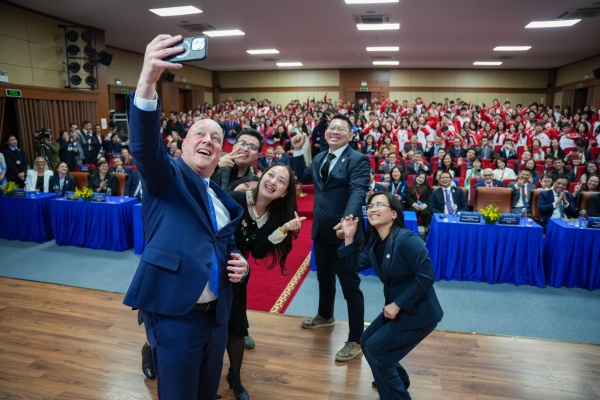
Prime Minister Christopher Luxon snaps some pictures with alumni at the New Zealand – Viet Nam EduConnect event.
AUT Vice-Chancellor Prof. Damon Salesa, Chair of Universities New Zealand's International Committee, represented Universities New Zealand to sign the Collaboration Arrangement with the Department of International Cooperation of the Vietnam Ministry of Education and Training.
The arrangement provides additional support to Project 89 scholars who wish to study in New Zealand. Project 89 is one of Viet Nam’s key initiatives to support its education sector, allowing local lecturers to pursue PhD study and postgraduate study overseas on fully-funded scholarships.
Following the success of education engagements during this trade mission, Amanda Malu, said New Zealand sees significant potential in strengthening education partnerships with Viet Nam.
“New Zealand will continue to expand the range of initiatives in Viet Nam across all levels of education, from schools to postgraduate study, to make it easier for Vietnamese students to engage in knowledge exchange, innovate and realise their dreams of studying abroad,”
“With Vietnam’s ambitious education and technology goals for 2045, our nation is well-positioned to support this journey,” she added.