Search
Showing 10 of 7351 results
- Tokyo20orientation20photo2033
- chinesetv1
- prweek logo
-
Trans-Tasman showdown comes to NZIEC
In this inaugural NZIEC debate, a team of three plucky Aussies will argue that New Zealand should look to Australia's lead when it comes to international education.
Already they’re laying down the challenge: “There’s no need for New Zealand to look to Australia,” says Aussie team member Stephen Connelly. “Just become a part of Australia – you know you want to!"
The Australian team will be represented by:
- Amanda Pickrell, director of international education from the Victorian Government’s Department of Economic Development, Jobs, Transport and Resources
- Darragh Murray, international development manager at Queensland University of Technology, and
- Stephen Connelly, director at Global Ed Services.
And the home team will comprise:
- Katy Mandeno, international director at Whangarei Girls’ High School
- Roger McElwain, chief executive of the University of Otago’s Language Centre and Foundation Year, and
- Tony O’Brien, programme director at Waikato Institute of Technology.
Will the Australians crumble like the Wallabies at Eden Park? Or will the Kiwis collapse like the Black Caps batting line-up in the 2015 Cricket World Cup final?
Either way, it'll be a debate of two halves and you'll be sure to pick up some interesting insights into the competitive advantages of both countries and areas for improvement.
Come along and cheer for your team!
With half of the available places already snapped up, confirm your spot at NZIEC today at www.nziec.co.nz
-
Online applications best for student visas
INZ Sector Relationship Manager (Education), Celia Coombes, says INZ is asking all providers to actively encourage students to make student visa applications through the online application system (or on campus through a Students Online partner provider), rather than via paper applications.
“Immigration Online is faster and cheaper than a paper application and provides students with an eVisa,” says Celia.
“It’s a good idea to get in the habit of encouraging students towards these channels, because in the near future paper applications will be phased out.”
INZ is also asking Auckland-based providers to alert students to a local “drop box” closure at INZ’s Auckland Office (280 Queen Street). The drop box allows students to leave paper visa applications there for transfer to Palmerston North for processing. However, from 31 May 2017 this service will be removed and students will be responsible for sending their application themselves.
Celia says the best option is to apply through the online application channels. However, any students still using the paper form must send this directly to:
Student Visa Applications
Immigration New Zealand
Level 5, 65 Rangitikei Street
PO Box 1049
Palmerston North - scholarship
- Picture7
-
Reflections from English Teachers in South Korea
In January 2024, six New Zealand teachers were selected to spend part of their summer season teaching English in South Korea as part of the New Zealand Korea FTA Partnership English Language Training Programme.
This programme is supported by Education New Zealand Manapou ki te Ao (ENZ) who assists with the teacher recruitment process. This was one of the key KNZFTA programmes recently discussed during the South Korea Government delegation visit to New Zealand late last year.
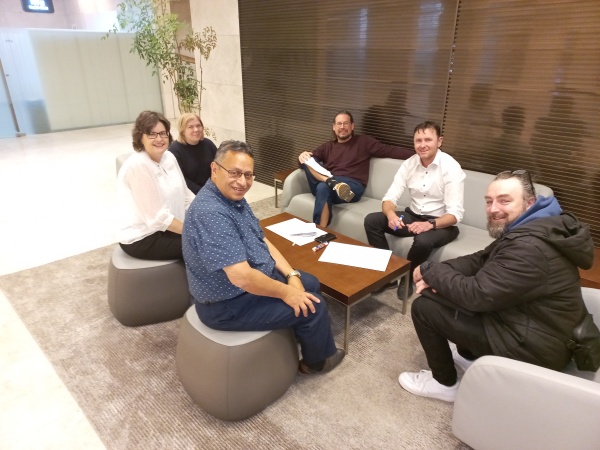
The group of six New Zealand teachers selected to teach English in South Korea in January. From left, Jane Bassett, Food Technology Teacher from Havelock North Intermediate School, Sharon Powell, English Teacher from Long Bay College in Auckland, Kara Shortland, Acting Team Leader (Bilingual) from Whangārei Intermediate School Te Tai Tokerau. Glenn Cheyne, Head of Learning Area Social Sciences from Nayland College in Nelson, Gordon Sim, Social Science teacher from Hillcrest High School in Hamilton, and Dan Greer, Social Studies/Drama teacher from Logan Park High School in Dunedin.
Kay Lee, ENZ Senior Market Development Manager – Korea, said that it was an absolute pleasure to see New Zealand teachers continue to travel to South Korea to teach English during their summer break.
“There are so many positive outcomes from the running of this cross-cultural programme for both the Korean students and the New Zealand teachers participating.
"On one hand, the students get the opportunity to hone their English language skills while experiencing the New Zealand teaching style, learning more about New Zealand, including its culture and education system. Meanwhile, while teaching English and serving as ambassadors of a New Zealand education, the teachers can immerse themselves in Korean life for a few weeks, seeing new sights, trying new food and making new friends.

Gordon, Jane, and Dan, sampling Korean cuisine at the end of the teaching day.
"Our Korean government partner for educational programmes, EPIS, has acknowledged ENZ for its significant contribution to the programme’s success through effective teacher recruitment. These positive outcomes are testament to the strength of our NZ-Korea Government-to-Government partnership,” added Kay.
Upon their return to New Zealand, two of the teachers who are trained in teaching English as a Second Language (ESL), shared their experiences with ENZ. Read on to hear about the reflections from their two weeks abroad....
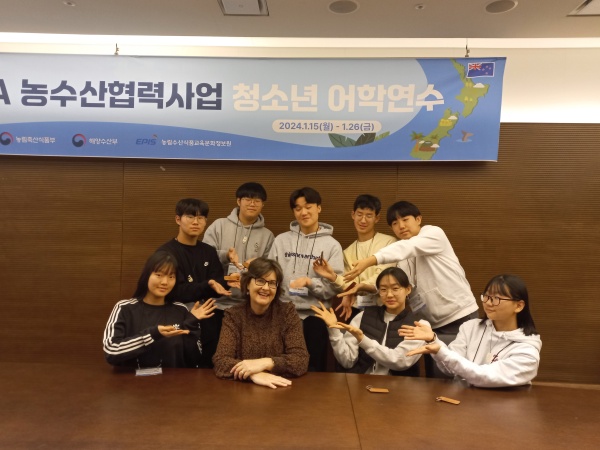
Jane Bassett (지안 (Jian) from Havelock North Intermediate School with her students.
Jane Bassett is a Food Technology teacher at Havelock North Intermediate School and said that the experience of exchanging cultures whilst teaching in an overseas classroom environment was an absolute privilege.
“Our students were aged 14 – 17 years old and came from all over South Korea with family backgrounds in the Agricultural and Fisheries industries. Each student had been awarded a scholarship from the Korean government to attend the two-week intensive English programme organised by the Hyundai Research Institute.
"The Institute went above and beyond in their efforts to ensure an incredible experience for both the students and our group of teachers.
“The teaching programme included a wide range of modules and as well as English grammar, we covered lessons on New Zealand culture, history, tourism, agriculture, sports, famous New Zealanders, and school life. My class was also exposed to the New Zealand Technology curriculum and was tasked with developing a new snack product. As part of the project, I introduced them to several New Zealand snacks and Kiwi classics such as WeetBix, Marmite and Watties Baked Beans, to varying degrees of enjoyment!”
Students were encouraged to speak in English throughout the day via fun-games, readings, conversations and plays so that the teachers could fine-tune their English to help them become more fluent with more natural English phrasing.
"We also explained aspects of Māori culture and the significance of pepeha (way of introduction). The students, who were from agricultural and fisheries backgrounds, were quickly able to identify their own awa (river) and maunga (mountain), showing their own personal connection to their land.”
Jane said that a personal highlight was being able to spend her birthday in Seoul learning about Korean cuisine through a cooking class on kimchi making and tea ceremony in a traditional house. She admitted that this was an appropriate birthday experience for a New Zealand Food Technology teacher!
She summed up the experience by saying that the group of teachers gained a greater understanding of cultural diversity and appreciation of the challenges learning English poses for new learners, learnings which they will take home with them.
“We really hope that our students will remember their experience as fondly as we will and that they will look to study and visit New Zealand in the future.”
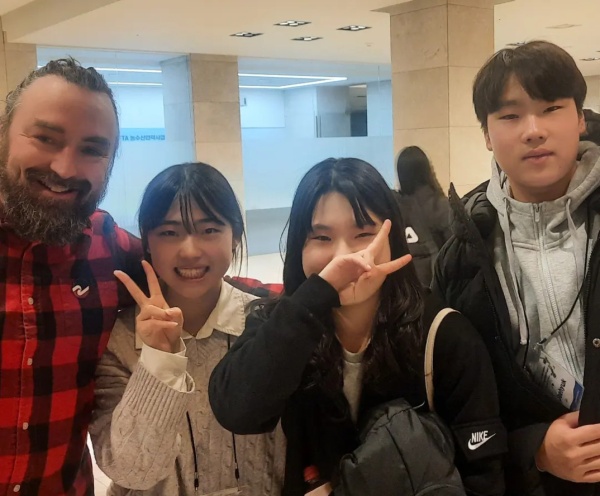
Drama and Social Studies teacher, Dan Greer, of Logan Park High School with three of his students.
Dan Greer, is a drama and social studies secondary school teacher from Logan Park School in Dunedin. He joined Jane as one of the six teachers selected to travel to South Korea, his second experience as an English language teacher in South Korea, having taught in Ulsan 12 years ago.
“I had such an amazing time participating in the Hyundai Research Institute’s programme. It was great to have other quality teachers on this experience with me and we were able to work together, mixing up the style of teaching and activities. I had the more beginner level class, and as a drama teacher we added games to my traditional English teaching. The students really enjoyed it, and it gave them more confidence to give things a go”.
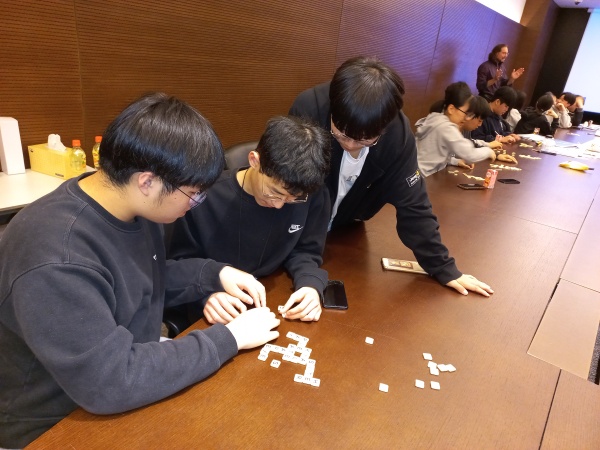
Dan reflected on the fact that there was one practice of teaching English in Korea that he had often thought was a little unfair, that being the naming of Korean students with English names.
“As an English teacher in Korea, you are often asked to name Korean students with English names. Sometimes this is because they want them, sometimes it is because they ’have’ to, and for many it is because westerners find Korean names hard to pronounce. I have named nine children in my life, one being my daughter and the other eight have been my Korean students”.
Dan used this practice as a topic of discussion in class one day and shared his opinion that it had not always felt right to him as he felt that if Korean students were taking the time to learn the English language, that teachers should make an effort in return.
He then asked his students whether English teachers should have Korean names. This prompted them to ask many questions about Dan including who he is when he is not “Dan the teacher”, his whakapapa, and the meaning of his name in English.
Dan said “You can imagine my surprise when my students were all waiting for me when I arrived the next day. One wonderful student then stood up and using perfect English gifted me a Korean name. I was no longer just “Dan the Teacher,” but also now 도혁 (Dohyuk), which meant I was ‘leading them to a bright path’.
“This was such a humbling experience that I will cherish forever. For me, this is what makes teaching and life so special,” added 도혁 (Dan).
If the Korean organisers decide to run the NZ-Korea FTA Partnership English Language Training Programme in the future, ENZ will continue to share the applications with NZ school teachers through the Asia NZ Foundation and Schools International Education Business Association (SIEBA).
-
Coronavirus update for ENZ stakeholders
We’re writing today to provide you with a further update on the coronavirus and its impact on the education sector.
National response
Education New Zealand is taking its lead from the Ministry of Health, who is monitoring the situation closely and will advise if any public health measures become necessary.
At this time, the Ministry of Health has publicly advised the likelihood of an imported case in New Zealand is high, but the likelihood of an ongoing outbreak remains low. However, we recommend that you follow the below advice to keep your students and staff safe and well.
ENZ update
ENZ is working closely with Government agencies to inform and share the advice being developed.
Please find below two updates on ENZ-led programmes based in China.
Prime Minister’s Scholarship (PMS) recipients in China
- The safety and wellbeing of New Zealand students in China is paramount. ENZ is contacting PMS recipients in China to check whether they’d like to come home or are comfortable staying in the current environment. ENZ will support their early return.
- We’re reminding students already in China to follow SafeTravel guidelines. We’re also providing individuals and groups of students scheduled to travel to China with the latest advice.
- ENZ is offering Prime Minister’s scholars who were planning to travel to China in the next three months the opportunity to defer their travel at this time.
- We have been working closely with tertiary education providers as we work through these options.
ENZ events in Asia
- ENZ is reviewing the agent seminars scheduled to go ahead in China this March. We expect to be able to share our decision with the sector shortly.
- Finally ENZ has set up an email address to receive sector feedback, questions and concerns – please email response@enz.govt.nz.
Advice from the Ministry of Education
- The Ministry of Education has released advice for principals, early learning services, tertiary and parents on keeping staff and students safe.
- The Ministry is advising providers to err on the side of caution. Staff and students who are arriving from China, have recently travelled there, or feel they may have been exposed to coronavirus are to take the voluntary precaution of staying at home for up to 14 days. This would take effect from their last date of exposure or from the time they arrived in the country if they are unsure.
- It is important to remember the safety and wellbeing of all students is of paramount importance during this period of uncertainty. As international education providers are aware, they have an important responsibility to ensure that students are well-informed, safe and properly cared for. For further information, see the Ministry of Health’s advice to principals or NZQA information.
- For further guidance, including for homestay, hostel and other accommodation providers, see the Ministry of Education's information for the education sector, caregivers and whānau of learners.
Health and travel advice
- Keep yourself safe by following the World Health Organisation’s standard recommendations to prevent infections:
- Wash your hands regularly
- Cover your mouth and nose when coughing or sneezing
- Thoroughly cook meat and eggs
- Avoid close contact with anyone showing symptoms of respiratory illness.
Key sources of information are:
- MFAT’s Safetravel website As of yesterday, it advises New Zealanders do not travel to Hubei province due to the coronavirus and the associated travel restrictions imposed by the Chinese authorities.
- Ministry of Health’s webpage on the Coronavirus. In addition:
- The Ministry has released information for travellers arriving to New Zealand in English, traditional Chinese and simplified Chinese.
- The Ministry encourages travellers who become sick within a month of their arrival to seek medical advice and contact Healthline (0800 611 116) or a doctor. It is important to mention recent travel to Wuhan and any known contact with someone with severe acute respiratory illness who has been in Wuhan.
- The Ministry is also publishing border advisories on this page which it shares with border stakeholders.
- The World Health Organisation (WHO) is providing situation reports, travel advice and advises on measures to protect yourself.
Please contact us if you have any issues or concerns - response@enz.govt.nz.
- 703367 5079 Columba 1390