Search
Showing 10 of 7351 results
-
Changes to post-study work rights
The changes are designed to support the attraction of international students enrolled in higher levels of study, and in high-quality sub-degree courses that deliver the skills needed in New Zealand’s growing economy.
Minister Lees-Galloway said the changes to post-study work rights will help ensure international students in New Zealand gain in-demand skills for our economic growth, incentivise study in the regions and help reduce the risk of student exploitation.
“These new immigration settings will better match the skills that people study in New Zealand with the skills that employers need to grow their businesses. The changes preserve a pathway to residence for people with the skills and qualifications we need,” Minister Lees-Galloway said.
“New Zealand is a nation that must compete on quality, not quantity. Our changes reinforce New Zealand’s attractiveness for international students and match up positively with our key comparator nations.”
The Government wants to support the transition to these new immigration settings. These changes include a three year, time-limited incentive for international students to study outside Auckland. This is to ensure the benefits of international education are shared throughout all New Zealand regions, supporting the Government's aims to lift regional investment, growth and productivity.
There is a three-year transition period, to enable those parts of the sector that are most affected by the changes (Institutes of Technology and Polytechnics (ITPs) and Private Training Establishments (PTEs) to be able to successfully transition, over time, to new immigration settings. It also supports the current ITP Roadmap 2020 work underway by the Tertiary Education Commission on the long-term viability of ITPs, while ensuring that Government goals for regional growth are not undermined.
These changes will not impact current post-study work visa holders or current students who are undertaking a qualification that (once completed) will meet the qualification requirements as set out in current immigration settings.
These changes support the Government’s broader plans for a high-quality international education system in order to generate educational, economic, social and cultural benefits to New Zealand.
Click this link for more detail on the changes to the Immigration New Zealand website.
-
New Zealand's growing presence in US study abroad
The Forum on Education Abroad
Held in Seattle, Washington, this year’s conference was an opportunity for New Zealand providers to meet with existing and potential partners in the US, and to participate in professional development sessions on standards in study abroad. The University of Auckland exhibited, and the University of Otago co-presented a session. Representatives from Nelson Marlborough Institute of Technology, University of Canterbury and Victoria University of Wellington also attended as did ENZ’s US Director of Education, Amy Rutherford, and ENZ’s US Field Director, Alanna Dick.
 The conference capped off at a luncheon plenary where Shanna Law, a former study abroad student, gave a talk about her year at the University of Otago. Shanna won the ‘Award for Academic Achievement Abroad’ for her research project on geology in Central Otago, which she presented to 1,000 conference attendees.
The Forum on Education Abroad is accepting nominations for next year’s Award for Academic Achievement Abroad. The deadline is 30 August 2017. The next conference will be in March 2018 in Boston, Massachusetts.
The Institute of International Education Best Practices conference
Alanna Dick also represented ENZ at the Institute of International Education (IIE) Best Practices Conference, in Florida, in March. The event showcased the 2017 winners of the IIE Heiskell awards, which acknowledge international partnerships, internationalising campuses and study abroad.
Monash University and Macquarie University were the only non-US award recipients to present their programmes. Awardees were given 15-minute speaking slots at the event, while their institutions were recognised through IIE press releases, a cash prize and an awards ceremony.
As the awards are a great way to showcase the innovative practices on campuses, Alanna hopes to see New Zealand institutions involved in future.
“New Zealand institutions have several innovative initiatives that could fit the Heiskell award categories, including the unique ways they run international partnerships with US institutions to meet the needs of students.
“The awards are self-nominated, and it’s never too early to be thinking about next year’s award selection,” Alanna said.
IIE Heiskell Award applications are due in October 2017. Winners are notified in December, giving ample time to prepare for the conference in March.
Get involved with the IIE
IIE aims to double the number of US students studying abroad by 2020. New Zealand institutions can partner with the IIE by becoming a participating university in the Platform for Education in Emergencies Response programme or hosting a professor or researcher from the Scholarship Rescue Fund.
For more information, contact Alanna: alanna.dick@enz.govt.nz.
-
Feedback from education agents opens up conversation on how ENZ can better support them
Over half (57 per cent) of those surveyed are members of the ENZ Recognised Agency (ENZRA) programme.
The survey, a cross-team ENZ initiative, was a useful opportunity to open up a conversation with agents and to continue to support them while borders remain closed.
Over 40 per cent of agents surveyed said that that 75 to 100 per cent of their business activities had changed or reduced due to the pandemic. Agents also reported experiencing a reduction of staff, closed branches and transitioning to fully remote operations.
ENZ-supported webinars, online and hybrid events were most valuable to agents, followed closely by digital collateral and marketing material, support for student-facing activities, B2B events with education providers and training.
On training needs, 60 per cent of agents surveyed said that they would like to receive training on student visa application processes, 50 per cent were keen on hearing about New Zealand education providers and their offering, while 40 per cent were keen for more professional development training.
Videos, templates (including banners and PowerPoint presentations), student testimonials and brochures were reported to be the marketing tools that agents find most useful.
ENZ’s Manager – Education Agents, Geneviève Rousseau Cung, says the survey is a key component of ENZ’s agent engagement plan as part of the Government’s Recovery Plan for International Education.
“Insights from the survey will allow ENZ to develop activities, tailored communications and training initiatives that are best aligned with agent needs, which in turn, will also inform and result in better outcomes for education providers.
“Seeing how the agent engagement plan is linked closely to the longer-term recovery of international education, it is crucial that we check in with our agents on a regular basis,” Geneviève says.
The current plan has three areas of focus – supporting the ENZ Recognised Agencies Activity Fund in New Zealand and offshore with marketing initiatives, driving the agent engagement plan through a range of initiatives, and ongoing recognition of the role of education agents.
For enquiries:
- Email Desiree (desiree.lee@enz.govt.nz) for the Asia region excluding China
- Email Jane (jane.liu@enz.govt.nz) for Greater China
- Email Javiera (javiera.visedo@enz.govt.nz) for the Americas, Europe and Middle East
- Email Geneviève (genevieve.rousseau-cung@enz.govt.nz) for New Zealand.
Keep an eye out for the full results from the Agent Survey in the next issue of ENZ’s The Insight Story, due out in early May.
-
Massey launches pre-degree pathway in Viet Nam
This is Massey University’s first pre-degree collaboration with a high school in Viet Nam. It will provide students at Nguyen Sieu School, as well as other schools in Hanoi, with the opportunity to begin a foundation pathway in Viet Nam that they can complete in New Zealand, before transitioning directly into degree study at Massey.
Andrea Flavel, Director of PaCE, said the programme equips students with critical skills needed for their futures and exposes them to the different learning style and culture of New Zealand.
“This programme is an example of the way PaCE works collaboratively with institutions around the world to create customised learning experiences that set students up for future academic success, and give them the opportunity to experience the best Massey has to offer.”
PaCE also presented Nguyen Sieu School with a special scholarship worth NZ$20,000 to support students to participate in the pathway programme.
The new Vietnamese Ambassador to New Zealand, His Excellency Ta Van Thong, and New Zealand Ambassador to Viet Nam, Wendy Matthews, attended the launch, which received nationwide news coverage in Viet Nam.
The first cohort of students will begin study in Viet Nam in July 2018, transitioning to study in New Zealand in February 2019.
-
You’re invited: Minister’s Latin America insights
There will be an opportunity for asking questions and networking.
-
PIF Recipient: Mission New Zealand
With support from Education New Zealand Manapou ki te Ao, New Zealand’s government agency for international education, Mission New Zealand showcases courses from a number of New Zealand institutes, and is being developed by The Mind Lab.
Mission New Zealand offers a fully immersive and distinctly New Zealand experience. It focuses on the best of what New Zealand has to offer and the benefits of being part of a global movement for positive change.
From anywhere in the world, learners can choose from a mix of short courses and micro-credentials, grouped around four themes that reflect New Zealand’s progressiveness and values: culture, tech innovation, creativity and sustainability. Courses range from one to 15 weeks in length, with a mix of free and paid options available.
A selection of The Mind Lab’s own micro-credentials is available on Mission New Zealand, along with offerings from Te Pūkenga - New Zealand Institute of Skills and Technology - and some of New Zealand’s most innovative private training establishments.
Visitors to the site will be greeted by the world’s first 360° virtual pōwhiri, starting at the gates of Ngāti Whātua Orākei Marae in Auckland. They will experience being called onto the marae with a karanga and stepping onto the grounds to be welcomed by members of Ngāti Whātua.
Personalised learning, with optional content and stories, insights and other material will help learners experience what makes New Zealand unique.
Through an immersive experience, Mission New Zealand invites learners to take the first step in a lifelong connection with Aotearoa New Zealand.
The new platform is designed to address the increasing global demand for connections with purpose and cause, for online learning options, and for shorter and more flexible courses.
Mission New Zealand is among a range of pilot projects supported by Education New Zealand's Manapou ki te Ao Covid Response and Recovery Fund product and service diversification workstream. This New Zealand Government-funded initiative encourages the development of new products and services in the international education sector.
The Mind Lab was founded in 2013 and has a strong background in innovation, online education delivery that builds impactful futures and building community connections, including relationships with iwi and Māori-led organisations.
More information:
-
Flying Kiwi makes return flight
Early in the new year, our Santiago-based Market Development Manager Javiera Visedo received a surprise visit from a familiar face – Flying Kiwi Catherine Lee. Catherine was one of the first group of seven Flying Kiwis to study in Santiago in 2013 and she had come back for a three week holiday in Chile to spend time with her host family.
“Although obviously my visit as one of the Flying Kiwis was very advantageous from a learning perspective, the friendships and bonds I have formed with my host family and classmates transcend language barriers and distance,” said Catherine.
Flying Kiwis is an ENZ initiative to send New Zealand secondary school students studying Spanish to Santiago for three weeks to attend school alongside Chilean students. The programme was developed in response to the Chilean Government-sponsored scholarship programme Penguins without Borders which sees Chilean students coming to New Zealand to study.
Catherine was in year 13 at Northcote College when she was chosen as a Flying Kiwi. At the time, her Spanish was advanced and she gave a speech for the welcome event at the Ambassador’s Residence.
With one daughter of their own, Catherine’s host family treated her like a second daughter. They loved the experience so much that they hosted another Flying Kiwi last year – they say now they have three daughters.
These days, Catherine is in her second year at the University of Auckland studying towards a Bachelor of Arts majoring in Spanish.
“Travelling to a Spanish-speaking country and learning more about the language definitely influenced my decision to study translation and interpreting at a tertiary level. I could see myself having a career as a translator – I knew that was what I wanted to do with my life,” said Catherine.
“I will definitely have an ongoing connection to Chile – I already miss my friends and host family! One day I would like to do another exchange to a Chilean university, or even live there for a while.
Several of Catherine’s Chilean schoolmates have plans to travel and study in New Zealand. Her host sister is investigating visas to study and work in New Zealand for a year.
“Even my host family are considering moving to New Zealand, as they have heard wonderful things about living there.”
Javiera said that Catherine now speaks beautiful Spanish and her story demonstrates the success of the programme.
“It’s great to see the long-term results of these initiatives. It makes us appreciate even more what we do and most importantly why we do it,” said Javiera.

Bottom left photo (Left to right): Catherine’s host sister, Javiera Jimenez Ortiz; Catherine; and friend Rubi Ruiz Vallejos
Bottom right photo (Left to right): Catherine’s host mother, Elena; Javiera Visedo (ENZ Market Development Manager); Catherine; and host sister, Javiera, at the New Zealand Embassy in Santiago -
NZ EdTech breaks into Middle East market with ‘Play Code Learn’ teaching solution
ByteEd is a New Zealand EdTech company with a mission to empower future generations to become creators of technology rather than just users. The company started out in 2018 by teaching industry-standard programming to high school and university students to create virtual reality worlds. However, a need to start reaching a younger audience was identified due to a lack of foundational concepts.
This led Founder and CE, Peter Dong and his team, to develop a comprehensive solution for students in their early years, using ‘Play Code Learn’ hands on kits combined with augmented reality and artificial intelligence to address this gap.
It is this solution that has been adopted as a core resource by Higher Colleges of Technology (HCT) in the United Arab Emirates for its new Computational Thinking course. All Emirati graduates from their six colleges will learn computational thinking and then using the Play Code Learn resource will teach this in schools where they will become teachers.
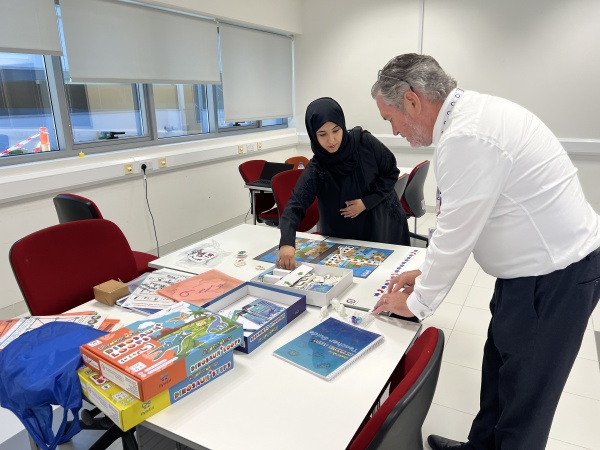
Dr Robert Miles and Haya Al Nuaimi undertaking training on the Play Code Learn kits at HCT Ras Al Khaimah
Peter says that getting to this point has been the culmination of several years of hard work and relationship building, with patience and persistence being key to their success.
“We went into this process knowing that it would take time. We started with a real understanding of our customers’ needs and in particular those of HCT. HCT is a large organisation and we needed to build relationships with multiple key decision makers.
“We are so excited to have made this breakthrough into the UAE and hope it paves the way for more New Zealand EdTechs to do the same;” said Peter.
“As more educators at HCT in the UAE use our solution and collaborate with ByTeEd, then we’ll be building New Zealand’s reputation for our country’s capability in developing innovative and valuable EdTech solutions,” he added.
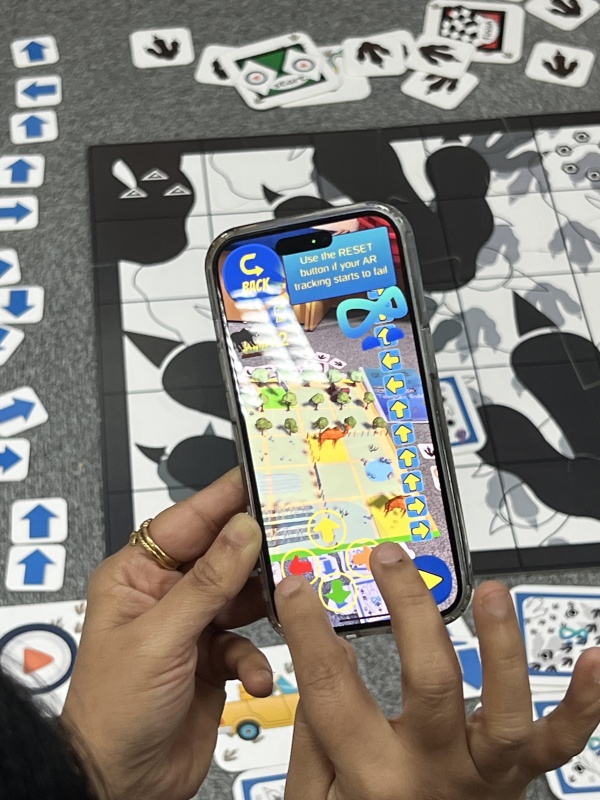
A student using augmented reality to program while the physical learning kit can be seen in the background.
The opportunity to work with HCT all came about from an introduction that was facilitated by Education New Zealand Manapou ki te Ao (ENZ) at the New Zealand Pavilion at the Dubai World Expo in early 2022. Several New Zealand EdTech companies were invited to be part alongside other New Zealand education providers.
Dr Angela Fitzgerald, Executive Dean – Faculty of Education at HCT commented that the work that her Faculty was doing with ByteEd is powerful.
“Their approach empowers teacher educators through lived experiences of computational thinking to prepare future teachers in equally dynamic ways to equip young children with these very skills and knowledge. This will be necessary as they navigate their future worlds,” said Dr Fitzgerald.
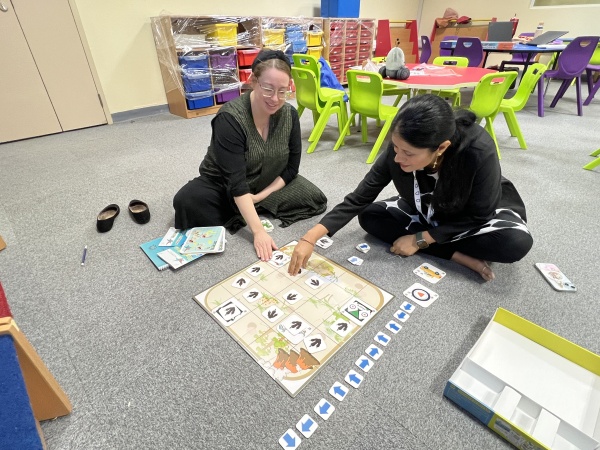
Lecturer Jennifer Filinuk and Senior Lecturer Savita Parashar are using the hands-on learning tools to learn computational thinking before combining it with augmented reality.
When asked what advice ByteEd would give to a fellow EdTech looking to expand their business overseas, and specifically into the Gulf Cooperation Council countries, Peter had some nuggets of advice.
He said that taking the first step to explore the market and gauge interest from target customers is key to gaining that initial understanding of the potential, as is gaining a clear understanding of the problem that you’re aiming to solve for this market.
“Show that you’re not just another visitor and be prepared to make multiple visits and build relationships.
“There are many opportunities in the Gulf region for New Zealand EdTech companies, with more funding available here due to a strong focus on education. The region is also one of few where the younger population is growing,” said Peter.
“There is also significant competition in this region however, so make sure to research potential competitors and consider how to position your company and product effectively”, he concluded.
For more information
ENZ, alongside EdTechNZ, recently hosted a Middle East EdTEch market deep dive with a presentation delivered by Nick Sheppard, Trade and Commercial Advisor from New Zealand Trade and Enterprise based in Dubai. Joining him in the session were the Founders of New Zealand EdTech’s ByteEd, Komodo Wellbeing and EDconnect. You can watch a recording of the presentation here with the slides available here.
If you have further questions about the support that ENZ can provide New Zealand EdTechs overseas, please contact ENZ’s Business Development Manager, Alana Pellow – alana.pellow@enz.govt.nz.
-
ISANA NZ – COVID-19 Update
Catch-up cafés
ISANA NZ is offering members and friends the chance to catch up and discuss the issues they are facing.
We have a weekly Zoom networking opportunity on Wednesday mornings from 11am. Join special guests each week including officials from ENZ, MoE, NZQA and INZ. MoE is providing responses to concerns and questions raised by the weekly events.
Register here for this week’s Catch-up Café, or through our Events tab on the website for upcoming Cafes. Please go to our Good Ideas and Responses page to learn more and access previous Café notes and responses.
Each week, the general Q&A starts at 11am, and special guests are introduced at 11:30am. Email contact@isana.nz to forward any questions ahead of a session.
Looking Ahead webinar series
ISANA NZ is pleased to announce our International education: Looking ahead webinar series.
This series includes professional standards and self-care, enabling international student integration and work readiness, responding to racism and supporting online learning. Keep an eye out in ISANA NZ mailouts, our website and social media platforms for details of our up-coming webinars.
Feel Good Friday
ISANA NZ would like to acknowledge members who are going above and beyond the call of duty.
Every fortnight on a Friday we would like to acknowledge these wonderful people through our social media channels and give them a chance to go in a draw for a $100 gift voucher to be drawn later in the year. Please send an 100-word explanation as to why you would like to nominate your colleague and also the logo of your institute (optional) to contact@isana.nz
-
ENZ highlights international students' contributions to New Zealand in comments to immigration settings inquiry
International students coming to New Zealand support the achievement of the Government's broader goals and objectives while contributing to an important export industry. This is one of the key messages from Education New Zealand's submission to the Productivity Commission's inquiry into immigration settings.
In the submission, ENZ says that international students should not be characterised as coming to New Zealand to seek employment, invest or run a business. Rather, international students are motivated by different drivers in deciding whether to come to New Zealand, and are different to other temporary migrants included in the scope of the inquiry.
International students bring foreign exchange to New Zealand to fund their studies and living costs, which contributes to New Zealand's economic development. The submission also discusses the broad benefits international students deliver for New Zealand, including regional development, research output, and strengthened bilateral relationships with other countries.
You can read ENZ's submission to the inquiry here (links to the Productivity Commission's website).