Search
Showing 10 of 7351 results
-
International students cap off education experience with Mural
Three students have rounded off their international education experience in Aotearoa New Zealand by teaming up with respected artists and local iwi to create a large street-side mural which celebrates the culture and diversity of Tāmaki Makaurau, their host city.
In the first collaboration of its kind, international students Nikita Sharma from Unitec, and Celia Lee, and Jenny Zhong from Auckland University’s Elam School of Fine Arts, were chosen to design and paint one panel of a three-panelled mural after Study Auckland invited art students from tertiary institutions across the city to join the project.
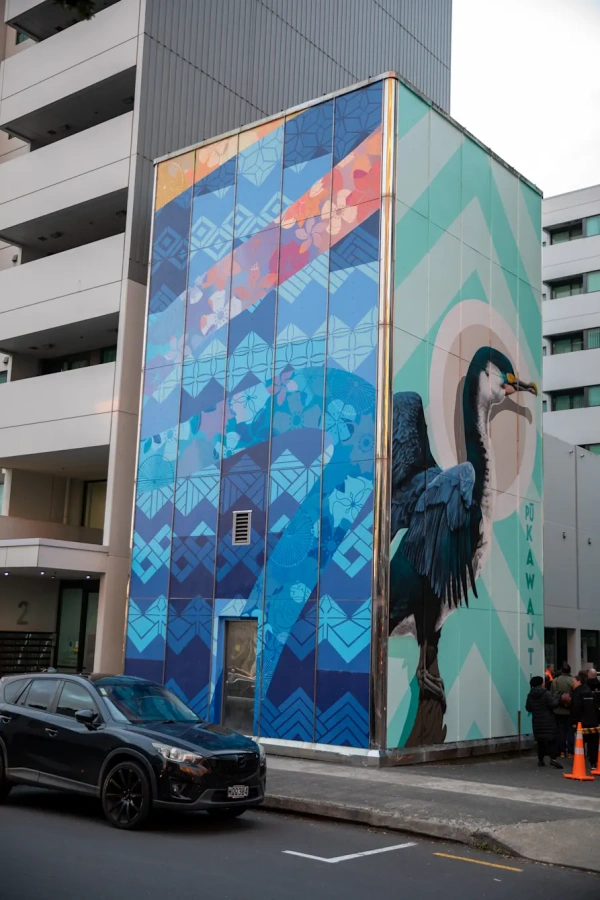
Nikita, who came from India to study in New Zealand, enjoyed working on the project along with Chinese-born New Zealander Jenny and Taiwanese international student Celia. “Our panel depicts diversity, inclusion and culture,” she says. “The project has given us the chance to give something back to the city and to the people who have welcomed us. We hope people feel a sense of connection to the artwork.”
International students were given the opportunity to connect with local iwi
The aim of the Study Auckland panel was to give international students the opportunity to connect with local iwi and work with respected local artists, including Hana Maihi of Ngāti Whātua Ōrākei, to explore what it means to make public art in New Zealand.
To help with the design process, the students joined Hana in a three-day wānanga at Ōrākei Marae to immerse themselves in Māori history, and learn about the significance of the mural’s location in Te Tōangaroa, on Ngāti Whātua Ōrākei owned land.
Study Auckland business development manager Beth Leyland, who led the project, is thrilled with the outcome and says the students are too.
“Auckland Unlimited’s Head of International Education Henry Matthews says the project truly reflects the principle of hospitality amongst the diverse cultures that make up our collective world right here in Tāmaki Makaurau.”
The students’ panel was funded through a $20,000 grant from the Ministry of Education’s International Student Wellbeing Fund. The other two panels were designed and painted by Hana and Te Whetū Collective member Poi Ngawati to bring awareness to the rich Māori heritage and taiao (environment) on which the city was founded.
Collectively, the three panels depict the importance of welcoming different cultures and diversity in Tāmaki Makaurau.
The vibrant 12-metre-high mural, incorporates elements of biodiversity which were once part of the landscape of the area. The students’ panel includes the poutama, a well-known step-like pattern seen in tukutuku panels adorning the walls of wharenui.
In 2019, 115,713 students from 180 countries enrolled to study in Aotearoa New Zealand, and became part of our communities. This injected $4.9b into our economy and supported more than 48,000 jobs. Just over 63,000 of those students were based in Tāmaki Maukaurau. The city currently hosts just under 13,000 international students.
-
NZIEC KI TUA 2023 programme announced!
The New Zealand International Education Conference 2023 brings together practitioners and leaders from across New Zealand’s international education sector to look to the future and explore strategies for growth.
Our keynote speakers include:
- Helen Souness: Pathway to the future
- Dr Hinemoa Elder: Māori stories for global learning and teaching
- Dr Stephen Holmes: Post-pandemic insights from international students and parents
- Yemi Penn: Igniting your rebellious curiosity
- Dr Paul Spoonley: International education in 30 years
- Bridget Williams: International education and the sustainable development goals
- Sharon Zollner: The national and global economic outlook for 2024
- Kaila Colbin: Future of education
The conference also includes a range of energising breakout sessions hosted by experts in the sector, centred on the themes of Marketing Smarts, Growing Global, Authentically Aotearoa and Fresh Offerings.
Breakouts include Excellent experiences – Spotlight on student experience insights hosted by Marie Clark and Ross Crosson, ChatGPT, now what? Pitfalls and opportunities of AI in student recruitment hosted by Audrey Voon, Ko wai koe? Building indigeneity into your internationalisation strategy hosted by Monique van Veen and The intersection of EdTech and traditional education hosted by an expert panel.
Check out the full programme here: https://www.nziec.co.nz/agenda
We look forward to seeing you at NZIEC KI TUA 2023, register today: https://www.nziec.co.nz/registration
-
Busy season for international education in India
The week after Prime Minister Christopher Luxon’s trade mission to India, Education New Zealand Manapou ki te Ao (ENZ) hosted the New Zealand – India Education Connect 2025 and flew the flag for higher education in New Zealand at the Asia Pacific Association for International Education Conference 2025 (APAIE).
New Zealand – India Education Connect 2025
ENZ hosted the New Zealand-India Education Connect focused on NZ universities strengthening academic and research partnerships with India. The event coincided with APAIE 2025 and was designed to align with India’s National Education Policy 2020 and support the Viksit Bharat 2047 vision.
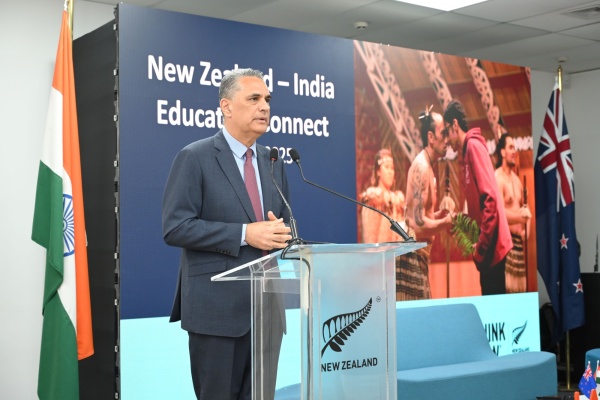
H.E Patrick Rata welcoming attendees of the New Zealand-India Education Connect.
The inaugural session at the Connect event served as a valuable platform to provide an update on the recent high-level bilateral engagements between New Zealand and India during the Prime Minister's visit. It also highlighted the continued prominence of education as a key theme across these discussions.
The event started with high-level bilateral updates by New Zealand’s High Commissioner to India, Patrick Rata, followed by an education overview by ENZ’s Chief Executive, Amanda Malu. Immigration New Zealand also attended and provided a market update as well as conducted a workshop with a selection of Indian education agents.
The programme was strategically designed to provide university representatives with expert intelligence and insights to support the development of their India engagement strategies, aligning with the evolving priorities and demands within the Indian context.
Panel discussions featured senior government officials and sector leaders, who shared perspectives on the increasing significance of deepening education sector collaboration between New Zealand and India. They also highlighted the opportunities presented by India’s National Education Policy 2020 to further strengthen these bilateral ties.
Following the New Zealand – India Education Connect programme and ahead of APAIE, ENZ hosted its NZ Networking Reception which was attended by more than 100 guests.
APAIE 2025
Running in tandem with New Zealand-India Education Connect, ENZ coordinated the New Zealand pavilion at the 2025 APAIE Conference, held in New Delhi from 24-28 March.
The pavilion featured 11 NZ institutions including, all eight New Zealand universities alongside representatives from the Southern Institute of Technology, Whitecliffe College, and Ignite Colleges. The pavilion also had in-attendance key representative from Immigration New Zealand to support providers and stakeholders.
This is the first time APAIE has been held in India that resulted in phenomenal engagement from Indian stakeholders, especially coinciding with this year’s theme on ‘Cultivating Global Citizens for the Future: The Higher Education Imperative in the Asia Pacific and Beyond’.
New Zealand featured strongly across eight panels, with ENZ Chief Executive Amanda Malu contributing to three panel discussions on Indigenous Perspectives in the Internationalisation of Higher Education; a regional update from New Zealand and Laos; and National Strategies for International Education: Three Perspectives from Asia-Pacific. The wider New Zealand speakers led critical conversations on international collaboration, indigenous knowledge, and sustainable education practices.
Director of Engagement for India, Jugnu Roy, said the New Zealand pavilion was buzzing across the three days of the conference.
“APAIE 2025 was an incredible opportunity to connect with global colleagues, exchange ideas, and gain fresh perspectives on the future of international education. The conversations offered plenty of inspiration and practical insights to take away,” she said.
APAIE aims to advance education through enabling greater cooperation between institutions to enrich and support international programmes, activities and exchanges; and to promote the value of international education within the Asia-Pacific region.
-
Expert advice for schools
The case studies provide expert advice for schools from leading international education practitioners within the school sector.
The case studies highlight key lessons from a primary, an intermediate and five secondary schools, from Auckland to Invercargill. The case studies explore a range of themes, including marketing, staffing models and capability, economics and financing, planning and processes, student experience, homestay and academic support, and overarching principles.
A summary of the key lessons from all the case studies has been compiled into the Top tips for international student programmes.
The case studies are part of the growing range of ENZ products and services for schools. Other support includes the Strategic Roadmap programme, the International Education Growth Fund, school website review service, school reference group and Business Development Managers who can provide advice and support to help you grow your international business. More tools to support schools will be released in the coming months. To keep up with developments, subscribe to our E-news and keep an eye on our web site.
-
Seven Flying Kiwis travel to Chile

'Flying Kiwis' Charlotte Butler, Catherine Lee, Shai Robinson and Caznae Raynes with two 'Penguins'
The ‘Flying Kiwis’ initiative was developed by Education New Zealand in response to the highly-successful ‘Penguins without Borders’ programme, which was piloted in New Zealand and saw 40 Chilean students come to Auckland to live and study for two terms in the first half of this year.
The ‘Flying Kiwis’ are all students from Auckland schools that hosted the ‘Penguins’. While in Santiago they will attend school and live in homestays, with some staying with the families of former or current programme participants.

‘Flying Kiwis’ Catherine Lee and Charlotte Butler address guests at a welcome reception held at the Ambassador’s residence in Santiago
The experience will give the ‘Flying Kiwis’ and their accompanying teacher an invaluable opportunity to immerse themselves in the Spanish language and the Chilean culture, and will enable them to see and experience the lives of the Chilean ‘Penguin’ school mates they have been studying and living alongside in New Zealand. The ‘Penguins’ have had a window in to the lives of Kiwi students, and now it’s the turn of the Kiwi students to gain some insights into their world.
The ‘Flying Kiwis’ initiative represents another strand in the strengthening education relationship with Chile and also contributes to the establishment of enduring connections between Chilean and New Zealand young people.
New Zealand school communities in Christchurch, Wellington and Auckland are currently hosting the second cohort of 101 Chilean students in the ‘Penguins without Borders’ programme.
-
New Zealand – Korea digital student exchange
Education New Zealand Manapou ki te Ao (ENZ) again worked in partnership with two education organisations in South Korea – Gangwon International Education Institute and Seoul Metropolitan Office of Education – as well as with NZ-based Learn English Live, to deliver the programme.
The programme offers opportunities for Korean 12–14-year-olds, and for New Zealand students, many from low-decile schools, to develop their language skills and engage in cross-cultural relationships with their international peers. This is done through Zoom sessions using quizzes and other interactive activities, where students can share aspects of their life. Facilitated, student-led discussions in small groups are another key feature of the programme.
In all, 654 students from 12 New Zealand schools and 16 South Korean schools participated in the programme, attending sessions once a week for seven weeks – 102 sessions in total.
Students who participated in the programme represented the following schools across New Zealand:
Sylvia Park School, Rotorua Intermediate, Raumati Beach School, Finlayson Park School, Tauranga Boys College, Taupo Intermediate, Cambridge High School, Waimea Intermediate, Tokoroa Intermediate, Solway College, Rowandale Intermediate, Auckland Grammar.
Each school assigned at least one of their classes to take part in this programme, with teachers recommending the initiative to their colleagues for future sessions.
Within the Seoul and Gangwon regions in South Korea the following schools took part:
Seoul Schools: Dongguk Middle School, Wonmyoung Elementary School, Nonhyun Elementary School, Sinseo Middle School, Soongeui Elementary School, Topsan Elementary School, Gajaeul Elementary School, Seoul Kyodong Elementary School, Hansan Elementary School, Seoul Anpyeong Elementary School, Singa Elementary School, Buksung Elementary School, Songwon Elementary School.
Gangwon Schools: Gangreung Haeram Middle School Buron Middle School Namchuncheon Girls' Middle School.
A total of 339 children from South Korea were digitally connected with children in New Zealand.
The 2022 programme has provided many positive benefits for schools, teachers, children, and the wider community both in New Zealand and South Korea. In a world where in-person exchange and cultural opportunities remain constrained, the programme has continued to enable school children to connect with their international peers and develop long-term connections.
Feedback from teachers in New Zealand highlighted the enthusiasm that children in the classroom showed towards the programme.
The incorporation of a hybrid STEM-based and cultural-based exchange model was especially welcomed and enabled the promotion of unique aspects of Māori culture, in a modern format, on the international education stage.
New Zealand teachers also gave the programme the thumbs up. Given their high workloads, they appreciated that they did not have to organise the content or facilitate the sessions, as this was taken care of by the Learn English Live (LEL) team.
The programme provided the opportunity to indirectly promote a New Zealand school education to a South Korean audience. Students there were reported to be highly engaged throughout the exchange. The ENZ team will give a presentation on the programme at the Australia International Education Conference (AIEC) in October 2022: The session will explain the programme evaluation and survey methodology and how the results are being used by ENZ and LEL to continue to enhance the digital exchange to benefit students. The presenters will also discuss how they overcame challenges relating to language barriers, as one of the main goals of the exchange is to support Korean students with learning and practising English.
Contacts for more information
New Zealand representatives attending AIEC can attend the ENZ session or contact our South Korea team to receive a copy of the presentation slides after the conference (Alanna Dick).
Know of a New Zealand school interested in the next round of NZ-Korea digital student exchange? Please contact Learn English Live (William Clarke).
-
Announcing closing plenary speaker for NZIEC KI TUA 2024
Drawing on his experience leading health care organisations and the health system in Aotearoa New Zealand, including during periods of significant change and uncertainty, Sir Ashley’s closing plenary session will focus on how to lead effectively now and in the future. He will talk to NZIEC KI TUA delegates about ‘leading through change and uncertainty’.
“We live in an increasingly volatile, uncertain, complex, and ambiguous world, which needs leaders to be agile and adaptable who can lead using different approaches than what we have used in the past. I am looking forward to speaking at NZIEC KI TUA on how we can lead in a world of rapid change and complexity,” Sir Ashley said.
Lead with Stories workshop by Jehan Casinader
Award-winning journalist and speaker, Jehan Casinader, will run a workshop, Lead with Stories at NZIEC KI TUA on 7 August. Casinader has spent 15 years telling compelling stories that resonate with people from all walks of life. He has a thorough understanding of New Zealand’s international education sector – and a degree in public policy.
Casinader says storytelling makes global influence possible.
“As New Zealand revives its international education sector, leaders and organisations will work harder than ever to engage the hearts and minds of students and partners around the world.
“However, in an increasingly noisy digital world, it’s harder to grab people’s attention.
"Traditional marketing no longer cuts it. And yet, many of us lack the confidence and skills to tell stories – or we’re afraid to. As a result, our most important messages are never heard,” Casinader says.
In his workshop, Casinader will share practical tools that helps leaders and staff from across the sector to tell compelling stories.
The NZIEC KI TUA 2024 programme will be available in July.
Register now – early bird registrations close on 31 May
Earlybird registrations are still open for the 31st New Zealand International Education Conference KI TUA (NZIEC KI TUA), which is being held in Te Whanganui-a-Tara, Wellington from 6 – 8 August 2024 at Tākina Wellington Convention & Exhibition Centre.
This year’s conference theme is NZIEC KI TUA – Te Ara ki te Ao*
‘Te Ara ki te Ao’, which translates to ‘the pathway to the world’, symbolises a journey that transcends borders and embraces global horizons. This concept frames Aotearoa New Zealand’s distinct international education environment, inviting participants to connect and collaborate to accelerate global growth.
Register now at NZIEC KI TUA 2024.
NZIEC KI TUA 2024 Partners!
Welcome to our newest partners Pearson, Edified, Te Herenga Waka — Victoria University of Wellington and Te Kunenga ki Pūrehuroa Massey University and Flywire, who join TOEFL, Studentsafe, idp, IELTS, and Host Families NZ as partners for NZIEC KI TUA 2024.
And welcome to our new media partner: The PIE News.
If you’d like to partner with NZIEC KI TUA 2024, email us nziec@enz.govt.nz
-
ENZ discontinues recognised agency programme
The decision followed a global review that included input from NZ education providers, education agents globally and NZ government agencies. It also considered practice across other jurisdictions and the global education agent landscape in a post-pandemic environment. The decision becomes effective immediately. The review was foreshadowed in the refresh of the New Zealand International Education Strategy in 2022.
“There are many positive aspects of our engagement with agents,” said General Manager of Sector Services, Sahinde Pala.
“Our global staff network and trusted relationships with agents are important factors in assisting students who wish to further their studies in New Zealand. ENZ’s AgentLab platform has also been a rich resource and information hub for education agents, particularly during the pandemic. We will continue to offer these services going forward.”
“But there were also issues. Our review showed that many successful agents did not see the value in joining the programme. The programme was also not accessible to emerging education consultants and organisations, and it did not meet the needs of New Zealand education providers.”
“After careful consideration of the feedback from many agencies and New Zealand education providers, it became clear that the existing programme was not fit for the emerging environment and the decision was taken to discontinue.”
“Looking forward, we want to ensure a more even-handed and efficient approach and feel the best way of achieving this is to open up the power of our international network, along with our information and training capability to all agents, regardless of their size, expertise or capability.”
While the ENZRA programme will cease, the new AgentLab platform will be launched in August and will include a wide range of updates relevant to education agents, including a calendar of events, details of upcoming webinars, resources, and latest news and updates from across the New Zealand education landscape.
Education agents will be able to access the same level of information and resources via the AgentLab platform. The discontinuation of the ENZRA programme will not affect this.
Any agent seeking more information or support should email: agent.help@enz.govt.nz
For further information:
Sai Raje | Senior Advisor Communications, Education New Zealand
+64 21 479 649
Notes to Editors:
About Education New Zealand (ENZ) https://www.enz.govt.nz/
Education New Zealand Manapou ki te Ao (ENZ) is the government agency responsible for taking New Zealand’s education experiences to the world. ENZ promotes a New Zealand education as one that teaches students to be critical thinkers, problem solvers and lifelong learners, which will help them succeed in their future careers and create a positive impact on the world.
With approximately 100 staff in 18 locations around the world, ENZ works closely with New Zealand’s diverse education sector including schools, English language providers, Private Training Establishments, Te Pūkenga (Institutes of Technology and Polytechnics), universities; and internationally with NZ Inc agencies, Government agencies and education providers to encourage sustainable growth and identify opportunities.
-
March update from Immigration New Zealand
Update on Student visa processing*
Since New Zealand’s international borders reopened in August 2022, Immigration New Zealand (INZ) has received 29,228 student visa applications from international students outside of New Zealand. We have completed 24,549 of these applications.
Our recent processing times for international student visa applications are published on our website. These are updated each month: Visa processing times for international students | Immigration New Zealand
*Figures current as at 10pm on 6 March 2023.
Impact of Cyclone Gabrielle on international students
We are aware that some education providers' campuses have been damaged by Cyclone Gabrielle and have been forced to close temporarily.
This affects students’ immigration status because their current student visa requires them to attend the place of study specified on the visa which may not be currently possible. We understand that this is a difficult time, and we would like to help. An information sheet has been developed for affected international students and can be found here.
Approval in Principle timeframe
We have shortened the standard length of time we allow most offshore students to provide a tuition fee receipt (or other financial evidence) from ten to five working days to encourage students to complete the final steps of their student visa application quickly. We understand that some students may not be able to provide evidence in the timeframe they are given due to their individual circumstances. Extensions to this timeframe are available – the student or agent just needs to upload a brief letter explaining how much longer they will require and why.
Tuition fees
We would like to remind you that changes to the requirements for tuition fee payment evidence for students were introduced last year as part of the Immigration Rebalance.
Students need to pay tuition fees for the first year, or first programme of study (whichever is the shorter), and they will have to prove personal/maintenance funds for the same period. We do not accept payment of tuition fees by instalment; the only exception is for some aviation students.
Agent declaration
If you are providing advice or assistance with a student visa application - DECLARE yourself in the application. Education agents outside New Zealand are permitted to give immigration advice on student visas but must declare themselves in the application. We are seeing increasing numbers of agents not declaring themselves and these applications may take longer to process as a result.
INZ is intending to resume reporting on agent visa approval rates later this year, probably in September/October. If you are not declaring your involvement in an application, this will have an impact on your publicly available performance information. Education providers in New Zealand will be encouraged to check the agent performance report.
-
PIF Recipient: Te Whare Hukahuka
Ka Hao is one of the successful initiatives to receive funding through the International Education Product Innovation Fund, a New Zealand Government-funded initiative designed to reimagine what an education from Aotearoa New Zealand can look like and mean for global learners.
With Education New Zealand Manapou ki te Ao (ENZ) - New Zealand's government agency for international education and the kaitiaki of the Product Innovation Fund – onboard as a partner, Ka Hao is set to grow and create impact beyond our horizons, empowering and developing indigenous entrepreneurs across Australia and the South Pacific.
Te Whare Hukahuka (meaning the House of Innovation) is an Auckland-based indigenous social enterprise on a mission to improve the lives of 10 million indigenous peoples. Across a six-year-long track record, Te Whare Hukahuka has run programmes and delivered training in governance, business coaching, innovation, and rangatahi (youth) development.
Through indigenous leadership, Te Whare Hukahuka is proving that enterprises owned and managed by indigenous communities can be financially successful, create positive social outcomes, respect the environment, and uplift the culture of local communities.
That’s exactly what Ka Hao, Te Whare Hukahuka’s latest initiative, delivers on. Ka Hao is a ‘by indigenous, for indigenous’ e-commerce programme. Across 18 weeks learners design, build, launch and grow their own e-commerce system selling products and services to the world. Although the programme is delivered online, Ka Hao supports and engages its learners with a pastoral care team of more than 50 people – a unique point of difference which sets Ka Hao apart from other education offerings. By enhancing the support for learners, Te Whare Hukahuka aims to create an engaging learner experience and significantly boost programme competition rates and graduation results.
Well-resourced learner support is just part of what makes Ka Hao different from traditional education offerings. Everything about Ka Hao has been designed to create a learning environment that is culturally sensitive, safe, and respectful of the historical, social, cultural, geographic and economic factors that have left indigenous peoples in a disadvantaged position near the bottom of wellbeing indicators, both in New Zealand and other countries.
With more than 500 Māori learners already on the waiting list for this year’s Ka Hao programme, Te Whare Hukahuka is looking to bring the Ka Hao kaupapa to indigenous peoples beyond Aotearoa. The funding provided by ENZ through the Product Innovation Fund will enable Te Whare Hukahuka to research, pilot, test and evolve their first education offering across 16 Pacific countries. The target audience is new and existing indigenous business owners.
The International Education Product Innovation Fund is also supporting six other pilot projects from both established and emerging education providers around New Zealand. Together, the pilots reimagine what a New Zealand education offering can look like for global learners. In the case of Ka Hao, the pilot will explore how providers such as Te Whare Hukahuka can weave Māori knowledge and worldview into an education offering that is culturally relevant and responsive for indigenous learners in other countries.
As New Zealand’s dedicated agency for international education, ENZ is working with all the fund recipients in a partnership approach, building mutual benefit and reciprocity. The lessons learned through the pilot projects will be shared for the benefit of New Zealand’s whole international education sector, contributing to a broader and more diverse understanding of what international education can do for New Zealand, as well as the global learners who trust us.
More information:
Visit Ka Hao’s Youtube Channel to see over 4700 videos from their indigenous alumni