Search
Showing 10 of 7351 results
-
International Student Research Community
Share your experience. Help shape the future of studying in New Zealand.
The International Student Research Community is a group of prospective, current, and former international students who share their views and experiences of studying with New Zealand education providers. It is run by Education New Zealand Manapou ki te Ao (ENZ), the New Zealand government agency responsible for promoting international education and supporting student experiences.
Your feedback helps shape decisions, services and experiences for future students.
About the community
Members are invited to share insights across the student journey – from choosing where to study through to life after study. These insights help shape policies, services, and initiatives across the sector.
Why join
- Have your voice heard and help improve the international student experience
- Influence decisions that affect future students
- Take part in research in a flexible way that suits you
- Receive incentives as a thank you for your time
How it works
- Sign up to join the community
- Get invited to participate in surveys, interviews or focus groups
- Take part in research in a flexible way that suits you
- Receive incentives as a thank you for your time
What to expect
Frequency
This varies depending on what’s happening in the sector. Typically, you can expect to participate in a few short surveys each year, with occasional opportunities to join discussions or share feedback on specific topics. Participation is always voluntary and you can choose which invitations to accept.
Time commitment
Most surveys take 5 to 15 minutes to complete. Some activities, such as focus groups or interviews may take longer – but we’ll always let you know what’s involved up front.
Benefits of taking part
There may be prize draws or gift vouchers, depending on the activity. Details of any incentive will be included in your invitation to participate.
You’ll also have the opportunity to make a real difference by helping shape important decisions around international education for New Zealand.
Privacy and confidentiality
Your responses will be combined with others and analysed to identify overall trends and insights. Results are reported in a way that does not identify individuals.
All personal information is kept secure and confidential, in line with privacy requirements.
Join the Community
We’re not accepting new sign-ups just yet. Check back soon for details on how to join the Community.
Leaving the Community
You can leave by using the unsubscribe link in any of our emails, or by emailing us at researchcommunity@enz.govt.nz.
About ENZ
ENZ is a New Zealand government agency. We promote New Zealand as a study destination and work to ensure international students have a high-quality education and experience.
-
Introducing David Downs, incoming Chief Executive
He most recently served as Chief Executive of New Zealand Story, a collaborative agency bringing together several internationally focused government organisations (including Education New Zealand Manapou ki te Ao (ENZ)) to curate New Zealand's brand and reputation to benefit the country's international growth aspirations. In this role, he led work to strengthen New Zealand’s global reputation and brand, supporting the country’s international growth ambitions.
He previously spent around a decade at New Zealand Trade and Enterprise (NZTE) in general manager roles, building extensive experience in international business. Earlier in his career at Microsoft, he led the South East Asia Emerging Markets portfolio within one of the company’s divisions and spent significant time working across the region. He has also worked in Europe.
David began his career as a software developer and remains closely connected to the technology sector, with a strong interest in artificial intelligence. He has spent several years building his expertise in AI and recently taught a course on the subject at The Icehouse.
Alongside his executive career, David has significant governance experience. He was until recently Chair of The Icehouse board, is Deputy Chair of Young Enterprise, and chairs the advisory group for the Kupe Leadership Scholarship at the University of Auckland.
You’ve just stepped into the CE role – what excites you most about leading ENZ at this moment?
A few things. Firstly, we’ve got a high-performing team here, and there’s been some great progress to build on. It’s also a fascinating time in the global environment – tricky, obviously, with global disruption and geopolitical tensions – but that leaves New Zealand in a relatively strong position as a trusted, safe destination for students. The export opportunity of international education is a significant one for New Zealand. And personally, I just love learning about the sector, and the strategic opportunity of bringing so many highly talented people into New Zealand – thinking about our future workforce, enabled through education.
What drew you to this role and to international education?
I’ve had a bit to do with the education sector over the last few years. While I was a very poor student myself – straight Cs in my undergraduate years! – I really appreciated the opportunity to have an education in New Zealand and overseas. For the last seven or eight years I’ve chaired the Kupe Leadership Scholarship at the University of Auckland, and I see the impact that education has. I’ve also been on the board of Young Enterprise, a programme that teaches business and entrepreneurship in high schools across New Zealand.
International education takes that to another level again – bringing talented people from around the world to New Zealand, while also building New Zealand’s reputation as a destination. It really builds on my previous role at New Zealand Story.
People describe you as a storyteller – how does that shape your leadership style?
Storytelling has always been my nature. As a stand-up comedian, actor and writer all through my twenties, telling stories as a way of getting information across, bringing people along and enthusing them towards a greater vision is just a natural way of how I like to work.
I believe good leaders inspire through stories – they’re far more memorable than data and facts alone. Stories motivate people, and they’ve been the way we’ve transmitted information for millennia. The power of storytelling is something I regularly reflect on and have taught workshops about, so I guess it’s simply part of what I do.
What’s something people might be surprised to learn about you?
It might surprise some people that I used to be a stand-up comedian as a job. That led me to setting up a comedy club and working in TV, which led me into business, which eventually led me into the government world. A strange career path! I doubt many other stand-up comedians are now government chief executives – although, surprisingly, President Zelensky of Ukraine used to be a comedian too, so I guess I’ve got big shoes to fill.

From your experience with New Zealand Story, NZTE and Microsoft, what have you learned about New Zealand’s place in the world – and how we tell that story?
My roles at New Zealand Story, NZTE and Microsoft – where I worked across South East Asia – taught me about New Zealand’s unique ability to be an aspirational destination, and an aspiration in general for people who see our country as not only good IN the world, but good FOR the world.
We really do stand out as an exemplar of a values-based country. Our Māori culture, te ao Māori, is such a critical part of our global image and such an opportunity to show who we are to the rest of the world. Our spirit of manaakitanga, kaitiakitanga and pono are great examples of New Zealand having a unique way to care for people and place.
Then we have this extra innovation streak. As the youngest country in the world – in terms of when we were populated by humans – we have an innovation and go-it-alone spirit. We refer to it as pōtikitanga: the concept of being the youngest child and wanting to carve our own path.
What’s your vision for ENZ over the next few years?
Firstly, to achieve our international growth targets. It’s critical for us as an organisation to contribute to the New Zealand economy. We also know the work we do brings in export revenue – highly valuable for a small exporting economy – and allows us a deep connection with others and the chance to build relationships.
I think ENZ is in a great position to take the great work that’s been done in the past and accelerate it – thinking deeply about building a future New Zealand through the links we make with education.
What are the biggest opportunities and challenges for New Zealand in international education, and how could we respond?
Virtually every sub-sector has an opportunity to keep growing and bringing in talent. There are definitely headwinds, and we’ve got to be mindful of those – making sure we remove friction and ensure the right quality candidates come into the country. I’m confident, with our relationships across NZ Inc, that we’re doing a good job of having high-quality education products and a pathway for our visitors.
How do you see ENZ working with education providers, agents and partners?
I’m still learning how ENZ works with education providers, agents and partners, but I’m really interested in getting more involved personally. I know our team has strong relationships across multiple parts of the sector – with individual entities and with the sector peak bodies – and I’m looking forward to meeting as many people in the sector as I can.
What would you like the sector to know about how you want to work together?
In a word: collaboration. We can’t be successful alone as a government organisation. We’re essentially a broker – what we do is facilitate introductions, leads and opportunities for international students to understand more about New Zealand. The real work comes when those students are introduced to educational institutions, so we need to collaborate and form tight relationships.
Outside of work, what do you like to do?
I have three boys, all in their twenties, and live with my wife, Katherine. I really enjoy getting into New Zealand’s outdoors. I also have a personal history with battling cancer – there’s a documentary about that journey called ‘A Mild Touch of Cancer’ – and I spend quite a bit of my time outside work in the cancer advocacy and fundraising space. I sit on several boards for health-related charities, championing bringing innovative cancer therapies to New Zealand. If people want to learn more about me, they can check out my TED talks.
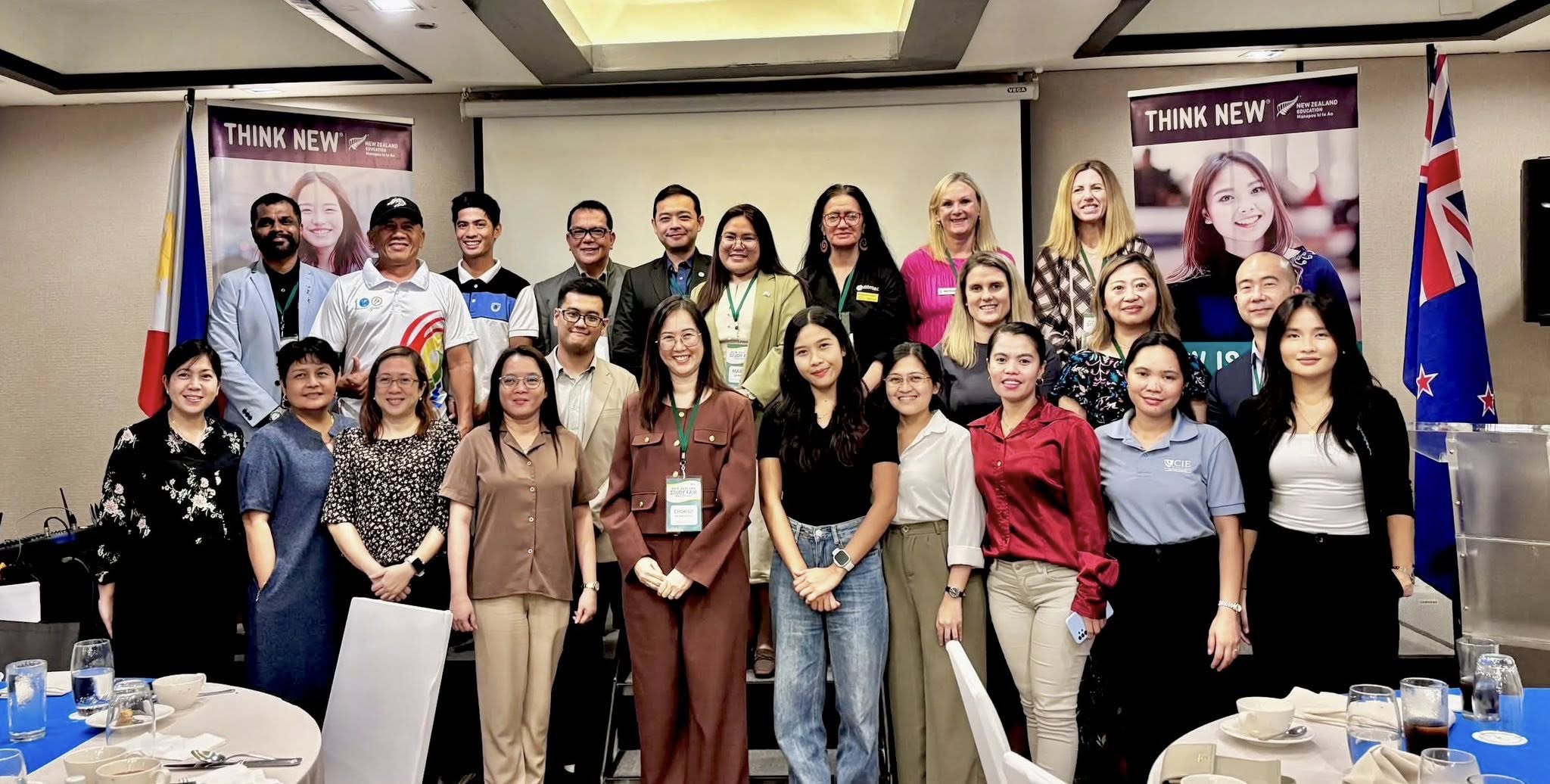
- Cebu school counselor workshop
- card 8
- PUC fair
- QR2 250x250
- UCIC
- PTE August 2015
-
From the Acting Chief Executive: Continuing our work together
Kia ora koutou,
As I pass the rākau to Chief Executive David Downs, I want to share that it has been an absolute privilege to support the sector through this important period, and to work alongside you as we continue to rebuild and position New Zealand for sustainable growth as envisioned in the Government’s International Education Going for Growth Plan to 2034.
New Zealand’s global position continues to strengthen. Our growing engagement in key markets is opening up new opportunities for collaboration, student mobility, and long-term partnerships. These efforts are reinforced by coordinated work across Government agencies, all supporting the Going for Growth strategy.
We are also seeing tangible progress in support areas that will make a real difference for providers. The new Schools Support Function, announced at the recent SIEBA Hui, for example, will provide practical, on-the-ground support to help schools build capability and grow their international programmes. This is a significant step in strengthening the schooling sector and ensuring more parts of the system can participate in international education.
Work is also well underway to finalise ENZ’s 2026–27 Go-to-Market Plans, providing a clear focus for the year ahead and helping target our efforts where they will have the greatest impact. What stands out to me most is the momentum we are building together. From market activity and partnerships to provider support, there is a clear sense that the sector is not just recovering but repositioning for the future.
I would like to thank you – our education providers, peak bodies, and partners across Government and industry – for the commitment, collaboration, and resilience you continue to show. It has been a privilege to work alongside you as ENZ’s Acting Chief Executive.
Ehara taku toa i te toa takitahi, engari he toa takitini
My success is not mine alone, but the success of many.
Ngā mihi nui,
Linda Sissons
Acting Chief Executive -
Around the world in five
UK
Scotland and Wales to pilot phone outreach for international graduates
A new graduate outcomes pilot will contact international alumni by telephone from December 2026 as the sector seeks stronger evidence of graduate outcomes beyond the UK.
Global
A social-listening analysis based on over 2,000 student posts and conversations finds that the traditional linear enrolment funnel concept is not suitable for international student recruitment and support today.
Global
What is happening to student mobility flows between the Global South and Global North?
In 2026, students in a number of important student source countries for Western schools and universities are increasingly likely to see their study visa applications rejected.
India
Currency crash and visa crackdowns force Indian students to rethink studying abroad
A weakening currency, bleak job prospects in the US and Europe, stricter visa requirements and immigration crackdowns have forced many Indian students to reconsider whether it is worth taking on hefty debts to move abroad.
Australia
When submission means suspicion: unpacking the AI anxiety affecting international students
For international students in Australia, navigating language, culture, and the immense pressure of overseas study has always been challenging. But the findings of the 2026 Australian Student Wellbeing Report (n=1,234 with 16% international) highlight a new and insidious weight being added to the balancing act: AI anxiety.