Search
Showing 10 of 7351 results
-
Hands-on agribusiness experience for NZ students in Brazil, Chile and Colombia
Despite being located on opposite sides of the world, New Zealand and Latin America have very similar climates, a phenomenon which serves as an opportunity for students in professions connected to agriculture to broaden their knowledge and practical skills. The Prime Minister’s Scholarship programme has supported students travelling to Brazil, Chile and Colombia to study this subject.
In operation since 2013, the Prime Minister’s Scholarship programme has already provided support for around 3,050 New Zealanders studying abroad, covering their travel, meals, accommodation, studies, technical visits, and journeys in different regions.
In 2022, Brazil was the most popular Latin-American country among group scholarship recipients, receiving visits from three groups. Brazil was also the first country to welcome New Zealand students from the program following the COVID-19 pandemic.
12 members of the Agronomy and Business Faculty of Lincoln University travelled to São Paulo in November last year. Over the course of five weeks, they visited and studied at three Brazilian universities, visiting farms and production centres in São Paulo, Minas Gerais, Paraná and Santa Catarina states.
According to Dr. Hugh Bigsby of Lincoln University, who coordinated the groups of students, their visits were organised so they could learn about the countries and their cultures through their food.
“Our programmes are called ‘agribusiness summer schools’ and the aim is to try to understand the local economy, over a period of five weeks, through processes involved in food production and the textile industry, for example,” Hugh said.
“In each country, we introduce the students to farms, sales chains and supermarkets. At the end of the program, they are required to present a business idea that can contribute to the commercial relations between New Zealand and each country visited, supporting exports and imports,” explained Hugh.
Amongst the places visited in Brazil were the Higher Education School of Agriculture of the University of São Paulo, in Piracicaba; the Faculty of Agrarian Sciences of the Federal University of Paraná, in Curitiba; and the experimental farms operated by the Federal University of Viçosa.
“The partnerships with the local universities of each country are fundamental to the success of our program, since each of them provides us with the local economic context, demonstrates technological advances that are underway, and explains the specific features of the local producers,” Hugh said.
At the same time, a group of 10 students, from the School of Agriculture and Development at Massey University, were in Chile to pursue their studies of agribusiness techniques. The students explored several regions across the country, visiting the Austral University of Chile, the Catholic University of Valparaiso, and Magallanes University in Punta Arenas.
In addition to the universities, the students went to the Santiago Botanic Gardens, dairy cattle farms, vineyards, avocado plantations, and food cooperatives.
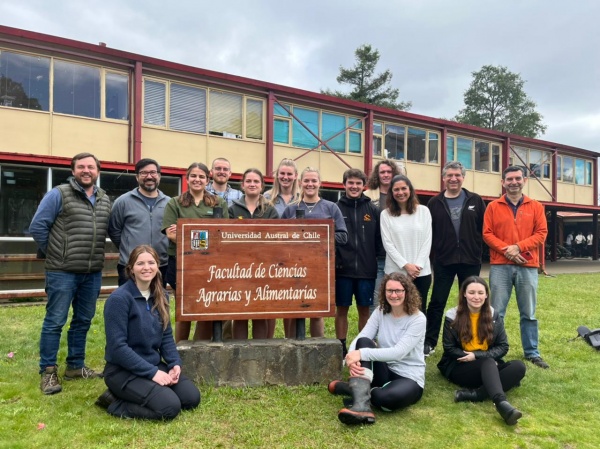
Massey University students at Universidad Austral de Chile, in Chile.
Massey University Professor Ignacio López, accompanied students on their visit. He said the trip was an incredible experience.
“The students were impressed with how the farmers are capable of sustainably farming foods in extremely harsh conditions” Ignacio said.
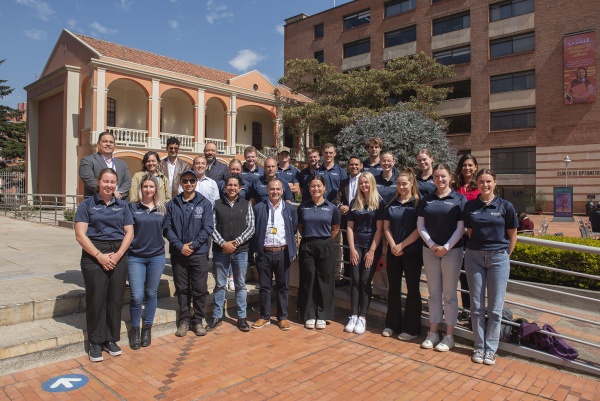
Lincoln University students at Universidad de La Salle, in Colombia.
A group of 20 students from the Agronomy and Business Faculty of Lincoln University travelled to Bogotá, Colombia, in January to study agribusiness. They were in the country for four weeks, studying at the La Salle University, located in the Colombian capital, and at Manizales University.
The students learnt about the wide range of agribusiness activities conducted in the country and in the Mercosur region, including detailed studies of Colombian coffee production techniques, which are considered a benchmark across the world.
The students from the three groups all returned home having recognised the creativity and experience of the Latin-American agricultural producers.
“For our students, the trip opened their minds to new possibilities and different ways of working with agriculture,” said Ignácio Lopez.
“They also realised that what they had experimented with can, indeed, be adjusted and applied in New Zealand” he said.
- ENZ ANNUAL REPORT 2022 23
-
Kōrerorero on quality education
Panellists included
- Dr Dawn Freshwater, Vice-Chancellor at the University of Auckland, who is also the first woman to hold this role
- Dr Sandra Regina Goulart Almeida, Vice-Chancellor at the Federal University of Minas Gerais (UFMG) in Brazil
- Dr Alejandro Ceballos, Vice-Chancellor at the Universidad de Caldas in Colombia.
With simultaneous interpretation in Spanish and Portuguese, the session attracted more than 100 attendees and 350 registrations from across Latin America and Aotearoa New Zealand. Panellists shared their thoughts on gender equality, integration, and inclusion, and how to achieve more equitable access to quality education. They also discussed the main priorities and focus of their institution in relation to SDG 4, and how they overcome challenges to achieve the SDG’s objectives.
Education New Zealand Manapou ki te Ao’s Kōrerorero webinar series is intended for academics, education agents and media in Latin America and New Zealand. It has been particularly effective in maintaining awareness of a New Zealand education while our borders are closed, while also contributing to discussions on important matters related to international education. Across the six episodes since its launch in 2020, more than 1,000 people have attended, with many subsequent views on YouTube.
If you would like to watch this episode, please click here
-
Strong start for Cohort 4 international students
Already more than 3,500 international students have been nominated by their education providers and confirmed by education agencies. More than 1,900 of these students have had their Request for Travel approved and have been invited by Immigration New Zealand to apply for their student visas, since the process opened on 13 April 2022.
Places remain available for students with a number of ELS and PTE providers. Only education providers can nominate students for this cohort. Interested international students or their agents should contact ELS or PTEs as soon as possible. Of the 5,000 places in this cohort, 1,000 were allocated to ELS and 850 to PTEs, with the remainder going to universities, Te Pūkenga, and secondary schools.
Once they have been nominated by an education provider and confirmed by education agencies, students have two weeks to make their Request for Travel through the Immigration New Zealand website. Following approval of the Request for Travel, students then have one month to complete and submit a student visa application to Immigration New Zealand, in time for a mid-year start for their studies.
Education providers are due to complete their nominations by 6 May 2022. Any unused places will be transferred to other providers, which means that some providers may get additional places as part of the reallocation process.
This is the fourth cohort of international students to be granted a border exception to enter New Zealand and is part of the progressive reopening of our borders. All visa categories are due to reopen from October 2022 onwards, including visitor and student visas.
For more information on this cohort of international students, see Cohort 4 » Education NZ (enz.govt.nz)
- Kate west tweet
- eqsafety
- Copy of Chief Executive expenses 01 Jul 2013 30 Jun 2014
-
US roadshow sparks interest in New Zealand universities
Education New Zealand Manapou ki te Ao (ENZ), together with Victoria University of Wellington, Lincoln University, the University of Auckland, and the University of Otago recently completed a successful tour of high schools across Hawaii. The aim? To inspire local students to think of New Zealand not just as a beautiful place to visit, but as a world-class place to study.
Across a week-long series of classroom presentations, university fairs, and dedicated sessions for school counsellors, the New Zealand delegation engaged directly with more than 300 students and families and connected with 25 high school counsellors.

Representatives from New Zealand universities talking to students and their parents about their study offering.
Director of College Counseling at Le Jardin Academy, Scott Liedtke, said face-to-face conversations are powerful.
“When New Zealand educators come to Hawaii, it helps demystify studying overseas. Students and families can ask questions directly about cost, safety and credit transfer, and hear answers from the source,” he said.
ENZ also partnered with the New Zealand Consulate in Hawaii to host two events for local school counsellors. A breakfast at the New Zealand Chancery and a brunch at the Consul General’s residence allowed for deeper discussions and relationship-building within the education community.
Dan Cairns, Administration Manager at the New Zealand Consulate, described the events as more than just informational.
“Each gathering was designed to reflect different kaupapa, from celebrating international education to acknowledging our shared Polynesian connections – these moments created space to build people-to-people ties that go far beyond the classroom,” he said.
The impact of the roadshow was immediate. Each of the attending universities reported that at least two students had begun applications to study in New Zealand.
Director of Engagement, North America, DuBois Jennings said for ENZ, the roadshow represents a step towards long-term engagement in a region with shared cultural values.
“The clear appetite for New Zealand study options, shows there is real value in continuing and expanding this mahi,” he said.
Scott Liedtke echoed that sentiment. “New Zealand feels like a home away from home for many of our students. With its island lifestyle, cultural familiarity, and globally recognised education, it’s a natural fit,” he said.
“Here in Hawaii, we say the ‘coconut wireless’ — word of mouth — is strong. Once a few students head to New Zealand and love it, that news spreads fast,” Scott added.
For New Zealand study providers looking to find out more about the Hawaiian market, you can contact DuBois Jennings directly via email: dubois.jennings@enz.govt.nz
-
Annual survey shows continuing strong support for international students in New Zealand
More than three quarters of 1,100 New Zealanders in the annual 2024 survey conducted by Education New Zealand Manapou ki te Ao (ENZ) believe the country should host the same or more international students in New Zealand.
This was the key finding of research, completed in October, to measure New Zealanders’ views on the contribution and challenges of international students studying in New Zealand.
For the first time this year, the annual survey asked respondents if they wanted to see more or fewer international students in the country. Forty-one (41) percent of those surveyed said they would like to see more, with another 36 percent supporting the same number of students. Only 11 percent indicated they would like to see fewer international students arrive.
Positive perceptions of international students also continued to track strongly with 72 percent saying the students benefit New Zealand. This followed similar levels of support of 75 percent in 2023 and 73 percent in 2022.
Commenting on the findings, ENZ’s Chief Executive, Amanda Malu, said the results reinforced the growing support and understanding of the contribution of international students to local communities and the country.
“Since 2018 we have seen increasing support for the contribution international students make in key areas,” said Ms Malu.
“Today 82 percent of New Zealanders agree that international students contribute to our cultural diversity, with 79 percent feeling they help local students learn about other cultures and ways of life, as well as contributing to local businesses during their studies.”
“This level of support is enormously pleasing. It tells us we can continue to steadily grow the number of international students in New Zealand and that they will continue to receive a warm welcome in our communities.”
Read the report here: 2024 Survey of the Public Perceptions of International Education | ENZ IntelliLab
For further information:Justin Barnett | Director of Communications, Education New Zealand
justin.barnett@enz.govt.nz
+64 21 875 132
-
Research communication platform for Asia-Pacific
The Context: Asia-Pacific is where you can get quick, plain language overviews of high-quality academic research. Recent stories include one about cultural intelligence research. Other examples include the capabilities that SMEs need to succeed in international markets.
The platform will also include youth voices from tertiary students interested in global engagement. You can subscribe to email newsletters to receive updates about your area of interest.
The Centres of Asia-Pacific Excellence were established by the government in 2017, to support New Zealanders to engage with North Asia, Southeast Asia and Latin America.