Search
Showing 10 of 7351 results
- Around the world in 18
- Schools full year 2014 PDF
-
Report concludes international education can recover and grow
In 2019, international education’s direct financial contribution to New Zealand’s GDP was $3.7 billion using the Computable General Equilibrium (CGE) methodology. This contribution was reduced to an estimated $0.8 billion in 2020 by the pandemic. The CGE methodology applied by EY to determine the contribution was supported by MBIE and MoE and is more rigorous than previous analyses.
Having established the direct financial contribution, EY explored the extent of the indirect longer-term contribution to New Zealand’s GDP from the small proportion international students that remain in New Zealand after completion of their studies.
EY found that international students living and working in New Zealand in 2019 and 2022 contributed economic, social, cultural, and international benefits. Using NZ Statistics Department IDI data and CGE modelling, EY found that these students contributed in the order of $6 billion in the form of labour supply and productivity to New Zealand’s GDP in both 2019 and 2022.
Determining this contribution involved estimating the GDP output and wage impacts associated with New Zealand educated international students who remained in New Zealand and transitioned into the domestic workforce in the 10 years leading up to each year.
ENZ Chief Executive, Grant McPherson said, “This report confirms the tough time the sector has had over the past two years, highlights the contribution it made in the past, the contribution it makes beyond economic value, and tells us that it is possible to become a vibrant, sustainable and resilient sector in the future.”
The majority of international students, 62%, return to their country of origin after they have completed their studies. A further 13% leave New Zealand after their post-study work experience meaning that in total 75% have returned home after three years, according to the research.
More broadly, EY concluded there is evidence that international education can enable New Zealand students to develop global competence within a structured teaching environment, and contributes to soft power in diplomacy, trade and perceptions of New Zealand through a range of mechanisms. Broader impacts for Māori are potentially also present across each area of impact from international education. These impacts were not directly quantifiable.
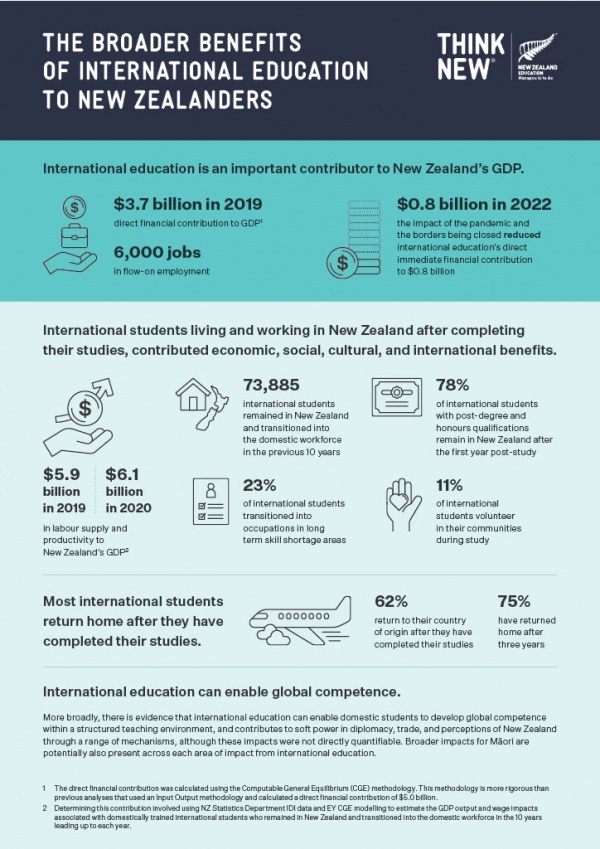
For a full-size image of the infographic, click here. For a full copy of the report, click here.
-
Have your say on immigration policy settings and international students under Year 9
Immigration policy settings
The Productivity Commission is inquiring into immigration policy settings, and submissions close on 24 December 2021.
The New Zealand Government has asked the Commission to undertake an inquiry into what immigration policy settings would best facilitate New Zealand’s long-term economic growth and promote the wellbeing of New Zealanders.
To have your say, go to productivity.govt.nz/inquiries/immigration-settings
Future of international students under year 9
The Ministry of Education has opened consultation on the future of the enrolment of international fee-paying students under Year 9, and submissions close on 11 March 2022.
The proposed policy change affects international students at the primary and intermediate levels and would require the amendment of the Education and Training Act 2020. To have your say, go to consultation.education.govt.nz/international-education/intlenrolunderyear9
Keep up with public consultations affecting the international education sector.
-
Around the world in five
Australia
Scott Morrison prepares to let in over 200,000 students and skilled workers
Japan
Travel ban lifted but students could be a long time coming
United States
68% increase in new first-time international enrolments across the United States
Global
Agent views of Australia/New Zealand drop as United Kingdom, Canada and United States benefit
United Arab Emirates
- IMG 0412 v3
- Auckland
- 2016 PTE and EL International Student Experience Survey FAQs
- Te Whare Hukahuka PIF End of Project Report
- TRanslations