Search
Showing 10 of 7351 results
-
Consultation on proposed changes to Rule 18
NZQA is consulting on the following proposed changes to the NZQF Programme Approval and Accreditation Rules 2018:
- Removing the student visa decline rate from Rule 18. This would no longer be the measure for when prior schooling with English as the language of instruction could be used as evidence of English proficiency.
- To use this provision, international students would need to have either
- a) completed their schooling in New Zealand, Australia, Canada, the Republic of Ireland, South Africa, the UK or the United States; or
- b) been awarded an internationally recognised qualification taught in English such as an International Baccalaureate Diploma or Cambridge ‘A’ Levels.
Dr Grant Klinkum, NZQA Deputy Chief Executive Quality Assurance, says the proposed changes respond to risks that NZQA and Immigration New Zealand have identified in the tertiary education sector.
“The student visa decline does not reliably reflect English language proficiency, and the countries involved had varying levels of quality within their English medium schooling options.
“We believe using prior schooling where English was the language of instruction will be a stronger indicator of English proficiency.”
NZQA is seeking feedback on the proposed changes, including what steps and how long your organisation would need to adapt to these changes, and if there are any other internationally recognised secondary qualifications taught and assessed in English that you would like to see included in Rule 18.
Consultation closes 11 February 2019.
To find out more and to complete the consultation survey, click here.
- Photo 2 2
- Student Visa Dashboard January 2017
- table
-
Recipients of the 2026 New Zealand – China Tripartite Partnership Fund
The recipients are:
- Lincoln University, with Beijing Forestry University and Yunnan Agricultural University, on national park landscape management
- Lincoln University, with China Agricultural University and Inner Mongolia Agricultural University, on research in carbon emissions
- University of Canterbury, with Shanghai Normal University and Qufu Normal University, on digital leadership in early childhood education.
For over 20 years, the New Zealand – China Tripartite Partnership Fund has supported researcher-led collaboration through a distinctive three-way structure, connecting New Zealand universities with multiple Chinese partners to build academic linkages and enable knowledge exchange.
The Tripartite Partnership Programme has delivered tangible education outcomes, including contributing to recently approved joint institutes and programmes involving the University of Canterbury and Lincoln University, and their Chinese university partners.
Lincoln University’s joint education programme on National Parks management with Beijing Forestry University was recently approved by China Ministry of Education.
Announcing new joint education programme focusing on national parks management | Lincoln University
University of Canterbury’s cooperation in the early childhood education field with Shanghai Normal University has evolved from a tripartite research collaboration into a joint education institute.
UC advances NZ-China education opportunities | UC
Outcomes from the 2025 Fund recipients
The 2025 Tripartite Partnership Fund recipients completed their projects in May 2026, reporting strong progress in academic collaboration and student mobility, along with joint publication submissions.
One project, led by Associate Professor Fiona Ell from the University of Auckland, focused on preparing future teachers in mathematics and science through comparative study and exchange between New Zealand and China.
The project delivered three key outcomes:
- completion of comparative policy analysis on mathematics and science teacher education policies in both countries
- examining the signature teacher education pedagogies in both countries to learn about new ways to prepare teachers
- delivery of reciprocal exchange visits, enabling in-person observation of school and university practice in both countries.
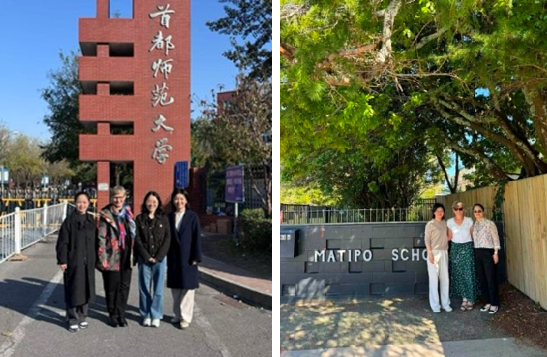
Left: Associate Professor Fiona Ell and Jingjing Liang from the University of Auckland visited research partners at Hangzhou Normal University and Capital Normal University in October to November 2025 as the first reciprocal exchange.
Right: During Associate Professor Yiling Yao and Dr Sisi Han’s visit to Auckland in February 2026, the group visited Matipo Primary School to observe a Year 3 mathematics class. - Programme Santiago Agent Seminar
- Dec 2012 Agent Newsletter
- Capability marketing
-
German students discuss sustainability with the Speaker
Mallard, a former Minister of Education (1999-2005), was eager to engage with students during his trip to Germany in January.
Olga Elli, ENZ’s Market Development Manager Europe, said LMU’s strong focus on sustainability research and interest in New Zealand presented a great opportunity for Mallard to discuss areas of mutual interest, and encourage young Germans to look to New Zealand to study.
“LMU is very keen to build on their existing links in New Zealand and formally partner with New Zealand universities,” said Olga.
“The Faculty of Geography, where Mallard spoke, has many links and relationships with New Zealand institutions and researchers. For Example, New Zealander Gordon Winder, Professor for Economic Geography and Sustainability Research at LMU Munich is Honorary Research Fellow at the School of Environment (The University of Auckland).”
During his visit, Mallard gave a presentation on “Sustainability, Conservation & Education in New Zealand” to geography and geology students. They asked lots of questions about sustainability, pollution, climate change, and what New Zealand’s response is to these challenges.
“Mallard emphasised that increased collaboration between our countries in areas of environmental research can create solutions to global issues. He also spoke of kaitiakitanga and the sense of responsibility Kiwis feels to protect their environment, which was really interesting to the students.”
After the presentation, the students continued the conversation with the Speaker at a reception alongside the New Zealand Ambassador to Germany HE Rupert Holborow and ENZ’s Team Europe.
“We will be working closely with LMU to foster relationships with New Zealand providers.” Said Olga.
- IMG 6153