Search
Showing 10 of 7351 results
- China forum
- Naluri Margaret Ziena Govenor General
- people nziec
-
Festival puts spotlight on global citizenship
The three-day summit held in-person at Wellington’s TSB Arena and around the world virtually, hosted more than 1,300 attendees from across all New Zealand regions. The event also attracted an online audience from more than 30 countries.
ENZ supported several international students and Prime Minister’s Scholarship alumni to attend the festival including Matt Le, who says the three-day summit was a valuable and memorable experience to be part of.
“Simply put, Festival for the Future represents the idea of: when change-makers get into the same room and have an open discussion about the future, great things are bound to bloom.
Matt says he enjoyed the inspirational stories and meaningful conversations cultivated by the event.
“For me, it was the realisation that change is possible, and change can start today.”
ENZ Global Citizens Manager Carla Rey Vasquez says the festival was a great opportunity to advance continued work on Global Citizenship, the third pillar of the International Education Strategy (NZIES).
“We partnered with Inspiring Stories because we firmly believe in the kaupapa of Festival for the Future, we want to show the world that New Zealand is a place where people care, where they take action on the things they care about and where new thinking is encouraged.”
As a silver sponsor of the festival, ENZ hosted attendees in a lounge on the festival’s marketplace floor, where they were invited to share coffee and a korero/conversation about international education and what it means to them. Their responses are being collated by ENZ and will help shape future work in advancing Goal Three of the NZIES.
Carla says ENZ wants every student who engages with the New Zealand education system to unleash their potential to change the world.
“The expo space offered ENZ the opportunity to connect directly with change-makers, innovators, influencers, leaders and dreamers, and to hear their thoughts about what Global Citizenship means to them, and what a New Zealand education can offer the world.”
The booth was visited by over 800 participants, and the team conducted and collected over 500 surveys.
“These insights will be critical in informing our approach to Global Citizenship strategy and how ENZ can contribute to this space in the future,” Carla says.
ENZ also supported the Global Impact Award during the event’s awards night. The award was presented to Francesca Goodman-Smith - a young New Zealander taking action to stop food waste globally, and presented by ENZ Chief Executive Grant McPherson.
See a list of nominees and winners of the 2021 Impact Awards here: theimpactawards.nz/2021-winners
If you’d like to know more about the Festival for the Future and ENZ’s involvement, get in touch with us here: info@enz.govt.nz
-
10 years of Impact: Festival for the Future is back in-person
Festival for the Future 2021 is a three-day summit showcasing leadership and innovation for impact.
This year, the festival will feature more than 35 speakers, including Deputy Prime Minister Grant Robertson; Animation Research Managing Director Sir Ian Taylor; Ethique Founder Brianne West; Young New Zealander of the Year Jazz Thornton; Banqer Founder and Impact Award Winner Kendall Flutey; and Sam Stubbs, Founder of Simplicity.
ENZ is proud to partner with Inspiring Stories and the Festival for the Future as a silver sponsor, and will have an exhibition space on the festival’s marketplace floor. Through this partnership ENZ is advancing work towards the third pillar of the International Education Strategy 2018 - 2030, Global Citizenship.
ENZ is also proudly supporting the Global Impact Award, presented to a young New Zealander who demonstrates leadership and takes action to support people and communities beyond our shores, especially in developing countries. The award will be presented as part of the Impact Awards night on Saturday 31 July.
Tickets are on sale now: https://www.festivalforthefuture.co/
Learn more about the Awards night at: https://theimpactawards.nz
- Media famil India Priyanka Srivastava
- Lead Management System Instruction Manual Thailand
- Immigration photo
- Ak uni prof Rowe Picture2
-
NZ EdTech breaks into Middle East market with ‘Play Code Learn’ teaching solution
ByteEd is a New Zealand EdTech company with a mission to empower future generations to become creators of technology rather than just users. The company started out in 2018 by teaching industry-standard programming to high school and university students to create virtual reality worlds. However, a need to start reaching a younger audience was identified due to a lack of foundational concepts.
This led Founder and CE, Peter Dong and his team, to develop a comprehensive solution for students in their early years, using ‘Play Code Learn’ hands on kits combined with augmented reality and artificial intelligence to address this gap.
It is this solution that has been adopted as a core resource by Higher Colleges of Technology (HCT) in the United Arab Emirates for its new Computational Thinking course. All Emirati graduates from their six colleges will learn computational thinking and then using the Play Code Learn resource will teach this in schools where they will become teachers.
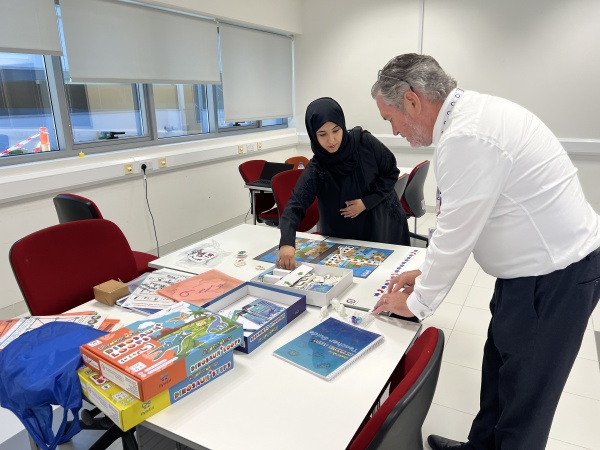
Dr Robert Miles and Haya Al Nuaimi undertaking training on the Play Code Learn kits at HCT Ras Al Khaimah
Peter says that getting to this point has been the culmination of several years of hard work and relationship building, with patience and persistence being key to their success.
“We went into this process knowing that it would take time. We started with a real understanding of our customers’ needs and in particular those of HCT. HCT is a large organisation and we needed to build relationships with multiple key decision makers.
“We are so excited to have made this breakthrough into the UAE and hope it paves the way for more New Zealand EdTechs to do the same;” said Peter.
“As more educators at HCT in the UAE use our solution and collaborate with ByTeEd, then we’ll be building New Zealand’s reputation for our country’s capability in developing innovative and valuable EdTech solutions,” he added.
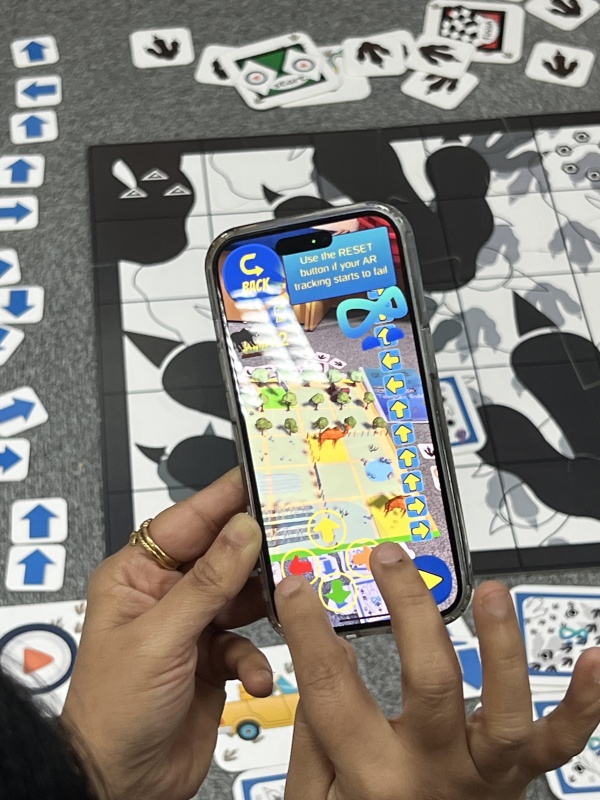
A student using augmented reality to program while the physical learning kit can be seen in the background.
The opportunity to work with HCT all came about from an introduction that was facilitated by Education New Zealand Manapou ki te Ao (ENZ) at the New Zealand Pavilion at the Dubai World Expo in early 2022. Several New Zealand EdTech companies were invited to be part alongside other New Zealand education providers.
Dr Angela Fitzgerald, Executive Dean – Faculty of Education at HCT commented that the work that her Faculty was doing with ByteEd is powerful.
“Their approach empowers teacher educators through lived experiences of computational thinking to prepare future teachers in equally dynamic ways to equip young children with these very skills and knowledge. This will be necessary as they navigate their future worlds,” said Dr Fitzgerald.
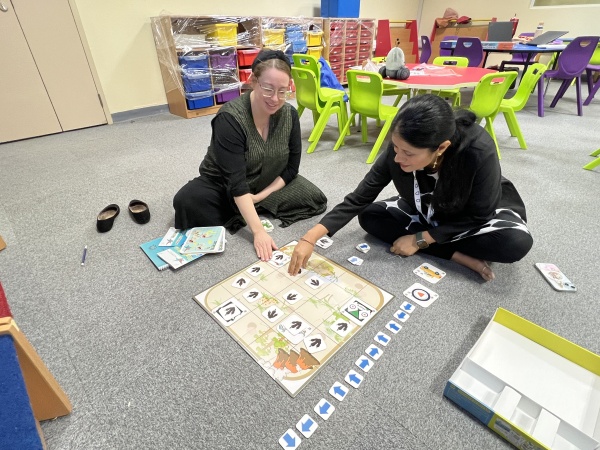
Lecturer Jennifer Filinuk and Senior Lecturer Savita Parashar are using the hands-on learning tools to learn computational thinking before combining it with augmented reality.
When asked what advice ByteEd would give to a fellow EdTech looking to expand their business overseas, and specifically into the Gulf Cooperation Council countries, Peter had some nuggets of advice.
He said that taking the first step to explore the market and gauge interest from target customers is key to gaining that initial understanding of the potential, as is gaining a clear understanding of the problem that you’re aiming to solve for this market.
“Show that you’re not just another visitor and be prepared to make multiple visits and build relationships.
“There are many opportunities in the Gulf region for New Zealand EdTech companies, with more funding available here due to a strong focus on education. The region is also one of few where the younger population is growing,” said Peter.
“There is also significant competition in this region however, so make sure to research potential competitors and consider how to position your company and product effectively”, he concluded.
For more information
ENZ, alongside EdTechNZ, recently hosted a Middle East EdTEch market deep dive with a presentation delivered by Nick Sheppard, Trade and Commercial Advisor from New Zealand Trade and Enterprise based in Dubai. Joining him in the session were the Founders of New Zealand EdTech’s ByteEd, Komodo Wellbeing and EDconnect. You can watch a recording of the presentation here with the slides available here.
If you have further questions about the support that ENZ can provide New Zealand EdTechs overseas, please contact ENZ’s Business Development Manager, Alana Pellow – alana.pellow@enz.govt.nz.