Search

Showing 10 of 7292 results

  • nz study abroad

  • Global citizens 830 card

  • Lavinya brighter

  • NZ-China Tripartite Partnership Programme Update 

    First established in 2005, the NZ-China Tripartite Partnership Fund is an ENZ sponsored initiative to support the development of diverse research relationships between New Zealand and China. This Fund supports our wider goals to develop strong global connections and highlight the quality of New Zealand education and research. 

    ENZ is pleased to announce the 2023-24 New Zealand – China Tripartite Partnership Fund recipients: 

    1. “Teaching physical education for the 21st century: Building collaborative partnerships to enhance the teaching of PE in schools” Associate Professor Alan Ovens, the University of Auckland will partner with Beijing Normal University and Gannan Normal University. 
    2. “Identification of molecular biomarkers of pain in red deer” Associate Professor Kevin Lawrence, Massey University will partner with City University of Hong Kong and Qingdao Agricultural University. 
    3. “The Digitalization of School Governance: A Comparative Study of School Governance between China and New Zealand” Liuning Yang, University of Auckland will partner with Peking University and Guangdong University of Foreign Studies. 

    ENZ also recently caught up with the 2022 NZ-China Tripartite Fund recipients to hear how their Tripartite Partnership research projects are tracking a year on. Professor Nicholas Rowe at the University of Auckland visited their research partner in May to provide a workshop at Beijing Normal University.

    Workshop participants at Beijing Normal University

    Professor Rowe also virtually presented on their project, Teacher training for creativity and collaboration at the NZ-China Higher Education and Development Symposium 19 May at Yangzhou University.  

    The research project Professor Stephen Croucher and Associate Professor Ming Li from Massey University are working on with their Chinese partners was recently featured as a case study in a publication commissioned by New Zealand China Council. You can learn more about this Tripartite research project, “Protection of the Endangered Languages and Cultural Diversity in West China: A Case study of Miao Minority Language in Guizhou Province, China” in Collaborative Horizons.  

    Dr Shengnan Wang at the University of Auckland is currently recruiting participants for The Project Hui: An innovative virtual exchange programme for preservice teachers in New Zealand and China.” Wang will travel to China in October to meet with research partners at Beijing Normal University to discuss publication and future collaboration opportunities. 

    The New Zealand China Tripartite Partnership Programme is experiencing a surge of activity as researchers between New Zealand and China plan and embark on travel to continue their research. 


  • International students report high satisfaction as New Zealand sees steady recovery in enrolments

    This year, 87 percent of students gave a positive rating of their overall experience, maintaining the upward trend seen in 2024 (86%). The proportion of students who rated their experience as ‘excellent’ rose to 43 percent, a two percent increase from the previous year. 

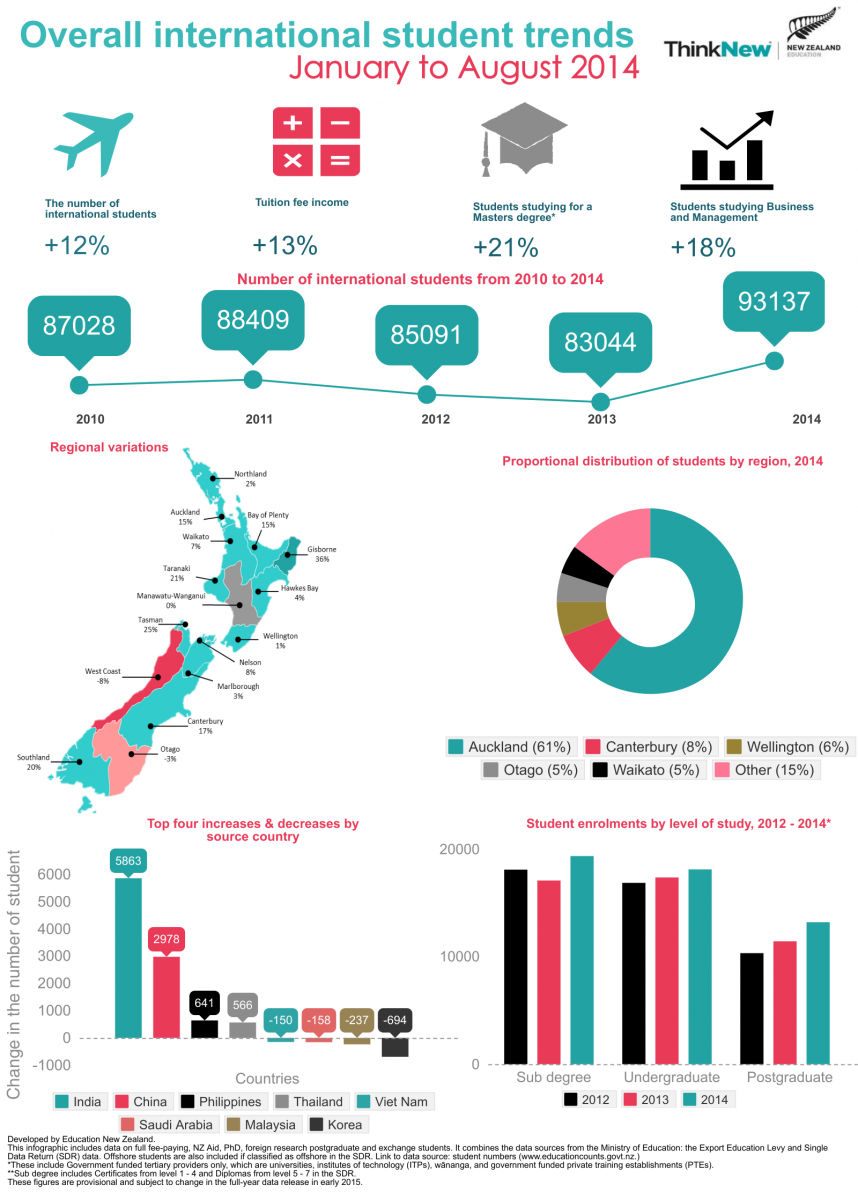
    These strong satisfaction results come asinternational student enrolments in New Zealand continue to grow. Between January and April 2025,63,610 international studentswere enrolled with New Zealand education providers, a16% increasecompared to the same period in 2024 (54,690), and a49% increaseon 2023 (42,700). 

    All education subsectors saw growth, with Private Training Establishments (PTEs) showing the strongest increase at +41% compared to 2024. 

    China and India remained the top source markets, followed by Japan, South Korea, Sri Lanka, USA, Nepal, the Philippines, Thailand, and Germany. Notably, Sri Lanka rose to fifth place (from ninth), and Nepal to seventh (from eleventh), reflecting shifting dynamics in student mobility. 

    What students value most  

    Students were most positive about the people and connections they made in New Zealand (92%), the quality of their education (90%), their arrival and orientation experience (89%), the ease of making study arrangements (87%), and their overall living experience (87%). 

    International students’ experiences of making study arrangements have notably improved, with 80 percent of students rating their experience with the visa application process positively (up from 78% in 2024), and 74% positively rating the time taken to get their visa (up from 64%). 

    Education New Zealand and Immigration New Zealand will continue to collaborate on provision of information to students to ensure an enhanced student experience. 

    The survey also shows an increasing proportion of international students regard New Zealand as offering good value for money, with positive perceptions rising from 65% to 76%. 

    Education New Zealand's Chief Executive, Amanda Malu, said the results reflect New Zealand’s ability to provide a high-quality education within an environment that fosters meaningful connections and relationships.

    “This is encouraging news for New Zealand. The fact that students continue to rate their experience here as excellent is a credit to our education providers and speaks to the warmth of the welcome our communities extend to international students,” she said.

    “We’re seeing a steady and encouraging recovery in international education. It’s not a boom, but a sign that our collective efforts are making a difference. What matters most is that students are not just coming to New Zealand, they’re having a high-quality experience that supports wellbeing and a sense of belonging.”

    “Under the International Education Going for Growth Plan, we’re focused on thoughtful, sustainable growth. These insights help us ensure that our progress is not just about numbers, but about delivering long-term value to students, communities, and the wider economy.”

    Education New Zealand’s Director Insights and Performance, Marie Clark, said the survey continues to be a key piece of work for ENZ and a useful tool for the international education sector. 

    “It remains the only national survey focused on international student experience in all subsectors in New Zealand. With several years of data now collected, we’re building a meaningful picture of student experience over time,” she said.  

    “The ability to break down insights by variables like country, sector, and gender makes the dataset especially useful. We expect the report and Tableau dashboards will be very practical resources for anyone working in the sector,” Clark added.  

     For further information: 

    • Sai Raje | Senior Communications Advisor, Education New Zealand Manapou ki te Ao 
      sai.raje@enz.govt.nz | +64 21 479 649 

    Notes to Editors: 

    About the New Zealand International Student Experience Survey 2025 

    The survey aims to better understand the overall experience of international students enrolled with New Zealand education providers, as well as recent graduates. It also identifies areas for improvement to enhance the student journey. 

    Fieldwork was conducted from 28 April to 19 May 2025 with 5,420 respondents across all education subsectors and stages of study. 

     About Education New Zealand Manapou ki te Ao 

    Education New Zealand Manapou ki te Ao (ENZ) is the government agency dedicated to helping New Zealand realise the social, cultural, and economic benefits of international education. Our role is to promote New Zealand as a high-quality education destination offering excellent education and student experiences.

    With approximately 85 staff in 13 locations around the world, ENZ works closely with New Zealand’s diverse education sector which includes schools, English language providers, Private Training Establishments, Institutes of Technology and Polytechnics (New Zealand Institute of Skills and Technology Te Pūkenga), and universities.

    Internationally, we work with a range of education stakeholders, including government agencies and education providers to identify and encourage sustainable growth opportunities for New Zealand’s education sector.

  • International student employment: overcoming barriers

    The panel, chaired by ENZ’s Director Student Experience, Hayley Shields, featured a diverse and informed range of views from

    • Brett Berquist, Director International at the University of Auckland
    • Dr Cate Gribble, Senior Research Analyst at the University of Auckland
    • James Koo, former international student and founder and CEO of Niesh, a free student discounts app
    • Paul Hickey, Managing Director at SpeakData
    • Charan Mohan, former international student and now Business Intelligence Analyst at SpeakData.

    Dr Cate Gribble talked about the need to raise awareness of the benefits to businesses of employing international students to counter employer concerns around the challenges of international student employees, including perceptions they won’t fit culturally, their English will be limited or that their visa situation will make paperwork too challenging. Students also find their international work experience in their home country is not always valued here, and employers often require New Zealand citizens or Permanent Residents.

    Brett Berquist added that we need to counter the perception that international students will not stick around.

    “The reality is that all students, both domestic and international, are equally mobile. Employers need to stop thinking Kiwis make employees for life, and that international students are a flight risk.”

    James Koo said the lack of transparency around these concerns is a challenge for international students. As a result, many international students end up sending a generic CV and cover letter to any and all available jobs, too discouraged to spend time tailoring their CVs to each role.

    James also noted that student expectations can sometimes be unrealistic, and some students expect to work in large, prestigious companies whereas most New Zealand companies are SMEs – which he noted can actually offer more opportunities and experiences for students and recent graduates.

    SpeakData’s Paul Hickey then talked about his experience  hiring international students, such as fellow panellist Charan Mohan. While Charan clearly had the hard skills required for his company, Paul needed to be convinced of his soft skills, which he calls being ‘Kiwi-ready.’

    017 Studyinnewzealand PAVE2“Often, international students come into interviews and talk solely about their studies and qualifications when actually, we’re just as interested in hearing about their interests outside of work.

    “That social aspect plays a big part – sharing a story about kayaking in Taupo at the weekend or going to an All Blacks game is an easy way to connect with Kiwi employers.”

    Paul also talked about the need to work with institutions to create a pipeline of talent.

    “Employers often take a short-term view and hire people ‘just in time’ rather than looking ahead, whereas if you expect to have 10 new positions available in two years’ time, why not try to establish a pipeline for talent through local institutions who can connect you with new graduates with relevant skills?”

    Panellists also agreed that having internships and work experience in education programmes will also help international students get into the job market when they graduate.

    Brett concluded that while all these approaches can reduce barriers, ultimately, a strategy is required – supported by data that is already available in reports such as the Ministry of Education’s ‘Moving Places’, ENZ’s Beyond the Economic and Immigration New Zealand data.

    It is an ongoing discussion that will continue to be in the spotlight in New Zealand as the industry works to meet international student expectations of global employability.

  • DSC 9572 opq771109478

  • CF1

  • school Jan August 2014 2 2

  • nzisa 2

What's in it for me?