Search
Showing 10 of 7357 results
-
From the CE: Our focus for the next 12 months
Kia ora tātou,
"To help providers of international education to build back onshore offerings" is Focus Area One of the New Zealand International Education Strategy. There are nine key short-term actions in Focus Area One. Education New Zealand Manapou ki te Ao is the lead Government agency in four actions and has an important role to play in eight of the nine. It can be no surprise then that for the next 12 months, and our next financial year starting in June, that the majority of ENZ's energy, time and resources will be focused on attracting learners to study with New Zealand.
This is no small challenge. Our borders have been open now for just eight months. And while students are returning, the latest visa application numbers I've seen report in the order of 43,000 applications (offshore and onshore), the recovery is variable at best. Even within the university sector, that on the face of it looks to have recovered better than others, the experience is mixed. Within the PTEs and English Language schools we have a long way to go to reach the levels of 2019 and early 2020. In such a highly competitive market, it is going to take some time to regain awareness with learners and overcome the head start other countries gained.
All our budgets are tight. At the very time we need to be investing and getting offshore to renew partnerships and networks, we are all resource-constrained and having to watch every cent. ENZ is no exception.
This means that for the next 12 months, more than ever, we need to focus. We need to focus our limited resources to where they have the greatest impact, and we need to be aligned as one with the sector.
India is an excellent example of a partner market that is worthy of focus. I have just returned from leading an ENZ delegation to India. India is forecasting economic growth of 6-7% every year for the next three to five years. They know, and their national education strategy makes it clear, they need educated, skilled and talented people to realise this opportunity. I repeatedly heard, "They want their people back".
That five Deputy Vice Chancellors joined the 23 sector representatives tells you how important India is. As one of the five said to me, "India today is what China was 15 years ago".
To be successful we need to agree that India is important. It is. We need to go there together. We will. We also need to work with our colleagues in other Government agencies to ensure they are aligned. This is what success looks like for me. And this is the level of focus on building back, and the level of partnership with the sector, that I expect from my ENZ teams over the next 12 months.
I will also work with them to secure the many gains we have made in government-to-government relationships, scholarships, diversity, equity, and inclusion, social licence, and in building a sustainable future. All the good work of the past two years remains important for the long-term future, set out in Focus Area Two: Building a new future for international education.
We are all very passionate about international education and its ability to transform lives. In 2023/24 when the sector is stronger than today, all of us will be better placed to address the short term and the medium to long term. Today our focus must be the immediate needs.
He moana pukepuke e ekengia e te waka
A choppy sea can be navigated
This proverb acknowledges the changing and challenging environment that we currently find ourselves in and how it can be navigated by collaboration and innovation.
Ngā mihi nui,
Grant McPherson
-
May update from Immigration New Zealand
Update on Student visa processing*
Since New Zealand’s international borders reopened in August 2022, Immigration New Zealand (INZ) has received 35,069 student visa applications from international students outside of New Zealand. We have completed 30,936 of these applications.
Our recent processing times for international student visa applications are published on our website. These are updated each month: Visa processing times for international students | Immigration New Zealand
*Figures current as at 10pm on 8 May 2023.
Visitor visas and short-term study
A holder of a visitor visa is permitted to attend a programme or programmes of study which are not more than a total of 3 calendar months in duration per 12-month period.
Recently we have received several queries regarding students intending to undertake a programme of study of more than 3 months duration (for example, a diploma) who wish to begin their studies while holding a visitor visa. This is not permitted as the intended programme is more than 3 months duration. Students must hold a student visa for the full duration of their intended programme of study (or hold an interim visa with open study conditions) if the programme of study is longer than 3 months duration.
Tuition fees
We would like to remind you that changes to the requirements for tuition fee payment evidence for students were introduced last year as part of the Immigration Rebalance.
Students need to pay tuition fees for the first year, or first programme of study (whichever is the shorter), and they will have to prove personal/maintenance funds for the same period. We do not accept payment of tuition fees by instalment; the only exception is for some aviation students.
- Dr Shengnan Wang University of Auckland
- nztech1
- Future Proof 2.0 Graphic Image 1200x628 08
- Valuation.card
- 52890573681 937a2fa356 b
- Lea Welcome to NZ scholar
-
High-level delegation visit strengthens education relationship with India
The New Zealand India Education Week – held from 17-22 April – included senior level participation from New Zealand universities and was designed to further strengthen the strategic education partnership with India.
Education New Zealand Manapou ki te Ao (ENZ) Chief Executive, Grant McPherson, led the delegation across New Delhi, Mumbai, and Chennai.
Demonstrating New Zealand’s overall commitment to India, New Zealand announced an investment of $400,000 towards internationalisation and student mobility initiatives, including the relaunch of the New Zealand Excellence Awards (NZEA).
The NZEA are unique scholarships designed exclusively for Indian students that are jointly funded by ENZ and all New Zealand universities. Since their launch in 2016, the scholarships have enabled more than 200 Indian students to study at one of New Zealand’s universities.
Another key focus for the week was to re-engage with the New Zealand Centre at Indian Institute of Technology (IIT) Delhi and discuss the future trajectory of the partnership.
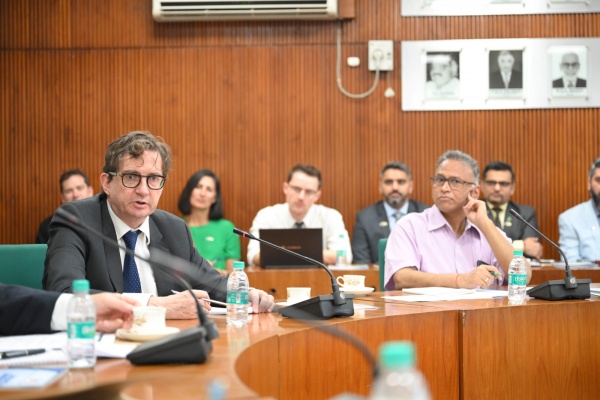
New Zealand High Commissioner to India His Excellency Mr David Pine speaking at a meeting with the Indian Institute of Technology Delhi.
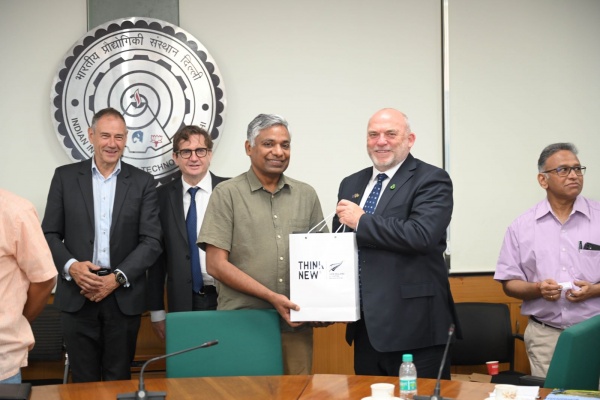
Caption: Education New Zealand Manapou ki te Ao Chief Executive, Grant McPherson (right), thanking Indian Institute of Technology Delhi (IITD) outgoing Dean International Naveen Garg (left) for hosting the NZ delegation at IIT.
Erik Lithander, Deputy Vice Chancellor Strategic Engagement at the University of Auckland, signed an MoU with IIT Delhi on behalf of all New Zealand universities to continue the relationship and further develop the New Zealand Study Centre.
The New Zealand Study Centre was inaugurated at IIT Delhi in February 2020 by Deputy PM Winston Peters, demonstrating the importance of education as a key part of the India-New Zealand relationship.
The week was bookended by two education agent fairs in New Delhi and Mumbai respectively, both of which exceeded expected student attendance numbers.
Speaking at a media briefing held at the New Zealand High Commission in New Delhi during the New Zealand India Education Week, ENZ CE Grant McPherson underlined the importance of New Zealand’s education partnership with India.
“India is one of New Zealand’s priority partner countries for collaborations, exchanges, and student mobility. We are excited that the announcements around the New Zealand Centre strengthening and the extensive package of scholarships under the New Zealand Excellence Awards scheme will further engagement with India,” Grant said.
ENZ Regional Director – Asia, Ben Burrowes, said with the sector’s focus on recovery and reconnections, the New Zealand India Education Week provided a great opportunity to refresh relationships with education sector stakeholders in India.
“India has always been a strong partner to New Zealand in the education space, and students from India consistently make up the second largest portion of international students studying in New Zealand.
“We are delighted for the opportunity that the New Zealand India Education Week offered us to reconnect and refresh our education links with India, and we look forward to building this relationship further over the coming years.”
Additional info –
To begin the week, sector representatives were provided with in-depth insights into the India-New Zealand relationship from High Commissioner David Pine, ENZ in-market staff and a consultant from EY. Representatives attended meetings with government departments such as the University Grants Commission (UGC) as well as B2B institutional networking events to support their university's global engagement. The delegation also met with two Indian Institutes of Technology (IIT), IIT Delhi and IIT Madras.
-
Introducing Sharon-May McCrostie, ENZ’s new Director Sector Engagement
Can you tell us about your professional background including the role you had prior to joining ENZ?
After graduating from the University of Waikato with a Bachelor of Management Studies specialising in Japanese and International Business, I joined the primary export sector. I held a range of sales, marketing and business development roles in the seafood and horticultural sectors with a focus on Asian markets, including with ENZA (the NZ Apple and Pear Marketing Board) in Singapore. My first job was in Bluff, exporting live lobster!
Prior to joining ENZ, I spent 20 years with New Zealand Trade and Enterprise in a range of roles supporting NZ exporters to realise their international growth ambitions. In my last role there, I was Customer Director where I led a team of customer managers supporting digital technology and services exporters across the central New Zealand region.
What are your thoughts on your new role so far?
I feel I have joined ENZ at the perfect time as the team here comes together to co-create next year’s business plan. Early in the role, I was catapulted into focus groups with sub-sectors to understand their priorities and ensure we focus on the right opportunities and challenges to enable the international education sector to flourish. Providers were generous in sharing insights and setting expectations for ENZ, providing important input into the business planning process.
As we work through the process, I have been incredibly impressed with the knowledge of my team and the wider ENZ team, and admire the depth of passion and ambition to ensure we make a difference to the sector.
What do you see as the challenges and potential opportunities for our sector?
The market for international learners is hyper competitive, and our main competitors are driving hard to win market share in the face of ongoing global uncertainty. New Zealand has an excellent reputation for education, but we must be smarter and nimbler to maintain an edge over our competitors and attract quality learners to NZ.
We must continue to build brand awareness and enable agents and providers to provide a compelling case for choosing a NZ education. As the sector shifts from recovery to rebuild, it is an opportunity to think differently about how we partner with the sector to co-create a robust, resilient, and innovative sector that meets the needs of the future learner: I am excited to be part of that conversation.
Outside of work, what do you like to do?
Wellington is blessed with rolling hills that embrace the harbour, and I love running its trails and taking in the soaring views. I also love to swim – mostly in a pool, with the occasional plunge in the ocean. Otherwise, I love to read, rummage through op shops for vintage china and linen, and hang out with my daughters who are my biggest teachers.