Search
Showing 10 of 7357 results
-
Insights Accelerator - 3 things for 30 minutes for PTE and ELS providers
The goal of the Insights Accelerator sessions is to offer concise information and insights to support our PTE and ELS providers. By focusing on three things within 30 minutes, Education New Zealand Manapou ki te Ao (ENZ) hopes to efficiently deliver useful takeaways while being mindful of busy schedules.
ENZ’s General Manager, Sector Engagement and Innovation, Wendy Kerr said that two Insights Accelerator sessions have been held so far and were well received by attendees.
“My team is constantly reviewing ways we can better engage with the sector and add greater value. With this platform, we hope that we can support providers in their strategic planning endeavours through the sharing of useful information about our services, as well as market insights.
“These sessions also provide an avenue for us to understand more about our customers. We will be hosting more of these sessions in the coming months so please keep an eye out for the invitation”, added Wendy.
For the launch session, Nick Sinclair, ENZ’s Global Brand Manager presented on the international advertising campaign: Learn New Every Day, and talked about the campaign rationale, channels and target markets, and campaign assets as well as where and how the sector can use these.
In the second Insights Accelerator, ENZ’s Director Insights Marie Clark presented information on ENZ Intellilab, including 2023 Ministry of Education Student Enrolment Data. Marie shared how providers can access Intellilab and the range of information available. The session also looked at the survey findings from the 2023 New Zealanders’ perceptions of the value of international education research and 2023 International Students Experience research.
If anyone missed the sessions, the slide pack and presentation can be accessed via the links below.
For further information, please contact Jane Yang, ENZ Business Development Manager – jane.yang@enz.govt.nz
-
Meet Up at NZIEC
Meet Up sessions are informal opportunities to connect with delegates during the networking breaks on particular issues or topics.
How do they work? Simply suggest a topic or topics you’d like to discuss. We’ll collate the responses and coordinate the Meet Up topics and times. It will be over to you to strike up the connections and the conversations.
If you have a burning topic you’d like to talk to others about, let us know. Perhaps it’s homestay management, using technology in back of house operations or you’re in a sole charge position and want to connect with colleagues in a similar situation.
Whatever the topic, just let us know and we’ll do our best to include it.We’ll publish a list of Meet Up sessions through the Conference App when it is launched next week.
Email your Meet Up topic suggestions to nziec@verve.co.nz
Please note: Registration closes on Friday 11 August. If you have not yet registered for NZIEC, please secure your place as soon as possible by visiting the NZIEC website.
-
Around the world in five
China
China’s Ministry of Education has approved a slew of new transnational educational partnerships, as the country aims to grow its TNE enrolments from 800,000 to eight million.
Global
Students around the world are more confident about career prospects but are increasingly concerned about a range of other issues, including student diversity and their quality of life, according to the latest Global Student Satisfaction (GSS) Report 2025.
United Kingdom
According to a new report from the All-Party Parliamentary Group (APPG) for International Students, International students contribute more than £41.9 billion annually to the UK economy, with their impact felt in local communities.
Australia
The Australian Centre for Student Equity and Success (ACSES) has released a new report calling for a complete shift in how Australia’s higher education system addresses equity and access issues.
United States of America
An estimated 30% to 40% fewer international students are expected on American college campuses in the fall of 2025, compared with trends in the 2024-2025 academic year, according to NAFSA: Association of International Educators.
-
India insights snapshot
Country dashboard – India
In the year ended December 2024 New Zealand exported $398.02 million of education related travel to India and imported $3.9 million, representing a trade balance of $394.12 million and a total trade value of $401.92 million.
Broad field and level of study for Indian students in New Zealand - 2023
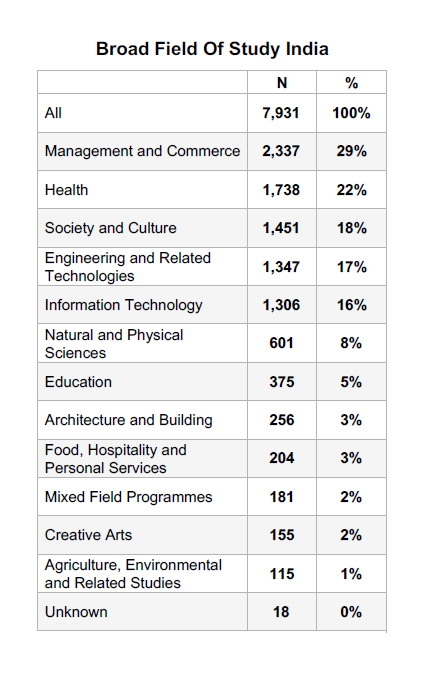
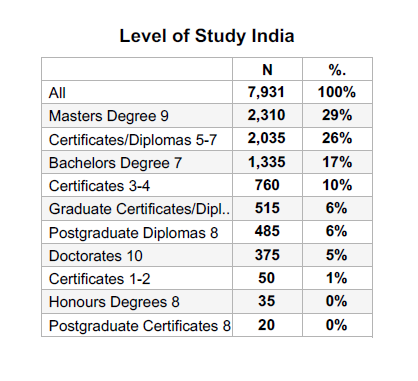
Browse the full country dashboards for India and other markets on this link.
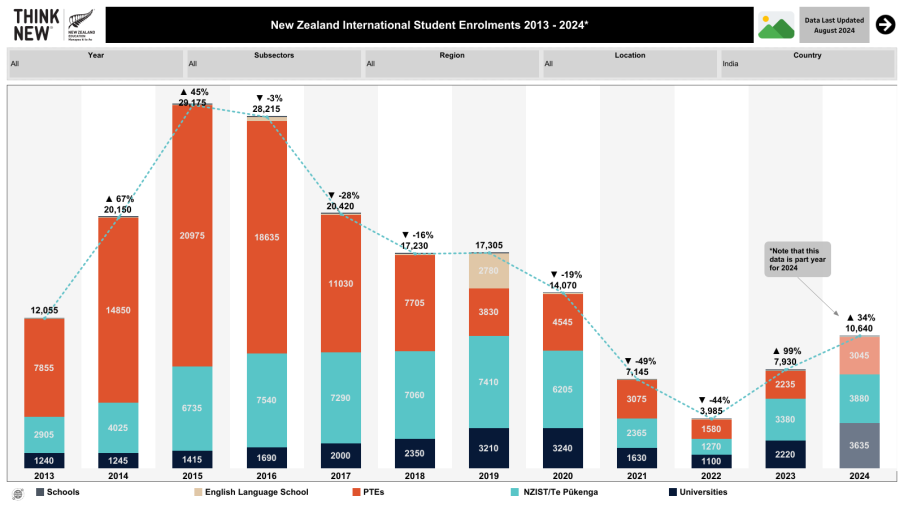
International student enrolments from India
Between January and August 2024, overall international student enrolments from India grew 34% to 10,640 from 7,930 enrolments in the full year period for 2023. Enrolments for universities grew around 64%, private training establishment enrolments grew 36% and Te Pūkenga enrolments from India grew 15% over the same period.
86% of Indian students in New Zealand rate overall experience positively
Indian students are thriving in New Zealand. The New Zealand International Student Experience Survey 2024 reveals that 86% of Indian students rated their overall experience in New Zealand positively.
From high-quality education and a warm, welcoming environment to strong community connections, these insights reflect New Zealand’s continued commitment to delivering a world-class, student-centred experience. -
International students learn how to crack job interviews
The ISA members have attended monthly meetings with the police throughout 2016, as part of an Ambassador programme designed to build awareness of crime prevention methods for students.
Jessica Phuang, Auckland City District NZ Police Asian Liaison Coordinator, said the mock job interviews were set up to show appreciation for the students’ involvement in the programme, as many of them will soon be graduating and searching for jobs.
“Some students were taken aback, especially with problem-solving questions which are not common practice in their own countries,” said Phuang.
The mock interviews were set up in the style of speed-dating, with Auckland Presbyterian Church generously lending its hall for the event.
 Interviewers included school providers, church members, community volunteers, and police Inspectors.
Each ISA member was interviewed for eight minutes, followed by two minutes of feedback on their answers, their CV and body language – before moving on to the next interviewer.
Common feedback from interviewers was that students had a tendency to expose their weaknesses, a cultural practice to demonstrate modesty, Phuang said.
“The interviewers encouraged the students to share their strengths, and demonstrated how to do this without being seen as ‘blowing their own trumpet’.”
The ISA programme is an Auckland-based police initiative that raises issues connected with safety for international students. The initiative was also launched in Wellington in September.

-
Global demand for English language learning: A market still shifting
Globally, more than one million students undertook English language study across the major destinations in 2024, generating around 7.6 million student weeks.
That’s a significant rebound from the pandemic years, but still well below 2019 levels, when the sector reached over 1.3 million students generating more than 10 million student weeks. The expectation was that 2024 would continue the strong momentum seen in 2022 and 2023. Instead, growth slowed.
As Ivana outlined, this wasn’t due to a drop in interest in learning English. Demand remains strong. What’s changed is the environment around it.
Across many of the major destinations, governments introduced tighter visa settings, enrolment caps and more restrictive policies. At the same time, students and families have been dealing with rising costs, weaker currencies and increased uncertainty. The result is a more constrained and more selective market. In 2024, global student numbers declined by around 6 percent and student weeks by 11 percent compared with the previous year.The presentation also highlighted that the shape of demand is changing.
Adult learners, once a core part of the sector, are declining across many destinations. In their place, younger learners are entering earlier, often for shorter stays. The average age of students’ first study abroad experience has dropped from around 15–16 years pre pandemic to closer to 12–13 today.
At the same time, traditional patterns of mobility are changing. More students are choosing shorter, more flexible experiences. Some are staying closer to home, supported by the growth of in country options and transnational education offers.
There’s also growing competition from newer destinations. Markets such as the Philippines and Dubai are expanding quickly, offering alternatives that can be closer to home or more affordable for students.
Taken together, these shifts point to a sector that is no longer simply rebounding, but actively reshaping. As Ivana noted during the session, the key driver is no longer just student demand, it is the interaction between demand, policy settings and economic conditions.
Download a copy of the report or view the presentation on our IntelliLab website.
Webinar on the global demand for English language provision | IntelliLab
-
Game on English – Golf launched in Korea
Game on English is an edu-sport programme that combines intensive English language classes with top quality sports training. Game On English – Golf is aimed at talented young Koreans, 13 years and over, who want to become professional golfers.
“Game On English combines New Zealand’s expertise and passion for sport with our education system that consistently ranks amongst the best in the world,” said Lisa Futschek, Education New Zealand’s Regional Director for Americas, Japan, and Korea.
“With an estimated 70,000 Koreans passionate about golf, and both our countries’ claims on World #1 women’s golfer Lydia Ko, it seemed the obvious sport to test out the Game On English market in Korea.”
To launch and raise public profile of Game On English in Korea, four young Korean golfers will be awarded scholarships to spend a month in New Zealand working on their game with the professionals at New Zealand’s Institute of Golf while improving their English at English language school, Unique New Zealand.
Applications for these scholarships will open in mid-2015.
-
Full house fairs
The fairs in Santiago, Sao Paulo, Rio de Janeiro and Beijing, as well as New Zealand fairs in Surabaya and Jakarta in Indonesia, were all characterised by big crowds, with lots of keen interest shown by prospective students.
The prize in the round went to Beijing, where the New Zealand exhibition was awarded ‘best pavilion’ by the organisers of the China International Education Exhibition Tour (CIEET). CIEET is acknowledged as China’s most influential international education fair ¬– the October 2013 tour attracted 443 education institutions from 32 countries, and over 40,000 visitors. Numbers were high again this year: on day one of the Beijing event, Education New Zealand staff handed out 1200 brochures.
We applied a bit of ‘Think New’ to our fair programme in Latin America this year. Innovations introduced in Chile included partnering with a reputable local education media/expo company to run a New Zealand only fair, which produced real improvements in the number and quality of student attendees. This bodes well for the coming fair in Bogota, Colombia. In Brazil we attended the FPP Edu-Expo commercial fairs in Sao Paulo and Rio de Janeiro and the New Zealand pavilion at both fairs was really popular.
Another innovation was to host a live feed from two Brazilian bloggers currently studying in Dunedin (between them this pair have an online following of several million). The sessions with Caio Komatsu and Luana Mazotti at the New Zealand stand ¬in Sao Paulo attracted a lot of attention, with the second sitting extended from 30 minutes to an hour to accommodate all the questions from students at the booth.
In Indonesia, the New Zealand Education Fair in Jakarta was opened by the Minister of Tertiary Education, Skills and Employment Steven Joyce. The official launch, accompanied by a cultural performance by Te Puia, was well attended by over 20 media organisations, including national and cable television.
A new aspect of the Jakarta fair was an alumnus presentation, by a graduate of Takapuna Grammar School and Auckland University. Vikra Ijas held a large audience in thrall with a humorous presentation on ‘The seven hardest things about living in New Zealand for Indonesian students’. With a closing endorsement “Life is about choices, I made the right one” it was a high value addition to the fair programme, the organisers believe.
Student numbers were high in Jakarta and in the fair in Surabaya the day before, with lots of the attending institutions commenting on the increased numbers of high quality prospective students, and greater awareness of New Zealand as a preferred study destination.
Next up:
March closes with events in Kuching, Malaysia (where New Zealand Week festivities are keeping Kiwis in the spotlight in lots of ways), and Shanghai and Guangzhou, China. In April, the fair round kicks off in India and in the Gulf states.
Hyderabad fair advisory
If you’re interested in The Hindu Education Plus fair in Hyderabad on 27 April, please get in touch with the organisers directly. Due to space restrictions we will run only a standalone ENZ booth. If you want to participate please contact event organisers directly: www.thehindu.com/features/education/article5339215.ece. -
New Zealand top of the world in university sustainability stewardship
New Zealand universities have come out on top of the world for sustainability stewardship in the Times Higher Education Impact Rankings 2024.
New Zealand universities’ approach to sustainability and equality has been announced as world-leading by Times Higher Education (THE) in its most recent Impact Rankings (2024). The stewardship rankings saw New Zealand score an average of 85.3 to come out ahead of Australia (84.4) and Hong Kong (81.9). All eight New Zealand universities participated in the rankings.
Now in its sixth year, the Impact Rankings is the only ranking system in the world that measures universities’ contributions to the United Nations’ Sustainability Goals (UN SDG’s). The Rankings assess the commitment made by universities to sustainability across four broad areas: research, stewardship, outreach, and teaching.
In topping the table for sustainability stewardship, New Zealand’s universities have scored well against indicators such as tracking food waste and having sustainable food choices on campus (SDG 2), the proportion of senior female academics (SDG 5), having water reuse policies and measurements (SDG 6), ensuring energy efficiency with renovations of buildings (SDG 7), and guaranteeing a living wage (SDG 8).
New Zealand universities also came second equal in the world against sustainability outreach, meaning high scores were achieved for contributing to policies addressing poverty (SDG 1), collaborating with health institutions (SDG 3), providing programmes for the local community to learn about energy efficiency (SDG 7), participating in cooperative planning for climate change disasters (SDG 13), and providing expert advice to government (SDG 16).
ENZ’s Acting Chief Executive Dr Linda Sissons welcomed the results and said the global recognition for New Zealand’s universities working hard to make a positive impact in the face of pressing environmental and social challenges world-wide was significant.
“New Zealand’s education system is guided by Kaitiakitanga (the Māori concept of guardianship). This principle instils a deep sense of connection to our land and a commitment to ensuring its health and vitality for future generations.
"Kaitiakitanga informs the approach taken by our universities to resource management, conservation, and sustainable development that all contribute to the UN’s SDGs particularly in the areas of food security, bioenergy, sustainable urban development, and climate change,” said Dr Sissons.
Dr Sissons added “It is incredibly positive to have our approach to sustainability stewardship and outreach recognised as world leading. This is particularly important to us as we know that students around the globe are increasingly prioritising environmental and social responsibility and choosing to study at institutions that align with their personal values.”
In this year's Impact Rankings, a record 2,152 universities from 125 countries/regions were assessed. Progress is measured for each of the individual 17 SDGs, and across the goals as a whole. View the full Impact Rankings 2024 results here.
Top countries/regions for sustainability stewardship in THE’s Impact Rankings 2024
Country/region
Number of ranked universities
Average stewardship score
New Zealand
8
85.3
Australia
21
84.4
Hong Kong
5
81.9
Ireland
8
81.4
Canada
24
80.5
United Kingdom
68
79.7
United States
46
69.1
South Korea
24
67.9
Belgium
5
65.2
Netherlands
6
64.5
Note: Table only includes nations with five or more ranked universities. Credit: Times Higer Education Rankings 2024
Top countries/regions for sustainability outreach in THE’s Impact Rankings 2024
Country/region
Number of ranked universities
Average stewardship score
Hong Kong
5
81.4
New Zealand
8
80.4
Canada
24
80.4
Australia
21
80
Ireland
8
76.4
United Kingdom
68
75.6
Belgium
5
71.9
Germany
8
68.1
South Korea
24
67.9
Netherlands
6
66.2
Note: Table only includes nations with five or more ranked universities. Credit: Times Higer Education Rankings 2024
For further information
Stephanie Morison, Senior Communications Advisor,
Education New Zealand Manapou ki te Ao
Stephanie.Morison@enz.govt.nz | +64223020104
Notes to Editors:
About Education New Zealand (ENZ) https://www.enz.govt.nz/
Education New Zealand Manapou ki te Ao (ENZ) is the government agency dedicated to helping Aotearoa New Zealand realise the social, cultural, and economic benefits of international education. Our role is to promote New Zealand as a high-quality education destination offering excellent education and students experiences and to encourage New Zealand students to study overseas.
With approximately 110 staff in 16 locations around the world, ENZ works closely with New Zealand’s diverse education sector which includes schools, English language providers, Private Training Establishments, Institutes of Technology and Polytechnics (Te Pūkenga), and universities. Internationally, we work with a range of education stakeholders, including government agencies and education providers to identify and encourage sustainable growth opportunities for New Zealand’s education sector.
-
Educational publishing showcases New Zealand strengths
Over the last three years, ENZ has supported the offshore activities of educational publishers under the Educational Publishing Export Programme, managed by the Publishers Association of New Zealand (PANZ).
ENZ’s Business Development Manager, Adele Bryant, said New Zealand has a proud history of educational publishing, from Dame Marie Clay’s development of reading recovery to Dame Wendy Pye’s mission to teach the world to read.
“New Zealand educational publishing builds on the quality of New Zealand teachers, the progressive nature of our education system and our innovative and responsive publishing sector,” said Bryant.
“Our industry’s digital publishing capability is also capturing the attention of new markets in Asia.”
Earlier this month, a senior delegation from China’s Higher Education Press (HEP) visited New Zealand to meet four New Zealand publishers in Wellington. HEP is the largest publisher in China of university and college-level textbooks, and also publishes Chinese language learning resources. China’s publishing market is the second largest in the world.
The New Zealand publishers took the opportunity to showcase their capability: Lift Education’s multi-media CSI Literacy resources for 8-13 year olds, Cognition Education’s range of customised resources and New Zealand Council for Educational Research’s academic, testing and assessment services.
The President of PANZ, Melanie Laville-Moore, provided an overview of educational publishing in New Zealand while ENZ’s Adele Bryant set the scene with an introduction to the New Zealand educational system.
New Zealand publishers are making inroads into China led by companies like Wendy Pye Publishing. Wendy Pye’s Key Words, written by one of New Zealand’s favourite children’s writers, Joy Cowley, is now being used in Chinese schools to teach English.