Search
Showing 10 of 7357 results
-
'Ask New Anything' campaign update
ENZ’s most technologically sophisticated campaign yet, ‘Ask New Anything’, is now live and we invite New Zealand education providers and ENZ Recognised Agencies to join us.
Aimed at prospective students, ‘Ask New Anything’ takes 100 questions frequently asked by international students considering New Zealand as a study destination and provides unscripted video responses from real international students, sharing their first-hand knowledge of studying and living in New Zealand.
All 100 Q&A videos are available on YouTube for New Zealand education providers and ENZ Recognised Agencies to use in your own marketing. The hero video, featuring a series of students answering the question “What surprised you about studying in New Zealand?” is available for download on the ENZ Brand Lab.
Digital media advertising will run for the next six weeks in 14 key markets: Brazil, Colombia, France, Germany, India, Indonesia, Italy, Japan, Korea, the Philippines, Thailand, the United Kingdom, USA, and Viet Nam. We encourage you to make use of the content and to leverage the campaign during this time.
- Explore the Ask New Anything campaign page
- Read more about the campaign and how to leverage it
- Browse campaign assets on the Brand Lab
By interacting with Tohu - the Study in New Zealand chatbot, or directly with current students through Instagram Live events and on a new Facebook group, prospective students can ‘Ask New Anything’. The chatbot technology, use of social channels and content localisation mean every prospective student will have a unique and personalised experience.
At time of writing, these Q&A videos are currently trending on Tohu:
- What are New Zealanders like?
- Are there any postgraduate training opportunities in New Zealand?
- What’s the learning style like at New Zealand schools?
- Are the facilities high quality in New Zealand?
- How many different cultures are at a New Zealand school?
The bespoke ‘Ask New Anything’ campaign was launched in China this week, using China-specific technologies and platforms. Read more about the China campaign on the ENZ corporate website.
-
Insights from Europe's biggest international education conference
EAIE is the main annual international education conference in Europe, and September’s event in Helsinki was the largest to date, attracting 6,200 higher education professionals from 95 countries.
ENZ Senior Advisor – Special Projects, Bronwyn Shanks, sees unique opportunities in the Europe market. “New Zealand education offers a contrast to the traditional, theoretically-based learning we often see in European systems,’’ she says. “New Zealand’s natural environment is already a big drawcard, and our practical, hands-on approach also attracts European students to New Zealand’s ITPs and PTEs.’’
European students willing to pay for education like to see a clearly defined return on their investment, she says. This means gaining skills for the future of work, learning to think critically, collaboratively and globally.
In areas of Europe where youth employment is high — it’s over 20 percent in France and above 30 percent in Italy and Spain — the focus is also work preparedness and employability.
ENZ’s focus markets in Europe are Germany, France, the UK and Scandinavia, as well as Italy at secondary school level only. Each market has its own nuances, but all have strong bilateral ties and research links with New Zealand, so it makes sense for ENZ to work with other New Zealand government agencies and institutions to build on those relationships.
Outside the UK, European students are used to a free public university system, which makes this a price-sensitive market. On the other hand, there are policies in place to encourage international student mobility and provide funding, for example through Germany’s Academic Exchange Service (DAAD), generous government funding programmes in Scandinavia, and EU programmes such as Erasmus+.
“To realise the opportunities Europe offers – especially if we’re being realistic about the resources we have – we need to focus on enhancing international engagement. This means partnering with education agents and building both institution-to-institution links and government-to-government relationships to expand our reach.”
- PR International Student Experience Survey Report 2023 final
- go20overseas
- August 2016
-
High-level delegation visit strengthens education relationship with India
The New Zealand India Education Week – held from 17-22 April – included senior level participation from New Zealand universities and was designed to further strengthen the strategic education partnership with India.
Education New Zealand Manapou ki te Ao (ENZ) Chief Executive, Grant McPherson, led the delegation across New Delhi, Mumbai, and Chennai.
Demonstrating New Zealand’s overall commitment to India, New Zealand announced an investment of $400,000 towards internationalisation and student mobility initiatives, including the relaunch of the New Zealand Excellence Awards (NZEA).
The NZEA are unique scholarships designed exclusively for Indian students that are jointly funded by ENZ and all New Zealand universities. Since their launch in 2016, the scholarships have enabled more than 200 Indian students to study at one of New Zealand’s universities.
Another key focus for the week was to re-engage with the New Zealand Centre at Indian Institute of Technology (IIT) Delhi and discuss the future trajectory of the partnership.
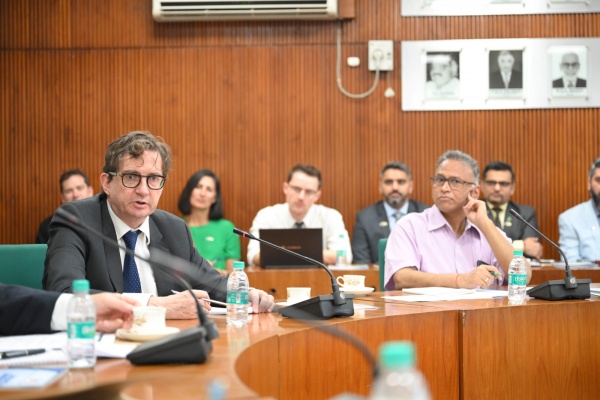
New Zealand High Commissioner to India His Excellency Mr David Pine speaking at a meeting with the Indian Institute of Technology Delhi.
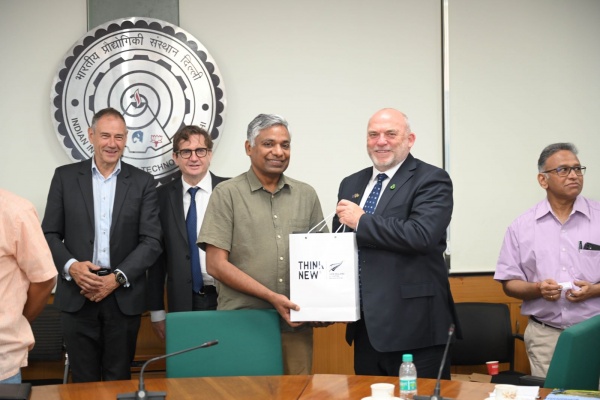
Caption: Education New Zealand Manapou ki te Ao Chief Executive, Grant McPherson (right), thanking Indian Institute of Technology Delhi (IITD) outgoing Dean International Naveen Garg (left) for hosting the NZ delegation at IIT.
Erik Lithander, Deputy Vice Chancellor Strategic Engagement at the University of Auckland, signed an MoU with IIT Delhi on behalf of all New Zealand universities to continue the relationship and further develop the New Zealand Study Centre.
The New Zealand Study Centre was inaugurated at IIT Delhi in February 2020 by Deputy PM Winston Peters, demonstrating the importance of education as a key part of the India-New Zealand relationship.
The week was bookended by two education agent fairs in New Delhi and Mumbai respectively, both of which exceeded expected student attendance numbers.
Speaking at a media briefing held at the New Zealand High Commission in New Delhi during the New Zealand India Education Week, ENZ CE Grant McPherson underlined the importance of New Zealand’s education partnership with India.
“India is one of New Zealand’s priority partner countries for collaborations, exchanges, and student mobility. We are excited that the announcements around the New Zealand Centre strengthening and the extensive package of scholarships under the New Zealand Excellence Awards scheme will further engagement with India,” Grant said.
ENZ Regional Director – Asia, Ben Burrowes, said with the sector’s focus on recovery and reconnections, the New Zealand India Education Week provided a great opportunity to refresh relationships with education sector stakeholders in India.
“India has always been a strong partner to New Zealand in the education space, and students from India consistently make up the second largest portion of international students studying in New Zealand.
“We are delighted for the opportunity that the New Zealand India Education Week offered us to reconnect and refresh our education links with India, and we look forward to building this relationship further over the coming years.”
Additional info –
To begin the week, sector representatives were provided with in-depth insights into the India-New Zealand relationship from High Commissioner David Pine, ENZ in-market staff and a consultant from EY. Representatives attended meetings with government departments such as the University Grants Commission (UGC) as well as B2B institutional networking events to support their university's global engagement. The delegation also met with two Indian Institutes of Technology (IIT), IIT Delhi and IIT Madras.
- 168882 540503 web version 1920px
- Ed publishing picedit edit
-
Around the world in five
VIET NAM
Hanoi boosts educational cooperation with New Zealand
A memorandum of understanding (MoU) on cooperation between Education New Zealand and the Department of Education and Training of Hanoi was signed in the Vietnamese capital city on October 29.
NEW ZEALAND
Otago Polytechnic hosts leading Chinese educators
Otago Polytechnic is this week hosting senior leaders from 10 leading Chinese vocational education institutions, illustrating the range of innovative and inspirational ways teaching and learning is delivered.
AUSTRALIA
Australia is attracting more students from Latin America than ever before
Latin America is emerging as the fastest-growing region for international enrolments, but while Australian private training providers are leading the way, those in the sector say universities have more work to do.
CHINA
China unveils new push for excellence in undergraduate programmes
The Chinese government has outlined a plan to reform the quality of undergraduate teaching, courses, and evaluation procedures at its universities in order to improve the employment prospects of students coming into the labour force.
INDIA
More than 750,000 Indian students abroad in 2018
Over the past five years India has become not only the world’s second-largest source market – after China – but also one of the fastest-growing sources of outbound students.
-
Upcoming ENZ webinars
Viet Nam school sector webinar
At this webinar, industry professionals in the school sector will learn about ENZ’s approach to the Viet Nam market, and how they can partner with ENZ.
Who should attend?
New Zealand-based marketing/international managers at secondary schools.
Session details:
2:30pm NZT, Wednesday 27 November
Vietnamese agent webinar
As part of ENZ’s commitment to raising the awareness of New Zealand among education agencies, ENZ has launched a webinar series to improve the profile, and understanding, of the benefits of a New Zealand education.
Who should attend?
Vietnamese education agencies and counsellors who currently share information about studying in New Zealand, or would like to.
Content:
The webinar will provide updates on:
- ENZ activity
- Study options
- Scholarships
- Employment and career pathway opportunities in New Zealand
Speakers will include New Zealand sector representatives, as well as ENZ and Immigration New Zealand staff.
Session details:
4pm NZT/10am Viet Nam time, Thursday 28 November
Please note: Registration for these webinars are for education agents only; ENZ is running a separate series of webinars for New Zealand education institutions.
US industry webinar
Registration is now open for an ENZ market intelligence webinar for the US. It will offer local market updates and insights and share ENZ’s outlook for the first half of 2020.
Who should attend?
International directors and marketing/international managers at tertiary level.
Content:
The in-market team will cover:
- Partnerships for reach: Learn more about ENZ’s strategic partnerships in the US
- Market engagement opportunities: In-market events Jan-June 2020
- Study Abroad scholarships
- Additional topics proposed by the sector
Session details:
You must register in advance to attend the webinar. If you have questions or topics you’d like to hear covered in the Industry Webinar, please email northamerica@enz.govt.nz with your suggestions by Friday 6 December.
11am NZT, Tuesday 10 December