Search
Showing 10 of 7357 results
- Around the world in 12
- Values for website 2026
- rachel liao award web2
- India 2
-
From the CE: Boosting global connections in education
Kia ora koutou,
In March, I spent an incredible couple of weeks in New Delhi and Mumbai as part of the Prime Minister’s Trade Mission to India, and for the 2025 Asia-Pacific Association for International Education (APAIE) conference.
During the trade mission, I was pleased to witness, together with Prime Ministers Christopher Luxon and Narendra Modi, the signing of a refreshed bilateral Education Cooperation Arrangement (ECA) between New Zealand and India. Education is a key feature in the New Zealand-India bilateral relationship, with India the second largest source market of international students for New Zealand.
The trade mission also served as a valuable opportunity to grow our connections with the Indian Institute of Technology New Delhi (IIT Delhi) through the New Zealand Centre, which is at the heart of our education partnerships in India.
IIT Delhi is backed by all eight New Zealand universities and is a hub for joint research and advancing India’s Digital India vision in AI, data science and advanced engineering. Prime Minister Luxon spoke at the education event which saw the announcement of several education initiatives, including a scholarship package and virtual internship programme, aimed at deepening bilateral collaboration.
There is no doubt that New Zealand has made a splash in India, and we look forward to continuing the momentum.
Last week, the Government announced its Quarter 2 Action Plan for New Zealand with 38 actions focused on economic growth. Boosting international education and export education earnings is a key action under the plan. ENZ is currently leading cross-agency work to develop an International Education Growth Plan for the Prime Minister and Ministers, and will be undertaking a series of sector engagements in the coming weeks.
It is an exciting time, and I look forward to sharing more about this work in my next column.
Ngā mihi nui,
Amanda Malu
Chief Executive
-
Immigration New Zealand update
India delegation
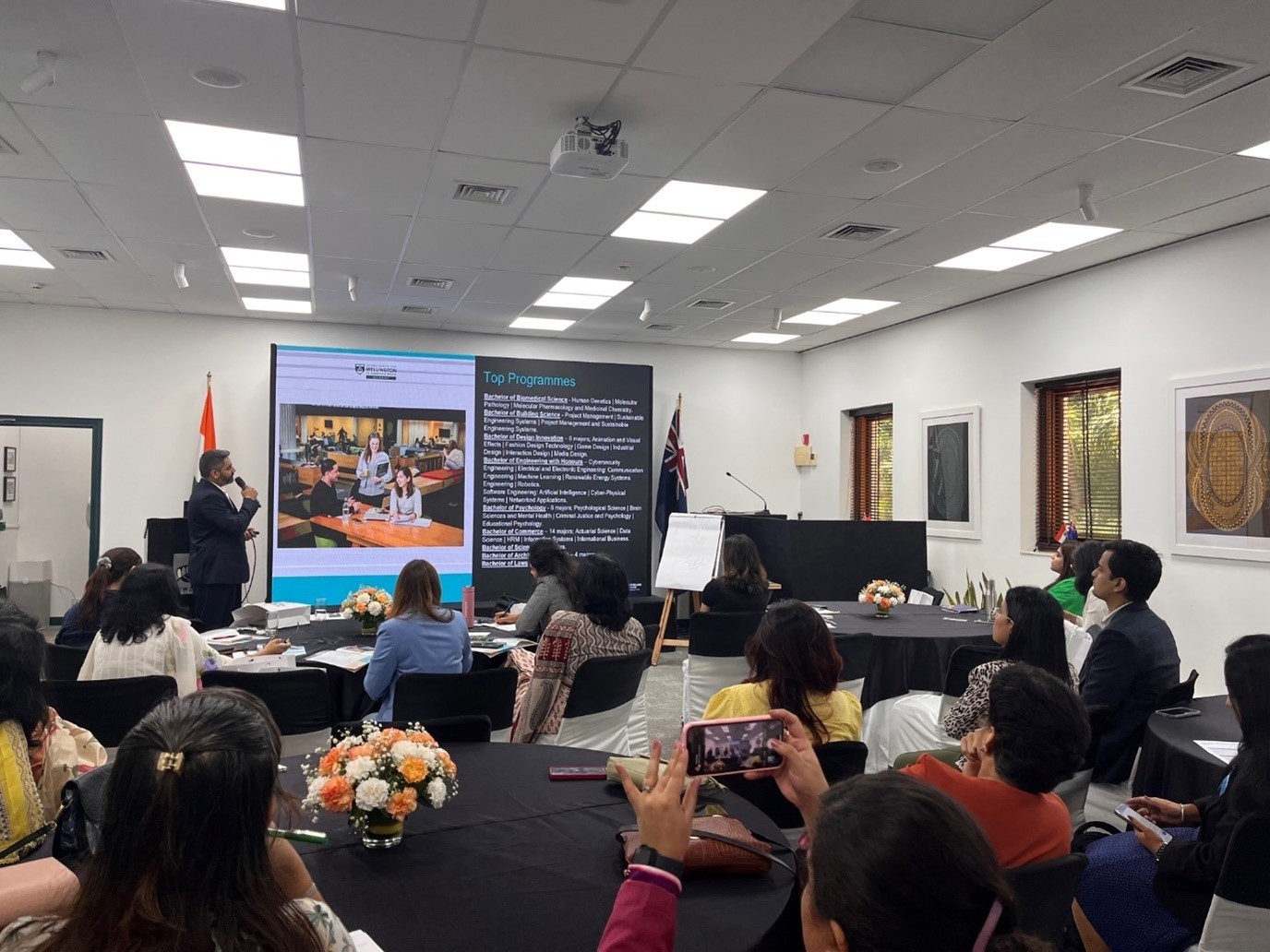
Alison McDonald, Head of Immigration, joined ENZ Chief Executive Amanda Malu as part of the Prime Minister’s official delegation to India. Celia Coombes, Director Visa at Immigration New Zealand, responsible for the student visa product, joined Amanda and Ben Burrowes in India afterwards where they supported the New Zealand delegation at the Asia Pacific Association for International Education (APAIE) and met with the New Zealand Education Representatives in India (NZERI), a group of Indian education agents.
“Immigration New Zealand found the trip very valuable and insightful,” says Celia.
“Now we are working on how we can continue to support the growth of the education sector, particularly in India which is such an important market for New Zealand, and what needs to be done to support more applications being approved.”
New local points of contact in India and China
Immigration New Zealand has new Engagement Advisors appointed in New Delhi and Beijing. They will be a local point of contact and working to improve communication within both the education and tourism industry.
Visa processing
INZ is in a strong position for processing student visas, following initiatives put in place to make our processing more efficient. At the end of March 2025, international student visas were being decided in 10 days (two weeks) on average.
On average Te Pūkenga (New Zealand Institute of Skills and Technology) applications are being processed within 2.5 weeks, 2 weeks for University applications, 3 weeks for Private Training Establishment applications and 1.5 weeks for school applications.
INZ have already decided more than 20,500 student visa applications so far this year, and approved around 18,000 student visa applications (from 1 Jan – 31 March 2025).
To help with faster visa processing, it is key that all the information and documents needed to decide the application is provided. All the details can be found on our information sheet for students on the INZ website: Student visa information | Immigration New Zealand.
- AUT Marae
- Xavier1
- Bogota Shipping Label
- Generation Study Abroad New Zealand Institutes of Technology and Polytechnics Excellence Awards NZITPEA application form