Search
Showing 10 of 7339 results
-
Alumni promote PhD study in NZ
Fourteen Vietnamese PhD students or alumni from our eight universities took part in the campaign, which generated extensive social media and other coverage.
The original plan to feature Facebook posts about outstanding PhD alumni and candidates was extended to include a webinar on 22 January 2022, “Ask NEW Anything: The PhD Journey”, involving five speakers from different areas of study: education, finance, food science, construction engineering and computer science.
The webinar generated a great deal of interest from participants, with numerous questions during the webinar and requests to connect with the speakers, as well as follow-up articles being published in the media.
One of the students was Phan Ngoc Quynh Anh, a PhD candidate at University of Auckland. Having worked as a lecturer at the University of Foreign Languages, Hanoi National University, and then completed post-graduate studies in Europe, Quynh Anh now has a scholarship from the University of Auckland where she is a third-year PhD student in education.
Quynh Anh is living in New Zealand with her husband and two young children, and says that studying in a country with good health, education and welfare systems for children was very important to her.

“I love the peace that New Zealand has to offer,” she says.
“The academic space at the University of Auckland is very open and free, and research materials are always abundant. I have two instructors who couldn't be better in the learning process.”
Van Banh, ENZ’s Market Manager, based in Ho Chi Minh City, says there is genuine interest from Vietnamese students in pursuing higher education in New Zealand.
“The New Zealand tertiary education setting is renowned world-wide for high academic standards, an excellent teaching community and a vigorous research network,” Van Banh says.
"Real-life opportunities, and a welcoming environment where innovation is encouraged have made New Zealand very appealing to Vietnamese students.
“Vietnamese students have access to a range of funding support, including some fully funded scholarships from the Vietnamese government, as part of a project to enhance the capacity of the Vietnamese university sector, improve research output and meet the increasing demands of students and industry.”
- International photo round-up
-
US students: Adventurers and Future Makers
When talking to American students, Lewis found that most held positive views of New Zealand, but lacked any specific details of what study in New Zealand involved. It got him thinking about the four international student personas and, for the most part, Lewis said US study abroad students fall into two categories – Adventurers and Future Makers.

The Adventurer persona
“Adventurers are students who see study abroad as an opportunity to experience new things and places, and to have fun while learning more about themselves,” explained Lewis.
“Most of my time with these students was spent mapping out the closest mountains to their university of choice, or explaining how to road trip around the country.“Adventurers are students who see study abroad as an opportunity to experience new things and places, and to have fun while learning more about themselves,” explained Lewis.
“They’re an easy sell for New Zealand but there were a number of other students who weren’t as convinced.”
Lewis believes this second group of students are in the Future Maker category. For them, career outcomes are top of mind, and education is seen as the road to get there. Lewis said these students were concerned that New Zealand’s appeal to thrill-seekers meant that the academic components wouldn’t be up to standard.
“For these students, study abroad is a serious opportunity. Beautiful pictures of Fiordland aren’t enough – they need cold, hard facts of New Zealand’s high quality education.

The Future Maker persona
“Because of the perception of New Zealand as a place for outdoor adventure, many students were surprised to hear that they could study subjects like mechanical engineering, IT or physiotherapy in New Zealand, and that all universities ranked in the top 3% in the world.
“They also had many enquiries about internship opportunities and programmes that combine study and work experience.”
Lewis also saw that alumni play a powerful role in this market.
"At one fair, alumni from the University of Southern California were key in piquing the interest of their fellow students, sharing that their courses in New Zealand were cross-credited, and that the Tongariro crossing was just as beautiful as the pictures.
“That’s the balance needed – students who are able to attest to both the academic rigour of courses in New Zealand and the adventure opportunities.”
-
NZ education shines in China
Running alongside the fairs were the ENZ-hosted agent seminars in Beijing, Shanghai and Guangzhou. 34 institutions participated in the seminar in Beijing, alongside 112 consultants, and 46 institutions participating in the Shanghai and Guangzhou seminars, with 60 consultants participating in Shanghai, and 116 in Guangzhou.
A true NZ Inc effort, Immigration New Zealand also attended the fairs and seminars. New Zealand students holding Prime Minister’s Scholarships to Asia and currently studying in China also helped out – and feedback from industry participants highlighted the usefulness of their Chinese-language skills and the value of their more recent experience of the New Zealand education system. The added bonus also being that these students are walking examples of the “outcomes” of New Zealand’s education system.
High-level support for New Zealand institutions in China was demonstrated by the attendance of the New Zealand Ambassador to China, John McKinnon, at the agent seminar and fair in Beijing, and the attendance at the seminars in Shanghai and Guangzhou of the Consul-General in Shanghai, Guergana Guermanoff and the Consul-General in Guangzhou, Rebecca Needham. This underlined the cross-NZ Inc recognition of and support for the key role education plays in the bilateral relationship.
International Market Manager - China, Amy Rutherford said, “I was delighted that so many New Zealand education institutions representing early, secondary, higher and vocational education participated in CIEET 2015 and the agent seminars. These events build on the previous work of industry and Education New Zealand to demonstrate the high value of a New Zealand education for Chinese students – work which is paying off, with New Zealand recently included in the Top 5 preferred overseas study destinations for China’s wealthy, as surveyed by the Hurun Report.”
-
SIEBA on track to boost international education in schools
This enthusiastic response to the launch of this sector-led organisation reflects the desire among schools to work together to drive growth in the sector – the central premise around which SIEBA was formed.
As a key outcome of the school sector roadmap development, success for SIEBA relies on having a strong and all-encompassing membership that truly represents the huge range of schools across the country.
Being a member of SIEBA will ensure that you are part of the conversation and that your school’s voice is heard.
Join SIEBA now and have a hand in developing the products and services that will help you achieve your school’s growth goals in international education.
-
Aotearoa sharpens Sherpa’s ambitions on conservation in Nepal
The Everest region of Nepal is his home, and he has seen first-hand the impact of climbers and climate change on the world’s most famous mountain environment.
The former international student to New Zealand is a columnist in the Kathmandu Post, readily highlighting successes and calling out failures on a range of environmental issues impacting Nepal. He is part of a generation determined to find solutions.
Tsewang recently completed his Master’s in Environmental Management at Lincoln University, an international education experience made possible by the Mingma Norbu Sherpa Memorial Scholarship. Mingma was an early graduate of Sir Edmund Hillary’s Khumjung School, an alumnus of Lincoln University, and one of the leading voices on conservation in Nepal and Bhutan through his work with World Wildlife Fund (WWF) before his untimely death in 2006.
His legacy is a scholarship jointly funded by WWF, Lincoln University, and the Greater Himalayas Foundation which supports students from remote regions of Nepal committed to careers in conservation to study at Lincoln.
Tsewang says the links with New Zealand which date back to the work of Sir Edmund Hillary, and his belief in the importance of education for future generations, are a driver for many Nepalese students seeking to improve their opportunities in life.
“The connection is very strong,” he says. “Sir Ed Hillary is such an icon and I feel that the students who come to New Zealand to study are continuing to strengthen the relationship established by Sir Ed and Mingma”.
Fulfilling the dream of a New Zealand education
“The scholarship allows you to fulfil a vision of having a higher education in New Zealand, but more than that, it connects many people already working in the conservation sector in New Zealand, Nepal, and other parts of the world.”
Tsewang spent two years in New Zealand, arriving just before the border closed in 2020 and is grateful that his studies were largely unaffected by the pandemic. He says he has learned much about New Zealand’s approach to conservation and gained a better understanding of te ao Māori and the concept of kaitiakitanga (guardianship and protection).
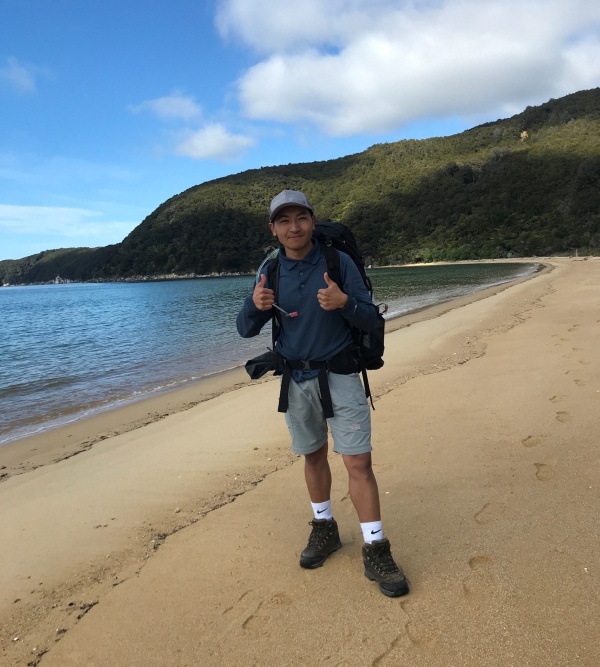
“I am a Sherpa. We are renowned as mountaineers, but we are also an ethnic tribe with a strong connection and respect for nature and a strong desire for environmental stewardship.
“Seeing Māori taking ownership of preserving and retaining their culture was an important learning for me. These are taonga (treasures) which we should be taking from one generation to another.
“Through my education I want to promote empowerment of local people on conservation issues,” Tsewang says. “Studying in New Zealand made me realise that this is already happening in Nepal, but we just need to find ways to make it more effective.”
Tsewang’s Master’s research was into the effectiveness of the Garbage Deposit Scheme (GDS) initiated by the Sherpa people, in which Everest climbers pay a US$4000 deposit that’s returned only if they bring back at least 8kg of rubbish produced during their expeditions. “Working in conjunction with the aims, aspirations, and opportunities of local communities is incredibly empowering.”
Making a positive impact in Nepal
The students who have come to Aotearoa have made a positive impact in Nepal, Tsewang says. “It’s all about learning from best practice and sharing knowledge.
As one person it’s hard to make change, but by sharing information and knowledge we can make incremental change.”
“We are seeing that governments globally are starting to overhaul their environmental protection policies. New Zealand has played a key role in the context of Nepal because people before me came to study and returned home to build crucial environmental education and awareness.”
Tsewang loved his time in Aotearoa, both inside and outside the classroom, having spent most of his free time hiking iconic tracks. “There’s so much learning that happens out in the field where you hear first-hand of the experiences of those working in conservation.
“This was an essential part of my education experience. You have unplanned conversations which are inspiring and hugely valuable,” he says.
“The last two years have been monumental in so many ways. It’s not just the academic learning, but also the personal growth. I have gained so much confidence to voice my opinion and share my knowledge.
“I will stay in touch with many of the people I have met and hopefully we will have the opportunity to collaborate in the future. Learning never stops.
“The international education opportunities with New Zealand only serve to strengthen the long-standing bond with Nepal. There’s a real legacy involved for both countries.”
-
Viet Nam kickstarts 2021 with series of offline student events
This January, ENZ’s team in Viet Nam sought out a number of opportunities for New Zealand providers to appear at in-person or hybrid events.
ENZ has also participated in a series of multi-destination education fairs organised by SiPM and ATS at three top high schools in Ha Noi, university admission day in the northern Vĩnh Phúc province, and a New Zealand University Fair co-hosted by ENZ at Nguyen Sieu school (a long-standing partner for several New Zealand institutions).
As travel restrictions are still in place around the world, these fairs are not necessarily aimed towards immediate student attraction. ENZ is attending these events as part of the marketing and brand protection work that comes under the third workstream of the Recovery Plan for International Education.
Many attendees expressed a wish to study in New Zealand, especially after learning about our successful COVID-19 response.
“Students and parents are still concerned about safety and political stability, so New Zealand is currently being viewed as an ideal destination for study when border restrictions are lifted,” ENZ Market Manager – Viet Nam, Van Banh, says.
Viet Nam’s economy was heavily impacted by COVID, but data still shows that Vietnam recorded net positive GDP growth in 2020, which is considered an impressive achievement in the present global context. As a result, other study destinations have also kept their promotional activities warm in this market.
-
Trans-Tasman showdown comes to NZIEC
In this inaugural NZIEC debate, a team of three plucky Aussies will argue that New Zealand should look to Australia's lead when it comes to international education.
Already they’re laying down the challenge: “There’s no need for New Zealand to look to Australia,” says Aussie team member Stephen Connelly. “Just become a part of Australia – you know you want to!"
The Australian team will be represented by:
- Amanda Pickrell, director of international education from the Victorian Government’s Department of Economic Development, Jobs, Transport and Resources
- Darragh Murray, international development manager at Queensland University of Technology, and
- Stephen Connelly, director at Global Ed Services.
And the home team will comprise:
- Katy Mandeno, international director at Whangarei Girls’ High School
- Roger McElwain, chief executive of the University of Otago’s Language Centre and Foundation Year, and
- Tony O’Brien, programme director at Waikato Institute of Technology.
Will the Australians crumble like the Wallabies at Eden Park? Or will the Kiwis collapse like the Black Caps batting line-up in the 2015 Cricket World Cup final?
Either way, it'll be a debate of two halves and you'll be sure to pick up some interesting insights into the competitive advantages of both countries and areas for improvement.
Come along and cheer for your team!
With half of the available places already snapped up, confirm your spot at NZIEC today at www.nziec.co.nz
-
Announcing closing plenary speaker for NZIEC KI TUA 2024
Drawing on his experience leading health care organisations and the health system in Aotearoa New Zealand, including during periods of significant change and uncertainty, Sir Ashley’s closing plenary session will focus on how to lead effectively now and in the future. He will talk to NZIEC KI TUA delegates about ‘leading through change and uncertainty’.
“We live in an increasingly volatile, uncertain, complex, and ambiguous world, which needs leaders to be agile and adaptable who can lead using different approaches than what we have used in the past. I am looking forward to speaking at NZIEC KI TUA on how we can lead in a world of rapid change and complexity,” Sir Ashley said.
Lead with Stories workshop by Jehan Casinader
Award-winning journalist and speaker, Jehan Casinader, will run a workshop, Lead with Stories at NZIEC KI TUA on 7 August. Casinader has spent 15 years telling compelling stories that resonate with people from all walks of life. He has a thorough understanding of New Zealand’s international education sector – and a degree in public policy.
Casinader says storytelling makes global influence possible.
“As New Zealand revives its international education sector, leaders and organisations will work harder than ever to engage the hearts and minds of students and partners around the world.
“However, in an increasingly noisy digital world, it’s harder to grab people’s attention.
"Traditional marketing no longer cuts it. And yet, many of us lack the confidence and skills to tell stories – or we’re afraid to. As a result, our most important messages are never heard,” Casinader says.
In his workshop, Casinader will share practical tools that helps leaders and staff from across the sector to tell compelling stories.
The NZIEC KI TUA 2024 programme will be available in July.
Register now – early bird registrations close on 31 May
Earlybird registrations are still open for the 31st New Zealand International Education Conference KI TUA (NZIEC KI TUA), which is being held in Te Whanganui-a-Tara, Wellington from 6 – 8 August 2024 at Tākina Wellington Convention & Exhibition Centre.
This year’s conference theme is NZIEC KI TUA – Te Ara ki te Ao*
‘Te Ara ki te Ao’, which translates to ‘the pathway to the world’, symbolises a journey that transcends borders and embraces global horizons. This concept frames Aotearoa New Zealand’s distinct international education environment, inviting participants to connect and collaborate to accelerate global growth.
Register now at NZIEC KI TUA 2024.
NZIEC KI TUA 2024 Partners!
Welcome to our newest partners Pearson, Edified, Te Herenga Waka — Victoria University of Wellington and Te Kunenga ki Pūrehuroa Massey University and Flywire, who join TOEFL, Studentsafe, idp, IELTS, and Host Families NZ as partners for NZIEC KI TUA 2024.
And welcome to our new media partner: The PIE News.
If you’d like to partner with NZIEC KI TUA 2024, email us nziec@enz.govt.nz
-
Big audience for ECE symposium streamed live from China
The New Zealand-China Early Childhood Education Symposium streamed live from Qingdao in Shandong Province in September, attracting an audience of around 24,000 viewers on a Chinese language streaming service, 170 at the venue and dozens more online from Norway, Mexico and Turkey.
The audience for the symposium, organised by Education New Zealand, has grown 20-fold since the first event in 2020, proving the appeal of events streamed in several languages.
The theme of this year’s symposium was the best practice for developing high-quality early childhood education (ECE) teachers.
Data from 2020 show there were over 48 million children enrolled in Chinese kindergartens and a shortage of nearly 300,000 full-time ECE teachers.
Delegates heard from New Zealand experts at the Ministry of Education, the University of Auckland, the Open Polytechnic, AUT, Te Rito Maioha Early Childhood New Zealand and Toi Ohomai Institute of Technology.
Toi Ohomai presenter Dr Rosemary Richards spoke from New Zealand on how to interact with children on visual art. She welcomes chances like these to share her work with a large and diverse audience.
“In this increasingly globalised world of education, it is important for educators to find ways to have meaningful connections that extend our intercultural and professional understandings,” Dr Richards says.
“The online symposium and live streaming also allowed for connections with wider communities and audiences that are not possible in traditional formats. Perhaps our future holds more potential for a combination of both.”
ENZ worked with the China Ministry of Education and the China Centre for International People-to-People Exchange to organise the symposium.
Local organisers included the Qingdao Municipal Education Bureau, the China National Society of Early Childhood Education, the Qingdao Preschool Education College and the Shanghai Institute of Early Childhood Education under Shanghai Normal University.
New Zealand and China collaborate on early childhood education under the mechanism of the Joint Working Group on Education and Training, last held in February 2021.
Want to know more about the symposium or upcoming ENZ initiatives in China? Contact China@enz.govt.nz
The University of Auckland’s Dr Marek Tesar and Dr Kiri Gould gave a keynote presentation on the pathway to becoming an ECE teacher. Audience members could scan the QR code on the screen to connect on WeChat.