Search
Showing 10 of 7357 results
- NZIEC day1 147
-
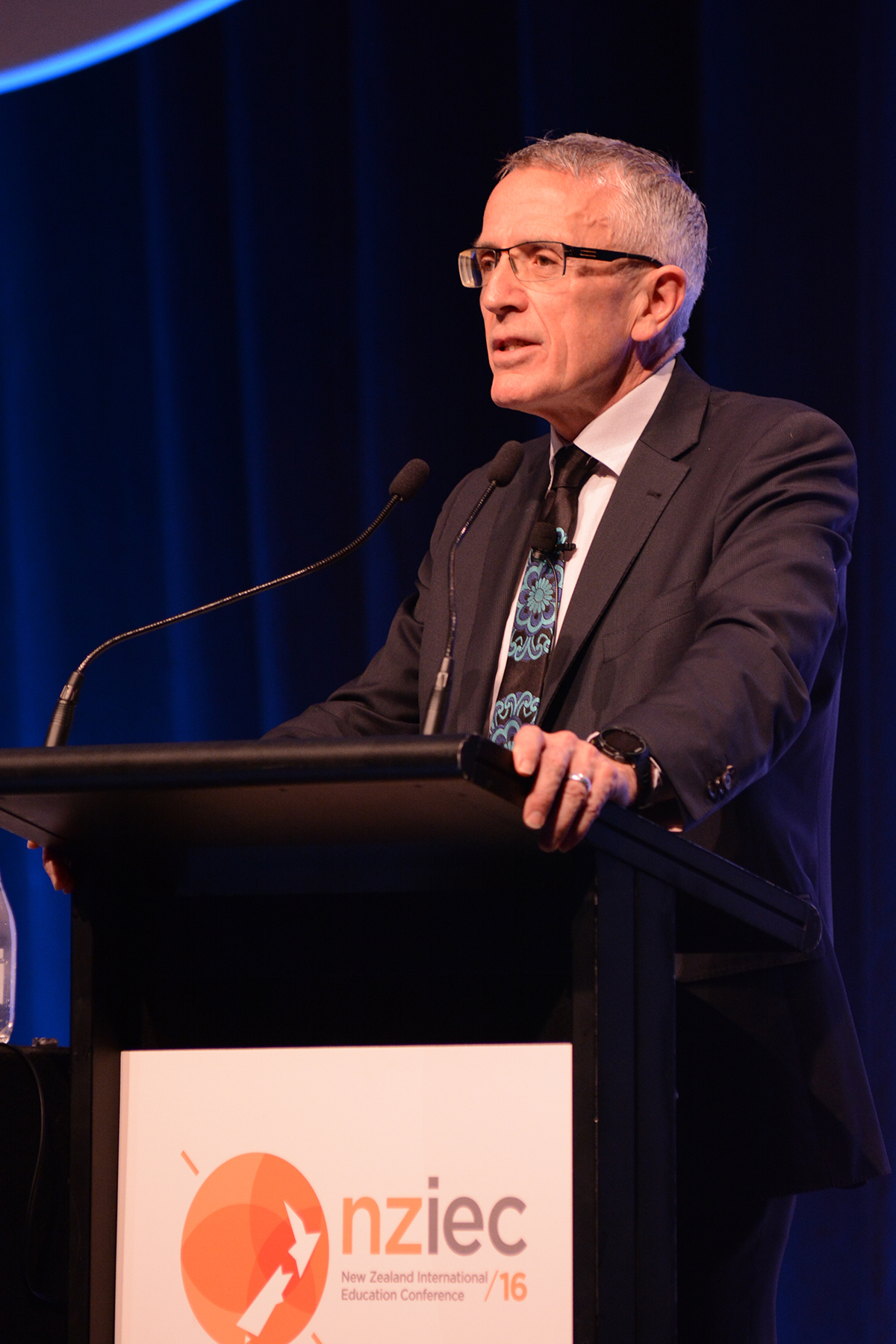
Insights from China
Session One: It’s all about the relationship: that’s the main message to emerge from a panel discussion between education providers that have partnered with institutions in China.
Professor Alister Jones is Senior Deputy Vice-Chancellor of the University of Waikato, which has a joint institute to fully deliver its degrees at Zhejiang University City College in Hangzhou.
“It can take 15 to 25 years to create those relationships so it’s important to maintain your China team,” says Alister.
Steve Burt, Director of International Education at Kāpiti College, says his school began developing its ties with schools in China by working with a Chinese education bureau eight years ago.
For the Eastern Institute of Technology (EIT), developing relationships with organisations in China’s provinces help it diversify and build on its strengths in viticulture and wine.
Fred Koenders, EIT’s Executive Dean for Commerce and Technology, says China is looking to increase its capabilities in vocational education.
Tips for forming partnerships
The panel’s tips for partnering with institutions in China include:
- Do your research.
- Be prepared to invest time and money into developing the relationship.
- There is no substitute for face-to-face communication.
- It’s critical to have a fluent Chinese speaker on your team.
- Your Chinese partners may become friends for life.
Session Two: Digital marketing in China
China has a unique and challenging digital landscape. So how can New Zealand’s education sector use digital marketing to effectively promote themselves in China?
Euan Howden, ENZ’s Director of Marketing Platforms and Campaigns, and Jordi Du, New Zealand General Manager of digital agency UMS, shared their insights into China’s social media landscape at NZIEC.
Is WeChat enough?
Jordi advises education providers adopt an omni-channel approach to digital marketing in China, rather than relying on WeChat.
He says it’s important to look beyond WeChat because:
- There are barriers to registering a WeChat official account.
- It can be expensive to invest in content, media and campaigns.
- It’s difficult to measure conversion.
- WeChat isn’t the right channel to target Generation Z (born from the mid-1990s to early 2000s) or possibly Generation Y (born from 1980 to 1994).
ENZ’s approach
Western websites and social media platforms have issues with accessibility, performance and loading speed in China, so ENZ has created bespoke digital technology to share the New Zealand education story with Chinese students.
We have multiple touchpoints with our Chinese audience, including an official WeChat account, a China-hosted version of our Study in New Zealand website, email, online media and a WeChat mini program to encourage students to use our My StudyNZ tool to connect with New Zealand education providers.
Creating a content strategy
When it comes to content strategy, Euan says some things are the same in China as they would be anywhere else.
“People want relevant content, in the right place, that resonates with them and makes them want to learn more.”
He advises using your own sources, such as current students, alumni, parents and agents, to create and share content across channels and tools.
Euan also suggests:
- Choosing the right platform by understanding where your target audience is.
- Developing carefully targeted content in the best possible format.
- Aligning with ENZ’s campaigns for better brand recall.
- Exploring and making use of key opinion leaders (KOLs) in China.
- Hargest3
-
Korea and New Zealand sign historic agreement
On 23rd February, New Zealand hosted a Korea-New Zealand education Joint Working Group (JWG) in Wellington, where a delegation of Korean education officials met with officials from the Ministry of Education (MOE), the New Zealand Qualifications Authority (NZQA) and ENZ to exchange policy updates and sign a Joint Recognition Statement – a landmark document regarding senior secondary school qualifications in both countries.
The statement follows the Comparison of Senior Secondary School Qualifications, a joint research report which concluded that the Korean High School Certificate and the New Zealand National Certificate of Educational Achievement Level 3 are broadly comparable.
New Zealand Secretary of Education Iona Holsted said the signing of the statement will support higher education institutions in both countries to make decisions about these qualifications, with the potential to open up study opportunities for young Kiwis and Koreans.
“The joint statement is a step towards our students being able to have previous qualifications more easily recognised abroad and will provide access to further study that has traditionally been difficult to access.
“While there is still more to do, I’m looking forward to seeing the shared benefits for both countries,” Ms Holsted said.
NZQA Chief Executive Dr Karen Poutasi said the Recognition Statement and research report are a result of the two countries’ collaborative work under the Education Cooperation Arrangement, signed in 2009.
“The statement is the first of its kind signed by Korea and is a sign of confidence in the quality of education in both countries,” said Dr Poutasi.
“The joint research report has helped to promote a shared understanding of the Republic of Korea and New Zealand’s education systems and curricula. We look forward to further dialogue between our two countries.”
Poutasi now hopes to see more Korean students coming to study in New Zealand, and vice versa.
- India event
-
Future Focus Programme seeds innovation
The Future Focus Programme is a new initiative which will provide $200,000 per sector in funding to help peak bodies seed innovation projects.
The school, university, private training establishment (PTE), polytechnic (ITP), English language, and education products and services sectors are all being supported through this programme.
The funding is to be used by peak bodies to develop an innovation plan for their sector, and to initiate innovation projects. Innovation projects are to focus in the areas of product development, online delivery, new business models and the development of innovation capability.
Through this support, ENZ wishes to encourage sectors to adopt new ways of working to mitigate the impacts of COVID-19 or similarly unprecedented events.
“The Future Focus Programme is a tangible way in which ENZ can help support sectors to shape their future in the ‘new normal’ post COVID-19,” ENZ General Manager – Partnerships & Marketing, Paul Irwin, says.
“The programme is additional to our normal activities and is designed with a clear focus on innovation – part of Goal 2 of the New Zealand International Education Strategy. With all the uncertainty we are currently facing, this programme is an opportunity to take stock of what COVID-19 means for how international education can operate in the future and develop new products, services, behaviours and models to help us be more resilient to change.”
“We’re pleased to be working alongside peak bodies to help shape their future focus plans and we look forward to seeing the launch of a number of innovative projects.”
ENZ is working alongside peak bodies as they develop their innovation plans and identify prospective innovation projects. These plans and projects will be agreed over the coming weeks.
Delivery timeframes will vary according to the peak body and the scale and nature of the projects they initiate, but projects are expected to be implemented over the coming 12 to 18 months.
-
Get tips and tools at ENZ’s Seminar Series
The seminars are being held in mid-March in six locations around the country. The morning and afternoon seminars are self-contained so you can opt to attend one or both. And, you can eat your lunch while watching the launch of the New Zealand School Story!
Each seminar will be limited to 40 participants so be quick off the mark to register.
Please register separately for each session, including the lunchtime launch.
Register online here.
Seminar details
Seminar 1 (9.30am- 11.30am): Personas: Understanding your Audience
Knowing how your audience think and behave is the most important step in connecting with them. In this session ENZ’s General Manager of Marketing and Channel development, Paul Irwin, and International Brand Manager, Kaylee Butters, will share the New Zealand International Student Personas, which were developed as part of a global research project. We'll introduce you to tools you can use to improve your student recruitment and student experience.
Morning tea will be provided.
Lunchtime session
Launching the New Zealand School Story (12noon – 1.00pm)
In this lunchtime session we will launch the New Zealand School Story. We'll take you on the journey from the planning through to the development of the final suite of resources – all of which will be available on The Brand Lab. We’ll also suggest ideas as to how you can use this story in your own international marketing activity.
Bring your own lunch – coffee and tea will be provided.
Seminar 2 (1.30pm- 4.30pm): Creating Effective Digital Marketing Programmes
Led by the ENZ digital marketing team, this interactive session will focus on the basics of digital marketing. We'll show you how to develop an effective programme from strategy to set-up, through to launch, evaluation and optimisation. We'll help you to decide where to focus your efforts, using case studies from ENZ's own marketing activity.
Afternoon tea will be provided.
Dates and venues
Date
Seminar
Venue
14/03/2016
Auckland North Shore
Bruce Mason Centre - The Promenade, Takapuna
15/03/2016
Auckland CBD
Cliftons - 45 Queen Street
17/03/2016
Wellington
Royal Society of New Zealand - 11 Turnbull St, Thorndon
21/03/2016
Tauranga
Trinity Wharf - 51 Dive Crescent, Tauranga
22/03/2016
Dunedin
Dunedin Public Art Gallery - 30 The Octagon
23/03/2016
Christchurch
Tait Technology Centre – 245 Wooldridge Road
Please register separately for each session, including the lunchtime launch.
Register online here.
-
ICEF ANZA returns to New Zealand
We’re pleased to announce that Tākina Wellington Convention and Exhibition Centre will host ANZA from March 4-6, 2026. ICEF ANZA will showcase New Zealand as a study destination to 160+ agents from all over the world, and is open to education providers from both Australia and New Zealand. ICEF ANZA was last in New Zealand in April 2024, where global agents and New Zealand and Australian education providers came together in Christchurch.
ICEF ANZA is an Australasia-focused event that gives education providers from Australia and New Zealand the opportunity to meet with top international student recruitment agents from around the world who have a focus on these key study destinations.
ENZ Group General Manager International and Sector Engagement, Sahinde Pala, said ENZ is excited to welcome ICEF ANZA back to New Zealand at a time when we are well positioned to attract more international students.“We encourage institutions to participate, as well as to invite agents to visit their regions before and after the event, to experience more of our beautiful country first hand," she said.
For more information please visit: https://www.icef.com/events/icef-anza/
Click here to register: https://www.icef.com/provider-registration-form/
-
Masterclass opportunity in Japan
Tokyo Metropolitan Board of Education will be hosting a virtual study abroad event on 23 of September, connecting secondary school students in Tokyo and beyond with tertiary institutions from Australia and New Zealand.
This half-day event will feature lectures in an interactive format so providers can engage with Japanese students. Selected tertiary institutions will also have an opportunity to work with the Tokyo Metropolitan Board of Education to produce additional content introducing their institutions and programmes to prospective international students.
Recordings will be made for the virtual study abroad event and will be shared on the Tokyo English Channel website which will launch in June 2021.
“This is a great opportunity for Education New Zealand and New Zealand tertiary providers to work with the Tokyo Metropolitan Board of Education to co-develop educational materials for the Japanese secondary school students. The content produced for the event will also be shared at future promotional events hosted by Education New Zealand and the New Zealand Embassy in Tokyo.” ENZ Director of Education – Japan, Misa Kitaoka, says.
Director at the Tokyo Metropolitan Board of Education, Yuki Sato, looks forward to receiving proposals from the New Zealand providers.
“We are excited to work with New Zealand tertiary institutions to showcase the virtual study abroad event offering Tokyo secondary school students an opportunity to connect with the world and enhance their communication skills in English. Students can expect of learn new ways of thinking from the lecturers and interact with other participants from around the world, including New Zealand.”
Education New Zealand signed a Memorandum of Understanding with the Tokyo Metropolitan Board of Education in 2017 to promote education exchange and cooperation between Tokyo and New Zealand. Since then, a range of projects have been initiated between the two parties including the co-development of online education material for intermediate English learners through the Tokyo Global Studio.
For further details on the opportunity, please download the proposal by the Tokyo Metropolitan Board of Education. Expression of interest is due on 25 of May and the selected provides will be contacted by Education New Zealand by the 31 of May.
-
‘Apply four months in advance of travel’ - INZ Update
Visa processing update
As at 7 October 2023, the average processing timeframe for an international student visa application submitted from outside of New Zealand is six weeks (29 working days). This is counted from the time the student submits their application, until the time the visa is declined, or the visa granted. Whilst the average processing time is six weeks, Immigration New Zealand continues to strongly recommend that students apply for their visas around four months ahead of their intended travel date, especially as we are entering the main student processing peak combined with summer, which sees high numbers of visitor visas. We cannot prioritise processing for late applications and are unable to prioritise based on travel bookings. Students should not finalise travel plans until they have their visa granted.
The approval rate for offshore student visa applications received (1 Aug 2022 – 7 Oct 2023) is 84%
Tertiary student in-study work rights
Tertiary students’ in-study work rights have typically been linked to whether the qualification being studied gains points under the Skilled Migrant Category (SMC). As of 9 October 2023, only qualifications at Bachelor’s degree Level 7 or above qualify for points.
To maintain work rights for tertiary students, references to the SMC in the in-study work instructions have been removed. Eligible qualifications, programme level and type will be shown instead, to carry over the eligibility of many students studying below a Bachelor degree.
Since 9 October, all students studying a full-time programme that directly results in a New Zealand qualification at Level 4 or above on the New Zealand Qualifications and Credentials Framework (NZQCF) are eligible for in-study work rights of 20 hours per week. Training schemes and micro-credentials are not qualifications and remain ineligible for in-study work rights.