
Search
Showing 10 of 7357 results
-
Game On English launched in style
New Zealand has teamed up its expertise in rugby and English language teaching to develop a new edu-sport programme for Japan in the lead up to the 2019 Rugby World Cup and the 2020 Summer Olympics.
On Monday 7 July Prime Minister John Key and Japanese Prime Minister Shinzo Abe launched Game On English in Auckland as part of Mr Abe's official visit to New Zealand.
The leaders threw a rugby ball to the programme’s inaugural students – Japan's national sevens female champions from Iwami Chisuikan High School – to kick off a rugby skills training session and officially launch the programme.
The Prime Ministers, current All Black Conrad Smith and Huriana Manuel, captain of the New Zealand women's sevens team and Black Fern, met and shook hands with each of the rugby players before they went through their training paces.
In the lead up to Japan hosting the Rugby World Cup and Summer Olympics Prime Minister Abe has announced a government goal to improve English language skills and increase sporting capacity amongst youth.
"As a country with an envious track record of developing the world’s best rugby players and a top quality education system, New Zealand is well placed to help the Japanese government meet their goal," says Grant McPherson, Chief Executive, Education New Zealand.
The Game On English programme matches English language providers with sports academies to deliver centrally-organised, bespoke courses for young athletes.
"Growing export revenue from international education is a key part of the Government’s Business Growth Agenda. Programmes such as Game On English are aligning New Zealand’s educational expertise with demand in the global market."
Japan is now the third largest source of international students to New Zealand.
"Our success as a country will be determined by our level of connectedness with the rest of the world. Education is one of the best ways to build international linkages.
"These students will act as ambassadors for New Zealand education promoting the quality of our education system when they return to Japan," says Mr McPherson.
The Iwami Chisuikan sevens team are studying English at the English Language Centre of Auckland Institute of Studies (AIS) in the morning and training with Auckland Rugby Academy in the afternoon for the month they are in New Zealand.
"New Zealand is very different from Japan, but the people here made it really easy for me to adapt and feel comfortable. I enjoy being able to communicate freely with people from different backgrounds in class, and the support we get from teachers is invaluable," says Iwami Chisuikan player Aoi Kurokawa.

"Kiwis train differently – they emphasise technique and make training fun. I would like to bring what I learned back to Japan."
Ran Aoki is also enjoying her rugby in New Zealand. "The best part of the programme is the training. Auckland Rugby make it fun and give invaluable comments and feedback."
"Kiwis value the quality of training in a given timeframe over accumulated hours which allows us to get the most out of our short stay in New Zealand.
"I learn English all around – in class, whilst training, and at home with my homestay family!"
In two weeks a second group of Game On English students will arrive from Japan.
Eleven secondary school players from Kanto Super League will be based in Dunedin - studying English at the University of Otago Language Centre and receiving rugby training from Otago Rugby Football Union and local Dunedin high schools.
Both groups of students are in New Zealand at the invitation of the New Zealand government to pilot the programme.
"It is our intention that Game on English will be rolled out nationally and New Zealand will support Japan in achieving their English language and sporting ambitions in the next five to six years and beyond," says Mr McPherson.
We will evaluate the pilot programme over the next month and advise the next step in due course.
-
Hands-on environmental studies for US students
EcoQuest Education Foundation is a charitable trust and PTE based in Whakatīwai, with strong connections to Ngāti Paoa and Ngāti Whanaunga.
“We had a wonderful day on the Wharekawa Coast,” says Ria Brejaart, EcoQuest’s Academic Director.
“Led by mana whenua, our students welcomed special guests US Consul General Sarah Nelson, Director of USA Study Abroad Heidi Manley, and Senior Education Advisor US Consulate General, Katie Sleeman. EcoQuest’s Board of Trustees and academic associates also attended the event, along with other key supporters.
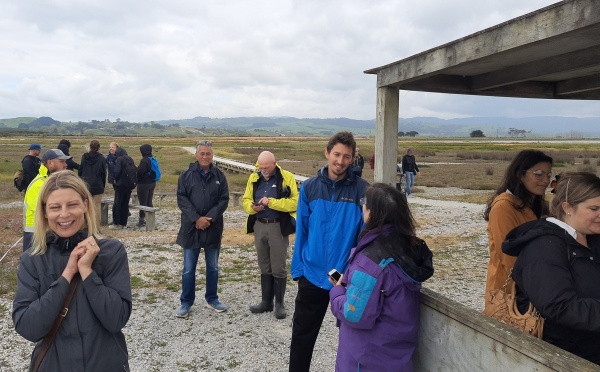
EcoQuest team and manuhiri at the bird hide.
“It was a great way to celebrate both the return of our US students after a long Covid-19 hiatus, and our enduring relationships with our collaborators and supporters. It felt particularly apt to be on the shores of Tikapa Moana, where the kuaka (bar-tailed godwits) return each year from Alaska.
“The morning of observing birds on the shell-banks was followed by a visit to Pūkorokoro Miranda Shorebird Centre, for a talk by Keith Woodley, Centre Manager. We then returned to EcoQuest where we marked the occasion by presenting Tū Ngātahi pins to all our students, on behalf of Education New Zealand Manapou ki te Ao.”
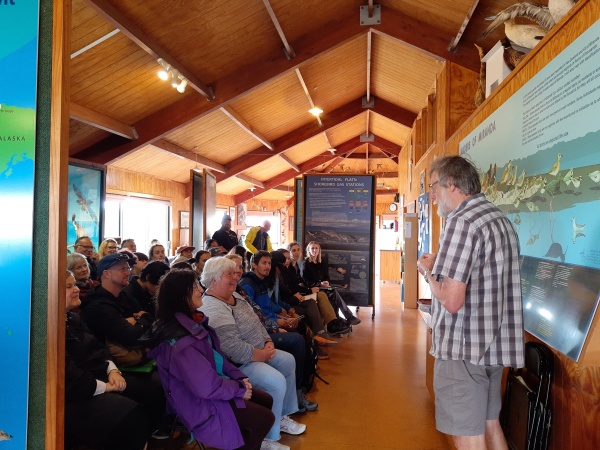
A presentation from Keith Woodley (Pūkorokoro Miranda Shorebird Centre Manager). Front row left, Beth Coleman (EcoQuest Board Chair) and Sarah Nelson (US Consul General).
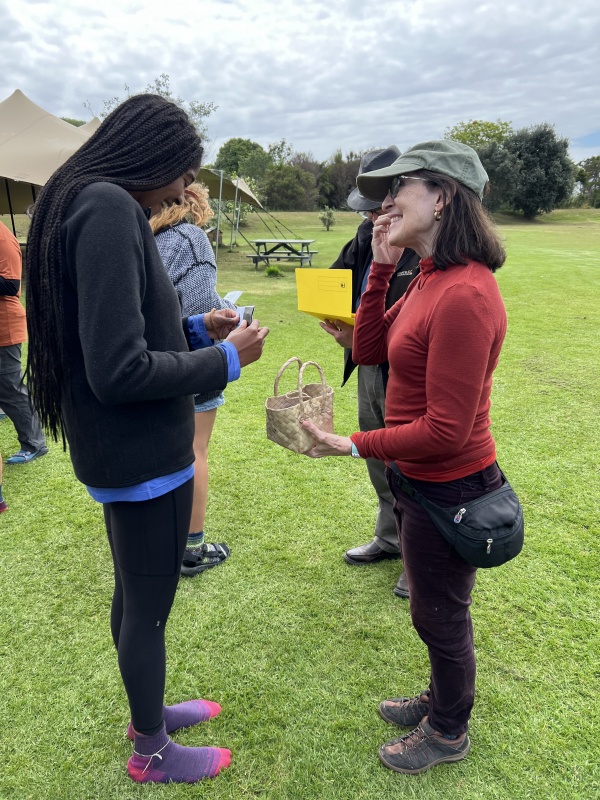
Beth Coleman (EcoQuest Board Chair) and Jono Clark (Director) presented Tū Ngātahi pins to the students.
The eighteen students are from the University of New Hampshire (UNH), Cornell University, University of Michigan, and Colorado State University. They are participating in a fifteen-week residential semester programme with EcoQuest, which offers undergraduate programmes in partnership with UNH. Students gain credits for their undergraduate degrees back home.
“Within the international education sector, EcoQuest contributes high-quality, niche programmes,” says Alana Pellow, Business Development Manager at ENZ.
“These international student programmes align well with New Zealand’s areas of excellence in ecology, restoration ecology, environmental policy, and sustainability. EcoQuest students undertake real-time research for many different collaborators including iwi, NGOs and trusts, councils, private land owners and the Department of Conservation. Academic and scientific rigour are the basis for these unique hands-on learning opportunities.”
“EcoQuest also contributes to international thinking around indigenous approaches to sustainability, through inclusion of elements of Te Ao Māori and mātauranga in its education and research activities.”
The current students are part of Cohort 4, the final cohort of international students to be given entry to New Zealand through a border exception earlier this year. Cohort 4, which was jointly led by ENZ and the Ministry of Education, saw 5,000 international students from 109 different countries nominated for student visas, before New Zealand’s borders fully reopened in August.
- Overall Q1 2015 visa dashboard
-
Getting ready to celebrate 25 years
2016 celebrates 25 years of New Zealand International Education conferences being held. During the conference, we’ll be celebrating some of the highlights of our industry’s journey.
If you’re joining us in Auckland, make sure you check out the history display in the exhibition hall. We traverse a handful of key highlights as the industry has developed and evolved over the past 25+ years.
If you’re not able to join us in Auckland, you can follow the conversation on Twitter at #nziec and on Weibo at #2016新西兰国际教育年会NZIEC#.
***
Here, Richard Smith, founding director of Auckland Institute of Studies (AIS), reflects on his time in the industry, outlining how AIS has evolved over the years.

Blazing a trail over 25 years ago
Richard Smith talks about his experience in the international education industry.“In the late 1980s, I was involved in business between New Zealand and China in both the public and private sectors, and regularly received enquiries about education in New Zealand.
So in 1990, my two business partners and I set up AIS. We were based in the Downtown Centre, Auckland, initially as an English language school, starting with a single class of international students. In our second year, we added business studies, then travel and tourism courses, and appointed marketing officers for Japan and China. AIS quickly grew to more than 200 students.

The entire roll of AIS could fit in one room back in 1991.
In the first five years, we worked seven days a week, putting in huge hours. I was on the business development and admin side, doing everything from paying staff, processing student applications, and signing up agent representatives.
In 1992, we brought in new business partners from Taiwan and Japan, and bought the old St Helens maternity hospital, set on 10 acres in Mount Albert. It had been empty for two years and was very rundown. Moving from the city to the suburbs was a good move as it allowed for expansion. Being in a residential area meant easy access to homestays for students. We also converted the old nursing home into student accommodation. In 1993, the doors of the new campus opened after a year of refurbishment.

AIS was reborn at the old St Helen’s maternity hospital.
The following year we launched our first degree, the Bachelor of International Business, becoming the first private business school at degree level in New Zealand. In 1995, we started delivering an MBA programme. Then in 2002, we opened our second campus, the Asquith Campus, where we developed new degree programmes in tourism, hospitality and information technology.
Over the years, more than 20,000 students have studied at AIS. Today, we cater for around 1,500 students from all around the world.
Looking back, we were like trailblazers really, starting from scratch alongside other new organisations like New Zealand Qualifications Authority and New Zealand Education International Ltd, and putting in the hard yards. In 2015, we celebrated our 25th anniversary.”

AIS students celebrate graduation, 1993.
-
Insights for PTEs & ELS on how to better attract students from China
In June, participants from Private Training Establishments (PTEs) and English Language Schools (ELS) in New Zealand were invited by Education New Zealand Manapou ki te Ao (ENZ) and the North Asia Centre of Asia-Pacific Excellence (CAPE) to attend a workshop looking at opportunities in China. The workshop was called “"Navigating the new dynamics of Chinese overseas students seeking to study with PTEs and English Language Schools."
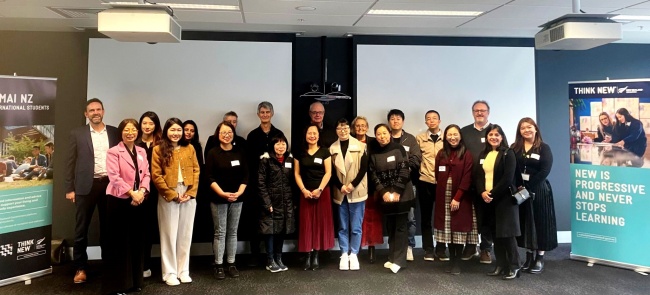
Participants from PTEs and ELS at the June workshop co-hosted by ENZ and North Asia CAPE.
Following the conclusion of the workshop, a report was commissioned by North Asia CAPE and facilitated by ENZ, with Shanghai-based market research company China Skinny conducting an in-depth exploration of key topics discussed during the event.
The report, ‘Insights for New Zealand’s English Language Schools and PTEs to better attract Chinese students’, was launched at an event at ENZ’s Auckland office in September with participants from PTEs and ELS. Mark Tanner, founder and managing director of China Skinny presented the report putting a focus on:
-
Building awareness of your institutions with your Chinese target audience.
-
Considerations for PTEs and English language schools.
-
Examples of how other institutions are marketing to their target audiences in China, with an accompanying checklist.
Richard Kensington, Principal of Academic Relations at UP Education, attended both the workshop and the report launch.
He said, “These initiatives by ENZ provided useful insights into Chinese students considering overseas vocational education, including some we were not previously aware of.
"It also reminded us of the significant potential in China’s vocational education market. We need to explore new, innovative ways to recruit students, rather than just relying on traditional methods,” continued Richard.
The report is based on insights drawn from a survey of 700 vocational and language school considerers and interviews with eight education agents in China. A copy of the full report can be found here - Insights for NZ's ELS & PTEs to better attract Chinese students.pdf
-
-
Lifeswap premiere celebrates friendship between New Zealand and Germany
The final two episodes of the cult-hit webseries Lifeswap, ‘Laughing Matters’ and ‘Die Brücke’, concluded the animated adventures of Duncan and Jörg – the German and Kiwi friends who helped one another understand a new culture.
‘Laughing Matters’ tells the story of Jörg, who had an excellent experience in New Zealand, and (due to his preparedness for the future) was accepted into one of New Zealand’s most innovative and technologically advanced companies ‘Rockets R Us’.
The episodes were commissioned by ENZ and the Germany Embassy respectively.
“We were very fortunate to be able to celebrate Lifeswap with its creators Steffen Kreft – who was himself an international student at Massey University in Wellington – and William Connor, and their many fans at a live event at Wellington’s Embassy Theatre,” ENZ Chief Executive Grant McPherson said.
“After a year of restricted international travel and very few in-person events, it was a reminder that global education connection and cooperation has not stopped.
“The Lifeswap series highlights how the longstanding friendship between New Zealand and Germany transcends the situation we find ourselves in. It is a very powerful example of international education relationships keeping New Zealand globally connected while travel is limited.”
Following the launch of Laughing Matters – which built on the success of the first joint ENZ Lifeswap episode Group Effort in which Prime Minister Jacinda Ardern had a cameo appearance – the partnership is also being shared with key partners and audiences in Germany as part of ENZ's Americas, Middle East and Europe Education Week.
To leverage the popularity of the new episode and the wealth of the important topics it deals with, ENZ is working with a PR agency in Germany to tell this positive story more widely.
The PR engagement will involve a mix of approaches, including traditional media, social media and partnering with influencers, to ensure we reach a wide audience on all relevant channels.ENZ General Manager – International, Lisa Futschekworked with Kreft and Connor for months on ‘Laughing Matters’.
“It’s a great fit for Education New Zealand to be working with such creative people who are telling a fantastic story about the friendship between New Zealand and Germany.”
Also in attendance was the German Ambassador to New Zealand, his Excellency Stefan Krawielicki.
In his speech to the audience, the Ambassador noted how the humour of Lifeswap allows New Zealanders and Germans to laugh at themselves, and understand our differences.
“It’s such an enriching experience for young people to go to New Zealand – or for young people to go to Germany – and learn about different approaches and shared values,” he said.
“Education is a bridge builder and makes young people [become] lifelong ambassadors.”
Lifeswap dates back to 2013, when creators and partners Kreft and Connor began to work together, pooling their considerable skills in language, animation, and cultural competency.
The pair said at the premiere that while they’re sad to leave Duncan and Jörg behind, their story is complete.
“It’s probably a little bit like what parents feel like when their kids are going to study overseas,” Kreft says.
-
Our values
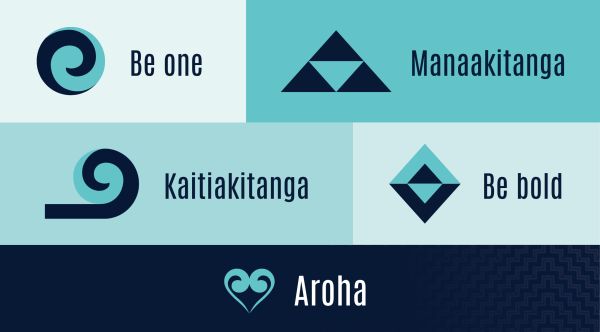
Our work is guided by Ngā Manapou – our values of manaakitanga, kaitiakitanga, be one and be bold that are all encompassed by aroha.
Manaakitanga
Manaakitanga refers to hospitality, kindness, generosity, or support as much as it does to the process of showing that respect, generosity or care for others.
Kaitiakitanga
Kaitiakitanga refers to guardianship, stewardship or trusteeship as we look after the environment and resources. At Education New Zealand Manapou ki te Ao we treasure cultural diversity, focus on finding sustainable solutions and remain open to new perspectives and ideas.
Be one
We interact positively with our colleagues to enhance our collective mana. We partner with generosity and appreciation. We work collaboratively and constructively. We appreciate effective teamwork.
Be bold
We consult genuinely before making decisions. We constantly challenge what’s gone before and shape what’s coming. We develop powerful relationships with our partners.
Aroha
Aroha – meaning love, affection, or compassion – guides and underpins all Ngā Manapou as we strive to think and act constructively, listen respectfully and value the beliefs and culture of all our staff.
-
ENZ reflections on NZIEC KI TUA 2024
ENZ’s Acting Director International, Ben Burrowes summed his experience up succinctly and said....
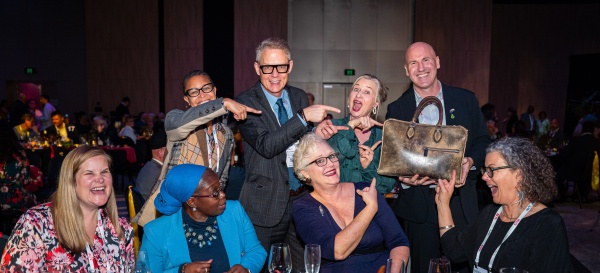
“As always, I found the conference to be an awesome opportunity to connect face-to-face with my colleagues and friends across the sector. It was hugely helpful to discuss (in-person) their areas of focus and how we can continue to align ENZ’s International team’s work alongside them”.
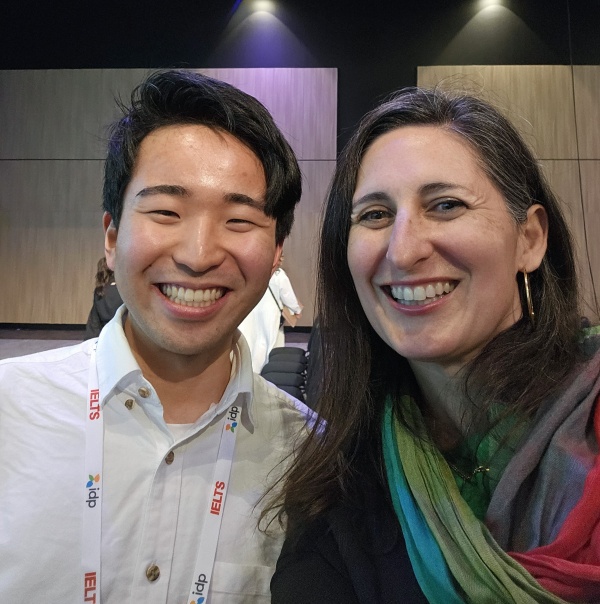
General Manager Sector Services Sahinde Pala with international student Ibuki Nishida.
General Manager Sector Services, Sahinde Pala, said....
“It was wonderful to see so many colleagues from across the global international education sector connecting with each other over the 2 ½ days of NZIEC KI TUA. Attendees and speakers brought a global approach to thoughts and reflections and was a reminder of the environment within which we’re working. The extended networking breaks saw much cross-sector collaboration and sharing of good practice.
“The attendance and speech by the President of India, Smt. Droupadi Murmu, was a great honour – the President reflected on the importance of international education for communities as well as the individual, how transformative education has been for her during her life, and the value of Indian international students in NZ,” said Sahinde.
“Dr Fanta Aw was a crowd favourite, with her reflections on the complimentary nature of international education alongside domestic education and the opportunity for us to collaborate globally given the societal value it brings to our communities and countries.
“My absolute highlight is always the student speakers, who threw down the wero (challenge) to delegates to keep focused on the importance of striving to deliver an excellent student experience,” Sahinde added.
I’m really proud of the whole ENZ whānau who collaborated to put on yet another successful NZIEC KI TUA”.
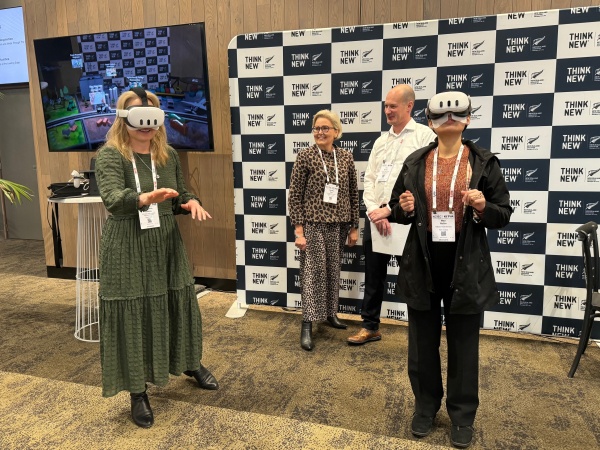
ENZ’s General Manager Sector Engagement, Innovation and Growth, Wendy Kerr (pictured second from left) said that attending NZIEC was incredibly energising.
“I was impressed by our teams combined approach to developing new areas for high value growth. Adrian Hirst, ENZ’s Director of Marketing, spoke passionately about the challenge of standing out in the competitive international education market. His words resonated with me: “In a sea of competing destinations, it’s increasingly difficult to stand out.” It really made me think about the importance of creating a unique identity that speaks to prospective students and their families," said Wendy.
"Christina Gomes, our Director of Innovation and Growth, shared an exciting framework that aligns global demand with New Zealand’s strengths. I was particularly drawn to her insights on the agri-food sector, which highlighted New Zealand's expertise and global reputation. This provides an anchor to develop our unique identity and secure additional learners by targeting a new segment".
Wendy added, "Tim Brown introduced a new “mixed reality” tool designed to immerse prospective students in the New Zealand agri-food systems career opportunities and study experience".
"I left the conference feeling energised and hopeful about these initiatives, knowing they could accelerate how we attract additional international students and showcase the incredible opportunities that New Zealand offers. It was a reminder of the exciting future ahead for our education sector!" -
Online visa application update
Immigration ONLINE – Student will allow international students around the world to apply, pay fees and upload supporting documents online. The new service will be available to full fee paying, scholarship, exchange and English language students.
Student applicants will still need to provide passports. This can be done offshore through Visa Application Centres or, if the applicant is already in New Zealand, through the INZ Palmerston North office.
Apply on behalf of functionality – for INZ’s third party partners such as immigration advisers, education agents and education providers – is now set to go live in 2015. Later this year INZ will provide more specifics around the delivery timing in 2015.
While the new system provides international students with a new way to apply for their visas, it does not affect existing services. All current student visa processes remain.
Education agents can continue to use current methods of applying on behalf of applicants, and information about Immigration ONLINE – Student is being made available to agents so they can continue to give advice about application options to prospective student.
For further information, please read detailed question and answers on Immigration New Zealand’s website.
-
Around the world in five
NEW ZEALAND
The global citizens helping connect New Zealand with the world
UNITED KINGDOM
Avoid transactional view of international HE, says guru
INDIAMore than half of Gen Z considering different career path in the wake of Covid-19
GLOBALConsolidation in English language travel: how Covid-19 has changed the market supply
GLOBAL
Global education has major role to play in climate change crisis
