Search
Showing 10 of 7357 results
-
Graduate’s Kiwi know-how helps reduce water use in UAE desert
Rather than travelling to New Zealand and undertaking theoretical research with limited relevance back home, Wafa was able to carry out hands-on work addressing critical water management issues in her arid home country, while being supervised by New Zealand-based experts.
It was a personalised and practical kind of international education experience which Wafa is grateful for. “It allowed me to continue working, while at the same time learning and finding solutions to the water management issues facing the UAE.”
The education partnership grew out of a New Zealand G2G (Government to Government) relationship with the UAE which dates back to 2014. “The aim is to build the capacity of local people and find solutions to real problems through scholarships for study,” she says.
Already qualified with a Bachelor’s degree in ecology and environmental science and Master’s degree in water and environmental engineering, Wafa was working as an environmental scientist for Environment Agency - Abu Dhabi (EAD) when asked to be involved in the programme.
The region needs to find ways to manage the growing demand for groundwater in a hyper-arid, saline environment. Abu Dhabi, the capital of the UAE, has about 19 million planted trees in desert “forests”, a precious legacy of founding father Sheikh Zayed Al Nayhan. They provide a range of ecological benefits but are heavily dependent on groundwater irrigation.
With EAD given a government mandate in 2016 to protect groundwater reserves, water meters were introduced and areas of wastage identified. Wafa’s research was required to determine the exact water needs of the plants through the implementation of New Zealand technology, and experimentation with the use of treated sewage effluent, or “grey water”.
Distance learning partnership with Massey University
She worked with a team at New Zealand’s Plant & Food Research and her project was supervised by Principal Scientist Brent Clothier. The programme was managed by Lesley Kennedy of Wellington-based consultancy firm OnlyFromNZ.
“I travelled to New Zealand once or twice a year to meet Massey University requirements such as attending exams, presentations, or conferences. Likewise, Brent would come to the UAE with his team and help oversee the research.”
“It’s fit-for-purpose academic knowledge with real practical utility,” Dr Clothier says.
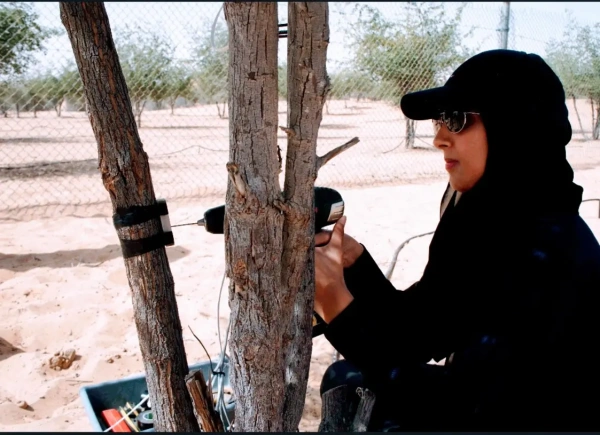
Wafa used Plant & Food Research’s heat pulse technology, which has been employed successfully in New Zealand and other parts of the world, but never in a region where temperatures can reach close to 50degC in summer. Once up and running, the technology provided readings every 30 minutes which allowed Wafa to calculate precisely the amount of water being absorbed by the plant.
“The data provided new and exciting information for us. We found that many of the trees had already adapted to the summer heat and did not take up as much water as we were providing through irrigation,” she says.
“By the end of the study we determined that we could save 35 - 70 percent of the water we have been supplying through irrigation.”
The technology was extended to other crops, and farmers are now provided with crop calculator software which provides guidance on the specific water needs of a tree, according to the month of the year, location, and soil type. “It’s a very important tool for growers in the UAE.”
“It’s good for countries to work together and find solutions to our challenges.”
Enduring relationship with New Zealand
Wafa is proud of the fact that her research is helping to solve a critical environmental issue in her country and knows that the collaboration with Massey through the NZ G2G partnership has been an integral part of her success. It has also paved the way for two other Emirati students to follow in her footsteps.
“I met other international students from the Middle East while at Massey and they were envious of me. They said I was very lucky because I was doing something for my country.”
She believes international education plays a key role in the exchange of information with other countries. “It’s good for countries to work together and find solutions to our challenges. If we are talking about the environment, we are all living in one world so it’s important that we work together to solve issues.”
But this academic partnership has not just produced practical results. It’s also seen a special bond develop between the New Zealand scientists and their Emirati students.
“I have built a long-lasting relationship with New Zealand,” Wafa says. “I know that I can always call my contacts in New Zealand to discuss an issue and they will be there for me.
“The relationship is much bigger than the life of the project and this is very important for me as a scientist and a researcher.”
- File 0012
- Massey in Colombia 1
- PMSA recipients 2017 18 Round 2
-
Inviting feedback on the Capability Toolkit project
More than 36 pages of tips, guidelines, tools, case studies and scenarios have been developed for the online resource, and ISANA NZ is seeking your feedback.
Material is grouped around key themes that include wraparound tailored support, intercultural competence in education contexts, and student experience information for agents and offshore partners. The toolkit will be published early in 2023.
“This is all about delivering an excellent student experience,” says Chris Beard, ISANA’s Executive Director.
“The toolkit will promote evidence-based practice that supports innovation, nimbleness and risk mitigation, and aligns with the Education (Pastoral Care of Tertiary and International Learners) Code of Practice 2021, which came into effect this year.”
To browse selected draft pages and provide feedback, go to the ISANA NZ website, and select ‘Toolkit’. To share your reflections, ideas and suggestions, please email content@isana.nz with the header 'Capability Toolkit feedback'.
You may also be interested in the following video presentation about the new toolkit, which was delivered for NZIEC KI TUA 2022: KT004 Student Experience Chris Beard Friederike Tegge - YouTube.
The next in-person presentation about the toolkit will be held at Victoria University of Wellington-Te Herenga Waka on 2 December, 10.30 – 12pm, AM106 (Alan MacDiarmid). Please contact chris.beard@isana.nz to register your interest.
-
Māori perspective in internationalisation
Having seen how international education creates long-term relationships and influences worldviews, in 2018, the University of Otago has established Tūrangawaewae Pōkai Whenua.This is an indigenous exchange programme connecting Māori with indigenous communities in Australia, Canada and the US.
Jason Cushen, Director International at the University of Otago, said the programme uses a network of partner universities to connect Māori students with other indigenous communities.
“International education is a lifechanging experience for students but for indigenous students in particular it can be a unique opportunity to connect with indigenous peers around the world, to share experiences and customs, and discuss the role cultural identity plays in education.
Jason and Tuari Potiki, Director of the Office of Maori Development, will present at NZIEC outlining how the programme will operate, and its place within broader mobility and diversity initiatives at the University of Otago.
A similar programme is being developed in Auckland, thanks to a partnership between Study Auckland and the hapū of Ngāti Whātua Ōrākei. Together, they have created the Rukuhia Leadership Programme, a cultural immersion experience designed especially for international students.
Students spend a day on a marae participating in workshops that focus on leadership, values, the connection of people, place and environment, and they learn about the work Ngāti Whātua Ōrākei does in the community. They experience a pōwhiri, meet iwi leaders, and learn te reo Māori greetings and pronunciation, waiata and haka.
Henry Matthews, Head of International Education at Study Auckland says the pilot programme emphasises the appeal of a uniquely New Zealand study experience.
“The leaders of Ngāti Whātua Ōrākei incorporate their values of Manaakitanga, Kaitiakitanga, Whanaunagatanga and Tino Rangatiratanga into the programme, which provides students with a powerful sense of belonging, connection and empowerment.
“It is an unforgettable international student experience, and something that can be easily replicated across other parts of New Zealand.”
Find out more about the programme at NZIEC, where Henry will lead an interactive session where you can hear first-hand from international students about how they found the experience.
NZIEC 2018 will be held on Thursday 9 and Friday 10 August at Te Papa Tongarewa in Wellington.
Tūrangawaewae Pōkai Whenua: A Place to Stand, a World to Explore, 1.30-2.10pm, Thu 9 Aug
Rukuhia Leadership Programme: A partnership with hapūto create unforgettable international student experiences, 11-11.40am, Fri 10 Aug
-
Meet the team: Paul Irwin
Hi Paul! What do you and the Partnerships and Marketing team do?
My team grew out of the former industry and marketing teams, following an organisational change around a year ago. Our team’s purpose is ‘to partner with international education providers to transform students’ lives and create a thriving, globally connected Aotearoa New Zealand’.
What this means in practice is that we aim to get the best alignment between the goals and capacity of our education providers with the aspirations and needs of our student audience.
Day-to-day, we look after and develop the ENZ brand, marketing channels and campaigns, digital platforms, student experience, scholarships and industry relationships.
How has your role evolved since you started at ENZ?
I joined ENZ in 2015 as the General Manager – Marketing & Channel Development. That role has evolved a couple of times through to my current role spanning the marketing and education industry teams.
Bringing our two teams together has been a big step forward. It’s given our marketers a much better insight into the needs of our providers and helped us to develop new ideas around marketing and product development with our industry.
One example of this has been the development of our new creative platform, I Am New, for our Think New brand. We all know lots of students whose lives have been transformed as a result of a New Zealand education and their wider experience while here. And we know that the world needs a new approach and our Think New education can deliver this, supported by New Zealand’s biculturalism and progessive and open society.
What I’ve found so far is that I Am New has resonated well with industry. It’s become almost like a rallying cry.
Can you tell us a bit about your professional background?
I’ve worked in marketing, publishing and advertising in New Zealand, London and in a regional role, based in Hong Kong.
My role in Asia was a transformational one – it really opened my eyes to the dynamism and diversity of Asian markets. I was also lucky enough to see in the historic handover of Hong Kong from the British to the Chinese in 1997.
In the 10 years before I joined ENZ in 2015, I worked for a range of advertising and marketing companies, and worked with clients like the Health Promotion Agency, Ministry of Education and Inland Revenue. Two of the highlights of that period were working on the launches of the Prime Minister’s Education Excellence Awards for the Ministry of Education and the award-winning ‘What’s My Number?’ campaign for the Electricity Authority.
How do you see marketing changing in the next few years, especially as digital transformation entrenches itself?
Over the years I’ve seen lots of changes in the world we operate in, but believe that while technology offers new opportunities, the principles of marketing remain the same. You need to understand both your audience and your business model, have a strong brand and value proposition, and provide a great customer experience.
I’ve worked in two significant industries, publishing and advertising, that have experienced major disruption and transformation. There’s always a spectrum from those resistant to change, believing ‘the proven ways’ are timeless, to those overhyping the radical nature of change. In my experience the truth lies somewhere in the middle, but the worst thing one can do is ignore change.
And finally, it’s no secret around the office that your weekends look a bit different to your nine-to-five. Can you tell us a bit about that?
My family lives on our 10 ha property in Marlborough. We have an organic vineyard, grow olives and keep a few animals (including, from time to time, mad sheep).
We don’t make our own wine; instead, we sell our grapes to a local winemaker who markets under the award-winning organic label, The Darling. We do, however, produce our own olive oil.
It’s a lot of hard work, but very rewarding. I grew up in mid-Canterbury on a farm near Rakaia, so working the land feels very natural to me and it provides a nice balance to my office-based role in Wellington during the week.
-
Runway to New Zealand
Runway to New Zealand was the result of a collaboration between fashion schools from AUT and Massey University, and two leading fashion institutions in India, the National Institute of Fashion Technology and the Pearl Academy. The project was supported by ENZ and by India’s premier fashion body, the Fashion Design Council of India.
Runway to New Zealand brought together six two-person teams of Kiwi and Indian student designers to create collections on the theme of ‘Future World Connections’. The project required the students to put together a ‘Think New’ collection using Indian sustainable fabrics to produce next generation contemporary garments.

The Indian judging panel and other officials L-R: John Laxon, ENZ; Varun Bahl, designer; Amit Aggarwal, designer; Sunil Sethi, FDCI; Rohit Bal, designer; Rina Dhaka, designer; HE Grahame Morton, High Commissioner; Jugnu Roy, ENZ
A panel of celebrity Indian judges judged each team’s efforts. The Indian students from the two winning teams secured two-week internships at the participating New Zealand fashion schools, where they will gain first-hand experience of New Zealand’s innovative teaching style.
The Kiwi students had the opportunity to spend a couple of weeks in India leading up to the fashion show, when they could see and touch the beautiful locally-produced fabrics, and observe local processing techniques and artisanship.

Aishwarya Jain and Claire Nicholson from the other winning team from AUT University, and their ‘Dystopia’ garments
The project has initiated discussions between the participating institutions that may well result in further exciting partnerships and collaborations.
Runway to New Zealand has boosted the profile of New Zealand as a high quality destination for fashion studies among the Indian aspirants. The event was attended by high profile Indian fashion media, resulting in coverage across a variety of outlets.
- graph3210313
- Korea ATEED edit