Search
Showing 10 of 7357 results
- Hero image Support
-
New Zealand institutions strengthen ties with Latin American education agencies
In April, ENZ supported the Study in New Zealand Agent Seminars – an event series organised by Kiwi EdLink, a New Zealand-based organisation that represents education providers across the country.
New Zealand’s educations offerings for Latin American students were showcased to education agents at the seminars. From English language programmes for children, youth, and adults to short or long-term school studies in New Zealand.
The participating institutions from New Zealand were the Kiwi English Academy, Glendowie College and Onslow College.
ENZ teams in Santiago and São Paulo hosted networking events at the New Zealand Embassy in Chile and the Consulate in Brazil, inviting selected agents aligned with Kiwi EdLink’s strategic goals in the region.
In addition to facilitating these connections, the ENZ team also provided market insights and engaged in conversations about future steps to deepen engagement and opportunities in Latin America’s dynamic education landscape.
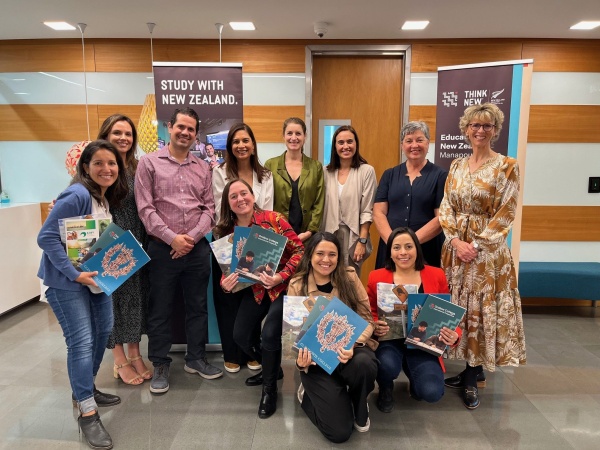
Attendees of the Study in New Zealand seminar in Santiago, Chile. This event was hosted at the New Zealand Embassy.
During the event in São Paulo, Director of Kiwi English Academy, Kathryn Herbert, said “This is a moment to reconnect with our Latin American partners so we can better understand how to offer relevant programs to Brazilian students.”
The feedback from sector attendees was positive. Director of International Students at Onslow College, Robynne Bloemstein, said that the institution is very excited to reengage with the Latin American market and welcome students from the region into its student body, which already includes 45 international students.
It was the first visit to Brazil for the Director of International Students at Glendowie College, Rebecca Johnstone. She said “We love Latin American students—we currently have 47 international students in total, including two Chilean students and a new Brazilian student starting in July. They all contribute greatly to the multicultural environment of our school.”
Check out the video report the ENZ team put together with the representatives of New Zealand schools at the São Paulo event.
-
From the CE: Purpose, Place and Partnership
Kia ora koutou,
I am pleased to report that the cross-agency work to develop an International Education Growth Plan for the Prime Minister and Ministers is progressing well.
In recent weeks, Education New Zealand has held a series of engagements with different parts of the international education sector to validate assumptions on supply and focus markets, and to better understand current system capacity and which interventions will enable quality, sustainable growth. This work continues at pace.
Last week, we were delighted to welcome to our Wellington office a visiting delegation of senior school leaders from the Incheon Metropolitan Office of Education - East Asia Global Education Institute. At the mihi whakatau, I explained the Māori phrase Nau mai and the New Zealand way of showing hospitality and care (Manaakitanga) to visitors.
The visit was a valuable opportunity to reinforce New Zealand and its education institutions as trusted partners for South Korea. I am certain their stay, which included visits to New Zealand schools and vocational training institutes, will contribute to raising awareness of the New Zealand education system in their hometowns and strengthen ties with education providers here.
Later this month I will be travelling abroad for NAFSA, the world’s largest international education conference, which will be taking place in San Diego, California. The theme this year is Purpose, Place and Partnership, and it is one that resonates in a time of global uncertainty. I am looking forward to engaging with our sector partners and team in market, as well as showcasing New Zealand’s unique education offering to the world.
He whenua auaha tātou, he whai tikanga, he whai whakaaro tonu ki te hapori.
We are a country that is creative, practical and community minded.
Ngā mihi nui,
Amanda Malu
Chief Executive
- New Zealand Alumni Day 375 resize
- Whanau
- Kaylee and Euan
- IMG 4332
- 190913 Santiago for Vital E
- Viet Nam alumni
-
Employers embrace influence of international students
These employers know that, along with their skills, the international graduates bring rich cultural context, a fresh perspective, an innovative mindset, and a solid work ethic to the office each day.
Assurity Consulting, a New Zealand-owned digital delivery services consultancy, has been hiring international students for their graduate programme almost since the company’s inception 17 years ago. Last year it won the International Student Workplace category at the Wellington International Student Excellence Awards.
“From very early on we took an approach of inclusive selection,” says Aron Chantelau, General Manager, People and Capability. “We wanted to find people whose values aligned with ours instead of simply trying to select based on people’s background and whether or not they went to Uni.”
Assurity has also partnered with Wellington NZ’s Employer Connect programme, established to provide insights into the business environment and networking opportunities for graduating international students; and the Work Ready programme, offering support on CV writing, cover letters, and what to expect from the hiring process.
“For the students, it is an opportunity to build their own network in a place where that might not otherwise be easy. For our staff, they get to connect with new people outside the industry and learn about the challenges the international students face, which gives them greater perspective.”
Aron says the students who attend both programmes are engaged, good at taking feedback, and highly motivated to start their careers.
Learning from each other
For Assurity, employing international graduates is about much more than filling jobs in the tech sector. “Our international graduates bring diversity of thought to our teams, which benefits our clients,” Aron says. “They also bring innovation, introducing new ideas and fresh perspectives which has led us over the years to try new things. And, culturally, it makes for an enjoyable workplace because there’s lots to learn from each other.”
He acknowledges there can be challenges, especially for students with English as a second or third language but says it’s all about providing the right structure and level of support. “We have a People Lead in all our teams. That role can be about supporting career progression, but it can also involve pastoral care - understanding what challenges that person is facing and helping to mitigate them.”
In Southland, Blue River Dairy is another company which recognises the value which international student graduates bring to their business. Since 2018, Blue River has hired more than 30 international students from the Southland Institute of Technology (SIT) and other institutions.
“The culture within an organisation is so important. Hiring only for skills is short-sighted,” says People and Capability Manager Abbigail Surridge. “With many of the international students that we have hired, we’ve been able to harness their life experience, dynamic exposure, and untapped potential as they have grown in their roles.”
“Diversity adds value to our organisation, by introducing different ways of thinking and problem-solving. When we collaborate, those differences help to create success.”

Jacky Shen arrived at SIT from Beijing in 2017 to study for his graduate diploma in Information Technology (IT). He already had a Master’s degree in Communication and Information Systems but wanted to better understand the New Zealand tech environment. He is now a software engineer at Blue River, leading a team of three.
Not only does the company benefit from Jacky’s technical skills, but also his language skills. “We have a number of Chinese suppliers, so I can speak to them easily and provide quick solutions for them,” he says. “Many companies want applicants to have local experience, but Blue Dairy allowed me to gain that experience on the job. It’s been a great opportunity.”
Economic and cultural influence
He believes that international students bring real value to the workplace. “We come with good technical skills, but we also contribute to the economy and to the cultural diversity of the country. It’s a win-win.”
Aron Chantelau says the international students who work in New Zealand have a bright future, whether here or overseas.
“They make a huge difference to our economy, both in terms of digital outcomes for New Zealand but also improving the quality of life here through the work they do,” he says. “Some of them will move overseas but if they’ve had a good experience here, they will become ambassadors for New Zealand.
“It’s great to be part of their journeys.”