Search
Showing 10 of 7357 results
-
ENZ showcases New Zealand’s commitment to sustainability in education and UN SDGs in India
Education New Zealand Manapou ki te Ao (ENZ) hosted a vibrant Sustainability Carnival on 14 November at the New Zealand High Commission in New Delhi to round off ENZ’s #SustainableTomorrow campaign that was designed to highlight New Zealand’s commitment to SDGs and sustainability in education.
The event showcased New Zealand university course offerings and officially launched ENZ’s Sustainability Guide, a comprehensive resource profiling course offerings in sustainability at New Zealand universities and the New Zealand Institute of Skills and Technology (NZIST).
The event saw over 150 attendees, including representatives from five New Zealand universities, three Indian universities, and students, parents, and teachers from New Delhi’s international schools. The Sustainable Tomorrow campaign was launched as a comprehensive digital and social campaign to spotlight sustainability within the educational landscape. Through diverse activities, and partnerships, the campaign highlighted New Zealand's commitment to embedding sustainable practices in education. It reached 82,266 accounts via the New Zealand in India Instagram page, engaged 2,935 accounts and saw 165 profile visitors.
As part of the campaign, ENZ launched a digital poster design competition for Indian high school students. Centred around the Innovating for a Sustainable Future theme, the competition aimed to raise awareness of key United Nations Sustainable Development Goals (SDGs), including Goal 7 (Affordable and clean energy), Goal 9 (Industry, innovation, and infrastructure), Goal 12 (Responsible consumption and production), and Goal 13 (Climate action). The winning posters were unveiled and recognised at the Sustainability Carnival, which also featured a series of other exciting activities, including street plays performed by students on the importance of sustainability, as well as a croquet match with the New Zealand High Commissioner to India Patrick Rata.
ENZ’s Director of Engagement, India and East Asia, Jugnu Roy, said the campaign did well to spotlight New Zealand’s strong credentials in sustainability stewardship to secondary school students, teachers and parents in India.
“The campaign was a fantastic opportunity to highlight New Zealand universities’ sustainability leadership, particularly their top global ranking for sustainability stewardship in the Times Higher Education Impact Rankings 2024.
“The launch of the ENZ Sustainability Guide that promoted course offerings related to UN SDGs at New Zealand universities and Te Pūkenga really drove home the message about New Zealand’s commitment to a sustainable future that’s visible through our wide range of sustainability-focused education offerings,” Jugnu said.

New Zealand High Commissioner to India, Patrick Rata interacts with New Zealand university and Te Pūkenga representatives at the Study with New Zealand booth at the Sustainability Carnival.

Secondary school and higher education institution students and teachers from India with New Zealand High Commissioner to India, Patrick Rata at the Sustainability Carnival in New Delhi.
-
India insights snapshot
Country dashboard – India
In the year ended December 2024 New Zealand exported $398.02 million of education related travel to India and imported $3.9 million, representing a trade balance of $394.12 million and a total trade value of $401.92 million.
Broad field and level of study for Indian students in New Zealand - 2023
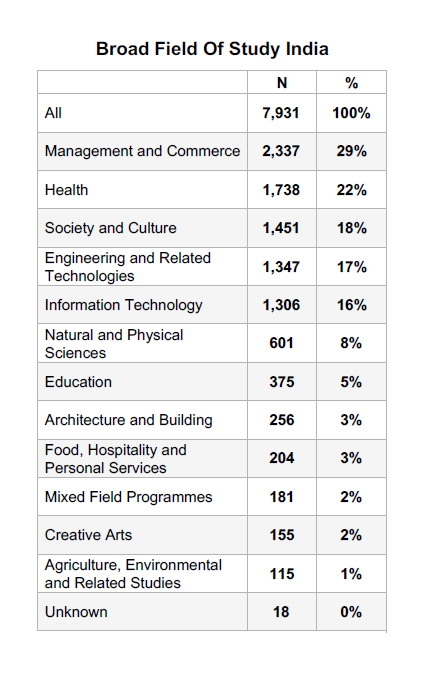
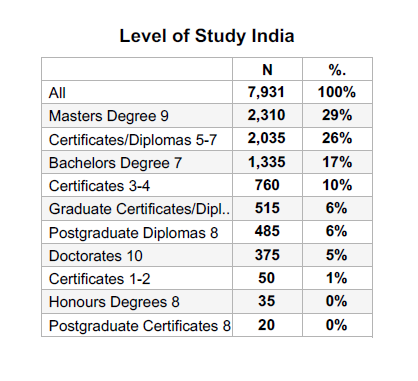
Browse the full country dashboards for India and other markets on this link.
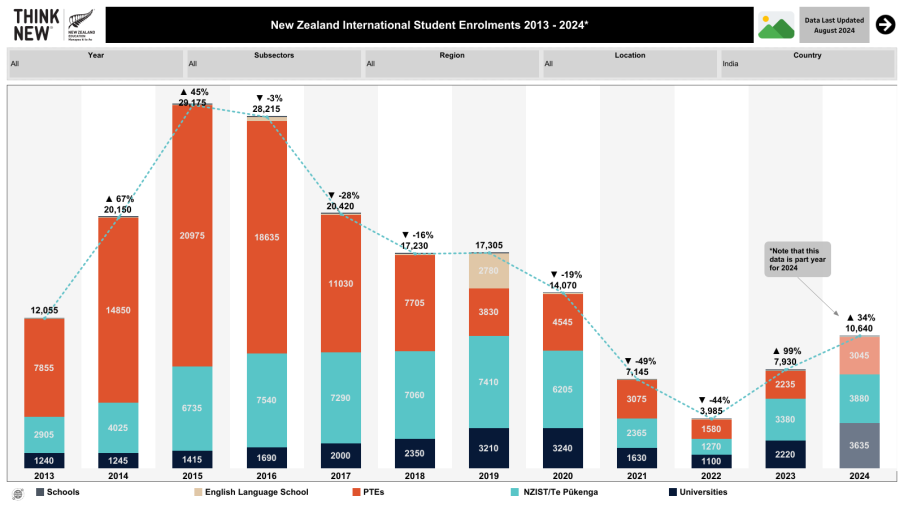
International student enrolments from India
Between January and August 2024, overall international student enrolments from India grew 34% to 10,640 from 7,930 enrolments in the full year period for 2023. Enrolments for universities grew around 64%, private training establishment enrolments grew 36% and Te Pūkenga enrolments from India grew 15% over the same period.
86% of Indian students in New Zealand rate overall experience positively
Indian students are thriving in New Zealand. The New Zealand International Student Experience Survey 2024 reveals that 86% of Indian students rated their overall experience in New Zealand positively.
From high-quality education and a warm, welcoming environment to strong community connections, these insights reflect New Zealand’s continued commitment to delivering a world-class, student-centred experience. -
Minister of Education, Chris Hipkins to address NZIEC 2019
For the second time in his role as Minister of Education, Minister Hipkins will address the conference delegates of NZIEC 2019.
On the morning of 7 August, Minister Hipkins will give a ministerial address followed by a brief question and answer session, where delegates will get to put their questions to the Minister through the Conference app.
Minister Hipkins will reflect on the past year in international education, and address the opportunities and challenges the sector will face in the coming 12 months.
Delegates interested in hearing more on the Strategy can head to the panel session on the Wednesday afternoon. Co-hosted by the Ministry of Education and ENZ, the ‘New Zealand Internation Education Strategy: One Year On’ session will discuss how the cross-agency action plan has affected positive change and collaboration. Additional to the Ministry of Education and ENZ, there will be representatives from all agencies involved including MFAT, MBIE, Immigration NZ and NZQA.
To be held over 7 and 8 August, the 28th annual NZIEC will focus on the theme of ‘Navigating our changing world’. You can view the full programme here.
The conference will host more than 600 delegates and a wide range of industry presenters. There are still a handful of tickets left, so register now on the NZIEC website if you don’t want to miss out.
-
Why country preference matters for international student experience
The 2025 International Student Experience Survey has recently closed. Many thanks to all providers who encouraged participation from their current or recent students.
As we grow our timeseries we aim to look below the topline findings for additional nuggets of information. For example, in our analysis of the 2024 International Student Experience Survey we looked at how a first-choice preference of study destination may impact eventual student experience.
Summary of findings
- 78% of international students currently or recently studying with a New Zealand provider reported that New Zealand was their number one choice of study destination.
- Of the 22% of respondents for whom New Zealand was not their first choice, Australia was most preferred (32%), followed by the USA (17%), Canada (15%), and the UK (14%).
- The most common reasons people gave for selecting a country other than New Zealand as their first choice of study destination was that their preferred country has ‘a good standard of living/is a developed country’ (26%), good institutions/education providers (24%), ‘a high quality of education’ (23%), and ‘good employment opportunities’ (23%).
- Country preference matters for student experience: Overall, experience scores were higher for those who reported that New Zealand was their first-choice destination for international education (median score 8 out of 10) compared to those for whom New Zealand was not their first choice (median score 7 out of 10). This effect persisted controlling for age, gender, subsector, and home country.
ENZ’s Director of Insights, Marie Clark, says that her team will be looking to focus on more of these sorts of insights for the coming year.
“With global policy changes impacting student decision making around country preference, it is important to understand how this might flow on to influence student experience and, even more importantly, actions providers can take to improve the experience of students for whom New Zealand may not have been the first choice for a study destination,” Marie says.
Recommendations for education providers to ensure a positive student experience
Irrespective of whether New Zealand is a prospective or current international student’s preferred study destination, education providers can take the following actions before and during the student application phase and after enrolment to ensure a positive overall student experience.
Prospective decision-making phase
1. Clearly articulate the benefits of studying in New Zealand, followed by benefits offered by specific locations and education providers to ensure that students have a broad idea of the New Zealand way of life.
2. Identify the key drivers of choice for your target students and if those drivers focus around country, course or provider choice.
3. Ensure that those supporting student decision-making are equipped with the same knowledge as well as how New Zealand compares to the alternative destinations that the prospective student may be considering.
Application and enrolment phase
4. Invest in pre-arrival communications, take the time to reinforce the choice of destination with both the international students and their influencers.
5. Ensure pre-arrival communications address common challenges or challenges regularly highlighted by international students of a similar demographic.
6. Consider how international students can begin to build their networks and local connections to ensure a smooth transition.
During study
7. Identify if there are a group of students at your institution, who may have been actively considering an alternative destination.
8. Look at which aspects of student experience have the most impact on overall experience and invest your resources there. For example, enhancements to living experience scores are likely to have the most impact on overall student experience.
-
Student visa processing update
INZ’s Head of Operations in Mumbai, Marcelle Foley said it is typical at this time of year for INZ to receive a high volume of applications, especially offshore. Marcelle says that applications that are submitted online, with all the required documentation will be prioritised.
“To ensure ample time for processing, students should apply at least eight weeks prior to the date of their intended travel to New Zealand. This allows INZ to appropriately assess the student’s application and to make any necessary verification steps to finalise the visa in time for the date of travel to New Zealand,” says Marcelle.
To enable the smooth processing of their application, students are encouraged to:
- Apply using the Immigration ONLINE submission platform. This is INZ’s preferred submission channel and the most efficient.
- Provide all the required documentation when submitting an application. Often, delays in processing occur when Immigration Officers do not have enough information at hand to make a decision on an application.
- Contact INZ only when required. There is no need to check in with INZ on the processing of an application unless the situation is urgent. As soon as an application is finalised or INZ needs further information, they will make contact with you.
If you have any questions regarding the visa process or wish to apply online please visit www.immigration.govt.nz
-
Digital skills and global citizenship at #NZAsiaTech Code Camp
A team of six students from Te Kura Māori o Porirua, a predominantly te reo Māori medium school in Porirua, interacted with school students in Japan, South Korea, Thailand, Viet Nam, Philippines, Malaysia, and Indonesia.
The overall theme was tourism, seen through the lens of the United Nations Sustainable Development Goals (SDG) - a theme that is highly relevant for the Asia-Pacific region. Students were given the task of profiling their home country’s SDG initiatives, with a focus on sustainable tourism.

Team Enterprise 12 from Viet Nam work on building website project during #NZAsiaTech Code Camp
The North Asia Centre of Asia-Pacific Excellence partnered with educational coding programme Code Avengers and Education New Zealand Manapou ki te Ao to deliver the event.
“With New Zealand’s borders having been closed for more than two years, it’s crucial that the next generation of students still have opportunities to build cultural competencies and make connections across the globe,” says Education New Zealand’s Regional Director for Asia, Ben Burrowes.
“The #NZAsiaTech Code Camp was an opportunity for Kiwi students to re-establish connections with students in other countries, while gaining critical digital skills to prepare them for the future.
“It also also gave a taste of New Zealand’s education offering to prospective international students from the Asia region, who might consider enrolling in high school or tertiary study in New Zealand in the future.”
Code Camps can help to generate subsequent visits by interested students to New Zealand. For example, the Code Camp held at Waseda Jitsugyo School in 2021 and at Waseda University Junior and Senior High School in 2022 has led to Waseda’s group students’ programme sending around 50 students from three schools to New Zealand for three weeks in March 2023. Code Camp served as a great opportunity for students and teachers from Waseda University affiliated schools to experience our world-class digital education first-hand.
Honam Jeon, the Education Manager at Gangwon International Education Institute said the programme helped increase awareness of New Zealand:
“South Korea is very interested in international engagement and exchange programmes for school students. The #NZAsiaTech Code Camp was a perfect example we want to continue to join. Thanks so much again to ENZ for organising the well-structured programme.”
The online programme included team building exercises, English learning, HTML coding lessons, and the creation of a website by student teams, to demonstrate their understanding of the importance of sustainable tourism.
“As our students look to enter an increasingly globalised word, developing cultural connections and transferable skills is so important,” says Te Kura Māori o Porirua school principal, Whāea Evelyn Wharehinga.
“The Code Camp has been an exciting growth experience for our students, who have extended their digital literacy skills while having the chance to connect with students of different ethnicities and cultures across the Asia-Pacific region.”
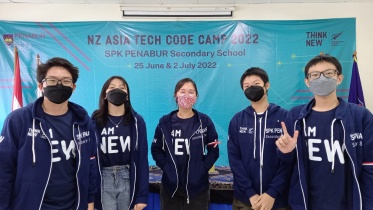
Team Indonesia was the winning team after presenting their newly developed website on Sustainable Tourism to a virtual panel of judges.
The students presented their sustainable tourism-themed websites to a panel of expert judges at the awards ceremony on 2 July 2022, with students from Indonesia winning the top prize.
Steve Budd of Code Avengers, a global edtech company based in New Zealand, said it was a great programme to participate in.
“It was a privilege to gift all participants a one-year free subscription to the Code Avengers site as part of our mission to build lasting digital capabilities for educators and young people, and bridge the digital divide,” says Budd.
-
ENZ invites proposals to establish New Zealand Education Centres globally
The centres will deliver education programmes for students progressing onto further study with New Zealand education providers, and act as pathways for greater education, cultural and diplomatic engagement between New Zealand and partner countries.
The centres will receive support from New Zealand universities, ENZ design and marketing packages, and have opportunities to host events, promotions and student mobility activities.
“In developing New Zealand Education Centres we are extending our support for international students offshore, and providing flexibility in how and where they experience a high-quality New Zealand education” ENZ Chief Executive Grant McPherson said.
“The establishment of New Zealand Education Centres will support both the Government’s International Education Recovery Plan and the goals of the New Zealand International Education Strategy aiming for a more globally connected New Zealand.”
Interested organisations can contact John Laxon, Director Global Education Partnerships (nzcentres@enz.govt.nz) to receive further information on the establishment process.
Download the NZ Centre Proposal Summary Information 2021 here.
Proposals are due by Wednesday 25 May, with centres being established and open for initial student intakes by 2022.
-
New Zealand top of the world in university sustainability stewardship
New Zealand universities have come out on top of the world for sustainability stewardship in the Times Higher Education Impact Rankings 2024.
New Zealand universities’ approach to sustainability and equality has been announced as world-leading by Times Higher Education (THE) in its most recent Impact Rankings (2024). The stewardship rankings saw New Zealand score an average of 85.3 to come out ahead of Australia (84.4) and Hong Kong (81.9). All eight New Zealand universities participated in the rankings.
Now in its sixth year, the Impact Rankings is the only ranking system in the world that measures universities’ contributions to the United Nations’ Sustainability Goals (UN SDG’s). The Rankings assess the commitment made by universities to sustainability across four broad areas: research, stewardship, outreach, and teaching.
In topping the table for sustainability stewardship, New Zealand’s universities have scored well against indicators such as tracking food waste and having sustainable food choices on campus (SDG 2), the proportion of senior female academics (SDG 5), having water reuse policies and measurements (SDG 6), ensuring energy efficiency with renovations of buildings (SDG 7), and guaranteeing a living wage (SDG 8).
New Zealand universities also came second equal in the world against sustainability outreach, meaning high scores were achieved for contributing to policies addressing poverty (SDG 1), collaborating with health institutions (SDG 3), providing programmes for the local community to learn about energy efficiency (SDG 7), participating in cooperative planning for climate change disasters (SDG 13), and providing expert advice to government (SDG 16).
ENZ’s Acting Chief Executive Dr Linda Sissons welcomed the results and said the global recognition for New Zealand’s universities working hard to make a positive impact in the face of pressing environmental and social challenges world-wide was significant.
“New Zealand’s education system is guided by Kaitiakitanga (the Māori concept of guardianship). This principle instils a deep sense of connection to our land and a commitment to ensuring its health and vitality for future generations.
"Kaitiakitanga informs the approach taken by our universities to resource management, conservation, and sustainable development that all contribute to the UN’s SDGs particularly in the areas of food security, bioenergy, sustainable urban development, and climate change,” said Dr Sissons.
Dr Sissons added “It is incredibly positive to have our approach to sustainability stewardship and outreach recognised as world leading. This is particularly important to us as we know that students around the globe are increasingly prioritising environmental and social responsibility and choosing to study at institutions that align with their personal values.”
In this year's Impact Rankings, a record 2,152 universities from 125 countries/regions were assessed. Progress is measured for each of the individual 17 SDGs, and across the goals as a whole. View the full Impact Rankings 2024 results here.
Top countries/regions for sustainability stewardship in THE’s Impact Rankings 2024
Country/region
Number of ranked universities
Average stewardship score
New Zealand
8
85.3
Australia
21
84.4
Hong Kong
5
81.9
Ireland
8
81.4
Canada
24
80.5
United Kingdom
68
79.7
United States
46
69.1
South Korea
24
67.9
Belgium
5
65.2
Netherlands
6
64.5
Note: Table only includes nations with five or more ranked universities. Credit: Times Higer Education Rankings 2024
Top countries/regions for sustainability outreach in THE’s Impact Rankings 2024
Country/region
Number of ranked universities
Average stewardship score
Hong Kong
5
81.4
New Zealand
8
80.4
Canada
24
80.4
Australia
21
80
Ireland
8
76.4
United Kingdom
68
75.6
Belgium
5
71.9
Germany
8
68.1
South Korea
24
67.9
Netherlands
6
66.2
Note: Table only includes nations with five or more ranked universities. Credit: Times Higer Education Rankings 2024
For further information
Stephanie Morison, Senior Communications Advisor,
Education New Zealand Manapou ki te Ao
Stephanie.Morison@enz.govt.nz | +64223020104
Notes to Editors:
About Education New Zealand (ENZ) https://www.enz.govt.nz/
Education New Zealand Manapou ki te Ao (ENZ) is the government agency dedicated to helping Aotearoa New Zealand realise the social, cultural, and economic benefits of international education. Our role is to promote New Zealand as a high-quality education destination offering excellent education and students experiences and to encourage New Zealand students to study overseas.
With approximately 110 staff in 16 locations around the world, ENZ works closely with New Zealand’s diverse education sector which includes schools, English language providers, Private Training Establishments, Institutes of Technology and Polytechnics (Te Pūkenga), and universities. Internationally, we work with a range of education stakeholders, including government agencies and education providers to identify and encourage sustainable growth opportunities for New Zealand’s education sector.
-
Does it matter if New Zealand wasn’t a student’s #1 choice? Join the Insights and Student Experience teams and find out!
In this session, Director of Insights, Marie Clark, Insights Analyst, Dr Tom Vardy, and Student Experience Manager, Ross Crosson, will give an overview of the key findings of the survey and will also exclusively preview our deep dive into the questions on decision making and country choice. Answering the question: Does it matter if New Zealand wasn’t an international student’s first choice?
In the 2024 International Student Experience Survey, students lifted their positive rating of their experience to 86 percent, two percent higher than the previous year. In addition, the number of students who rated their experience as “excellent” lifted eight percent to 41 percent. ENZ’s media release which includes links to the report and data sets can be found on our website - Rise in international students rating New Zealand experience positively.
As many education providers are looking to take advantage of new opportunities, this webinar is an important first chance to identify what additional support for international students may be required for the 2025 academic year.
Click this link to join the session: Student Experience Webinar | Tuesday 24 September 11am to 12pm.
-
Refresh of ENZ Recognised Agency programme
The ENZ Recognised Agency is a programme focused on identifying and engaging with proven, committed and ethical education agencies. It was re-launched in late 2018.
ENZ is dedicated to increasing engagement with quality education agencies that have demonstrated a long-term commitment to promoting New Zealand as an international study destination and are successfully placing students at New Zealand education providers.
The Recognised Agency programme intends to allow ENZ to better, and more regularly, interact with high-quality education agents. While it is not a regulatory programme, it is anticipated that education providers and prospective students will have a higher level of confidence in the quality, expertise and commitment of a Recognised Agency.
Recognised Agencies are able to display the above logo.
Go to our StudyinNewZealand website to view the refreshed list. For queries regarding education agents, please email: agenthelp@enz.govt.nz.