Search
Showing 10 of 7347 results
- nzfashionmalaysia
- 2324 048 OIA Request koha payments to ex Board Chair and correspondence queries
-
Innovative leadership programme funded by PIF proves great success
The Crusaders partnered with Christchurch-based education provider Boma to develop an engaging online leadership programme sharing the Crusaders Way with rugby coaches for all age levels. The programme draws on rugby legends Scott Robertson, Robbie Deans, Kieran Read and Samuel Whitelock to help participants build a connected and skilful team.
The Crusaders chose to collaborate with Boma because of the values alignment between the two organisations, combined with Boma’s expertise in crafting compelling, impactful, scalable online learning experiences.
Boma is a recipient of ENZ’s Product Innovation Fund, which assists in the development of programmes that deliver new, meaningful and unique learning experiences from New Zealand, for the world.
The funding allowed Boma to embark into a new area and develop the Crusaders pilot programme. Boma already runs events, workshops, and courses, and has worked with leading organisations in Aotearoa and around the world. Some of Boma’s clients include IAG, Meridian Energy, Stuff and New Zealand Trade and Enterprise.
While fully on-demand online courses have been around for a long time, they typically generate low completion rates. Boma’s approach is different, creating a cohort of learners who move through the programme together, leveraging pre-recorded video with time-sensitive community engagement.
Boma founder Kaila Colbin says their unique method delivers extraordinary outcomes.
“Our programmes are designed to offer the quality and impact of Stanford, the scalability of Masterclass, and the excitement and shared experience of TED,” she says.
Kaila explains that the coaches have the flexibility to complete the course in their own time but have a sense of urgency and accountability because of the community element.
The two-week pilot was completed by 114 coaches from 14 countries. It had glowing written feedback and earned a Net Promoter Score, or NPS, of 80%. NPS is a widely used customer satisfaction benchmark in which the potential score ranges from -100 to +100. A positive score is considered good and a score above 50 is considered outstanding.
Boma has big plans for the future, growing from rugby leadership to sports leadership to business and general leadership.
Registrations are open for the next Crusaders course, which starts on 30 January 2023.
Find out more about Boma here and find out more about the Crusaders Coaching Leadership Programme™ here.
- ENZ NauMai MP English QR code
- PD Advisor Government Stakeholders
-
International education contributes $5.1 billion to New Zealand
Announced by Education Minister Chris Hipkins, the figure consists of $4.8 billion attributed to international students visiting New Zealand and $0.3 billion to education and training goods and services delivered offshore. This places international education (onshore and offshore delivery) as New Zealand’s fourth largest export industry.
The report, based on 2017 data, also shows that 49,631 jobs are supported by the international education sector.
ENZ Chief Executive Grant McPherson says the figures reflect the hard work of education providers, government and everyday New Zealanders who welcome international students into their homes and communities.
“While economic contribution is one positive aspect of international education, it also brings a range of social and cultural benefits.
“This is reflected in the International Education Strategy, which sets out a path for the future of New Zealand’s international education sector focussed on offering an excellent student experience and building a sustainable sector that provides benefits for all New Zealanders.”
National infographics, as well as regional infographics covering Northland, Auckland, Bay of Plenty (including Tauranga, the Western Bay of Plenty and Rotorua), Waikato, Taranaki, Manawatu, Whanganui, Wellington, Hawke’s Bay, Nelson-Marlborough-Tasman, Canterbury, Otago (including Dunedin and Queenstown) and Southland, are available here.
A factsheet with further detail can be found here.
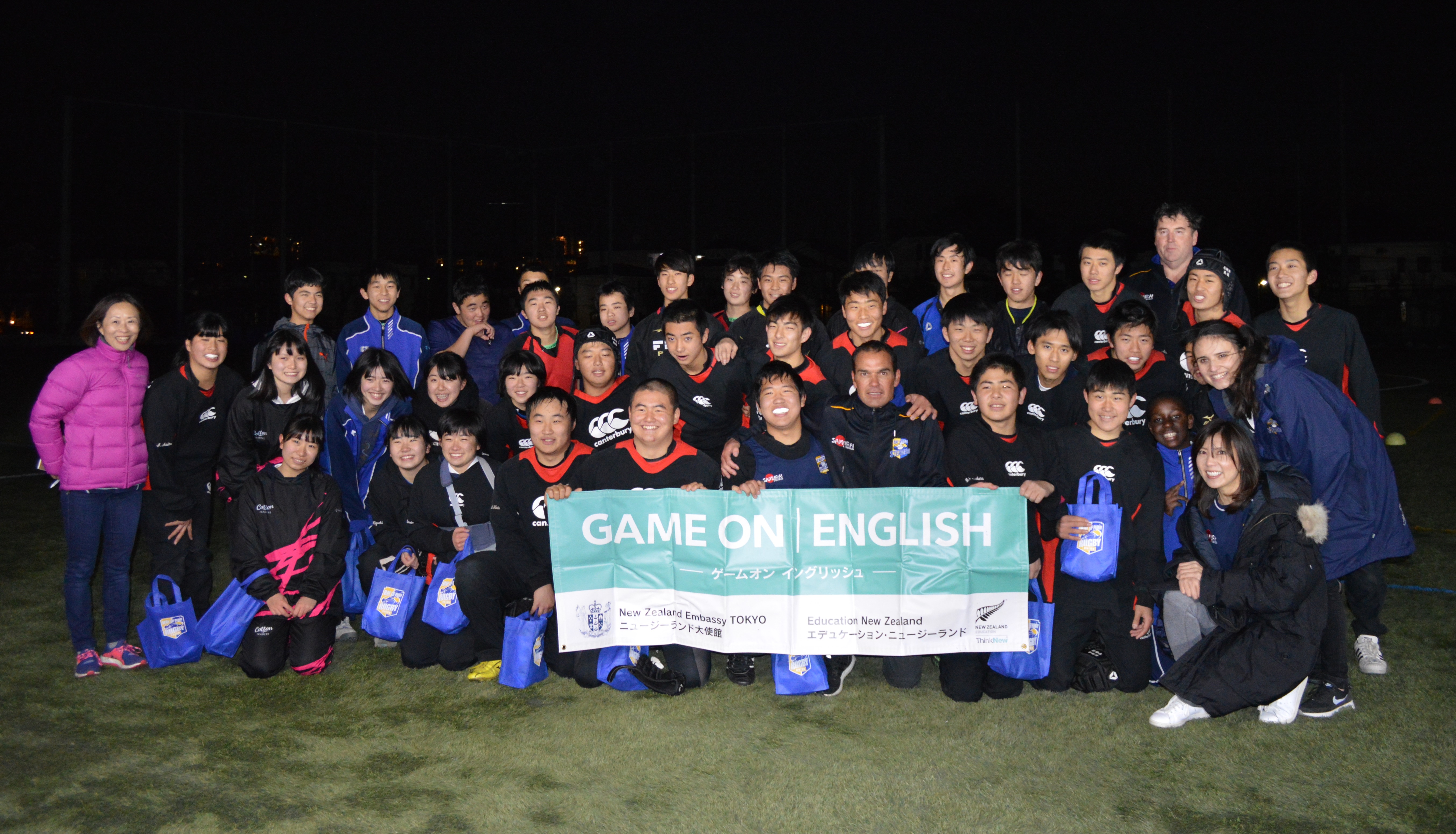
- Post training photo session with the students
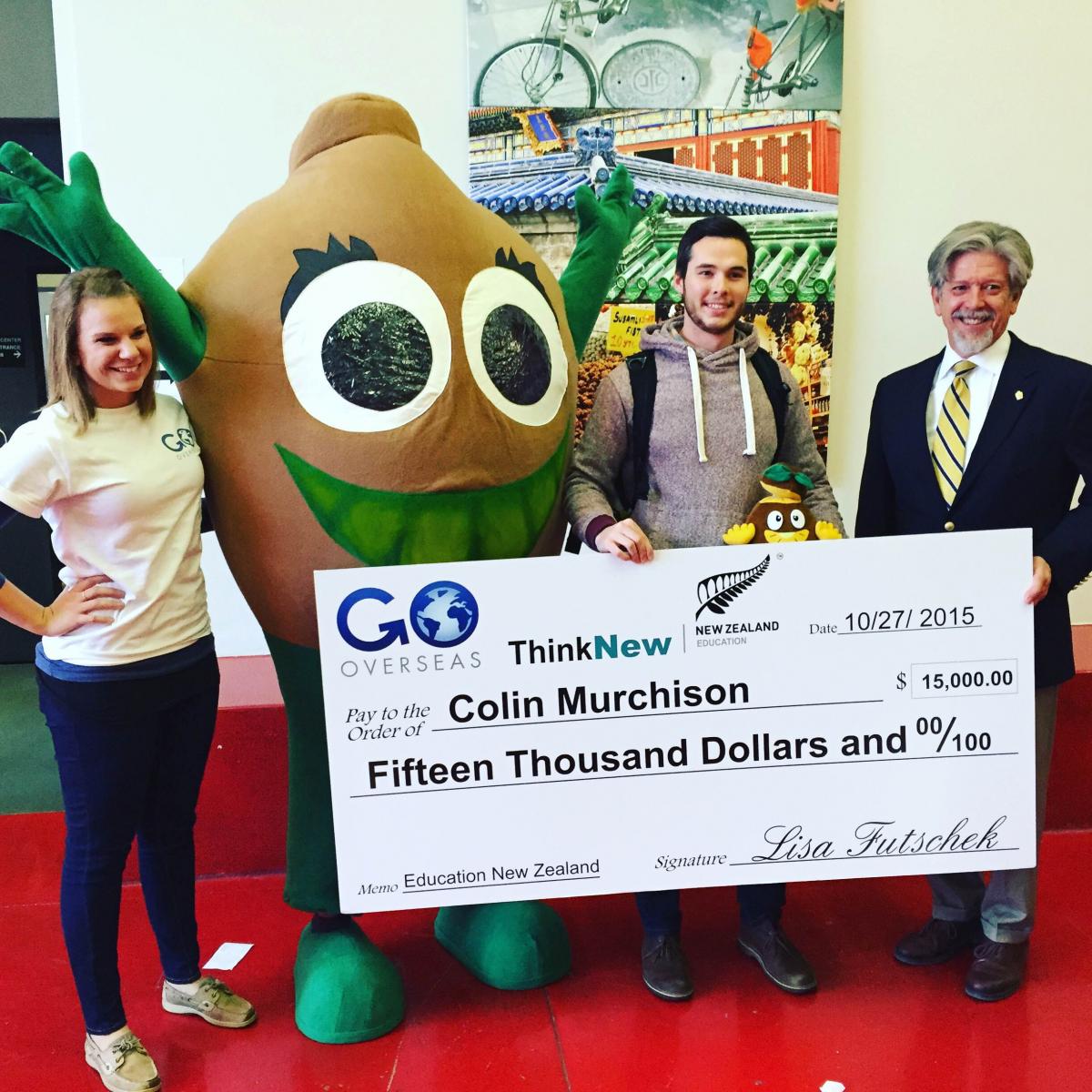
- Go20Overseas20winner
- Student Visa Dashboard January 2017
-
Aotearoa welcomes New Zealand Schools Scholarships students from Viet Nam
14 high-achieving Vietnamese students will be arriving in Aotearoa New Zealand over the next few months to take up school placements across the country from Kerikeri to Upper Hutt, from Ōtūmoetai to Manawatū.
NZSS is the flagship initiative under the Aotearoa New Zealand School Sector Strategy in Viet Nam. It was launched in 2019 and is exclusively offered to Vietnamese students from Grade 8 – 10. Since its launch NZSS has grown to become a prestigious, top of mind scholarship for local students.
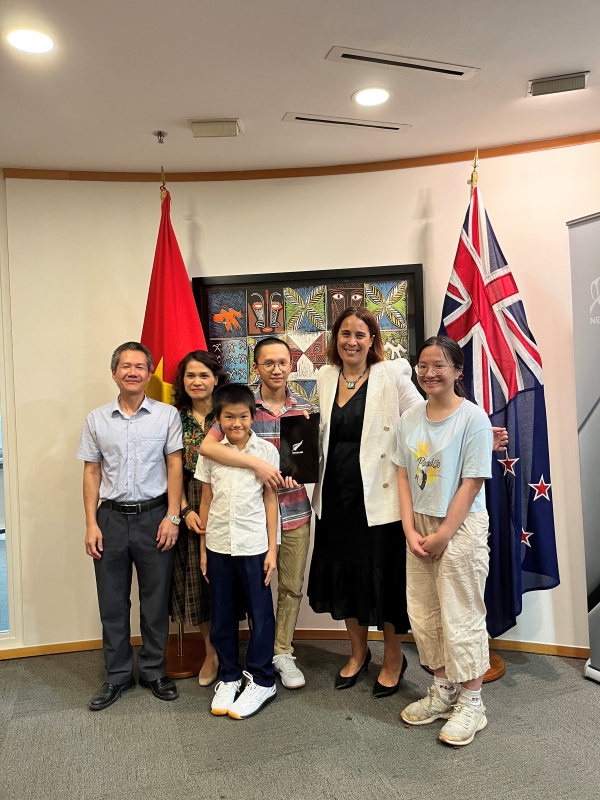
Nguyen Huy could not make it for the in-person Awards Ceremony in HCMC, so we arranged a special meet-up for his family at the Embassy in Hanoi with Ambassador Tredene Dobson, who awarded him with the NZSS certificate.
ENZ’s Business Development Manager, Mary Camp said that the scholarship programme not only offers talented Vietnamese students the opportunity to experience our country’s world-class education but also brings new perspectives and ways of thinking to Kiwi students as they learn alongside international friends.
“Schools in Aotearoa New Zealand are excited to welcome these top scholars from Viet Nam. Previous scholarship winners have had great academic success, made valuable contributions to their schools in NZ, and have gone on to attend top quality universities in NZ and internationally” added Mary.
This year’s award winners were celebrated at a ceremony on 18 June in Ho Chi Minh City where H.E Tredene Dobson, New Zealand Ambassador to Viet Nam opened the awards ceremony and pre-departure briefing and congratulated all the students.
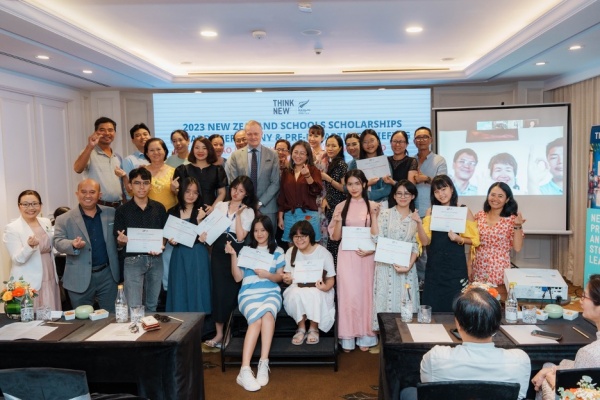
ENZ’s market manager Van Banh (far left) and Guy Lewis, Consular, NZ Embassy in Hanoi, with NZSS award recipients and family members at the awards ceremony and pre-departure briefing.
ENZ’s Regional Director for Asia, Mr Ben Burrowes also congratulated the students via video link and said it was fantastic to have a range of ex-scholarship winners and parents join us to share their tips and advice to this year’s winners.
“ENZ is absolutely committed to its relationship with Viet Nam and we are excited to welcome the NZSS recipients this year. The NZSS programme is designed so that more Vietnamese school students can access a world-class New Zealand education experience. As we saw pre-COVID, the NZSS recipients received the highest quality education and care while they were in New Zealand and that will certainly continue in 2023,” said Mr Burrowes.
A special thanks goes to the VSANZ - Vietnamese Students' Association in New Zealand for its President's presentation on the Pre-Departure Checklist and the NEW tips.
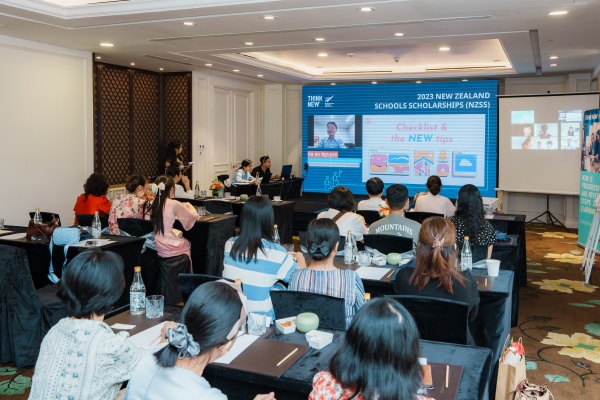
Ms Ha An Nguyen, President of VSANZ, shared useful tips for NZSS students to get well-prepared for the new learning journey in New Zealand.
We wish these students the absolute best for an exciting and rewarding study experience ahead as they start school across the country this week and in the coming months.