Search
Showing 10 of 7357 results
- US Fall
- Frankfurt 1
- lifeswap card 2
- Karen Rolleston3
- September 2018 student visa summary
-
Graduate’s Kiwi know-how helps reduce water use in UAE desert
Rather than travelling to New Zealand and undertaking theoretical research with limited relevance back home, Wafa was able to carry out hands-on work addressing critical water management issues in her arid home country, while being supervised by New Zealand-based experts.
It was a personalised and practical kind of international education experience which Wafa is grateful for. “It allowed me to continue working, while at the same time learning and finding solutions to the water management issues facing the UAE.”
The education partnership grew out of a New Zealand G2G (Government to Government) relationship with the UAE which dates back to 2014. “The aim is to build the capacity of local people and find solutions to real problems through scholarships for study,” she says.
Already qualified with a Bachelor’s degree in ecology and environmental science and Master’s degree in water and environmental engineering, Wafa was working as an environmental scientist for Environment Agency - Abu Dhabi (EAD) when asked to be involved in the programme.
The region needs to find ways to manage the growing demand for groundwater in a hyper-arid, saline environment. Abu Dhabi, the capital of the UAE, has about 19 million planted trees in desert “forests”, a precious legacy of founding father Sheikh Zayed Al Nayhan. They provide a range of ecological benefits but are heavily dependent on groundwater irrigation.
With EAD given a government mandate in 2016 to protect groundwater reserves, water meters were introduced and areas of wastage identified. Wafa’s research was required to determine the exact water needs of the plants through the implementation of New Zealand technology, and experimentation with the use of treated sewage effluent, or “grey water”.
Distance learning partnership with Massey University
She worked with a team at New Zealand’s Plant & Food Research and her project was supervised by Principal Scientist Brent Clothier. The programme was managed by Lesley Kennedy of Wellington-based consultancy firm OnlyFromNZ.
“I travelled to New Zealand once or twice a year to meet Massey University requirements such as attending exams, presentations, or conferences. Likewise, Brent would come to the UAE with his team and help oversee the research.”
“It’s fit-for-purpose academic knowledge with real practical utility,” Dr Clothier says.
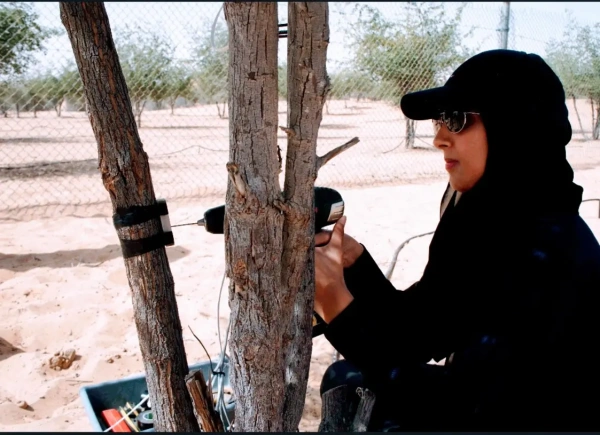
Wafa used Plant & Food Research’s heat pulse technology, which has been employed successfully in New Zealand and other parts of the world, but never in a region where temperatures can reach close to 50degC in summer. Once up and running, the technology provided readings every 30 minutes which allowed Wafa to calculate precisely the amount of water being absorbed by the plant.
“The data provided new and exciting information for us. We found that many of the trees had already adapted to the summer heat and did not take up as much water as we were providing through irrigation,” she says.
“By the end of the study we determined that we could save 35 - 70 percent of the water we have been supplying through irrigation.”
The technology was extended to other crops, and farmers are now provided with crop calculator software which provides guidance on the specific water needs of a tree, according to the month of the year, location, and soil type. “It’s a very important tool for growers in the UAE.”
“It’s good for countries to work together and find solutions to our challenges.”
Enduring relationship with New Zealand
Wafa is proud of the fact that her research is helping to solve a critical environmental issue in her country and knows that the collaboration with Massey through the NZ G2G partnership has been an integral part of her success. It has also paved the way for two other Emirati students to follow in her footsteps.
“I met other international students from the Middle East while at Massey and they were envious of me. They said I was very lucky because I was doing something for my country.”
She believes international education plays a key role in the exchange of information with other countries. “It’s good for countries to work together and find solutions to our challenges. If we are talking about the environment, we are all living in one world so it’s important that we work together to solve issues.”
But this academic partnership has not just produced practical results. It’s also seen a special bond develop between the New Zealand scientists and their Emirati students.
“I have built a long-lasting relationship with New Zealand,” Wafa says. “I know that I can always call my contacts in New Zealand to discuss an issue and they will be there for me.
“The relationship is much bigger than the life of the project and this is very important for me as a scientist and a researcher.”
-
Homestay host grateful for her international student whānau
Over a six-year period, Anne hosted 20 homestay students from all corners of the world and says she has remained in contact with a number of them.
Anne started hosting students when her son Jonas was just a baby. Now seven, Jonas has picked up the basics of Mandarin, Japanese, and Portuguese, and is relaxed with new arrivals in his life.
“He’s great at welcoming people and he’s very interested in languages. He might even go on to study language when he’s older,” she says.
Instead of a life which could, at times, have felt isolating as a mum bringing up a child on her own, Anne says her house was always a busy place. She loved the involvement the students had in her son’s life and the excitement they shared in his achievements and milestones.
“It was really an amazing experience for all of us.”
Rewarding to share cultural experiences
“There were times we shared the cooking, and some of the students taught me how to prepare meals they enjoyed in their culture.
Anne says she would show the students around Auckland, often taking them for day trips to Piha and sometimes to her father’s place in Whitianga for a classic Kiwi BBQ.
“It was important to me to show them New Zealand and our culture. They joined in family events and felt a sense of belonging.”
Anne has hosted students from China, Japan, Korea, Vietnam, Taiwan, Brazil, Saudi Arabia, and Germany, and experienced the many surprising ways in which they were enriched by each other’s cultures.

“I remember sitting on the beach with King, who was from China. He asked why people were smiling at him. I said that in New Zealand we tend to smile at each other and chat to people we don’t necessarily know. He said that didn’t happen in China and it was something he really enjoyed about New Zealand.”
Homestay experience broadened horizons
Now able to afford her own home, Anne says her experience as a homestay host opened her mind to accepting flatmates from a range of nationalities.
“We love having the mix of cultures in the house. I don’t think this would have happened if we hadn’t had the homestay students. I just feel grateful to have hosted them and think of them as extended whānau.”
- Caroline Su pic 02.jpg resize
- f9ea9140 26bb 403a 8311 a53f5b966364
- IMG 0780