Search
Showing 10 of 7357 results
- Whakatane4
-
ISANA - Enhancing international student experiences
The ISANA New Zealand Annual Conference held at AUT University in Tāmaki Makaurau last month provided the perfect forum to address the challenges of strengthening capability and ensuring sustainability as the sector addresses ways in which to grow international education.
A key feature of the conference was the presentation of a new online ‘Capability Toolkit’ - a collaboration between ISANA NZ and Education New Zealand Manapou ki te Ao (ENZ). Developed as a resource for education practitioners, the toolkit presents strategies, tools, tips, guidelines, case studies, scenarios and more to assist with every facet of engagement with international learners.
ENZ’s General Manager Sector Services, Sahinde Pala, said that the conference provided a great opportunity to reconnect face-to-face with professional colleagues.
“We all enjoyed the opportunity to exchange experiences and hear from frontline practitioners how the rebuild of the sector is going from their perspective. It was a great opportunity to connect with those relatively new to the sector and let them know the role of ENZ and the resources available to assist them in their role.”
“It was also encouraging to see our industry coming together to collectively focus on improving our services for students. The Capability Toolkit is an important, practical resource that will assist education practitioners provide even better support for our international learners.”
The Capability Toolkit provides links to resources in the following areas:
- Wraparound tailored support for international students
- Critical incident management for international students
- Innovative leadership in international education
- Intercultural competence in educational contexts
- Student experience information for agents.
ENZ is continuing to work with ISANA to further develop the Capability Toolkit and other content will be added over time. In the meantime, anyone who has not had a chance to look at the toolkit, can explore this further on ISANA NZ’s website here.
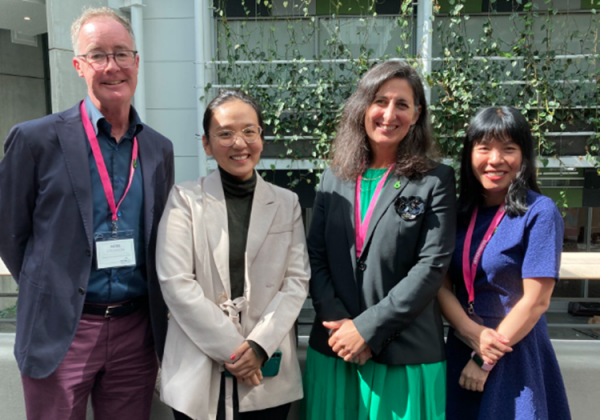
Vaelyn L, International Student Representative (second from left) with ENZ representatives at the ISANA conference Ross Crosson, Student Experience Manager, Sahinde Pala, General Manager Sector Services, and Faymie Li, Senior Advisor Student Experience
-
Education New Zealand nominated for three upcoming awards
ENZ recognised for Gilman Scholarship mahi
Education New Zealand has been selected as a finalist in the 2021 AmCham - DHL Express Success & Innovation Awards. The awards, run by the American Chamber of Commerce in New Zealand, celebrate the success and innovation of companies doing business with the United States.
ENZ is a finalist in the Bilateral Connections category and our entry focusses on how our Gilman Scholarship funding and other initiatives underway with US federal agencies and education institutions are helping build lasting connections between New Zealand and the United States through education. The winners will be announced at a function in Auckland on 26 August.
ENZ's digital China ecosystem recognised in China Business Awards
ENZ is a finalist in the 2021 HSBC NZCTA China Business Awards, New Zealand's preeminent awards for recognising business success in China. ENZ is nominated for the United Media Solution Award for Digital Excellence in Business between China and New Zealand, for our China digital ecosystem and experience work.
Tū Ngātahi nominated in prestigious marketing awards
ENZ's Tū Ngātahi campaign, delivered by Special Group, has been selected as a finalist in the Designers Institute of New Zealand Best Design Awards. Tū Ngātahi calls for New Zealanders to stand together with our international student community and send a message of empathy and support. It is nominated in the Public Good category.
-
February update from Immigration New Zealand
Update on Student visa processing*
Since New Zealand’s international borders reopened in August 2022, Immigration New Zealand (INZ) has received 25,471 student visa applications from international students outside of New Zealand. We have decided 17,601 of these applications, with more than half of our decisions made in under four weeks.
*Figures current as at 10pm on 30 January 2023.
We have updated our reporting
INZ is improving the way we publicly report on processing times for different visa categories. We now publish the processing times for applications decided in the previous month, instead of the previous three months.
The website illustrates the median number of days, along with the actual number of days it takes to process 90% of applications. These new metrics give a good indication of what customers can expect, regardless of the complexity of their application.
Check out our updated processing times here: How long it takes to process a visa application | Immigration New Zealand
Apply for visas at least 8 weeks ahead of intended travel date
New Zealand is in the middle of our student processing peak period. You can apply up to three or four months ahead of intended travel if you wish, however please ensure that applications are applied for at a minimum of 8 weeks ahead of intended travel date.
INZ generally processes applications in date order and the course start date is also taken into consideration.
We appreciate that students are keen to have their travel bookings confirmed given the cost of flights and flight route limitations, however INZ recommends that students do not confirm travel bookings until a visa has been granted. If students still wish to book travel ahead of a visa decision, we recommend that they explore flexi travel dates or refundable tickets.
Student visa checklists
The student visa checklist is key to submitting a complete student visa application that has the information we need to make a decision. We update the visa checklists regularly, so be sure to use the web link rather than download the checklist. The first time international students visa checklist was last updated in December 2022.
- 32
-
International student employment: overcoming barriers
The panel, chaired by ENZ’s Director Student Experience, Hayley Shields, featured a diverse and informed range of views from
- Brett Berquist, Director International at the University of Auckland
- Dr Cate Gribble, Senior Research Analyst at the University of Auckland
- James Koo, former international student and founder and CEO of Niesh, a free student discounts app
- Paul Hickey, Managing Director at SpeakData
- Charan Mohan, former international student and now Business Intelligence Analyst at SpeakData.
Dr Cate Gribble talked about the need to raise awareness of the benefits to businesses of employing international students to counter employer concerns around the challenges of international student employees, including perceptions they won’t fit culturally, their English will be limited or that their visa situation will make paperwork too challenging. Students also find their international work experience in their home country is not always valued here, and employers often require New Zealand citizens or Permanent Residents.
Brett Berquist added that we need to counter the perception that international students will not stick around.
“The reality is that all students, both domestic and international, are equally mobile. Employers need to stop thinking Kiwis make employees for life, and that international students are a flight risk.”
James Koo said the lack of transparency around these concerns is a challenge for international students. As a result, many international students end up sending a generic CV and cover letter to any and all available jobs, too discouraged to spend time tailoring their CVs to each role.
James also noted that student expectations can sometimes be unrealistic, and some students expect to work in large, prestigious companies whereas most New Zealand companies are SMEs – which he noted can actually offer more opportunities and experiences for students and recent graduates.
SpeakData’s Paul Hickey then talked about his experience hiring international students, such as fellow panellist Charan Mohan. While Charan clearly had the hard skills required for his company, Paul needed to be convinced of his soft skills, which he calls being ‘Kiwi-ready.’
 “Often, international students come into interviews and talk solely about their studies and qualifications when actually, we’re just as interested in hearing about their interests outside of work.
“That social aspect plays a big part – sharing a story about kayaking in Taupo at the weekend or going to an All Blacks game is an easy way to connect with Kiwi employers.”
Paul also talked about the need to work with institutions to create a pipeline of talent.
“Employers often take a short-term view and hire people ‘just in time’ rather than looking ahead, whereas if you expect to have 10 new positions available in two years’ time, why not try to establish a pipeline for talent through local institutions who can connect you with new graduates with relevant skills?”
Panellists also agreed that having internships and work experience in education programmes will also help international students get into the job market when they graduate.
Brett concluded that while all these approaches can reduce barriers, ultimately, a strategy is required – supported by data that is already available in reports such as the Ministry of Education’s ‘Moving Places’, ENZ’s Beyond the Economic and Immigration New Zealand data.
It is an ongoing discussion that will continue to be in the spotlight in New Zealand as the industry works to meet international student expectations of global employability.
- Year of Connection 2023 one pager
- ENZ ORIENTATION G9C4062
- Champlain
-
Around the world in five
Australia
The latest Agent Perception Survey from Navitas has demonstrated the impact of policy changes in Australia and Canada on demand and how the countries are viewed, and also shows that students are casting the net wider for higher education options and that demand for alternative destinations is growing.
India
Future of overseas education is set for major transformative shifts, driven by advancements in AI and immersive technologies. AI-led Virtual Reality tours are just one aspect that is set to revolutionise student exploration of overseas campuses.
South Korea
At the same time as leading Western destinations – e.g., Australia, Canada, the Netherlands, the United Kingdom – are applying brakes to slow or reverse the expansion of their foreign enrolment, several Asian destinations are doing the opposite: pursuing policies to boost international enrolments to record-high levels. Japan, Malaysia, Taiwan, and South Korea have all set ambitious new international enrolment targets.
United Kingdom
The UK government is considering replacing the Secure English Language Test (SELT) with a Home Office-owned testing model as part of an overhaul of the language requirement for student visas.
United States
International applications to US institutions continued to grow in 2024/25, though at a slower pace than in previous years, a new survey published in August 2024 has revealed.