Search
Showing 10 of 7329 results
- 703367 5079 Columba 1389
- PMSA 2016 17 rd 2 results 2
- Charlie3 FamilyPlanting 579
-
Support for Prime Minister’s Scholarships for Asia and Latin America recipients to continue to June 2026
The Prime Minister’s Scholarships programme was discontinued, and its funding reprioritised in the latest Government Budget 2025.
The decision to discontinue the programme is in line with the Government’s priority to deliver effective and fiscally sustainable public services and the need to focus on core activities in the current constrained fiscal environment.
The change takes effect from 1 July 2025. The decision will not impact any of the scholarships’ current recipients or recipients of the final group round, who were confirmed in June.
ENZ will continue to support current recipients, including those who are yet to travel overseas to 30 June 2026.
Since their inception in 2013 and 2016, respectively, the Prime Minister’s Scholarships for Asia and Latin America have been among ENZ’s significant, transformative and impactful programmes of work. To date, the programme has awarded 3,991 scholarships that have helped New Zealanders not only deepen their understanding of different cultures and languages but also enrich appreciation for their own culture and place in the world.
ENZ’s Group General Manager, International Marketing, Brand and Scholarships, Anna Gestro, said the Prime Minister’s Scholarships for Asia and Latin America have had a truly positive impact for building New Zealand’s connections in two key global regions.
“To date, the programme has awarded 3,991 scholarships that have helped New Zealanders deepen their understanding of new cultures and languages and enriched appreciation for their own culture and place in the world.
“The programme leaves a rich legacy through its rich and diverse alumni, who will continue to be global citizens in the way they nourish the connections and learnings picked up from their life-changing experiences from the scholarships,” Anna said.
- International Education Dashboard for 2016
- World map by region
- from Robbie Pickford2
-
Indigenous to indigenous education: Shaping global futures together at WIPCE
The conference, hosted by Auckland University of Technology, brought together participants from around the world for rich discussions on how Indigenous knowledge systems and leadership continue to shape global futures. Keynote addresses, panel discussions, and interactive sessions showcased the transformative potential of indigenous-led education.
A major focus of the gathering was to create pathways for mobility and partnership that uplift Indigenous students worldwide.
Attendees explored strategies for student exchanges, co-designed programmes, Indigenous-led research and teaching partnerships, and long-term relationship building across institutions.
These conversations laid the foundation for future initiatives that will enable Māori and Indigenous learners to connect across borders, deepen cultural understanding, and access education that reflects their identities and aspirations.
Beyond the formal programme, WIPCE created space for whakawhanaungatanga through shared kai (food), cultural exchange, and informal connection—reinforcing the relational foundations of Indigenous leadership: trust, reciprocity, and shared purpose.
ENZ Māori Advisor Āriana Ngarimu-Goldsmith represented ENZ in discussions and sessions at WIPCE and said the experience highlighted the strength of collective action.
“There is great power in coming together and uplifting one another, as we work towards a future where indigenous education is centred, valued, and celebrated.”
Pre-WIPCE hui in Tāmaki Makaurau
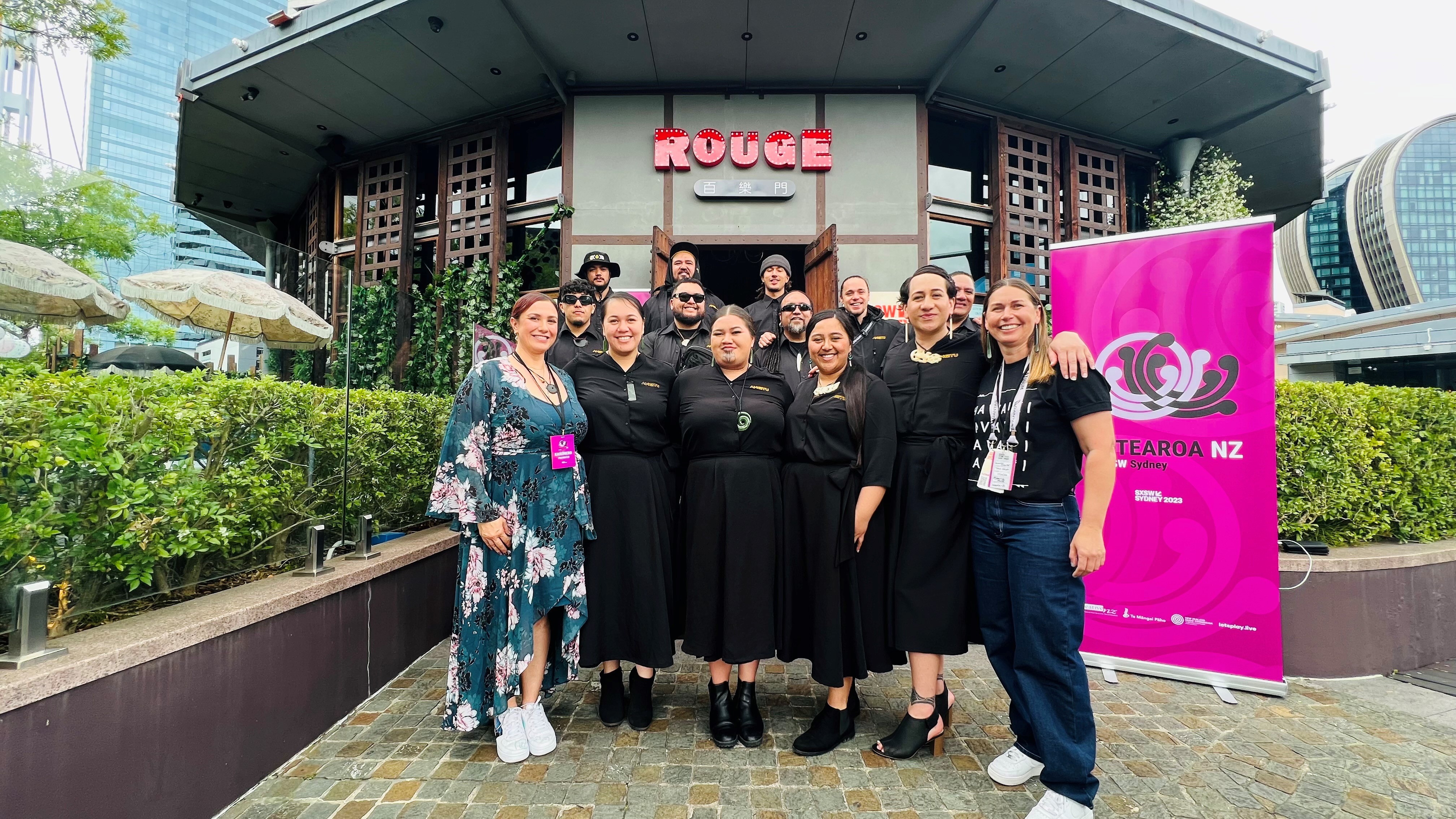
In partnership with APAIE (Asia-Pacific Association for International Education), ENZ Manapou ki te Ao hosted a pre-WIPCE gathering on 14 November in Tāmaki Makaurau Auckland. The hui brought together indigenous connectors from across Aotearoa, Australia, Canada and USA to share, wānanga, and prepare collectively for WIPCE 2025.
Ngāti Whātua Ōrākei opened the hui with mana and aroha, setting the tone for a day of genuine connection, respect, and belonging.
Attendees shared collective aspirations and challenges within the education systems, reinforcing a collective commitment to tackle structural inequities, elevate culture and identity as foundations for learner success, and strengthen indigenous-to-indigenous connections globally.
Ed Tuari (Manukura – Chief Advisor Māori) facilitated discussions exploring what is front-of-mind for participants as they moved toward WIPCE 2025.
The wānanga format intentionally moved away from “stand and deliver” presentations, instead fostering an open space for reflection, dialogue, and shared learning.
ENZ Manukura Chief Advisor Māori, Ed Tuari, said the events affirmed the power of indigenous knowledge to not only educate, but to transform.
“These engagements remind us that shaping global futures requires indigenous leadership, cultural integrity, and enduring relationships,” he added.
Ko ngā tini aho o te tukutuku whakaniko i te hinengaro
Me tuitui ki te tūmatakahuki o te hononga taketake o te aoBy Rāhera Shortland,
The many strands of knowledge that embellish the mind
Are woven upon a lattice of Indigenous connectivity across the world. - 1 million cent website
-
Southern Institute of Technology cultural education exchange introduces Aotearoa to Kansas
When Covid hit, the Southern Institute of Technology (SIT) knew that it was well placed to engage with its students digitally, as it already had a well-established distance learning faculty. The next move was to look at how that capability could be used for international education.
Using distance learning for cultural education internationally
Beyond widening its offering of fees-based online courses, SIT understood the value of establishing cultural exchanges which would engage current learners and potentially generate interest from future learners, says Study Abroad and Partnership Officer Whitney Irwin. She worked in collaboration with the School of Business faculty to set up the cultural exchange between SIT students and those at Johnson County Community College (JCCC) in Kansas, USA. “Being able to create buy-in and have a motivated faculty to get partnership projects across the line is the key to success. SIT has a wonderful culture, and we have all worked together to reorientate our international strategy for the greater good of SIT and our wider community.”
Experiencing New Zealand Life from afar
Twenty-five JCCC Economics students asked to be involved out of a class of sixty, reflecting a desire to learn about far-flung New Zealand, meet global peers and to try something new. From SIT, 23 Management students and 28 Communications students took part, with both groups of students using the interactions to produce assessed work.
“Our aim was to allow US students to see New Zealand life and get a taste of who we are, what we do, and how do we do it, with the bonus that it could also lead to the opening of doors for students to visit New Zealand, and vice versa,” says tutor Selena Coburn.
Using Zoom, Snapchat, and Instagram, students interviewed each other to learn about our different cultures, looking at differences in communication, lifestyle, politics, and making economic comparisons. Minimum wage, average house prices, and everyday living costs were compared, what the US and NZ dollar bought, and who was actually better off overall.
They learned about New Zealand’s response to the Covid-19 pandemic, rural life, Māori culture, the filming of the Lord of the Rings film trilogy, our outdoors lifestyle, and our connections with Australia. They also explored more personal subjects - relationships, music preferences, religious beliefs, parental expectations, and what they did in their spare time.
“The Kansas students now have a real sense of the kind of people we are,” Ms Coburn says.
Creating opportunities with a cultural education exchange
Digital collaboration also presents an opportunity for students, both in New Zealand and offshore, who could never afford to travel or would be uncomfortable leaving their home country, to still experience the cultural exchange which international education offers,” Ms Irwin says.
“It builds confidence and familiarity with a destination such as New Zealand which may encourage the students to travel here for study later on.”
And this has proved to be the case, with six Kansas students already saying they are keen to come to New Zealand.
“All going well, the intention is to host JCCC students here at SIT in 2023.” Ms Irwin says she expects the changes in the ways education is being delivered will continue well into the post-Covid environment.
“Virtual exchanges are a fantastic collaboration of ideas, which can lead on to the development of other educational products and services.”