Search
Showing 10 of 7355 results
-
Join us for the Latin America Study with New Zealand Virtual Fair
“The fair will be a great opportunity for providers to connect with prospective students in the Latin American market, using an interactive digital platform,” says Javiera Visedo, Director of Engagement Latin America for Education New Zealand Manapou ki te Ao (ENZ).
“ENZ is seeking expressions of interest in the fair, which we are hosting in collaboration with FPP. If you are interested in participating, please fill out the Expression of Interest form by 9 December 2022.”
Invitations to register will follow in the new year.
Find out more about Latin America
Key areas of focus for ENZ in Latin America include Brazil, Colombia and Chile, and we have staff based in São Paulo and Santiago.
Close to 6,000 international students came to New Zealand from Latin America in 2019, and Brazil is our eighth largest market. Since the pandemic there has been intense activity from our competitors with many of them establishing in-country representatives, which demonstrates the importance of this region in international student recruitment.
Beyond student recruitment, ENZ also values the government and education connections with the region.
ENZ recently hosted a series of Latin America Masterclasses, which saw participants from around Latin America tuning in to watch live lectures delivered by New Zealand academics.
In June this year, Education Minister Chris Hipkins created great buzz with his visit to Brazil and Chile, part of his first international trip since the beginning of the pandemic.
Group recipients of the Prime Ministers’ Scholarships for Latin America have recently started making their way to Brazil, Colombia and Chile to participate in short study exchanges. These include several Māori led groups, supporting connections with indigenous nations in the region.
In September, ENZ attended the FPP Virtual Fair in Colombia. The fair had more than 800 visitors, with over 100 visiting the ENZ booth. There was strong interest in tertiary programmes and language studies. The virtual fair was a great opportunity to promote New Zealand as a study destination within the Latin American market.
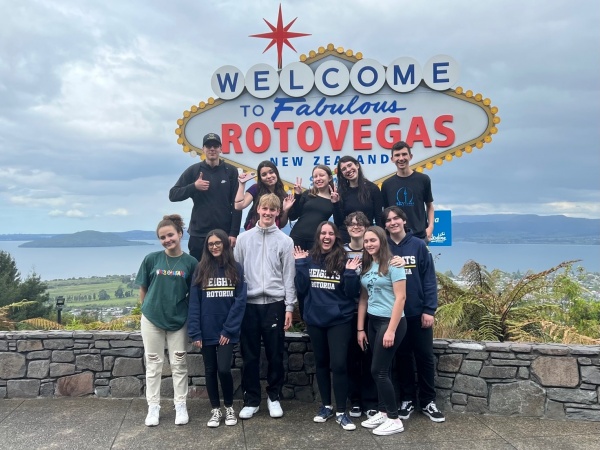
A group of 100 high school students from Paraná State in southern Brazil had a three-month study experience this year with schools in Auckland, Rotorua, Hawkes Bay, Palmerston North, Wellington, Canterbury and Invercargill.
Brazil
In 2019, there were 3,324 Brazilian students studying in New Zealand. Being from non-English speaking countries, the majority of Latin American students will start their education experience in New Zealand studying English. Scholarships offered by the local state governments have also contributed to the presence of Brazilian students in New Zealand and in 2022, 100 students from the state of Parana in Brazil travelled to New Zealand on a 3-month exchange. The students were placed at high schools across the country and gave positive feedback about their time here.
Colombia
Colombia is New Zealand’s second largest market in Latin America, second only to Brazil. In 2019, there were 1,360 Colombian students studying in New Zealand.
In 2023, 22 students from Bogotá, Colombia, will travel to New Zealand to study during terms one and two. Most of the students will be based at schools across the North Island, with one group heading down to Nelson.
On 23 November 2022, ENZ launched the I AM NEW campaign in Spanish at an event in Bogotá, to promote a New Zealand education.
Chile
The recent CAPE LatAm ‘Celebrating 50 years of diplomatic relations with Chile’ event, hosted at Parliament, was a great example of the rich history of connections between New Zealand and Chile.
Chile is New Zealand’s third largest market in Latin America. In 2019, there were 1,193 Chilean students studying in New Zealand. The majority of Chilean students come to New Zealand to study English Language, but enrolment in schools has also been consistent, with 17% of students studying at New Zealand schools in 2019.
Flights
Latam will be resuming their daily flights to Sydney via Auckland from mid-December and Qantas is flying three times per week from Santiago direct to Sydney. Although the cost of flights is high, in line with worldwide trends, the resumption of regular flights demonstrates the high demand for the Latin America to Oceania route.
Expressions of interest in the Latin America Study with New Zealand Virtual Fair are due by 9 December 2022. You can access the online form here.
If you have any questions about the event, please contact latinamerica@enz.govt.nz
- Agent FAQs image
- Strategy.our.vision.830x380
- 2025 NZ China Tripartite Fund Proposal Form
- Protected Disclosures (Protection of Whistleblowers) Procedure
- Virtual Medical Coaching PIF End of Project Report
-
Smart cities and AI technology key focus for KIWI Challenge 2023
The competition is designed to inspire youth across Indonesia to be engaged in entrepreneurial activities that address societal issues.
The 2023 theme is “Reforming Indonesia’s mobility and smart cities using AI technology”.
Education New Zealand Manapou ki te Ao (ENZ) organises the competition in collaboration with a New Zealand university and Kopi Tuli (Deaf Cafe), a deaf community in Jakarta. This year, ENZ is partnering up with Auckland University of Technology (AUT) to co-host the initiative.
School groups are required to submit video entries to a judging panel made up of AUT academics and ENZ representatives. Submissions are reviewed by the panel and finalists selected. The students will then be supported through a number of workshops and mentoring by the AUT academics.
The participating academic from AUT is Senior Lecturer International Business, Strategy and Entrepreneurship, Dr Taghreed Hikmet, who has expertise in smart cities and is passionate about mentoring and inspiring young future leaders. She has had close involvement in multiple programmes like YES, where she mentored young entrepreneurs pitching their business ideas.
Dr Hikmet says she is honoured to be involved this year.
“It is a delight to have the opportunity to inspire Indonesian students to think creatively about what the future can look like. The development of smart cities is about improving sustainability, creating opportunities for economic development and enhancing the quality of life for people, I’m looking forward to seeing the ideas students put forward,” she says.
ENZ Director Asia Ben Burrowes says that this initiative showcases New Zealand’s world-class education and academics in a meaningful way.
“Now entering its fourth year, KIWI Challenge has grown into a unique platform for New Zealand and our top academics to remain connected to Indonesian students in a way that is in touch with what matters to them. We continue to work with partners in Indonesia to identify the themes that resonate with students” he says.
The winners of the competition will be announced on Saturday 25 November, the top three groups will be awarded vouchers worth IDR 2,000,000 – 10,000,000.
To date, the competition has attracted more than 1,000 Indonesian students through the programme and each year has showcased a New Zealand university and a particular theme. Previous university partners were Massey University (Tourism), Lincoln University (Agribusiness) and the University of Canterbury (Education Technology).
- sam roadshow1
- thumbnail
-
Update from Immigration New Zealand
Update for international students: In-study work hours increasing from 3 November
From 3 November 2025, eligible international students will be able to work up to 25 hours per week during the semester - an increase from the current 20-hour limit. This change applies to all new student visas granted from that date, even if the application was submitted earlier.
If international students hold a student visa with a 20-hour work limit and want to take advantage of the new 25-hour allowance, they will need to apply for a variation of conditions (VOC) or a new student visa and pay the relevant fee
They can choose to apply now for the extra five hours or if their visa allows full-time work during summer vacation then they do not require the extra five hours and may choose to wait until later to apply for a variation. Some students will choose not to apply for a variation of conditions at all, and wait until their next student visa application
The process for applying for a variation of conditions depends on which system a visa was submitted through i.e. the old system or through enhanced Immigration Online.
For more information, visit Upcoming changes to student visa work rights: Immigration New Zealand
If they’re unsure which system their visa was issued in or which form to use, they can contact us for support before applying: Contact us: Immigration New Zealand
Update for international students: Changing your education provider or lowering your level of study from 3 November 2025
If a student visa holder is planning to change education provider or lower their level of study (for example, from a degree to a diploma), they’ll need to apply for a new student visa - not just a variation of conditions.
Upcoming changes to student visa work rights: Immigration New Zealand
This requirement ensures their visa accurately reflects the new study situation and complies with immigration requirements.
Before making any changes, students or their representatives should check the INZ website for guidance on how to apply for a new student visa on enhanced Immigration Online and ensure they apply in advance to avoid any disruption to their studies.
For more information, visit Study visas: Immigration New Zealand
Update for international students: Keep your visa photo filter free
We all like to look our best, but to avoid delays or declines, visa application photos must be a true, unedited likeness. That means students must abandon those filters and submit an accurate photo in order to avoid processing delays or declines.
Immigration New Zealand uses facial recognition, so filters, AI edits, or beauty enhancements interfere with identity checks. Photos must meet international biometric standards - natural skin tones, clear lighting, and no digital alterations.
Edited images including smoothing skin, changing eye size, reshaping facial features, or cropping your head onto a plain background will cause delays in processing and may lead to declined applications.
Key tips:
- Don’t use selfies - get someone to take your photo or use a professional.
- Tell photographers not to apply digital enhancements, like beauty filters or AI adjustments.
- Some photo apps or online tools may not be suitable for visa applications.
More information and examples of acceptable photos can be found on our website: Acceptable photos for a visa or NZeTA : Immigration New Zealand
Guardian visitor visa applications moving online from 3 November
From 3 November 2025, all Guardian Visitor Visa applications should be submitted on Immigration New Zealand’s enhanced Immigration Online system. This update is part of INZ’s broader digital transformation, aimed at improving the visa experience for families supporting international students.
While the information required remains the same, the application form may look a little different.
The enhanced system offers better application tracking and a more streamlined experience for applicants. Updated guidance and support materials are built into the form.
If you have an application in draft or submitted under the old application form, you will still be able to access or submit this application after 3 November 2025. We will notify you when the old application form is due to close.
For current visa holders, if your child is applying for a new student visa and you intend to apply for another Guardian Visitor Visa, both applications should be submitted through the enhanced system.
This change is particularly relevant for education providers, agents, and advisers supporting families of international students. Please share this update with your networks and encourage early preparation ahead of the transition.
Guardian Visitor Visa applications moving to enhanced Immigration Online: Immigration New Zealand