Search
Showing 10 of 7355 results
-
Māori and Pasifika experiences: diversifying our outbound programmes
At NZIEC, Jason Cushen, University of Otago’s Director, International and Claire Porima, Senior Project Manager, Office of Māori Development, talked about the need to diversify New Zealand’s outbound cohort and reduce barriers for Māori and Pasifika students.
“Our international exchange programme is 21 years old. In that time, the demographics of Otago’s student body have diversified, with currently 12% of our students Māori and 8% Pasifika – yet outbound numbers for Māori and Pasifika students remain low.
“In fact, the profile of the average student on that programme hasn’t changed. A typical Otago exchange student would be a 19 or 20-year-old Pākehā female from Epsom. Our Māori students are underrepresented amongst those engaged with international education opportunities.”
To overcome cultural and social barriers, the university launched Tūrangawaewae Pōkai Whenua in July 2018, an indigenous exchange programme connecting Māori with indigenous communities in Australia, Canada and the US.

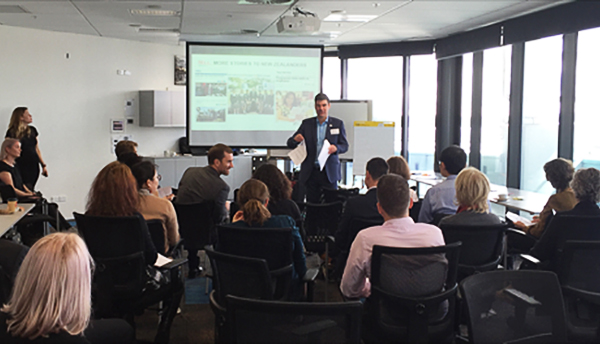
Jason Cushen at NZIEC 2018
“Programmes like this go beyond just an institutional relationship, the relationship with indigenous community is equally important. It adds richness to the experience we can offer Māori students, and can help Māori parents who feel uneasy about their whanau going abroad to feel more comfortable. We are hopeful that this will increase in the future of the programme – already we have 13 MOUs with iwi about developing opportunities for their rangatahi at Otago.”
ENZ is facing similar challenges with the Prime Minister’s Scholarship for Asia (PMSA) and Latin America (PMSLA) programmes. Christine Roberts, ENZ’s Student Scholarships Manager is working on a strategy to encourage wider diversity.
“Māori and Pasifika are significantly underrepresented in those applying for these scholarship programmes. We know there are quality candidates out there but many lack the confidence to apply or face other barriers.
“Sometimes family are not keen on them travelling during their studies, they may see it as a distraction and worry about taking time out of their course and extending the time it takes to complete their degree. Many students also face significant family commitments and responsibilities that make it difficult to get away. And many simply just don’t hear about the programme.
“There’s also a perception that scholarships are exclusively for wealthy students with the highest academic grades, but actually we place more importance on the ambassadorial role, alumna support role, community service, youth leadership qualities and broader cultural experience that many bring.
“We are working on an engagement strategy to change this. Our goal is to have an outbound programme that is reflective of – and values the contributions of all New Zealanders.”
- greg sc
- DSC 5865
-
You’re invited! Find out about Brazil international education trends in upcoming webinar
Join us to dive into the results of the 10th edition of the Brazilian Educational & Language Travel Association (Belta) Seal Survey, the most comprehensive study on international education trends in Brazil.
The study surveyed 586 education agencies and 1,780 students from across Brazil to understand trends, behaviours, and preferences in the international education sector, showcasing Aotearoa New Zealand as one of the fastest-growing destinations among Brazilians seeking an international education.
Hosted by ENZ, hear from Belta President, Alexandre Argenta, who will share the survey’s results and the main factors driving the choice of New Zealand as a destination for students from Brazil.
Date: Thursday 7 August
Time: 8:45am – 10:00am (NZT)
Registration link: https://enz.zoom.us/webinar/register/WN_Bt7353-iTJ2Ru5rj8Rqv-w
- Grant McPherson 5
- PMSA 16 17R1 Recipient list
-
Auckland schools build relationships with education agents and schools in Japan
For the first time, a group of 16 Auckland-based high schools collectively visited Japan.
Their aim? Engaging with education agents and local schools to explore building long-term relationships, develop student exchanges and promote study at primary and secondary schools in Auckland.
ENZ supported the delegation by hosting an event at the New Zealand Embassy in Tokyo for the school’s delegation to make local connections. Over 50 local education agents, schools and the New Zealand delegation were brought together to connect, share and learn from each other.

Representatives from Massey Highschool and Waiuku College speaking to education agents at the New Zealand Embassy event.
Mount Roskill Grammar School International Director, Wendy Reid, said the visit showed what regions can achieve with a joined-up approach.
“It was a privilege to work with so many professional and knowledgeable Auckland schools, and continue to build relationships with our Japanese partners,” Wendy said.
Feedback from partners in Japan was also positive. Ritsumeikan Uji Junior and Senior High School English Head of Department, John Headon, said the regional approach to this engagement showcased New Zealand’s strength in community spirit.
“No matter which school you visit, there’s a strong sense of reassurance that the entire region will come together to support their students,” he said.
The participating schools were Auckland Grammar, Botany Downs Secondary College, Gulf Harbour School, Howick College, Maraetai Beach School, Massey High School, Mount Albert Grammar, Mount Roskill Grammar School, One Tree Hill College, Rosehill College, Sacred Heart College, St Mary’s College, St Peter’s College, Takapuna Grammar, Waitākere College and Waiuku College.
While in Japan, the Auckland school group maximised the opportunity by independently visiting other key regions, visiting partners and meeting with prospective families.
Since their return, the group of schools has been busy following up with the new and existing partnerships.
- General Manager Industry Development PD
-
US delegation delighted by New Zealand biculturalism
Although many of the study abroad advisors were already working with New Zealand partners and sending students to New Zealand, they hadn’t experienced the country themselves.
Prior to the visit, participants listed Māori culture and heritage as one of their top three focuses for the visit to New Zealand institutions.
In Dunedin, the delegation was welcomed onto the Otago Polytechnic campus with a powhiri. In return, the delegation sang “Te Aroha” – after having practised it on the bus ride from their hotel.
The group said this moment, and similar experiences on other New Zealand campuses, was what provided them with a better understanding of New Zealand and the international student experience – even more so than the brochures they received from institutions.
“I was surprised and very impressed to see how Māori culture is so integrated and celebrated around the country. This is unique and a stark contrast to the experience of indigenous cultures in other countries,” said one delegate.
Alanna Dick, ENZ Field Director – North America, said the advisors left with a better understanding of New Zealand, and a drive to help more US students experience it too.
“It was clear to me the visit was a success when one study abroad advisor told me that now they understand the main points of difference between New Zealand and Australia! They now tell their students they would have a unique study experience in New Zealand, especially if they take a course to learn more about the indigenous culture like Kapa Haka or introduction to te Reo Māori.”
The US delegation offered suggestions for New Zealand institutions to consider when hosting international guests:
- Explain how Māori culture is embedded into curriculum
- Invite Kiwi students to sit on a student panel or lead campus tours
- More conversations over kai with faculty, staff and students and less PowerPoint presentations
- Consider having faculty give a short presentation about their area of research or courses they teach.
The US delegation also attended NZIEC to present a session on US engagement. They shared interesting initiatives and partnership models from their campuses, highlighted the importance of curriculum integration between US and overseas institutions, and shared best practices for outreach to students from diverse or underrepresented backgrounds.
- Expense disclosure 1 July 2025 to 6 February 2026