Search
Showing 10 of 7355 results
-
Putting a healthy smile on the dial of Fiji’s children
“I love working with children, particularly those living with disabilities and special healthcare needs who require more inclusive oral health policies and programmes.”
He spent the early years of his career working as a hospital dentist and teaching at the Fiji National University’s School of Dentistry and Oral Health but was ambitious to accomplish much more and knew he would have to study overseas to achieve his goals.
He travelled first to Portugal to enrol in a Master’s in Public Health and then to the University of Otago’s Faculty of Dentistry to undertake his Postgraduate Clinical Doctoral Degree in Paediatric Dentistry.
As a third generation Fijian of Indian descent, he describes his international education experience as “life-changing, academically and culturally fulfilling.”
But Jason says he could never have afforded to study in New Zealand without the support of a Manaaki New Zealand Scholarship, funded through the Ministry of Foreign Affairs and Trade. The programme sets out to build future leaders in developing countries by supporting students to upskill here.
Advocating for better oral health outcomes
Improving the oral health of young people drives Jason’s clinical and research work and he knows that implementing a preventative approach to tooth decay is key to achieving sustainable outcomes.
“The mindset in the Pacific is that people mostly don’t come to the hospital clinics for dental care, they wait for pain or symptoms before seeking help,” he says. “But we need to advocate strongly for prevention which is more cost-effective and acceptable.”
Arriving at the University of Otago in 2019, Jason embarked on his thesis researching the remineralisation potential of selected peptides (one of the building blocks of protein) in preventing tooth decay.
“Dental decay is prevalent, especially among children, but it is reversible in its early stages. The mainstay of prevention has been fluoride, but we proved that the peptides do have remineralisation potential. Investigation is now under way to learn how it performs alongside fluoride.”
“I think it has huge potential for the future. The dream would be that we have the next generation of children growing up without fillings in their mouths.”
Jason says this kind of research would not have been possible in Fiji. “I was very grateful for the experience at Otago. It was an environment that was both supportive and collaborative. It opened up networking opportunities for me. And those networks still support me today.”
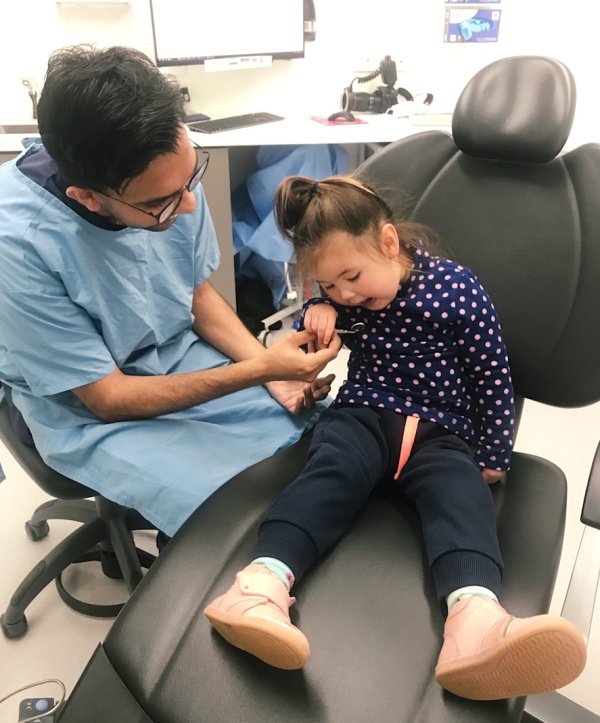
Jason also cared for patients at the faculty’s clinical facilities and theatre suites and provided on-call dental services for emergency patients after-hours at Dunedin Hospital, building close bonds with some of his young patients, especially those with special needs.
"The dream would be that we have the next generation of children growing up without fillings in their mouths."International education builds skills and confidence
After his graduation in December, Jason returned to FNU School of Dentistry with additional skills and new-found confidence. “I think that gaining a formal specialist qualification has given me a voice to continue to advocate for children’s oral health through dental education.”
He wants to establish preventative oral health programmes in schools and help improve the curriculum being taught to dental students in the region, integrating recent innovations and research evidence.
It’s something he has been thinking about for many years. “Hopefully now we’ll get this done.”
“I’ve expanded my knowledge, upskilled, and I think I have become more confident as an academic, and as a person. I’ve got my international education and training to thank for that.”
Manaaki scholar gives back to the community
Jason is certainly fulfilling the brief of the Manaaki Scholarship to give back to his community. He is maintaining his clinical hours, teaching the next generation of dental students, volunteering his services at an NGO-run paediatric cardiac care hospital, and mentoring students wanting follow in his footsteps by studying overseas.

“International education is very important to Fiji as a developing country,” he says. “I thought it would be valuable to be able to guide students who would benefit from international scholarships in meeting their professional goals, while building capacity in the region.”
At heart, though, he is an academic and he hopes that in the coming years he can raise the research profile of the Pacific region and build a solid database which will help to secure the funding for much-needed oral healthcare programmes.
“My message is that there is no general health without oral health. It’s not going to be easy, but we need to start somewhere to get a voice for children and for the profession.”
- International photo round up
-
ENZ calls for funding proposals for New Zealand-China research partnerships
The New Zealand-China Tripartite Partnership Fund 2025 offers funding of up to NZD 20,000-30,000 including GST for each partnership project, with the call for proposals open until 2 March 2025.
Funding proposals are due by 2 March 2025. Download the New Zealand-China Tripartite Partnership Fund 2025 Guidance and Call for Proposals and the Proposal Form. Send your completed proposal as a PDF, and any questions, to china@enz.govt.nz.
The fund supports new or existing research partnerships between New Zealand and Chinese universities. There are usually three universities involved – two from China and one from New Zealand.The Tripartite Partnership Fund, administered by ENZ, has a pool of up to NZD 100,000 in 2025 for research partnerships in the arts, humanities, social sciences, sciences and applied sciences. Designed to encourage strategic academic relationships, the fund focuses on fostering relationships and the development of the partnership rather than funding the research itself.
The Tripartite Partnership Fund is a key piece of education cooperation between New Zealand and China. Projects under the fund have enjoyed a high level of visibility and attention in both New Zealand and China.
Established in 2005, the Tripartite Research Partnership is a valued part of the New Zealand – China bilateral education relationship and we welcome proposals from researchers to join the growing list of funding recipients.
- nzisa
- Around the world in 31
- immigration
- 3cc929299734c9eda9a9513b3da7974a
- ENZ Agent Seminar Wuhan 7 Nov Group Photo
- latam delegation 3
-
Prime Minister’s Scholarship group round opening soon for applications
New Zealand organisations and institutions will soon be able to apply for this year’s group round of Prime Minister’s Scholarships for Asia and Latin America.
This award is administered by Education New Zealand Manapou ki te Ao (ENZ), enabling New Zealanders to experience international education and continue to build and maintain key trade relationships between New Zealand and key Asian and Latin American regions.
Acting Group General Manager, International Marketing, Brand & Scholarships, Sahinde Pala, said the group programme is flexible, and applicants are encouraged to think creatively about their learning programmes.
“We invite organisations and institutions to design a learning experience that can give learners the chance to follow their passion, develop connections, and make an impact in our global and local communities” she said.
Successful past applications have included semester exchanges, language immersion, indigenous-to-indigenous exchange programmes, internships, and research projects.
Applications can be made by any education provider (including universities, institutions, wānanga, iwi, hapū, whānau, institutes of technology and polytechnics, and private training establishments).
About the scholarship
All citizens or permanent residents of New Zealand over the age of 18 can apply for the scholarship. Recipients do not need to be in tertiary education, as the programme aims to make international educational opportunities accessible to all New Zealanders.
The scholarships cover tuition fees for offshore institutions, and a contribution towards internship fees, flights, living, accommodation, and visas.
Since the programme’s beginning in 2013, at least 3810 scholarships have been granted to New Zealanders.
Applications are open from 26 February to 11 April, find out more by visiting the Prime Minister’s Scholarship website.
You can also email any questions to the ENZ Scholarships team at scholarship@enz.govt.nz.