Search
Showing 10 of 7355 results
-
Major engagement for ENZ’s latest marketing campaign
ENZ’s first marketing campaign for 2019, New Futures Need New Paths, is focussed on expanding prospective international students’ understanding of New Zealand education and sharpening New Zealand’s brand position.
Because of this, the campaign has been designed to focus on engaging with target audiences, says Patrick Holden, ENZ’s Digital Media Project Manager.
“Already, we’ve had more than 21 million engagements with our digital paid media. This has come from 38.9 million viewers who have seen ENZ’s paid advertisements through a number of ad placements.
“We have seen an increased overall engagement rate of 12.60% compared to 8.43% for the previous Future Proof campaign, which is a great improvement! This is because we have tweaked the style and type of campaign content to that which best engages our student audience, including using new ad placements which uses custom-fit content tailored to different channels.”
The highest engagement has come from Korea, Germany and Japan. In an online website poll, more than 85% of users say they are ‘very likely’ or ‘somewhat likely’ to consider New Zealand as a study destination.
“While engagement is the campaign’s primary objective, we’re also achieving secondary objectives such as attracting new database leads, as a high volume of our audience are also engaging with our campaign landing page to find out more about studying in New Zealand,” said Patrick.
The campaign has been integrated with ENZ’s social audiences too. So far, the engagement has been positive.

A screenshot from the Study in New Zealand Facebook page.
Thank you to all our industry partners for collaborating with us on this campaign, in particular by sourcing talent.
The campaign will run until the end of May.
-
Delegation promotes NZ in Japan
Arrangement with Japan Women’s University
An Education Cooperation Arrangement with Japan Women’s University (JWU) was signed on 22 April by Dr Ryoko Imaichi, Chancellor, Japan Women’s University Educational Corporation, and Grant McPherson on behalf of Education New Zealand Manapou ki te Ao. The Prime Minister was also present and spoke at the event.
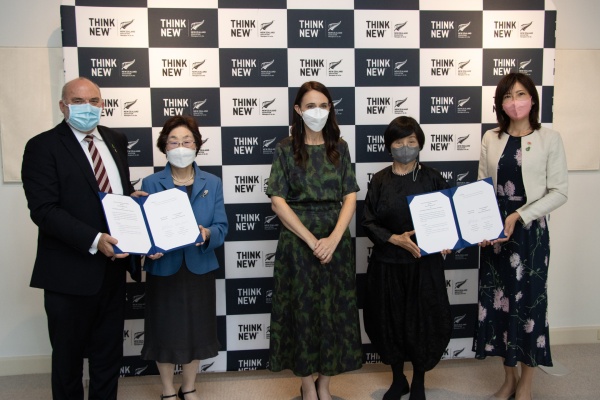
Image above: From left, Grant McPherson, ENZ, Dr Ryoko Imaichi, Chancellor, Japan Women’s University Educational Corporation, Prime Minister Jacinda Ardern, Professor Satoko Shinohara, President, Japan Women’s University, Misa Kitaoka, Director of Education – Japan, ENZ
The partnership with JWU will see more students from the university and its four affiliated schools come to study in New Zealand. Eleven university and school students from the JWU network attended the signing ceremony and spoke with the Prime Minister about their pre-COVID 19 experiences travelling to New Zealand.
This event came shortly after the Prime Minister met with her former homestay sister from over 30 years ago. The homestay sister also attended the signing ceremony, where the Prime Minister spoke about her personal experience of international education, including hosting homestay students in New Zealand and studying abroad at Arizona State University.
“Like Japan, New Zealand is a long island nation from north to south, and while being influenced by diverse cultures, I deeply sympathize with the historical background that has led to the present. Moreover, the current New Zealand society, which embodies world-leading sustainability, should be a great learning experience for our students,” Professor Satoko Shinohara, President of Japan Women’s University, said.
In Japan, there is a strong focus on the United Nation’s Sustainable Development Goals at the national and institutional level. Gender equality has received more emphasis in recent years and the new arrangement is timely for many reasons, as New Zealand and Japan focus on reconnecting to look towards the future.
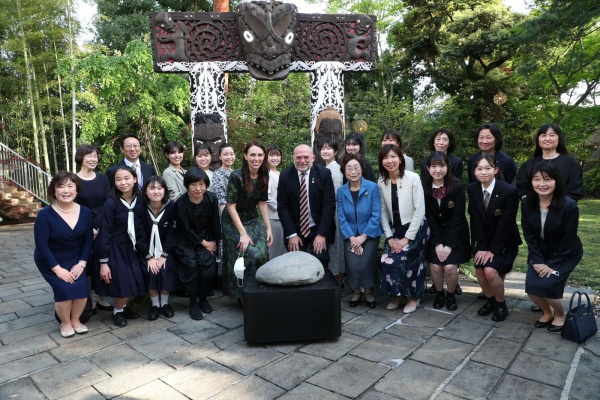
Relaunch of Game On English
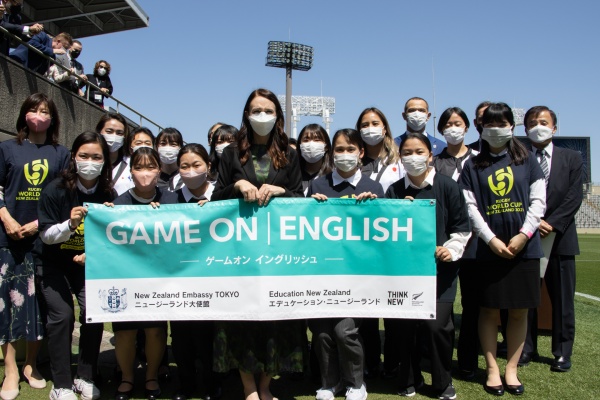
The Prime Minister, alongside the President of Fonterra Japan, Yasuhiro Saito, and the Commissioner from Japan Sports Agency, Mr Koji Murofushi, relaunched the Game On English programme that had been paused due to COVID-19. The 2022 phase of Game On will see female rugby players travel to Hamilton to study English and receive high-performance rugby training, sponsored by Fonterra.
Originally launched in 2014, during former Japanese Prime Minister Abe’s visit to New Zealand, Game On English was an initiative that allowed New Zealand to support Japan’s efforts to lift international skills and English language capability while also supporting rugby skills development in the lead up to the Olympics and Rugby World Cup 2019. More than 195 female and male high school rugby players have visited New Zealand to participate in the three-to-four-week programme.
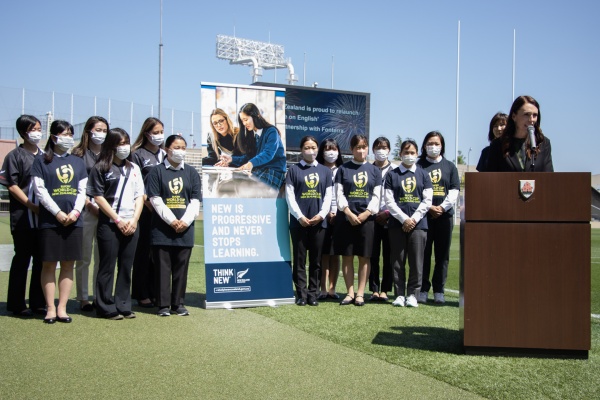
Image above: Prime Minister Ardern speaks at Chichibuya Stadium in Tokyo on 22 April 2022 to support the relaunch of Game On English for female rugby players to study English and receive rugby training.
Working Holiday Scheme students
Former Working Holiday Scheme participants from Japan were invited to an event held at Cookie Time Harajuku (Tokyo) store. Several students spoke about their work or study experience, and a recurring theme was how New Zealand changed their life. Working Holiday visa holders from any country can study for up to six months while on a working holiday visa in New Zealand.
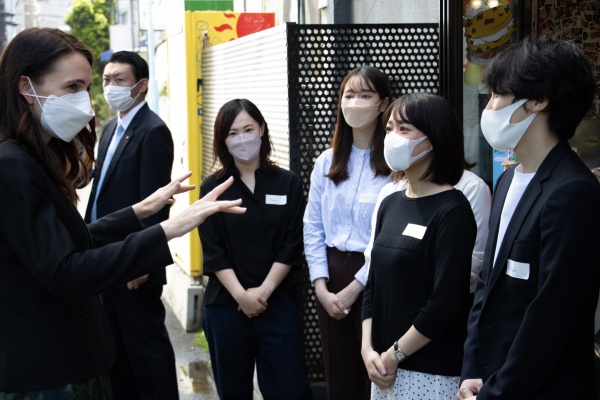
Image above: Prime Minister Ardern speaks to former working holiday visa holders about their work and study in New Zealand.
There has been extensive media coverage of all three events in Japan, including via national newspapers and TV stations. This coverage will support ENZ’s promotional activities before the New Zealand border reopens on 2 May 2022 to short-term students from Japan, as a visa-waiver country.
- NZIEC202372of135
-
Auckland Agency Group progresses student well-being initiatives
AAG Chair Isabel Evans, Director of the Ministry of Education (MOE) in Auckland, says more than 60 per cent of international students currently study in Auckland.
“The AAG group was established to build cross-agency government leadership in the Auckland region,” she says.
“We also wanted to ensure that agencies on the ground in Auckland are collaborating effectively.”
Education members of the AAG include the MOE, Education New Zealand (ENZ), New Zealand Qualifications Authority (NZQA) and Tertiary Education Commission. Other government agencies include New Zealand Police, Ministry of Business, Innovation and Employment (MBIE), Immigration New Zealand, Ministry of Foreign Affairs and Trade, Ministry of Social Development and Office of Ethnic Communities, Waitemata and Auckland District Health Boards and the Human Rights Commission. Auckland economic growth agency ATEED also plays an important role.
Ms Evans said the AAG was involved in stakeholder engagement in August which contributed to a draft International Student Wellbeing Strategy.
“From this engagement, we identified a number of action areas. Since then, group members have been working on ways to improve the overall international student experience in Auckland, with the potential to roll these out nationally if successful.”
Below are some of the initiatives underway.
- ATEED and NZ Police are working on a refresh of a safety video for international students. While it will be filmed in Auckland, its messaging will apply to students nationally, and should be available from early 2017.
- ATEED is developing an International Student Experience programme in partnership with ENZ and industry partners.
- Several agencies are looking at ways to improve the information available to international students and their families. Students are seeking more information on such topics as the true cost of living, insurance and what it covers, employment rights, health services and New Zealand culture.
- Agencies are also looking at ways to provide more volunteer and internship opportunities for international students. ATEED and MBIE will also launch phase two of their job-ready graduate programme working with ICT grads specifically.
- Several agencies are looking at ways to better support international parents, particularly those accompanying children who are studying at primary school here. These parents can be isolated and lonely. This support can also extend to the homestay parents who host international students.
“These initiatives are a start, and the AAG members are enthusiastically collaborating to make sure that opportunities to enhance the international student experience are progressed,” says Ms Evans.
She says the AAG’s work is aimed to enhance the service that international students receive from their education provider, rather than replacing it.
For further information, please contact ENZ Acting Director, Student Experience, Sahinde Pala at Sahinde.pala@enz.govt.nz.
-
Indian and Kiwi students explore water issues
The Untouched World Foundation’s (UWF) Waterwise Leadership and Global Citizenship Programme gave students the opportunity to learn about the entirety of the water resource chain - from primary energy players, through to farming, recreation, cultural and conservation interests.
Taking part were students and teachers from Otago secondary schools, tertiary institutions and the Mahatma Gandhi Institute of Education for Peace and Sustainable Development (MGIEP). Representatives from YESPeace Youth Network in Asia also attended.
The programme involved a week of activities which included visits to lakes, rivers, vineyards and orchards, discussions with water and land use and tourism and irrigation experts, and interviews with locals.
“Youth leadership is firstly about agency – understanding the many facets of the issue, developing the transferable skills to collaborate with others, acting responsibly and then finding a clear path to actively and positively model their own views and behaviour. It is vital we all listen and engage with an international perspective on these issues,” says Mark Prain, Executive Director of UWF.
Key partners included Otago Regional Council, Otago Community Trust and Contact Energy. Further support was also provided by ENZ, Ministry of Foreign Affairs and Trade, and Ngai Tahu.
“Otago Polytechnic believes educating youth on key issues facing society, unlocking their unique leadership potential and inspiring them to become active change-makers is vital,” said Marc Doesburg, Otago Polytechnic Director Globalisation.
Last week’s activities are just part of a range of ongoing initiatives. An “Acts of Kindness’” Campaign is also being developed and will involve MGIEP and UWF mobilising youth in partner institutions to foster meaningful exchange of ideas, knowledge and action towards the achievement of UNESCO’s Sustainable Development Goals.
Organisers are aiming to establish a New Zealand-India youth leadership exchange programme with a focus on fostering youth leadership, which is a key aspect of the United Nations Educational, Scientific and Cultural Organisation (UNESCO) Global Action Programme.
For further information visit the Untouched World Foundation website
-
Consultation on ENZRA and ENZ’s agent work
Clive Jones, General Manager Business Development, ENZ says the 2015 review of ENZRA undertaken by external consultants found significant shortcomings in the ENZRA programme.
“Education agents continue to make a significant contribution to the success of international education in New Zealand, and the ENZRA review also recommended ways for ENZ to better support education providers and education agents to be successful. We have been exploring all recommendations throughout our consultations.”
As part of our consultation, ENZ now invites organisations active in New Zealand’s education industry to complete a 10-15 minute survey by Thursday 30 June 2016.
“The survey results will help us identify the products and services we should be offering education agents and education providers to best support the recruitment of quality international students for New Zealand,” says Clive.
Depending on what ENZ hears through consultations, and the amount of analysis and development needed, it’s likely ENZ will announce the next steps in its work regarding agents later this this year.
- Complete the online survey for industry and education providers
- Complete the online survey for education agents
Please complete this survey by Thursday 5pm New Zealand time 30 June 2016.
- IMG 0499
-
Around the world in five
Canada
The government of Canada has announced a CAN$1.7 billion scheme to attract international research talent, including scholarships for international doctoral students, as well as funding to recruit established and early career researchers.
The United Kingdom
Franchise providers have been told to “clean up or close down” as the UK government moves to bring the fast-growing sector under mandatory regulation and crack down on “rogue operators” exploiting students and public funds.
America
Just 4% of international students recently surveyed said they felt “very or extremely” safe in the US, as shifting visa rules and hostile immigration policies contribute to a climate of fear on American campuses.
India
The number of Indian students pursuing higher studies abroad has declined for the first time in three years, according to data from Ministry of External Affairs (MEA) released to the Indian parliament.
Global
Times Higher Education’s new report, Towards 2035: Projecting the Future of Global Higher Education, predicts that university-level enrolments will continue to grow through 2035 from their present number (264 million globally), but that those enrolments will be shaped and driven by much different forces than in the past.
- Visiting my Taiwanese friends in Taipei
- Picture1 thailand