Search
Showing 10 of 7355 results
-
Attracting PhD students to New Zealand
The PhD page highlights the initiatives that have given New Zealand an international marketing advantage in attracting PhD students from around the world.
The page promotes the five key benefits of studying for a PhD here. International PhD students:
- pay the same fees as domestic students
- can enrol their children as domestic students in our state schools
- can work full-time
- are able to apply for a 12-month post-study work visa after graduating
- entitle their partners to apply for an open work visa.
Students can check out the page to find out how our PhD programmes are structured, discover the career benefits of studying for a PhD in New Zealand, read case studies from current international students and learn how to apply – there are links to the PhD areas of each university’s website.
Vietnamese student Tan Duc Do, for instance, decided to study undertake a PhD in Mathematics at the University of Auckland because of the inspiring teaching of his supervisor.
“Most of the lecturers here are working mathematicians, so they can give insight and inspiration into the subject,” says Tan.
For Jeffery Garae, a student from Vanuatu, the major attraction of studying Cyber Security in New Zealand was that international PhD students pay the same fees as local students.
“I was looking at doing a Masters here and when I read about the PhD fees I thought, ‘Whoa – that’s an even better advantage,’” says Jeffery.
The new PhD page also shines a spotlight on the academic and research performance of New Zealand universities, and on the wide range of subjects available for doctoral research.
-
International education gets $444,000 boost in co-funding
The IEGF is designed to help New Zealand’s education providers achieve growth by boosting bold, innovative ideas to maximise international education opportunities.
“The 2016 round of the IEGF brought applications from around the country, building on a sustained period of growth in international students choosing New Zealand as their study destination,” said ENZ Chief Executive Grant McPherson.
“We are particularly keen to see further growth across New Zealand so it is encouraging that more than two thirds of the innovative projects awarded funding are from education providers in the regions.”
Successful projects range from a fully integrated literacy programme in the United States, and the development of school-to-university pathway programme with middle schools in Changzhou, China, to the establishment of institutional relationships with selected Norwegian institutions.
Massey University is collaborating with the University of California at Davis to develop a world-class training programme in oiled wildlife response.
AFS Intercultural Programmes New Zealand is working with intermediate schools in Wellington to deliver a short programme for Chinese students which has a strong intercultural component.
“It is vital for New Zealand to continue to build on our international connections and ensure our young people are equipped with the cultural capability to study, live and work in the increasingly interconnected world we live in,” said Mr McPherson.
“Market diversification is key to the sustainable growth of international education. We welcome education providers exploring new avenues and looking to expand into new markets. Over half of the successful recipients are targeting more than one market while others are setting out to widen their reach to include US, Germany, Norway and Japan,” he said.
Matched funding worth up to $50,000 is open to all quality education providers, peak bodies, and businesses that offer education services or products internationally. The application process is competitive with preference given to bold approaches to growing the international education industry. In this latest round, 49 applications were received.
For a list of the successful recipients, click here.
- Capture1
-
Update from Immigration New Zealand
Peak processing season in full swing
Immigration New Zealand (INZ) has seen an increase in applications submitted during September 2024, ahead of the 1 October visa fee and levy increase and because of our ‘apply early’ messaging.
In September 2023, approximately 3,104 international student visa applications were submitted and in September 2024, approximately 6,893 international student visa applications have been submitted, an increase of 122%.
Now that we are in our peak processing period, we expect these processing times to grow as we receive a higher volume of applications. Students should get their visa application in at least 3 months before they plan to travel to New Zealand for the first semester of 2025.
By now, most students should have received an offer of place from their chosen education provider. Anyone expecting to study in the first term of 2025 should apply now.
We acknowledge that some students who are waiting on key study documentation are unable to apply 3 months ahead. In these cases, they should apply as soon as they have all of their documents, but they need to be aware that late applications may not be processed in time for them to start studying.
Immigration New Zealand has three student processing sites in New Zealand, and has allocated more staff to processing student visas, compared to last year’s peak.
Ensure you submit a complete applicationTo avoid delays, we encourage students, agents and advisers to follow the advice in our student visa information sheets. If they do not include all the required documents when they submit their application, it may be declined.
Applications that have a statement of purpose letter written by the student, telling us about their personal circumstances and plans in New Zealand, help us assess their intent. If a student intends to apply for another visa after study, they should declare this. Students are allowed to apply for another visa after they finish studying.
- 31066372290 7eb35a70ce oEDIT
-
US students attend Kiwi youth leadership summit
Hosted at the University of Canterbury and led by ENZ and the Ministry of Foreign Affairs and Trade, the Marjory Stoneman Douglas High School (MSD) students teamed up with the Student Volunteer Army to discuss student leadership and mobilisation.
Over five days, they heard from prominent speakers from across New Zealand’s business, government, university and non-profit sectors. Students also conducted a tree-planting project, held panel discussions and visited Government House in Wellington at the invitation of Governor General Dame Patsy Reddy.
In February, Marjory Stoneman Douglas High School (MSD) became the site of one of the deadliest school shootings US history. In the aftermath, MSD students mobilised to create a student-led ‘Never Again MSD’ organisation, and used their time in New Zealand to learn about the leadership of the Student Volunteer Army, which mobilised following the 2011 Christchurch earthquake.
ENZ’s Director for the Americas and Europe, Lisa Futschek, said the summit was an exceptional opportunity to raise the profile of New Zealand’s education system in the US, and to demonstrate how it equips young people to become independent leaders, thinkers and global citizens.
“The Summit was a great example of how international education can equip and inspire emerging global influencers and leaders.
“It was great to see New Zealand featured in high profile publications including the New York Times, The Washington Post and the Los Angeles Times, along with major US television networks showcasing our country as a desirable international education destination, well placed to host aspiring student leaders.”
US student numbers in New Zealand grew seven percent from 2016 (2,852) to 2017 (3,050) – the majority at university level.


-
Official Information Act Requests
People in New Zealand can request government information (official information) and can expect it to be made available unless there is a good reason to withhold it.
The Official Information Act 1982 (or OIA) enables citizens, permanent residents, visitors to New Zealand, and body corporates registered or with a place of business in New Zealand, to make a request for official information held by government agencies, including Education New Zealand (ENZ).
ENZ is the government agency dedicated to helping New Zealand realise the social, cultural and economic benefits of international education.
Please note the Ministry of Education is the New Zealand Government's lead advisor on the New Zealand education system.
More information can be found at: The role of the Ministry of Education
Ministry of Education OIAs can be directed to info@education.govt.nz
If you have a complaint about a particular school, you may wish to contact the school directly or contact the Ministry of Education at enquiries.national@education.govt.nz
Making a request relating to international education
Your request should be as clear and specific as you can possibly make it. Before making a request please check our other sources of information listed below.
You can contact us in a number of ways to request information:
- ENZ.Ministerials@enz.govt.nz
- Telephone (04) 472 0788
- Postal address: Level 5 Lambton House, 160 Lambton Quay, PO Box 12041, Wellington 6144
We would like:
- your name
- contact address (email or postal)
- details of the information you want.
We may ask you for more details if we’re not sure what you are seeking. If you make your request by phone or in person, we will confirm it in writing.
The State Services Commission provides tips for requesting information and guidance on how agencies will respond.
Before making a request for information
Before requesting official information from ENZ, we encourage you to check the list below to see if the information you need is already publicly available:
How long will it take?
We are required by law to give you our decision on your request as soon as possible, and no later than 20 working days after we receive your request.
If we need more time to make our decision on your request, for example if you are requesting a lot of information, we will let you know and give you an idea of how long it will take. We will also try to keep you updated on the progress of our response to your request. You can complain to the Office of the Ombudsman if you’re not happy with our decision to extend the time.
What does it cost?
Requesting official information is free, though we can charge a reasonable amount if it will take a lot of work to supply the information requested.
You can complain to the Office of the Ombudsman about our decision to charge.
What if I’m not satisfied?
You may wish to contact us in the first instance to see if we can resolve the issue.
You can make a complaint to the Office of the Ombudsman if you:
- have concerns regarding the decision we made on your request
- were unhappy about the way your request was treated or processed.
These concerns can relate to the withholding of information, extending the timeframe to respond to you, any charges for providing the information you have requested, delays in providing you with a decision or the information, or your request being transferred.
The Office of the Ombudsman can investigate and review our decision and may make a recommendation to us if it is considered appropriate.
Responses to Official Information Act 1982 requests
ENZ publishes responses to Official Information Act 1982 requests at the end of each month. ENZ first published its responses to requests for official information on its website in April 2018.
The response from ENZ details the information being released and explains what information, if any, has been withheld and under which grounds of the Act. The response also explains that we intend to make the information publicly available. The requestor's name and address have been removed from the response.
Documents are only available in Adobe PDF format and are listed in release date order, with the most recently released responses at the top.
-
From the CE: Board announces new ENZ CE
Tēnā koutou katoa
Our Board yesterday announced the appointment of Amanda Malu (Ngāi Tahu) as our new Chief Executive. Amanda is currently Deputy Chief Executive Service Delivery at ACC, and formerly Chief Executive at Whānau Āwhina Plunket, leading that organisation through extensive change over six years in the role. She previously held senior marketing and communication roles including at the Tertiary Education Commission, and earlier in her career worked in marketing and international student recruitment in the polytechnic sector. Amanda will take up the role in September. Until then, I will continue as Acting Chief Executive.
This is excellent news. I am sure you will all join me in giving Amanda a very warm welcome to Education New Zealand Manapou ki te Ao and our international education community.

Amanda Malu has been appointed ENZ's new Chief Executive by ENZ's Board.
To the visit of Premier Li. Last Friday I had the privilege of attending three events held as part of Premier Li’s visit to New Zealand. Significantly, Premier Li was accompanied by Minister of Education Huai Jinpeng who led a delegation of Chinese university senior leaders and senior education officials. This is Minister Huai’s second visit to New Zealand within 12 months following his engaging contribution to NZIEC Ki Tua 2023. This is a very special recognition of the close education ties between New Zealand and China.
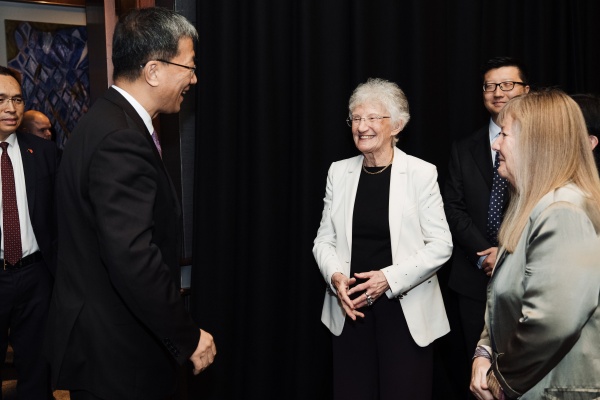
ENZ's Acting Chief Executive Dr Linda Sissons greets Minister Huai with Minister Penny Simmonds and ENZ Regional Director & Counsellor, Greater China (Education), Michael Zhang, prior to the Education Forum (held at the Pullman Hotel, Auckland)
Our Minister for Tertiary Education and Skills, Penny Simmonds and Minister Huai co-chaired a “Looking into the Future: High Level Education Forum”. The Forum was attended by 11 University Presidents from some of the most prestigious universities in China, and all eight of our university Vice-Chancellors. The Forum discussed themes spanning student and academic mobility, research partnerships, innovation and productivity and digital education. A compelling discussion topped off with the signing of twenty institution-level MOUs.
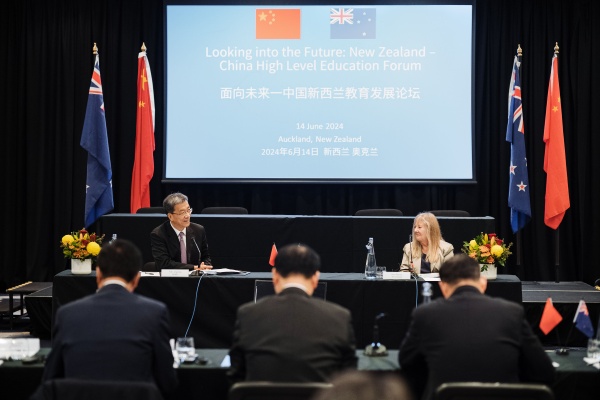
Minister Huai and Minister Simmonds open 'Looking into the Future: New Zealand - China High Level Education Forum
And towards the end of the Forum, Premier Li, our Prime Minister, the Rt Hon Christopher Luxon, as well as the Minister of Education, Erica Stanford, joined the closing ceremony and took an active part in proceedings. This included the Prime Minister presenting the latest Prime Minister’s Scholarships to a group from Canterbury University heading to China and announcing the 2024 recipients of the New Zealand-China Tripartite Research Partnership Fund. Premier Li also announced allocations of scholarships for New Zealand Chinese Language teachers, summer camp places for New Zealand students and donations of Chinese language textbooks.
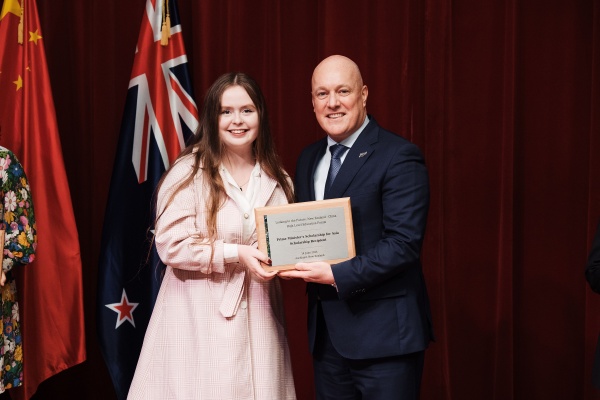
Prime Minister Rt Hon Christopher Luxon with Maia Hosking of the University of Auckland who will begin her programme in China under the Prime Minister's Scholarship for Asia.
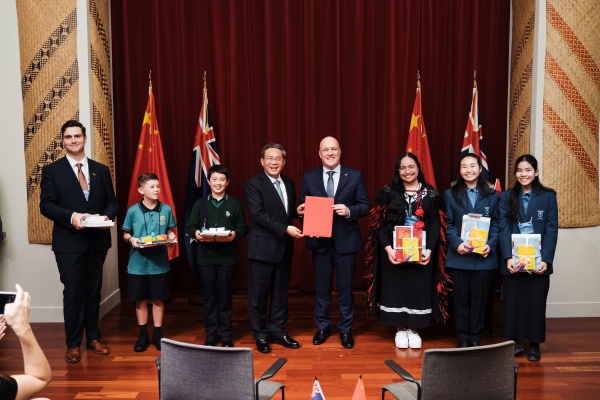
Premier Li (centre left) presents list of announcements to Prime Minister Rt Hon Christopher Luxon (centre right) on stage with six New Zealand students who received Chinese Language books
To close the day, we accompanied our Minister, our Chinese and New Zealand university colleagues, and NZ Inc representatives to the Gala dinner where Prime Minister Luxon called out education among the other vital ties between China and New Zealand.
These special events proved a unique opportunity to showcase our high-quality education offering to China while demonstrating our commitment to enhancing student mobility and future education and research collaboration. It was fantastic. We can all be very proud of education’s contribution to this important relationship.
Ngā mihi nui,
Dr Linda Sissons
Acting Chief Executive
Education New Zealand Manapou ki te Ao
-
About this site
Plain Language
We aim to use plain language on this site. Plain language is appropriate to the intended audience, and clear, concise and well organised.
The Plain Language Act 2022 sets out some requirements for using plain language in our documents.
Plain Language Act 2022 – New Zealand Legislation
Let us know if you find something that isn’t clear, or that doesn’t comply with the Plain Language Act. We’ll use your feedback to make our content easier to understand. To send us feedback, please email info@enz.govt.nz.
-
Charles Finny's address to the India New Zealand Business Council

Charles Finny
India and New Zealand have been friends and trading partners for a long time, and thanks to our Commonwealth heritage, our democratic tradition, and our shared love of cricket, we have much to celebrate.
The Indian community here adds richness and vibrancy to New Zealand life, through great food, music, art and sport, diverse business ties, and annual festivals such as Diwali.
New Zealand’s economic future is very much tied to our key trading partners. India is currently our 10th largest trade partner, and the Government’s vision is for India to become a core trade, economic and political partner. The importance of the relationship is reflected in the visit in April of the President of the Republic of India, Shri Pranab Mukherjee and, of course, our Prime Minister John Key will visit India later this month.
We have been negotiating a Free Trade Agreement bilaterally for several years and we are both part of the Regional Comprehensive Economic Partnership (RCEP).
One of the strongest parts of our relationship is in international education. Last year international education was probably the largest single item exported from New Zealand to India.
India is, and will continue to be, an important part of New Zealand’s international education strategy.
Every day, tens of thousands of Indian international students, alongside other international students, are helping New Zealand to build our research capability and global linkages, to fill skill shortages and enrich New Zealand culture.
The India New Zealand Business Council is a valued partner in our international education strategy. A number of education providers and immigration and education consultants are Council members, and all members play an important role in ensuring Indian international students have a positive experience in New Zealand. You do this not only through recruiting and employing them in your businesses, but also in providing leadership in upholding high standards when it comes to their treatment and welfare.
Many members of our Indian community have come to live in New Zealand after studying here. If we can continue to work together on skill development (and I’ll touch more on this later), then the transfer of knowledge, innovation and best practice will not only benefit the individuals involved but also our respective countries.
Countries that have innovative and skilled workforces prosper and it is the education system of a country that nurtures those skills.
The education experience that New Zealand offers is first rate. Our universities are world-class – all eight are rated in the top 3% globally, and we offer quality qualifications and hands-on vocational learning through our institutes of technology and private providers.
This quality has clearly been recognised by the Indian student audience, as we have experienced significant growth over the last three years – from 13,000 to 29,000 students between 2013 and 2015.
Such growth has demonstrated New Zealand’s strength as a world-class education destination, but it has also created some challenges as we adjust to manage this demand. I will spend some time outlining how the Government is ensuring a sustainable education sector – particularly for our Indian students and stakeholders.
Our education system has strong government oversight, a commitment to continuous improvement and we place student success and wellbeing front and centre.
We do this through a comprehensive framework of support, and many of us have a role to play here. These include the main government agencies, Education New Zealand, Ministry of Education, New Zealand Qualifications Authority, Tertiary Education Commission and Immigration New Zealand.
Other key players include education providers and the agents they use, employers and businesses, community and ethnic groups and other support services.
This extends also to our bilateral relationship – we have regular catch ups with the High Commissioner of India to New Zealand, Mr Sanjiv Kohil.
All of us have a collective responsibility to ensure the experience of our international students is a positive one and results in positive outcomes for them and ultimately for our businesses and New Zealand society and economy.
We welcome international students who come here with genuine intent and means. But New Zealand, like any sovereign country, will take steps to protect our borders and deal decisively with fraudulent or unlawful behaviour when we see it.
Immigration New Zealand has invested heavily in intelligence gathering and verification support resources for immigration officers in India. As a result they have become more aware of risk and fraud in the market.
The visa decline rates from India are evidence of a significant effort by Immigration NZ to manage students and agents who submit false and misleading information in visa applications.
Immigration New Zealand is doing a lot of work to educate providers about student selection, and the need to manage their agent networks.
Immigration New Zealand and the Immigration Advisers Authority also ran a campaign in India earlier this year encouraging people to use a New Zealand licensed immigration adviser if they are seeking assistance to come to New Zealand.
I think it’s important to acknowledge at this stage too that New Zealand is not alone in facing issues of student visa fraud and dishonest agent behaviour. The United States, Canada, Australia and other countries all face the same challenges.
New Zealand government agencies are committed to acting in a fair and reasonable manner when dealing with students affected by issues of provider quality, or when students’ personal circumstances are, for a variety of reasons, less than straight-forward. Each student is dealt with on a case-by-case basis.
The New Zealand Qualifications Authority, for example, is working with a group of former IANZ Level 6 students who were required to undertake reassessment to confirm their preparedness for study at another provider, EDENZ. More than 210 students will need extra support and assistance to get them to a standard where they can continue their studies. This is being provided to students at no additional cost so that they can move on from this period of change and continue their studies.
And, throughout this process, advice, support and counselling is being made freely available to all of the affected students.
Some of the issues that international students are experiencing are an important reminder that the majority of our international students are young adults, not only crossing geographical divides, many for the first time, but more often than not, cultural divides, away from the familiarity and care of family and friends.
The New Zealand government agencies I mentioned earlier are working closely together on these issues, to ensure all international students are treated fairly and are well cared for – that they feel welcome, are safe and well, enjoy a high-quality education and are valued for their contribution to New Zealand.
This joint-agency work on international student wellbeing has focused in recent months on Auckland where the majority of international students are located. It has involved a wide range of community meetings and student focus groups to ensure student needs and concerns are being heard and addressed.
We must maintain high standards across our international education industry. Equally, we are determined not to let the actions of a small number of individuals damage the reputation of an entire community, nor devalue the contribution that students from India and elsewhere, and our education providers, make to New Zealand.
Most providers are doing a very good job for their students. Satisfaction rates among students surveyed by the International Student Barometer in 2014 and 2015 ranged from 88% to 94% as being satisfied or very satisfied with their overall experience at their New Zealand institution.
Government agencies are working with providers to address any issues with quality, including insisting they work with reliable education agents in India.
Agents play a key role at the beginning of a student’s international education journey in ensuring that the students are informed and make the right choices, and know what to expect as a student in New Zealand.
The reality is, the seeds of what will be a positive or negative international student experience are often sown before the student has even left India.
Education agents are central to the Indian market, with more than 90% of Indian students using agents when applying to study in New Zealand. There are thousands of agents in India, and the Government is promoting the use of high-performing agents through:
- Education providers having a responsibility for agent performance and advice under the revised Code of Pastoral Care, which I’ll talk more about shortly
- Education New Zealand and Immigration New Zealand providing more information on agent performance to education providers and students, including through the Immigration New Zealand website
- Education New Zealand revising the ENZ Recognised Agencies programme, to ensure we better support and promote the use of high-quality agents in markets such as India.
I’m interested too in your thoughts as to what we can do together – at both a government and business level – to ensure that Indian students are working with genuine agents? Perhaps that’s something we can discuss at the end of this address.
The onus is also on students to ensure they have the financial means to support themselves in their study, and to take responsibility for understanding the requirements to study in New Zealand, including the immigration requirements. When students apply for a visa, they must sign their application as a true and accurate record and have the documents to support their application.
The cross-agency wellbeing work I mentioned earlier complements the pastoral care Code of Practice which New Zealand was the first country to introduce and which was recently strengthened with effect from 1 July.
Only education providers who are approved signatories to the Code are allowed to enrol international students. To maintain this privilege, they are expected to meet high standards of service delivery, in accordance with the Code.
The strengthened Code now means that providers are directly accountable for the behaviour of their agents. Expectations include carrying out reference checks of agents, having a written contract with agents, actively monitoring agents and terminating contracts where there is evidence of misleading, deceptive or illegal behaviour, or where an agent is breaching the Code. The focus is on creating sustainable growth by prioritising higher value, higher quality students.
Tough sanctions are now available to deal with providers who fail to manage their agents, including the removal of the right to enrol international students. Enforcing the Code is the responsibility of NZQA who are working closely with Immigration New Zealand to ensure providers proactively comply with the Code.
At the same time, as I mentioned earlier, international students also have an obligation to come here with genuine intent – that their primary purpose is to study, and they have the means to do so.
Working in New Zealand while studying is a way to complement the classroom skills they learn and to really engage with New Zealand’s everyday life. It is not intended as a lifeline to cover living costs.
Not having enough money to support themselves creates vulnerable students who are easy to exploit. This is the reason why Immigration New Zealand has a minimum level of fund requirement for international students to cover their time here.
And of course when students do get jobs, New Zealand employers have a legal and moral responsibility to uphold New Zealand employment law, to pay for hours worked and to honour the minimum wage. Everyone in New Zealand has the right to protection through minimum work rights.
I urge Council members to show leadership in modelling and upholding these rights in the Indian community, in your businesses and through your wider networks.
We continue to encourage individuals to come forward if they have specific examples of exploitation. This is the only way we can address these issues.
The support and input of the New Zealand communities of our international students is also vital to good outcomes.
INZBC has a crucial role to play in helping to bridge the gap that may exist through differing cultural contexts, where, for example, some international students aren’t aware that their rights in New Zealand are protected.
I’d like to applaud the contribution of INZBC members who acknowledge the opportunities that a New Zealand education can offer Indian students in terms of skills and knowledge transfer.
To be truly successful we need to attract students who have the best potential for positive outcomes to New Zealand. These are the students coming to New Zealand to study high-value programmes that can put them on the path to further study, or to work in high-demand areas in New Zealand, India or across the world.
Our ‘target South’ India strategy focuses on attracting genuine students interested in pursuing high-level qualifications in our education market.
As part of this strategy we established a presence in Mumbai in early 2015 and have since focused our promotional activities in the south and west of India where students have higher levels of visa approval rates and student mobility.
This strategy involves promotion across a variety of channels, including digital, social and traditional media, promotional events and scholarship initiatives, academic exchanges, and education fairs.
Education fairs continue to be a strong recruitment channel for us in India, providing outreach to students and families so they can discuss the benefits of New Zealand as a study destination. These fairs are well supported by industry, with more than 30 New Zealand providers attending each of our fairs this year.
We will continue to adjust the locations and formats of fairs to anticipate local market conditions, and they remain an important part of ENZ’s India promotional strategy.
We are trialling new initiatives in-market too. In August, ENZ partnered with New Zealand universities and Indian institutions to host a series of guest lectures by eminent New Zealand academics in cities in South India.
The lecture series was extremely successful in raising awareness of New Zealand’s technical expertise in the areas of engineering, science and business, and building institutional partnerships between our countries.
We have also boosted the numbers of scholarships aimed at Indian graduates interested in pursuing post-graduate study here. The New Zealand Excellence Awards, announced mid-year, offer scholarships to 35 Indian scholars at all eight of our universities. There is also the Christchurch Educated Skills Scholarship for India which targets post-graduate students studying courses in skill shortage areas that are directly related to the Canterbury earthquake rebuild.
In closing, I’d like to repeat how much the social, cultural and economic contribution of Indian students to New Zealand is valued. I want to acknowledge again the Council’s part in that, as well as its important role in demonstrating leadership to the Indian business community when it comes to recruiting, employing and supporting Indian international students.
While we all play a role in the welfare and outcomes of our international students, we also have a collective responsibility to share and promote the positive contribution that international education makes to our communities.
As a result of the policy changes that we have already introduced you will notice that the number of Indian students coming to New Zealand will have reduced to levels similar to that we achieved in 2013. As we solve some of the problems I have discussed today that number may slow further before starting to grow again.
Can I end by emphasising that over the longer term we look forward to welcoming as many high quality Indian students who want to come to New Zealand to study higher end qualifications who meet our entry criteria. We look forward to working in India and here with stakeholders such as the INZBC to ensure that we have a sustainable level of Indian students in New Zealand and that this vital part of the bilateral relationship is not put further at risk by the actions of a few.
Thank you.