Search
Showing 10 of 7355 results
-
From the CE: New Zealand education promotion continues at pace
I can assure you I have never seen as much interest in New Zealand as an education destination. Despite the challenges we’re all aware of and the activities of our competitor countries, the New Zealand education offering remains attractive. We all must continue to tell the New Zealand education story.
On Friday 17 March, Minister of Education Jan Tinetti announced new appointments to our Board. I want to acknowledge outgoing Board Chair, Steve Maharey, and welcome Tracey Bridges to the role. Steve has been a stalwart and tireless advocate for international education, both in the community and the corridors of power for over 30 years. In his time as our Chair, he has seen and contributed to enormous change within the sector and ENZ. Personally, I have appreciated his deep understanding, straight talking and clear direction.
Tracey Bridges has knowledge of regional economic development, expertise in strategy, risk and reputation management, and in social marketing. She is Chair of the Wellington Economic Development Agency Limited (WellingtonNZ), co-founder of The Good Registry and sits on the Boards of Sky Stadium, Whānau Āwhina Plunket, the Wellfed NZ Trust and the Digital Media Trust.
Tracey is joined by Dr Therese Arseneau. Dr Arseneau also has knowledge of economic development including international education’s contribution to regional economic development, and governance experience in the tertiary sector at the Ara Institute and the Open Polytechnic. She previously chaired Regenerate Christchurch and Enterprise North Canterbury.
We all know that the contribution of international education is far broader than just the direct and immediate economic impact of the students that come to New Zealand. For the first time, ENZ along with EY have sought to quantify the extent and the value of these wider benefits.
Research commissioned by ENZ that will be released before the end of March found that international education is not only a significant contributor to the New Zealand economy but also that international students living and working in the country bring in a raft of social, cultural, and international benefits. It goes on to explore the extent of the indirect longer-term contribution to New Zealand’s GDP from the small proportion of international students that remain in New Zealand on completion of their studies. The research also quantifies the impact of the pandemic.
Look out for the formal release and when it is available I urge you to download the report from Intellilab.
To complete your international education-related reading list, our Briefing to the Incoming Minister, Minister Tinetti is now available here on the ENZ website. The BIM, as it is known, is prepared when new Ministers are appointed to portfolios.
He maurea kai whiria! – Ignore small matters and direct effort toward important projects!
Ngā mihi nui,
Grant McPherson
-
Regional Partnership Programme – reaching new heights
With Southland, Northland and Waikato recently joining the programme, ENZ now has 15 regions looking to develop and implement new strategies, and better tell their regional international education story.
Here’s a snapshot of the good things currently underway.
The Global Workforce project
The Global Workforce project aims to better position regions as education and career development centres, and to more effectively connect international talent with skilled employment
 opportunities.
 This initiative will continue to expand the options for students to participate in the existing Work Ready programmes by working with government agencies and employers in sectors with future skill shortages.
Better regional data
International education is a valuable industry, and soon we’ll have the numbers to show it. Precise data will demonstrate the level of contribution that international education makes to regional economies, with clear information about value, job creation and the average international student spend per region. We expect the first round of data to be available for regional partners in early 2017.
Regional workshop

Fifteen regions were represented at the workshop, gaining new insights on destination marketing best practice.
In late November, representatives from 15 regions gathered for a two-day workshop in Christchurch.
The workshop included a presentation by ICEF (International Consultants for Education and Fairs) Asia-Pacific Vice President, Rod Hearps, on maximising engagement with agents, and the importance of destination marketing. Also on the agenda was a session on how regional organisations can collaborate with SIEBA (Schools International Education Business Association) and an inspiring presentation from Christchurch Educated on its progress to date.
Get to know your region
If you’d like to know more about New Zealand’s international education regional organisations and how you can get involved with the Regional Partnership Programme, click here.
For more information, contact Greg Scott, Programme Manager – Regional Partnership Programme
- ANA update
- WREDA 1
-
From the CE: Coming together to offer a New Zealand Education online
Through this initiative, we’re bringing a New Zealand education to those who can’t be onshore due to COVID-19 restrictions. We’re also tapping into a wider audience of learners looking for online options, and developing a pipeline of learners seeking a pathway to study in New Zealand.
This initiative supports the Government’s Recovery Plan for our international education sector. Part 3 of the Plan led by Education New Zealand, Transforming to a more sustainable future state, has accelerated the diversification of products and services, one of three goals set out in the New Zealand International Education Strategy.
ENZ is supporting the international education sector through this initiative by facilitating engagement with a global audience online. Our partnership with FutureLearn lets us explore the value of promoting New Zealand content under a national online banner, as well as the benefits of partnering with third parties who have existing online audiences.
Some quick day-one statistics that I would like to share with you. We had close to 1,000 enrolments in a New Zealand-based course within the first 24 hours of launching. I expect to see very strong enrolment numbers once the promotional campaign funded by ENZ begins today (9 June).
FutureLearn host quality online courses that help learners build skills and upskill in areas of interest or need, from home – with potential to continue study in country (when border restrictions ease sufficiently) or continue online where available. The New Zealand collection collated for this initiative includes short courses from universities, English language and TESOL educators, vocational/institutes of technology and edtech educators including virtual reality developers and game designers. ENZ has funded the initial eight-week promotional campaign to celebrate the FutureLearn initiative’s launch.
We understand sustainability is becoming an increasingly important factor in a student’s study choices. Research commissioned by ENZ in May 2021 indicated that 79 percent of responders showed interest in studying sustainability and climate change as a subject.
Moreover, the QS Environmental Concerns Survey in 2019 found 79 percent of prospective international students were “somewhat more likely” or “much more likely” to choose a degree if the content helped them to learn about reducing their environmental impact.
A survey undertaken by Times Higher Education in April 2021 on students, sustainability and study choices showed that 80 percent believe in living their lives as sustainable citizens.
To cater for this, more than half of the courses included in this initiative are themed around sustainability. Courses like teaching and learning for sustainable education, English language for sustainability, and growing a sustainable workforce. It’s a great demonstration to the world that we take our cultural value of kaitiakitanga seriously.
Let me take this opportunity to also thank the providers who took the leap and joined ENZ on this new and exciting journey.
If you’re worried about missing this opportunity, it’s not too late to be part of the action. Get in touch with Project Manager Tim Brown [tim.brown@enz.govt.nz] for more information on how you can be part of this 12-month initiative, and any future initiatives that spring from this.
And if you’re keen to make the most of the New Zealand education offerings on FutureLearn, visit the following link: futurelearn.com/courses/collections/study-new-zealand
Ngā mihi,
Grant McPherson
Chief Executive Education New Zealand Manapou ki te Ao - UC Event International Welcome Day 20
-
Register for the China Mayoral Forum education session
The forum theme is sustainable economies, and is an opportunity to strengthen relationships with regions of both countries. Fifteen mayors and vice-mayors from across China will attend alongside 33 mayors from across New Zealand, including smaller regional centres.
Following introductory presentations by Sir Richard Taylor (WETA Group) and Maggie Zhou (Alibaba), the forum will discuss opportunities for trade, investment, education and developing mutually beneficial partnerships.
The forum is being organised by Local Government New Zealand (LGNZ) and Wellington City Council, with support from ENZ.
LGNZ President Dave Cull says the forum is an excellent opportunity to grow relationships with New Zealand’s largest trading partner.
“There is much to be gained for our communities in developing a greater understanding and appreciation of how China operates,” said Mr Cull.
“Face-to-face meetings provide the opportunity for the representatives of our cities, districts and regions to engage directly and look for mutually-beneficial economic development opportunities.”
Sarah Gauthier, ENZ Regional Project Manager, said the education break-out session would be particularly relevant.
“This will be an engaging panel discussion touching on key ideas and interactions with China on education, followed by a chance to engage with some of the Chinese representatives,” said Sarah.
“We encourage education institutions, regional education organisations and other service providers to attend.”
Registration is free but spaces are limited. To register click here.
For more information, contact Sarah Gauthier: sarah.gauthier@enz.govt.nz
-
New Zealand and Vietnam celebrate 45 years of bilateral ties
The alumni were: Le Thi My Hanh, Country Representative at Global Green Growth Institute (GGGI); Nguyen Bao Tram – Vice President, User Growth Strategy and Planning at Lazada Vietnam; Trinh Thi Thuy Lien – PhD Candidate in Education and Higher Education, College of Education and Higher Education Development Center at the University of Otago; Le Ba An Binh – Managing Director at Adtima, a division of VNG; Nguyen Minh Dung (Daniel Nguyen) – Executive Chef at Mia Saigon Luxury Boutique Hotel; Founder of Coco Consulting Limited in Auckland; and Nguyen Quang Dat – Captain (Airbus A320), Pacific Airlines.
ENZ Regional Manager – East Asia, Ben Burrowes said, “We are extremely proud to recognise each individual awardee today and to celebrate the role that a New Zealand education has played in both their personal and professional lives. It is inspiring to learn what they’ve achieved since graduating in New Zealand and to hear real-life examples of New Zealand’s unique approach to learning.”
New Zealand Ambassador to Vietnam, Wendy Matthews, also spoke at the awards ceremony.
“The quality of New Zealand education can be seen in the quality of our graduates, and these alumni are examples of the globally engaged students New Zealand aims to produce,” she said.
“New Zealand is committed to helping build the future leaders of Vietnam. We are proud of our alumni and the New Zealand alumni community, who have come to be affectionately known as the ‘Kiwi mafia’. Alumni play an integral role in the New Zealand-Vietnam bilateral relationship, which celebrated its 45th anniversary this year.”
Vietnam and New Zealand first established diplomatic ties in 1975. The countries’ education relationship stretches back even further to the 1960s, with Vietnamese students having come to New Zealand since the first days of the Colombo Plan.
Today, Vietnam remains an important market for New Zealand’s international education sector. Vietnamese students make up the seventh biggest cohort from a single country. In 2019, 3,040 Vietnamese students studied at New Zealand institutions, up 10 percent from the year before. Of the 3,040 students, 35 percent studied in the universities, followed by schools (28 percent). The number of Vietnamese students studied in schools and universities increased 29 percent and 9 percent respectively from 2018 to 2019.
-
Incheon Metropolitan Office of Education deepens links in New Zealand
The delegation from Incheon Metropolitan Office of Education East Asia Global Education Institute (Incheon MOE) travelled to Ngatea, Wellington, Canterbury and Otago – visiting providers from the schools, university and vocational education sectors.
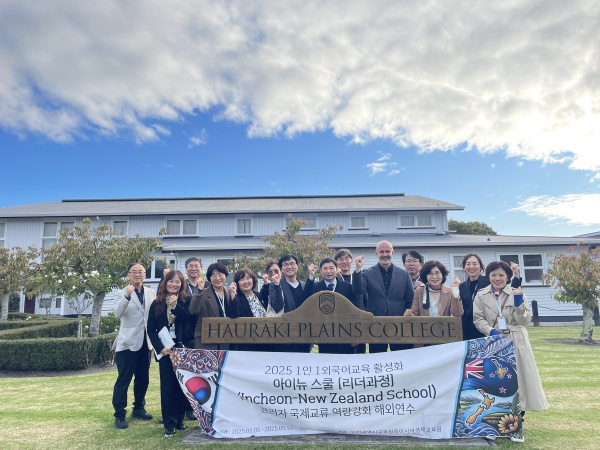
The visit began with a visit to Ngatea to connect with Hauraki Plains College and Ngatea Primary School.
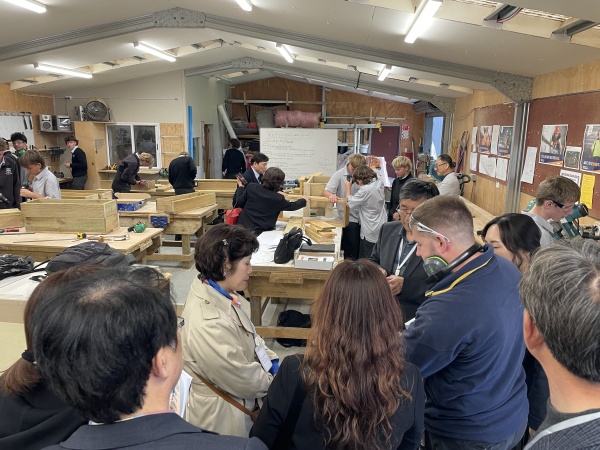
Observing the Agriculture Academy and trades-based courses at Hauraki Plains College.
A key aspect of the delegation’s time in Ngatea was the signing of a Memorandum of Understanding (MoU) between Hauraki Plains College and four schools from Incheon: Sunin High School, Shinsong High School, Geomdan High School and Youngwha International Tourism High School.
The intent of the MoU is to strengthen educational ties between the schools, which includes a reciprocal exchange program.
The first of these exchanges will see 28 students from across the four Incheon schools visit Hauraki Plains College in October 2025, 28 students from Hauraki Plains College will then travel to Incheon in April 2026.
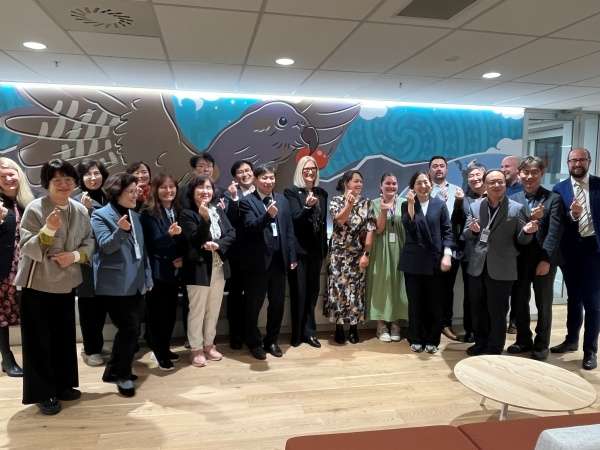
The delegation was formally welcomed to the Wellington with a Mihi Whakatau hosted by ENZ Chief Executive Amanda Malu, local staff and the Ministry of Education (MOE).
In Wellington, the delegation received a detailed briefing from the Ministry of Education and visited Scots College to observe the school in action.
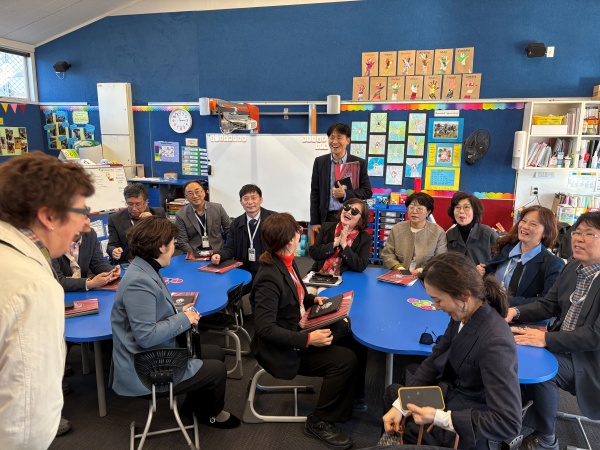
Scots College Junior School Principal, Rachael Huggins, showing the Incheon delegation around a primary-level classroom.
Down to Christchurch, the Incheon delegation visited Lincoln University to fine-tune the details of an MoU signed in January this year. The partnership arrangement will support five Incheon students to study at Lincoln University each year.
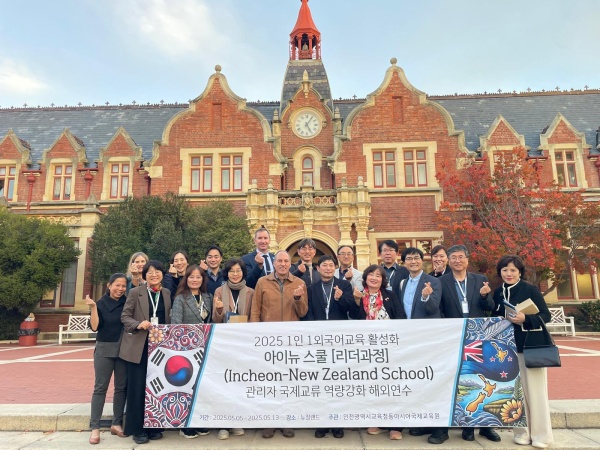
Incheon delegate members with Lincoln University staff from the Faculty of Agriculture and Life Sciences, Faculty of Agribusiness and Commerce, Academic Preparation and Pathways and International Operations.

Waitākiri Primary School Principal Mr. Andrew Barker introduces a Year 6 long-term international student from Korea to the delegates. She shared how much she has enjoyed her time at Waitākiri Primary School and expressed her sadness that her year at the school is coming to an end.
The group visited Shirley Boy’s High School and Avonside Girls High School in Christchurch, with a side-visit organised with Waitākiri Primary School.
Further South, a visit was arranged with Otago Polytechnic in Cromwell to understand the pathways to vocational education in New Zealand.
Director of Incheon Metropolitan Office of Education East Asia Global Education Institute, Jooyong Kim, said visiting New Zealand schools was a truly meaningful and deepened delegates understanding of the education system.
“We hope this visit will help strengthen the relationship between schools in New Zealand and Incheon”.
“We look forward to future collaborative projects with New Zealand institutions,” he added.
Several of the schools visited have expressed interest in deepening these new relationships, with planning underway to keep up the momentum and connect again at ENZ-led fairs and agent seminars in Korea later this year.
-
New Zealand headlines Saudi Arabian vocational conference
The Saudi Technical Conference and Exhibition on 14-15 December in Riyadh was organised by the government’s Technical and Vocational Training Corporation and focused on the skills and training solutions required to support the country’s 2030 Vision.
Saudi Arabia’s 2030 Vision aims to raise the percentage of vocationally qualified Saudis, and to increase the connections and alignment between their school and vocational education systems.
Dr Ede opened the final day of the conference with a presentation on Jobs of the Future: Increasing Job Opportunities & Productivity. The presentation explored how technology is disrupting employment and skills ecosystems, and showcased where New Zealand is meeting these challenges through world-leading education solutions such as The Mind Lab and Tech Futures Lab.
John Laxon, ENZ’s Regional Director for South/South East Asia & the Middle East, said New Zealand is now well placed to stand out in the market for this education industry.
“The conference provided an invaluable opportunity to showcase New Zealand’s expertise, at a time when Saudi Arabia is reforming its education system and looking for international partners” said John.
 Dr. Rick Ede presenting to the Conference on 'Jobs of the Future'
“We’re grateful to Rick and the Corporation for making the most of this opportunity. New Zealand’s successful integration of TVET and higher education means that we’re uniquely placed to support the Saudi Government in their vocational reform initiatives.”
The conference was the first to be held under the sponsorship of the Minister of Education, signalling a shift in oversight for Saudi’s vocational education system from the Ministry of Labour.
Further partnership opportunities between Saudi and international operators were also signaled during the conference.