Search
Showing 10 of 7355 results
-
Government delegation from South Korea visits New Zealand to reconnect with several of our education providers
New Zealand and South Korea have strong education links and one unique partnership is the education cooperation under the Korea-New Zealand Free Trade Agreement (KNZFTA) which has historically included education programmes for Korean school and tertiary students.
The visiting delegation included representatives from the Korea Ministry of Food, Agriculture and Rural Affairs (MAFRA), the Korea Ministry of Oceans and Fisheries (MOF), the Korea Agency of Education, Promotion and Information Service in Food, Agriculture, Forestry and Fisheries (EPIS) and Korea Fisheries Resources Agency (FIRA), the implementing agency for the MOF-funded project.
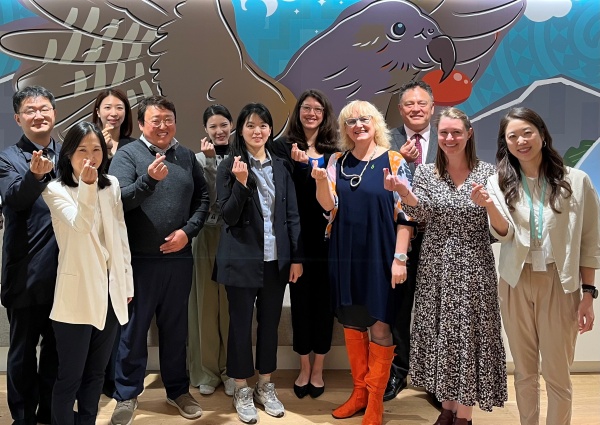
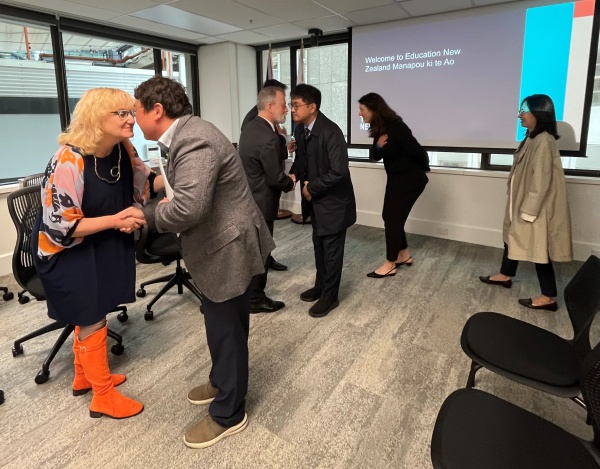
The delegation was welcomed to the ENZ Wellington office with a mihi whakatau on their first day. ENZ, Ministry of Education (MoE) and Ministry of Foreign Affairs and Trade (MFAT) colleagues joined together for waiata and kai with our Korean guests.
Following a welcome and mihi whakatau in Wellington, the group travelled on to Nelson where they visited Te Pūkenga Nelson Marlborough Institute of Technology (NMIT) and Nayland College. The visit to Nayland College was an opportunity for the Korean representatives to gain a better understanding of the pastoral care for school students and the unique offerings such as outdoor education and horticulture programmes.
Kay Lee, ENZ Senior Market Development Manager – Korea, said it was important for the Korean delegation to experience firsthand the welcoming and safe environment of New Zealand schools to regain confidence in the Schools Visits Programme.
“After the COVID-19 pandemic, the Korean Government was concerned about sending students, especially younger students, overseas to study particularly on scholarship programmes because parents wanted assurance their children will be well looked after. In the debrief with the Korean representatives, it was clear they gained confidence from speaking to the New Zealand institution representatives around the procedures and systems in place to support students.”
“We hope that this renewed confidence will mean that we start seeing Korean government scholarship school students studying in New Zealand again in the near future”.
High on the agenda during the delegation’s visit were the School Visits and Tertiary Training Programmes, both of which were affected significantly during the pandemic.
From 2016 –2019, the School Visits Programme provided 150 high school scholarships per year for South Korean students from rural areas to attend New Zealand schools for eight weeks. The Korean Government planned to continue the Schools Visits Programme with its own funding in 2020, however, the programme was cancelled due to travel restrictions during the pandemic.
An alternative programme was run by MAFRA and MOF from December 2022 which involved short-term English Language Training for school students in Korea with three New Zealand teachers travelling to Korea to teach English (Read about their experience here).The Korean organisers have decided to run the English language programme in Korea again with six New Zealand teachers traveling to Korea to teach English in January 2024.
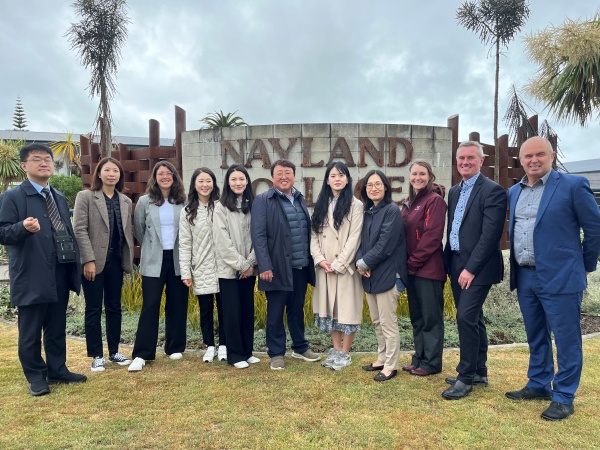
Nayland College demonstrated manaakitanga by welcoming the group to rainy Nelson but provided an Asia Kiwi lunch complete with meat pies and sushi!
Like the Schools Visits Programme, the pandemic interrupted tertiary programmes and the revised programme ran in January 2023 with short term group programmes. The site visits in November to Te Pūkenga NMIT and Lincoln University provided an opportunity to discuss the institutions’ proposals to host Korean tertiary students in January 2024.
Also discussed was the importance of reciprocity and it was noted that Korea is a popular destination for New Zealanders under the Prime Minister’s Scholarship for Asia (PMSA) scheme. Since 2016, the scheme has awarded scholarships to 196 individuals or groups for study, intern or research programmes in Korea. Lincoln University, in particular, has been successful in facilitating group PMSA programmes focused on agriculture to Korea.
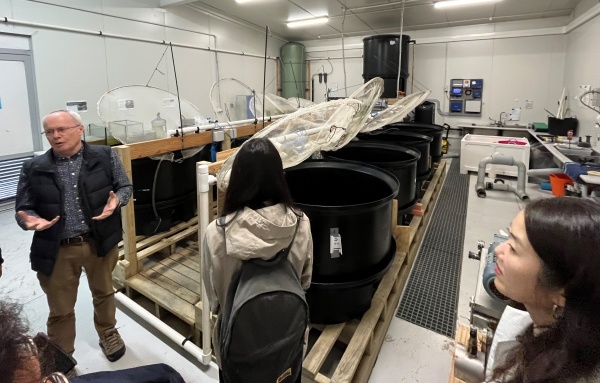
Dr Mark Burdass, Aquaculture Programme Coordinator and Tutor, introduces the hands on learning in the aquaculture programme at Te Pūkenga NMIT.
At the conclusion of their visit, the Korean delegation expressed their gratitude to the institution hosts for making their time in New Zealand memorable and valuable through fruitful discussions. The delegation emphasised the importance of conducting these meetings in person and visiting the campuses to meet with institution staff and academics. The ENZ Manapou ki te Ao team is pleased to continue close cooperation with our Korean education partners to facilitate connections with New Zealand education providers for the education programmes.
If you are interested in finding out more about the education initiatives originally outlined in the KNZFTA, you can read about this in a 2016 E-News article here - New opportunities for New Zealand and Korea.
-
SheLeads Campaign – inspiring future Indian learners
Launched on International Women’s Day on 8 March, the SheLeads campaign was developed by Education New Zealand Manapou ki te Ao’s (ENZ's) India-based team. The campaign was multi-pronged and aimed to celebrate women leaders and alumni across various disciplines from New Zealand education providers with a diverse audience of young and mature learners in India.
The campaign was launched on ENZ’s South Asia LinkedIn channel which was then used throughout to highlight the impact and value of a New Zealand education through the sharing of success stories of women leaders in New Zealand and beyond as well as those of Indian women alumni. Education media across several key Indian publications also reported on the campaign to their estimated 58 million readers.
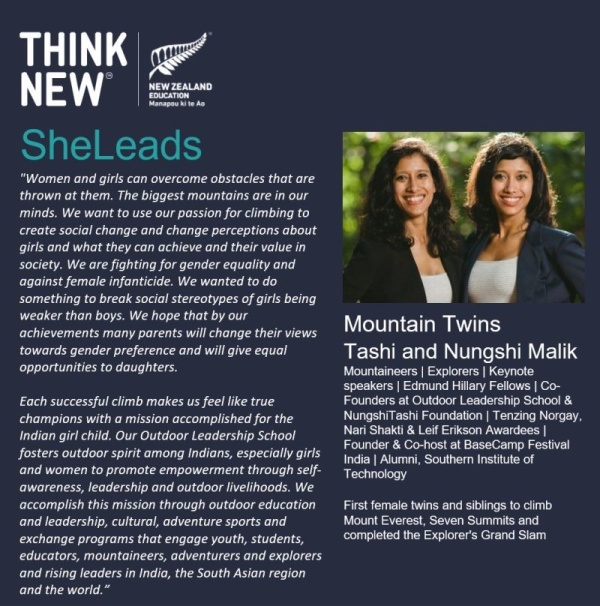
The LinkedIn campaign profiled over 24 women leaders and achieved 105,000 impressions, 1,500 page views, while the ENZ South Asia page gained more than 600 new followers, surpassing the campaign’s targets.
To engage students and lift the NZ education profile amongst this group, a SheLeads debate competition was organised between five leading schools in Delhi. The students were tasked with debating “the underrepresentation of women in STEM”’ and the 50 plus participants were invited to share diverse perspectives and include examples from New Zealand.
Undergraduate learners from over 100 tertiary Indian Institutions were also invited to participate in the campaign through submission of video essays. A shortlist of 10 entries were judged by Professor Carol Mutch from the University of Auckland’s Faculty of Education and Social Work.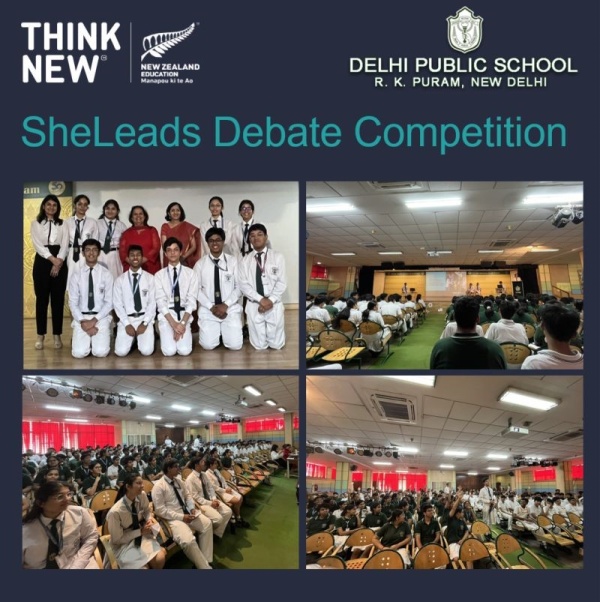
Images from the SheLeads debate competition held at Delhi Public School.
Finally, ENZ hosted a virtual workshop on ‘Organisational Change and Resilience’ with school principals and leaders from over 500 schools across India invited to attend. This workshop was facilitated by AcademyEx Founder, Frances Valintine and discussions focused on the innovative approach to learning that leaders must now consider in this rapidly changing world.
The finalists and winners of both competitions were invited to a campaign concluding event at the New Zealand High Commission in New Delhi on May 18. The event featured an engaging line up including an inter-school debate competition for the debate competition finalists, a panel discussion featuring alumni titled “Trailblazers: Women leaders who catalyse change” and the SheLeads Essay Showcase featuring the top three finalists. New Zealand’s High Commissioner to India, H.E Patrick John Rata was on hand to present the winners with their awards in front of guests that included high school counsellors, students, parents, and representatives from New Zealand institutions as well as the Principal of Jesus and Mary College in New Delhi.
ENZ’s Director of Engagement East Asia and India, Jugnu Roy, said that it was a huge privilege being able to interview so many talented women leaders and alumni to showcase their outstanding achievements. She also said that seeing the energy and enthusiasm that the students brought to both competitions was another campaign highlight.
“New Zealand has a proud history of striving for gender equality and continues to improve outcomes for women by strongly supporting women in education and training, utilising women’s skills to grow the economy, and encouraging and developing women leaders.
“I am sure this campaign will inspire our students here in India, particularly our female students, to consider choosing New Zealand as an education destination and follow in the footsteps of these incredible role models,” said Jugnu.
- Peter Bull3
-
Attracting PhD students to New Zealand
The PhD page highlights the initiatives that have given New Zealand an international marketing advantage in attracting PhD students from around the world.
The page promotes the five key benefits of studying for a PhD here. International PhD students:
- pay the same fees as domestic students
- can enrol their children as domestic students in our state schools
- can work full-time
- are able to apply for a 12-month post-study work visa after graduating
- entitle their partners to apply for an open work visa.
Students can check out the page to find out how our PhD programmes are structured, discover the career benefits of studying for a PhD in New Zealand, read case studies from current international students and learn how to apply – there are links to the PhD areas of each university’s website.
Vietnamese student Tan Duc Do, for instance, decided to study undertake a PhD in Mathematics at the University of Auckland because of the inspiring teaching of his supervisor.
“Most of the lecturers here are working mathematicians, so they can give insight and inspiration into the subject,” says Tan.
For Jeffery Garae, a student from Vanuatu, the major attraction of studying Cyber Security in New Zealand was that international PhD students pay the same fees as local students.
“I was looking at doing a Masters here and when I read about the PhD fees I thought, ‘Whoa – that’s an even better advantage,’” says Jeffery.
The new PhD page also shines a spotlight on the academic and research performance of New Zealand universities, and on the wide range of subjects available for doctoral research.
- NZIEC day1 501
- Senior Market Development Manager Korea Dec 2016
- Internship Providers for PMSLA5
-
International student employment: overcoming barriers
The panel, chaired by ENZ’s Director Student Experience, Hayley Shields, featured a diverse and informed range of views from
- Brett Berquist, Director International at the University of Auckland
- Dr Cate Gribble, Senior Research Analyst at the University of Auckland
- James Koo, former international student and founder and CEO of Niesh, a free student discounts app
- Paul Hickey, Managing Director at SpeakData
- Charan Mohan, former international student and now Business Intelligence Analyst at SpeakData.
Dr Cate Gribble talked about the need to raise awareness of the benefits to businesses of employing international students to counter employer concerns around the challenges of international student employees, including perceptions they won’t fit culturally, their English will be limited or that their visa situation will make paperwork too challenging. Students also find their international work experience in their home country is not always valued here, and employers often require New Zealand citizens or Permanent Residents.
Brett Berquist added that we need to counter the perception that international students will not stick around.
“The reality is that all students, both domestic and international, are equally mobile. Employers need to stop thinking Kiwis make employees for life, and that international students are a flight risk.”
James Koo said the lack of transparency around these concerns is a challenge for international students. As a result, many international students end up sending a generic CV and cover letter to any and all available jobs, too discouraged to spend time tailoring their CVs to each role.
James also noted that student expectations can sometimes be unrealistic, and some students expect to work in large, prestigious companies whereas most New Zealand companies are SMEs – which he noted can actually offer more opportunities and experiences for students and recent graduates.
SpeakData’s Paul Hickey then talked about his experience hiring international students, such as fellow panellist Charan Mohan. While Charan clearly had the hard skills required for his company, Paul needed to be convinced of his soft skills, which he calls being ‘Kiwi-ready.’
 “Often, international students come into interviews and talk solely about their studies and qualifications when actually, we’re just as interested in hearing about their interests outside of work.
“That social aspect plays a big part – sharing a story about kayaking in Taupo at the weekend or going to an All Blacks game is an easy way to connect with Kiwi employers.”
Paul also talked about the need to work with institutions to create a pipeline of talent.
“Employers often take a short-term view and hire people ‘just in time’ rather than looking ahead, whereas if you expect to have 10 new positions available in two years’ time, why not try to establish a pipeline for talent through local institutions who can connect you with new graduates with relevant skills?”
Panellists also agreed that having internships and work experience in education programmes will also help international students get into the job market when they graduate.
Brett concluded that while all these approaches can reduce barriers, ultimately, a strategy is required – supported by data that is already available in reports such as the Ministry of Education’s ‘Moving Places’, ENZ’s Beyond the Economic and Immigration New Zealand data.
It is an ongoing discussion that will continue to be in the spotlight in New Zealand as the industry works to meet international student expectations of global employability.
- Student visa airport photo
- goldsmith IES