Search
Showing 10 of 7355 results
- SocailPostImage1
- unspecified
-
ENZ Facebook group connects international students
The ENZ social media team has created #MyStudyinNZ Journey, a Facebook group for international students across New Zealand to connect, share upcoming events and meetups, ask questions and offer advice.
ENZ Director of Student Experience, Hayley Shields, says the group is a space for international students to support one another while also offering ENZ valuable learnings about the types of information they need. Plans are in place for a similar group on WeChat to be launched later in the year.
“This idea has come out of our student experience research where students told us they value the advice of other students. Facebook communities provide an easy forum for our international students to connect.”
To ensure the Facebook group is entirely student-focussed, ENZ has recruited a group of domestic and international students to act as moderators. They will ensure students get the information they need while maintaining the group atmosphere as a safe and positive space.
One of the Facebook moderators, Pritchard Mukuka, says, “For me, this group means bringing home, security and comfort to fellow international students to make their study and stay as pleasant as possible.”
How education providers can get involved
Please share the Facebook group details with your international students and encourage them to join up.
If you would like to share information about events taking place at your institution with the group, please email ENZ International Social Engagement Manager, Olivia Silverwood, on olivia.silverwood@enz.govt.nz
- LatAm SWNZ 2
- Attendee List Bogota Agent Seminar
-
Felix Loh: kūwaha a symbol of enduring ties to New Zealand
Now chief executive of the stunning and expansive botanical attraction that is Singapore’s Gardens by the Bay, Felix is delighted that it was selected as the site for a Māori kūwaha, or carved doorway, which feels personally symbolic to him.
Recently unveiled by Prime Minister Jacinda Ardern, the kūwaha celebrates the long-standing friendship between Aotearoa New Zealand and Singapore. “New Zealand has a special place in my heart, and I am honoured to host this precious Māori artefact. I hope the kūwaha will be a symbol of our friendship for many years to come.”
New Zealand now feels like a second home to Felix, but he shocked his parents and perplexed the scholarship selection committee back in 1988 when he told them he wanted to study horticulture at Massey University.
“I knew that Massey was well-known as an agricultural centre of excellence, and that horticulture was a very popular course,” he says. “But they were puzzled and asked me why I wanted to be a farmer in an urban city state like Singapore.
“My Dad did not speak to me for a few years, because Asians all want their kids to be lawyers, engineers, and doctors, and I chose to be a plant doctor instead. But I never regretted that decision.”
Felix says he felt welcome from the moment he arrived in New Zealand and enjoyed his four years as an international student so much he would have stayed on if he could. But the terms of his scholarship meant he needed to return to Singapore.

The Māori kūwaha recently unveiled at Gardens by the Bay.
No such thing as a stupid question
A less formal approach to education, with an emphasis on inquiry and collaborative learning, proved an initial challenge for Felix but ended up being one of the reasons he rates his New Zealand education experience so highly.
“At my first class we were told that we were expected to ask questions. This was the first time that I heard the phrase ‘there’s no such thing as a stupid question’,” he says. “That shook me, because in Singapore in those days nobody answered a question in class unless they were sure they had the right answer. For the first time, someone was willing to explore an alternative point of view.”
He turned up to English classes thinking it would simply be language tuition but discovered it was all about writing for your audience, with essays to be critiqued by classmates. “I initially questioned why fellow students would judge my work, but I quickly understood the value in taking on board a diversity of views to refine an idea or get a better product.”
And group project work certainly provided a life lesson for Felix, who had been conditioned to individual success based on exam results. “Not only did we have to work in groups, but we couldn’t choose our project partners,” he says.
“I’ll never forget the lecturer telling us that when we get to the workplace, we cannot choose our boss or even our colleagues, so we need to be able to work with different people. I learned that New Zealanders place people at the centre of what they do, and that we need to learn to appreciate the input of others.”
“I learned that New Zealanders place people at the centre of what they do”
Felix says his New Zealand education set him up for life-long learning which has helped to drive his career success. “You’ve got to learn and unlearn throughout your whole lifetime. It’s not so much about the content, but about being curious and knowing where to go for the answers.”
Friendships lead to enduring ties
It is through the people he met that he has forged an enduring relationship with New Zealand. Fellow churchgoers and schoolmates became life-long friends and “a moral and emotional support base” over the years. He has returned to New Zealand many times and stays in touch with former lecturers and teaching staff, some of whom are now plant suppliers for him in his role at Gardens by the Bay.
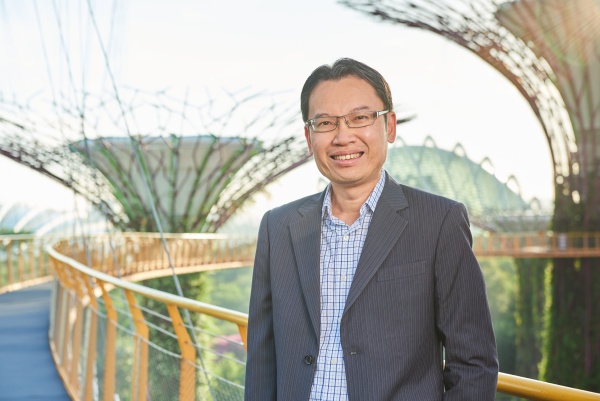
Felix at Gardens by the Bay.
“When I took on this job, one of my first trips was to go back to New Zealand to source new plants for our temperate Flower Dome. I visited a number of nurseries, just knocking on their doors, and I was made to feel so welcome. It just felt like I was at home.”
The world is a very different place from what it was in the 1990s, but Felix says the value of international education remains as important as ever.
“International education helps us to understand other perspectives better and demystify misconceptions we have about each other.
“In today’s uncertain world it is always good to have friends in other places. You discover that we have more things in common than set us apart.”
- rom 3
-
Viet Nam Market Insights: Opportunities and Challenges for New Zealand's PTEs and ELS Providers
On 29 August, Education New Zealand Manapou ki te Ao (ENZ) held an Insights Accelerator session for representatives from Private Training Establishments (PTEs) and English Language Schools (ELS) across New Zealand. ENZ’s Market Manager - Viet Nam, Van Banh, delivered a presentation that outlined Viet Nam’s current market trends, barriers to student recruitment, and essential tips for providers aiming to strengthen their presence in this dynamic country.
The session had 30 representatives from 20 PTEs attending, demonstrating how New Zealand education providers are recognising the opportunities for growth given the country’s expanding economy and growing middle class. As Van noted " Viet Nam offers significant growth opportunities, but success will require a tailored approach that addresses both the evolving demands of Vietnamese students and the competitive landscape."
The demand for English language skills is particularly high in business, technology, and education, as Vietnam continues its global integration. This makes New Zealand's high-quality ELS programmes attractive.
For PTEs, the country's growing economy requires a workforce with practical, vocational skills, which New Zealand’s providers are well-positioned to offer. Many PTEs and ELS institutions provide pathway programmes that help students transition into higher education or industries with globally recognised qualifications, Vietnamese students are attracted to New Zealand programmes that enhance employability both in Viet Nam and internationally.
Van added that despite these opportunities, there are some challenges.
“Tough competition from other study destinations and the changing preferences of Vietnamese students—away from traditional English and vocational courses—will require providers to adapt and innovate. The country's rapid development and young population present long-term growth potential, but strategic planning and market responsiveness will be key,” said Van.
The slides from the Accelerator Session can be found here. You can also watch a recording of the session here - https://youtu.be/KQE22JV1t2w
- 15
- 624x428