Search
Showing 10 of 7355 results
- Europe school workshops 1
-
New Zealand well represented at the 2024 World Digital Education Conference
The 2024 World Digital Education Conference, attended by representatives from over 70 countries and regions as well as international organisations, aims to work with governments, the education sector, and stakeholders to jointly implement the outcomes of the United Nations Transforming Education Summit, promote education recovery post-pandemic, equitable quality education through digital education transformation, and advance the realisation of the Sustainable Development Goals (SDGs).
Chinese Education Minister Huai Jinpeng provided the keynote speech at the opening ceremony. He noted the impact of technology on education and the need to prioritise education reform to keep pace with changes and harness the benefits of digital education. Minister Huai concluded by saying they look forward to the new impetus into promoting international cooperation in digital education through this conference.
New Zealand was represented by Minister of Education, Hon Erica Stanford (through a pre-recorded session); H.E. Grahame Morton, New Zealand Ambassador to People’s Republic of China; Ardi Barnard, New Zealand Consul-General to Shanghai; Dr Grant Klinkum, Chief Executive New Zealand Qualifications Authority and Education New Zealand’s China-based representatives. The strong presence at the conference contributes to New Zealand’s reputation as an education partner with an innovative approach to digital learning. New Zealand Education Minister Hon Erica Stanford gave a video address and shared New Zealand’s efforts to harness digitalisation to improve our education system and support lifelong learning.
“As an education minister with a relentless focus on the progress and achievement of all students, I see that digital tools and the well-designed use of data have enormous potential to help us drive progress and achievement,” said Minister Stanford.

Hon Erica Stanford, New Zealand’s Minister of Education delivered a pre-recorded session, sharing New Zealand’s efforts to harness digitalisation and data in education.
In his address at the Opening Ceremony, Ambassador Morton highlighted the important role of education in the New Zealand-China relationship and gave insights into New Zealand’s innovative EdTech sector.
“Digital education is at the centre of New Zealand’s EdTech sector and its developments. Three-quarters of New Zealand EdTech companies are actively looking to take their offerings to the world,” said Ambassador Morton.
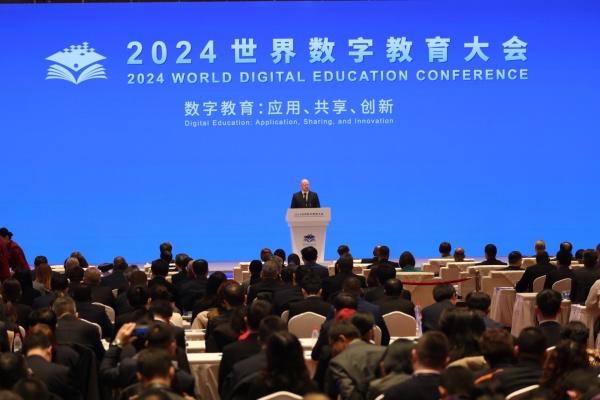
Ambassador Morton addresses the audience during the Opening Ceremony of the conference.
During the Parallel Session on Governance and Digital Transformation, Dr Klinkum shared New Zealand’s experience in quality assurance, qualification recognition and assessment delivery in the digital era.
“We would like to continue working with our international colleagues to ensure that we provide credible education for learners and that life-long learning and global mobility is supported by digital education and reflects the needs of increasingly digital societies,” said Dr Klinkum.
During the conference, organisers held the inaugural launch ceremony of the World Digital Education Alliance (WDEA). Universities New Zealand, on behalf of the University sector, joined the Alliance. The first batch of members is by invitation and as of 30 January 2024, 104 agencies from 41 countries joined the alliance ranging from schools to Technical and Vocational Education and Training (TVET) institutions, training centres, colleges and universities as well as research institutions and enterprises. The initiative aims to fulfil the UN SDG 4, build a mechanism for international cooperation and exchange in digital education, form synergy to promote global educational development, and create a new environment for smart education.
-
NZIEC 2017: Call for speakers open
ENZ warmly welcomes presentation proposals from across the New Zealand and global international education industry. Presentations can relate to any aspect of the industry.
Check out the NZIEC 2017 Call for Presenters document and presenter guidance on the NZIEC website.
Presentation submissions close on 28 February 2017.
A new partnership
 ENZ is pleased to welcome ISANA International Education Association New Zealand as an official conference partner for NZIEC 2017. The partnership will see ISANA design and deliver a full breakout stream focused on enhancing the international student experience during the two-day conference.
ENZ Chief Executive Grant McPherson said the partnership was a natural fit.
“ISANA has a track record of helping education providers to better support international students through the adoption of strategies, models and evidence for teaching, learning and support.
“ISANA’s involvement in NZIEC 2017 will mean that hundreds of international education professionals attending the conference can access that capability.”
Check out all the details here.
Exploring leadership in international education
 At NZIEC 2016 we celebrated the journey our industry has taken from small beginnings to becoming New Zealand’s fourth largest export earner.
At NZIEC 2017 we will explore the leadership required to raise our vibrant and successful industry to further heights in years to come.
Whether we are forging positive student experiences, developing cutting edge products and services, taking our international relationships to the next level, or delivering innovative education offerings offshore, leadership matters.
Find out more about our conference theme here.
About NZIEC 2017
The 26th New Zealand International Education Conference is expected to attract up to 700 delegates. Registrations will open in April 2017. For more information, check out www.nziec.co.nz.
We hope to see you at NZIEC 2017!
- collage
- Kant twitter
-
Masterclass opportunity in Japan
Tokyo Metropolitan Board of Education will be hosting a virtual study abroad event on 23 of September, connecting secondary school students in Tokyo and beyond with tertiary institutions from Australia and New Zealand.
This half-day event will feature lectures in an interactive format so providers can engage with Japanese students. Selected tertiary institutions will also have an opportunity to work with the Tokyo Metropolitan Board of Education to produce additional content introducing their institutions and programmes to prospective international students.
Recordings will be made for the virtual study abroad event and will be shared on the Tokyo English Channel website which will launch in June 2021.
“This is a great opportunity for Education New Zealand and New Zealand tertiary providers to work with the Tokyo Metropolitan Board of Education to co-develop educational materials for the Japanese secondary school students. The content produced for the event will also be shared at future promotional events hosted by Education New Zealand and the New Zealand Embassy in Tokyo.” ENZ Director of Education – Japan, Misa Kitaoka, says.
Director at the Tokyo Metropolitan Board of Education, Yuki Sato, looks forward to receiving proposals from the New Zealand providers.
“We are excited to work with New Zealand tertiary institutions to showcase the virtual study abroad event offering Tokyo secondary school students an opportunity to connect with the world and enhance their communication skills in English. Students can expect of learn new ways of thinking from the lecturers and interact with other participants from around the world, including New Zealand.”
Education New Zealand signed a Memorandum of Understanding with the Tokyo Metropolitan Board of Education in 2017 to promote education exchange and cooperation between Tokyo and New Zealand. Since then, a range of projects have been initiated between the two parties including the co-development of online education material for intermediate English learners through the Tokyo Global Studio.
For further details on the opportunity, please download the proposal by the Tokyo Metropolitan Board of Education. Expression of interest is due on 25 of May and the selected provides will be contacted by Education New Zealand by the 31 of May.
- Akl US waka image 4
-
All Covid-19 requirements removed

Changes that take effect from Tuesday 15 August 2023
- Confirmed Covid-19 cases will no longer be legally required to self-isolate
- Masks will no longer be mandatory in any locations
This means that tertiary education providers can operate as normal, and set their own policies and procedures to ensure they meet their obligations to staff and learners, including under the Health and Safety at Work Act 2015, and the Education (Pastoral Care of Tertiary and International Learners) Code of Practice 2021.
Advice for tertiary providers and students
The Ministry of Education recommends that tertiary education providers follow COVID-19 health advice, and support staff and learners to do so.
Full COVID-19 health advice can be found at: Unite against COVID-19.
The Ministry of Education will also be updating advice for tertiary providers and students on the Te Mahau COVID-19 website following this announcement.
The latest health advice on COVID-19 includes:
- Stay at home if you are feeling unwell - if you, or someone in your household develops one or more of the following symptoms, you should take a Rapid Antigen Test (RAT) for COVID-19: a runny nose, sore throat, cough, fever, vomiting, diarrhoea, headache, loss of smell or taste, shortness of breath.
- If you have tested positive for COVID-19, it is recommended you isolate for 5 days, even if you only have mild symptoms, starting at Day 0, which is the day your symptoms started or when you tested positive, whichever came first.
- If you do need to leave your home during your 5-day isolation period, it is very important you take precautions to prevent spreading COVID-19 to others. You should wear a mask whenever you leave the house. You should not visit a healthcare facility (except to access medical care), an aged residential care facility, or have contact with anyone at risk of getting seriously unwell with COVID-19.
- If you are in isolation at the time of the setting change announcement, we recommend you continue isolating until you have completed 5 days. If you have already been isolating for 6 or 7 days, and are well, you can return to your normal activities.
- After completing 5 days isolation –
- If your symptoms have resolved and you feel well, you can return to your normal activities.
- If you still feel unwell, we recommend you stay home until you have recovered.
- We recommend you wear a mask if you need to visit a healthcare facility or an aged residential care facility, or you have contact with anyone at risk of getting seriously unwell with COVID-19 up until 10 days after your symptoms started or you tested positive. This is because some people are infectious for up to 10 days.
Mask wearing remains an important way we can prevent the spread of respiratory illnesses
Free masks are available for pick up with free rapid antigen tests (RATs) from participating collection sites.
RATs will remain free for everyone throughout 2023
You can find out participating pick-up points for RATs and masks at COVID-19 Testing • Healthpoint or by calling 0800 222 478 and choosing option 1.
The Government's media release can be found here.
-
Education New Zealand’s Brand Protect our most successful brand campaigns to date
Both campaigns exceeded previous ENZ results and were well above industry standards. These results, alongside the brand tracking research, have affirmed that global appetite for a New Zealand education remains high.
“We have learnt that our message resonates globally with people who are now seeing New Zealand in a whole new light,” ENZ Director Brand, Clayton Foster, says.
The second brand protect campaign – also known as Brand Protect 2.0 – ran from November to December 2020. It targeted the UK, Vietnam and Indonesia, and utilised the same video as the first campaign.
Brand Protect 2.0 reached 47 million people and achieved a high view through rate of 33.79 percent – or one in three viewers watched the video to a meaningful extent. The overall engagement rate was also high at 29.42 percent.
The first global brand campaign ran from July to August 2020. For a modest investment of $190,000 in Germany, Indonesia and Brazil, this campaign reached more than 30 million people across the three key markets and achieved an engagement rate of 22.35 percent. One in four people who came across this campaign watched the video to a meaningful extent.
The Brand Protect campaigns are a key part of the Recovery Plan’s third workstream, ‘Transforming to a more sustainable future state’. They leverage the positive global sentiment towards New Zealand to keep the dream of a New Zealand education alive in-market.
- Summit lookout 2